

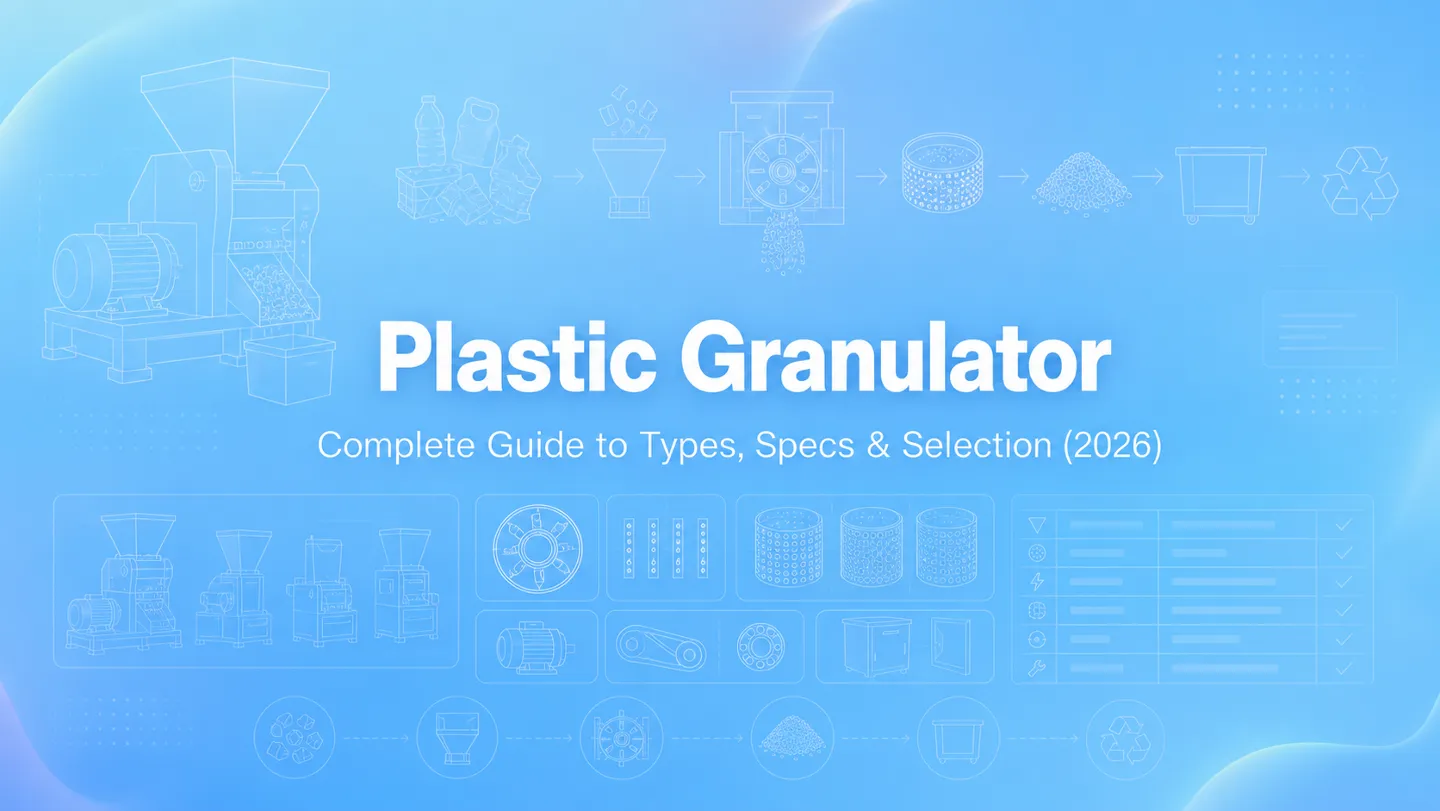
UM granulador de plástico reduz resíduos de plástico — rebentos, sprues, garrafas, tubos, perfis, filme — em escamas uniformes de 6–15 mm (chamadas de regrind), prontas para lavagem, compounding ou extrusão direta. O granulador certo depende do material de entrada, da capacidade de produção e do processo subsequente; a escolha errada significa baixa capacidade, entupimentos frequentes ou desgaste prematuro das lâminas, dobrando o custo operacional. Este guia cobre os 5 principais tipos de granuladores de plástico, especificações-chave que importam, seleção específica de material, trocas de material de lâmina, benchmarks de energia, níveis de custo de capital ($8,000–$200,000+), um framework de seleção em 5 etapas, problemas comuns de solução, certificações e diferenças de preços regionais.
Para aprofundar sub-tópicos, consulte nossos guias especializados sobre escolhendo lâminas de granulador de plástico, escolha do granulador correto, granuladores de plástico molhado, e top 10 especificações a verificar. Este artigo serve como referência abrangente conectando todos esses tópicos.
Decisão Rápida: Granulador vs Crusher vs Shredder
Os compradores frequentemente confundem essas três máquinas. A regra de decisão mais simples:
| Máquina | Tamanho de Entrada | Tamanho da saída | Uso |
|---|---|---|---|
| Triturador de plástico | Resíduos volumosos grandes (tubos, tambores, balas, peças de 1+ m) | 40–150 mm de chips | Redução primária de tamanho (primeira fase) |
| Granulador de plástico | Chips pré-cortados, rebentos, garrafas, peças menores (abaixo de 200 mm) | 6–15 mm de escamas | Redução de tamanho secundária (tamanho final da escama) |
| Triturador de plástico | Resíduos de tamanho médio, frequentemente partes vazias (sobrepõem-se a ambos) | 10–30 mm de pedaços | Ponte entre shredder e granulador; às vezes usado standalone para tubos de parede grossa |
Para a maioria das linhas de reciclagem de plástico processando material pré-selecionado com tamanho de entrada até 200 mm (rebentos de injeção, escamas de garrafa, chips de tubo), um granulador de plástico é a escolha certa. Para resíduos oversized (tubos inteiros, tambores, balas), comece com um shredder e alimente o granulador no processo subsequente. As palavras são às vezes usadas de forma intercambiável — “plástico crusher” e “plástico granulador” se sobrepõem em nomes de produtos entre fabricantes — mas a distinção de função acima se mantém nas linhas de produção.
O que é um granulador de plástico?
Um granulador de plástico é uma máquina de redução de tamanho precisa que corta resíduos de plástico em escamas uniformes de 6–15 mm chamadas de regrind. Granuladores de plástico padrão da indústria (também comercializados como máquinas de granulação de plástico, máquinas de granulação de plástico ou crushers de plástico em alguns mercados) usam um rotor de alta velocidade com lâminas cortantes que passam contra lâminas fixas, accionadas por um motor de 7.5–110 kW a 400–800 RPM. Uma grade perfurada abaixo da câmara de corte controla o tamanho das escamas de saída. O regrind de plástico sai pela grade e é alimentado para a próxima etapa do processo — lavagem, compounding, secagem ou granulação.
Granuladores de plástico diferem de shredders de plástico em dois aspectos. Primeiro, eles lidam com peças de entrada menores (abaixo de 200 mm) a velocidades de rotor mais altas (400–800 RPM vs. 50–150 RPM para shredders); segundo, eles produzem saída uniforme controlada pela grade (6–15 mm) enquanto os shredders produzem pedaços variáveis (40–150 mm). A maioria das linhas de reciclagem de plástico usa ambos: shredder primeiro para a redução de tamanho primária, e granulador para o tamanho final de escama necessário para a extrusão subsequente.
Como Funciona um Granulador de Plástico (Processo de 4 Etapas)
- Alimentação de material — o resíduo de plástico entra na câmara de corte por um funil, transportador ou conexão direta ao lado da prensa. A taxa de alimentação é controlada por sensores ou doseamento do operador.
- ação de corte — um rotor de alta velocidade (tipicamente 400–800 RPM) carregando 3–6 lâminas cortantes passa contra 2–3 lâminas fixas. A ação de corte semelhante a tesoura corta o plástico em pedaços menores. O espaço entre lâmina (o espaço entre a lâmina do rotor e a lâmina fixa) é ajustado com precisão para 0.2–0.3 mm para cortes limpos sem contato metal sobre metal.
- Tamanho da grade — uma grade perfurada (diâmetro de buraco de 5–25 mm) abaixo da câmara de corte controla o tamanho das escamas de saída. O material abaixo do tamanho da grade passa; peças oversized ficam na câmara para cortes adicionais. O tamanho do buraco da grade determina a especificação final do regrind.
- Descarga — o regrind de escama sai pela grade para um recipiente de coleta ou transportador pneumático que o transporta para a próxima etapa do processo (linha de lavagem, sistema de secagem ou funil de alimentação de granulação).
O ciclo completo desde a entrada do material até a saída da escama leva 2–8 segundos dependendo da dureza do material e do tamanho da grade. A capacidade típica de um granulador de plástico no ponto de design é de 100–3,000 kg/h dependendo da potência do motor, do diâmetro do rotor e do material processado.
5 Tipos de Granuladores de Plástico
1. Granulador Central
Um granulador central lida com resíduos de plástico de várias linhas de produção coletados em um local centralizado. Capacidade típica de 500–3,000 kg/h com motor de 30–110 kW. Melhor para: instalações de reciclagem, MRFs (material recovery facilities), e grandes fábricas onde o resíduo de várias fontes é consolidado. Custo de capital: $15,000–$80,000 dependendo da capacidade, material de lâmina e nível de automação. Configuração mais comum em operações de reciclagem de plástico dedicadas.
2. Granulador ao Lado da Prensa
Instalado diretamente ao lado de uma máquina de injeção de moldagem ou extrusão, este granulador compacto processa os corpos de fluxo e sprues imediatamente conforme são produzidos. Capacidade típica 50–300 kg/h com motor de 5,5–18,5 kW. Opera a menor velocidade (300–500 RPM) para operação mais silenciosa e poeira mínima adequada para o ambiente da linha de produção. Custo de capital: $5,000–$25,000. Melhor para: moldadores de injeção processando seu próprio resíduo limpo com reciclagem em ciclo fechado interno. O material reciclado é devolvido para a mesma máquina de moldagem — taxas típicas de conteúdo reciclado 15–30% misturado com polímero virgem.
3. Granulador de Plástico Molhado
UM granulador de plástico úmido injeta água na câmara de corte durante a operação. A água resfria as lâminas, lava a contaminação superficial das escamas, reduz a poeira e melhora a eficiência de corte em materiais sujos ou contaminados. Capacidade típica 500–2,500 kg/h com motor de 22–75 kW. Melhor para: fluxos de plástico pós-consumidor (bottles, film, pipe com sujeira superficial), reciclagem de escamas de garrafas PET e qualquer operação onde o material de entrada tenha terra, poeira ou rótulos que beneficiem da lavagem em processo. Custo de capital: $20,000–$80,000 (maior do que o granulador seco devido à gestão da água).
4. Granulador de Plástico de Alta Capacidade
manuseia resíduos de plástico de parede grossa ou plástico duro — tubos HDPE, peças automotivas ABS, placas PC, tubos PVC, componentes de nylon, recipientes rígidos. Eixo de rotor reforçado, rolamentos maiores e lâminas SKD-11 ou com ponta de carbeto aumentam a vida útil em materiais difíceis. Capacidade típica 800–3,500 kg/h com motor de 45–150 kW. Melhor para: fábricas de extrusão de tubos, recicladores de tambores, recuperação de plástico automotivo. Custo de capital: $35,000–$200,000 — o intervalo superior cobre configurações especializadas como a large-diameter HDPE pipe crusher para resíduos industriais de tubo.
5. Especializado: Granulador de PVC e Triturador de Tubo
Granuladores de PVC requerem lâminas endurecidas (SKD-11 ou com ponta de carburo) e extração de poeira para gerenciar a emissão de cloro durante o corte. A velocidade do rotor opera 25–35% mais baixa que os granuladores de HDPE (300–500 RPM) para evitar finas excessivas. A mesma classe de máquina inclui quebradeiras de tubo — aberturas de alimentação extra-largas para aceitar fragmentos de tubo de quebradeiras upstream. Custo de capital: $25,000–$120,000 com configuração apropriada para PVC. Melhor para: reciclagem de tubo de PVC, resíduos de revestimento de vinil, recuperação de condutor elétrico. — verifique a classificação para seu material e tamanho de tela. As classificações do fabricante são frequentemente o melhor caso (HDPE rígido limpo em 16 mm de tela). A capacidade real em material contaminado na tela de 8 mm pode ser 30–50% menor.
Especificações de Granulador de Plástico que Importam
As folhas de dados do fabricante listam 30+ especificações. Essas 8 são as que realmente determinam o desempenho:
- Motor power (kW) — geralmente 7,5–110 kW dependendo do throughput. Regra das pontas: 1 kW por 8–15 kg/h de capacidade para plásticos rígidos; 1 kW por 5–10 kg/h para materiais duros (PVC, ABS, nylon).
- Diametro do rotor (mm) — geralmente 150–500 mm. Rotor maior = maior torque mas menor RPM. Para material de parede grossa, priorize o diâmetro do rotor sobre o RPM.
- RPM do rotor — geralmente 400–800 RPM para granuladores padrão; 300–500 RPM para de alta capacidade/PVC. RPM mais alto = mais ciclos de corte mas mais calor e ruído.
- Número de lâminas do rotor — geralmente 3–6 lâminas. Mais lâminas = corte mais suave mas escama individual menor por corte.
- Número de facas da cama — geralmente 2–3. A distância de corte (fenda de faca) entre o rotor e as facas da cama deve ser 0,2–0,3 mm para cortes limpos sem contato metálico.
- Tamanho da grade (mm) — geralmente 5–25 mm de diâmetro de furo. Saídas padrão: 6 mm (alimento de pelota premium), 8 mm (usos gerais), 12 mm (throughput mais rápido, escama maior), 16+ mm (redução de volume apenas).
- Dimensões da câmara de corte — largura e profundidade determinam o tamanho máximo do pedaço de entrada. Para garrafas HDPE, câmara típica de 350×500 mm; para resíduos de tubo, 600×800 mm ou maior.
- Capacidade de throughput (kg/h) Verifique a classificação para seu material e tamanho de tela. As classificações do fabricante são frequentemente o melhor caso (HDPE rígido limpo em 16 mm de tela). A capacidade real em material contaminado na tela de 8 mm pode ser 30–50% menor.
Para uma lista de verificação mais detalhada sobre dureza das lâminas, desgaste da grade, torque do motor em reserva e recursos PLC, veja nossas top 10 especificações técnicas de granulador de plástico.
Seleção de Granulador de Plástico Específico do Material
A configuração correta do granulador muda significativamente dependendo do material de entrada. A tabela a seguir mostra configurações recomendadas para plásticos comuns:
| Material | Melhor Tipo de Granulador | Material da lâmina | RPM do rotor | Requisitos Específicos |
|---|---|---|---|---|
| HDPE/PP rígido | Central ou úmido | Aço de ferramenta D2 | 500–700 | Configuração padrão |
| Escamas de garrafas PET | Granulador de plástico úmido | D2 ou SKD-11 | 400–600 | Injeção de água para remoção de rótulos |
| PVC tubos e perfis | Duro de uso + extração de poeira | SKD-11 ou carbeto | 300–500 | RPM mais baixo para reduzir finos + sistema de poeira |
| Engenharia ABS/PC | Duro de uso | SKD-11 | 400–600 | Rotor reforçado para impacto alto |
| Nylon (PA6, PA66) | Duro de uso | Cortador de carbeto | 300–500 | Lâminas de carbeto para recheios abrasivos de nylon |
| Resíduos sólidos mistos | Central com tela de segurança | SKD-11 | 400–600 | Detecção de metal upstream obrigatória |
| Filme (PE, PP) | Rotor anti-enrolamento apenas | D2 com perfil de corte de filme | 600–800 | Velas de granulador padrão e paradas — use design específico de filme |
| Restos de tubo (pós-destroçador) | Crusher de tubo de uso duro | SKD-11 | 300–500 | Alimentação ampla para manuseio de chips |
Operações de processamento de múltiplos materiais devem configurar o granulador para o material mais exigente na mistura. A troca de tamanho de tela ou configuração de lâmina entre materiais é viável para o operador, mas leva 30–60 minutos por troca. Granuladores dedicados de material único sempre superam unidades de múltiplos materiais no material específico para o qual estão configurados.
Lâminas de Granulador de Plástico: Materiais, Vida Útil & Seleção
As lâminas de granulador de plástico (também chamadas de facas) são o componente de desgaste primário e o maior item de custo operacional contínuo. A seleção da lâmina afeta a capacidade de produção, a qualidade da saída, o consumo de energia e a frequência de manutenção. Três níveis de material de lâmina cobrem a maioria das aplicações:
- Aço de ferramenta D2 — opção padrão para a maioria das aplicações de granulador de plástico. Dureza HRC 58–62. Vida útil de 600–1.200 horas de operação em HDPE/PP. Custo: $80–$300 por lâmina dependendo do tamanho. Recortável 3–5 vezes antes da substituição.
- Ferramenta de aço SKD-11 de trabalho em frio — opção premium para materiais resistentes (ABS, PC, nylon, PVC). Dureza HRC 60–62. Vida útil 1.500–2.500 horas. Custo: $200–$600 por lâmina. Melhor retenção de borda em materiais abrasivos; recomendado para qualquer operação processando mais de 1.000 kg/h.
- Lâminas de carburo — opção especializada para materiais altamente abrasivos (nylon recheado com vidro, plásticos reforçados com fibra, fluxos contaminados). Vida útil 3.000–6.000 horas. Custo: $400–$1.200 por lâmina. A borda de corte de carburo resiste ao desgaste 3–5× melhor que o D2, mas custa 2–4× mais caro no início.
A seleção da lâmina de faca (barra cortadora estática) segue os mesmos materiais. Tanto as lâminas do rotor quanto as facas da base devem coincidir com a classe de material — usar lâminas do rotor D2 contra facas da base SKD-11 causa desgaste irregular e reduz a vida útil dos dois componentes.
Orientação prática: para operações de primeiro ano em HDPE/PP padrão, comece com lâminas D2 para gerenciar capital. Mude para SKD-11 no segundo ano, após medir a vida útil real das lâminas no seu material — a extensão da vida útil de 3-5× geralmente compensa a diferença de custo das lâminas dentro de 6 meses. Para operações em PVC, ABS ou nylon, comece com SKD-11 desde o início. Para uma orientação completa sobre a seleção de lâminas, incluindo configuração do espaço da lâmina e procedimentos de reafiar, consulte nossa guia de seleção de lâminas de granulador de plástico.
Padrões de Consumo de Energia (kWh/Ton)
O consumo de energia de granuladores de plástico varia 3–5× entre materiais e configurações. Os números abaixo são benchmarks típicos para equipamentos bem mantidos operando perto da capacidade de projeto:
| Material | Energia Tipical (kWh/ton) | Notas |
|---|---|---|
| HDPE rígido (bottles, drums) | 40–60 | A menor energia entre os plásticos rígidos |
| PP rígido (caps, crates) | 45–65 | Semelhante ao HDPE |
| Escamas de garrafas PET | 50–75 | Um pouco maior devido à fragilidade |
| PVC tubos e perfis | 70–110 | Redução da RPM aumenta o consumo de energia por tonelada |
| ABS/PC (engenharia) | 80–120 | Material difícil aumenta a carga |
| Nylon (recheado) | 100–150 | O vidro recheado duplica a energia base |
| Resíduos sólidos mistos | 60–90 | Depende do material dominante |
| Resíduo de tubo (pesado) | 70–100 | Parede grossa aumenta a carga do motor |
Para um granulador de 1 tonelada/hora operando 4.000 horas por ano em resíduo rígido de HDPE a $0.10/kWh, o custo energético anual é aproximadamente $20,000–$24,000. Para a mesma operação em PVC, o custo energético aumenta para $28,000–$44,000. A eficiência energética melhora significativamente quando os granuladores operam perto da capacidade nominal — operando a 50% da capacidade nominal geralmente aumenta o custo energético por tonelada em 30–40% porque as perdas fixas (motor ocioso, exaustor, controles) se tornam uma parte maior do consumo total.
Níveis de custo de investimento em granuladores de plástico
O preço do granulador de plástico varia 25× entre configurações. Três níveis realistas cobrem 95% das decisões do comprador:
- Compacto / para instalação junto à impressora: $5.000–$25.000 — Capacidade de 50–300 kg/h, motor de 5,5–18,5 kW. Ideal para: empresas de moldagem por injeção que processam resíduos internos, pequenas linhas de produção, operações de laboratório/I&D.
- Gama média: $15 000–$80 000 — Capacidade de 500–2 000 kg/h, motor de 22–75 kW. Ideal para: operações dedicadas à reciclagem de plástico, instalações de triagem de resíduos (MRFs) e recuperação de resíduos de fabrico de média dimensão. A configuração mais comum vendida a nível mundial.
- Industrial de alta resistência: $35 000–$200 000+ — Capacidade de 1 500–3 500 kg/h, motor de 75–150 kW com eixo reforçado, lâminas de alta qualidade, PLC avançado. Ideal para: linhas de reciclagem de tubos, máquinas de recuperação de PET de grande volume, operações com plástico rígido (ABS para a indústria automóvel, chapas de PC).
Adicione 15–25% ao custo do equipamento para instalação: trabalho de fundação, conexão elétrica, sistema de extração de poeira, conexões de transportador para equipamentos upstream/downstream. O custo total do projeto geralmente é 1.2–1.5× o preço de etiqueta do equipamento.
Estrutura de seleção de granuladores de plástico em 5 etapas
Passo 1: Definir o material de entrada e a fonte
Que tipo de plástico entra no granulador? Garrafas de HDPE, resíduos de PP, tubos de PVC, flocos de PET, material rígido misto? Cada material requer um tipo de lâmina, uma velocidade do rotor e um tamanho de peneira diferentes. A qualidade da matéria-prima também é importante — a sucata pós-industrial limpa permite a utilização de lâminas D2 e uma configuração padrão; os resíduos pós-consumo contaminados requerem lâminas SKD-11, uma maior reserva de binário do motor e, possivelmente, funcionamento em condições húmidas.
Passo 2: Calcule o Volume de Produção Necessário
Multiplique sua meta diária de volume por uma margem de segurança razoável (1.3–1.5×). Uma linha processando 8 toneladas/dia em uma jornada de 8 horas precisa de uma capacidade média de 1.000 kg/h, o que significa uma capacidade nominal de 1.300–1.500 kg/h para lidar com picos e variabilidade de material. A capacidade nominal do fabricante é geralmente medida em material ideal; a capacidade real no seu material específico é frequentemente 60–80% da classificação.
Passo 3: Especificar o tamanho dos flocos de saída
O processo a jusante determina o tamanho de floco necessário. A peletização de garrafa de PET para garrafa requer 6–8 mm. Os rPellets padrão para injeção aceitam 8–10 mm. A extrusão de tubos ou a composição de grandes volumes podem utilizar 12–15 mm. Uma malha de filtro mais fina reduz o rendimento em 15–30% — escolha a malha de filtro mais larga que cumpra as especificações do seu processo a jusante.
Passo 4: Verificar as restrições relativas ao local e à alimentação elétrica
Confirme a área útil disponível (os granuladores de gama média necessitam de 4–6 m²; os de alta capacidade, 8–12 m²), a altura livre (normalmente 3–4 m), a capacidade elétrica (motor + cargas auxiliares até 130 kW para os de alta capacidade) e os limites de ruído (75–95 dB, dependendo da configuração). No caso dos granuladores a húmido, confirme o abastecimento de água (200–500 L/h) e a capacidade de descarga de águas residuais.
Passo 5: Testar o material antes da compra
Envie 50–200 kg dos SEUS resíduos plásticos específicos ao fabricante para um teste de funcionamento. Verifique o rendimento real, a qualidade do produto final, o consumo de energia e o ruído com o seu próprio material — e não com a amostra de referência do fabricante. Os fornecedores que se recusam a realizar testes com o material estão a revelar problemas de capacidade. Para obter orientações completas sobre o processo de compra, consulte o nosso guia de seleção de granulador de plástico.
Problemas comuns nos granuladores de plástico e resolução de problemas
Problema: Baixo rendimento, apesar de a potência ser adequada
Causas: lâminas cegas (a causa mais comum), folga incorreta entre as lâminas (acima de 0,4 mm reduz a eficiência de corte em 30–50%), tamanho incorreto da tela (demasiado pequena para o material) ou material húmido/pegajoso a obstruir a tela. Soluções: inspecionar e reafiar as lâminas a cada 600–1 200 horas; verificar mensalmente a folga entre as lâminas com um calibrador de folga; mudar para uma tela maior, se o processo a jusante o permitir; adicionar uma etapa de pré-secagem para matérias-primas húmidas.
Problema: Excesso de partículas finas (pó) no produto final
Causas: velocidade do rotor muito alta para o material, lâminas opacas esmagando em vez de cortar, material frágil (PET, PVC) na velocidade de rotor padrão. Soluções: reduzir a RPM do rotor 15–25% para materiais frágeis; substituir lâminas opacas; instalar tela de finas downstream para separar poeira do reprocessamento.
Problema: Disparos frequentes por sobrecarga do motor
Causas: peças de alimentação demasiado grandes, objetos estranhos (fragmentos de metal, pedras), correias de transmissão gastas, motor com potência insuficiente para a densidade real do material. Soluções: verificar se o tamanho das peças de entrada é inferior a 200 mm; instalar um detetor de metais a montante (obrigatório para resíduos mistos); inspecionar as correias de transmissão a cada 500 horas; substituir o motor por um mais potente se for processado material mais denso do que o previsto nas especificações originais.
Problema: Ruído e vibração excessivos
Causas: rolamentos do rotor gastos, rotor desequilibrado (frequentemente devido ao padrão de desgaste das pás), parafusos de fixação soltos, eixo do rotor rachado. Soluções: substituir os rolamentos ao primeiro sinal de degradação; rodar ou reequilibrar as pás a cada 200 horas; verificar mensalmente os parafusos de fixação; inspecionar o eixo do rotor para detetar fissuras caso surja vibração de forma repentina.
Certificações e normas de segurança
As normas de segurança relativas aos granuladores de plástico variam consoante a região. Em 2026, cinco certificações serão importantes para os compradores industriais:
- Marcado CE (UE) — obrigatório para qualquer granulador vendido nos mercados da UE. Cobre a Diretiva de Máquinas 2006/42/CE, Diretiva de Baixa Tensão e Diretiva de EMC. Verifique se o certificado CE é genuíno (testado por terceiros) e não declarado por si mesmo.
- UL (EUA) — Certificação da Underwriters Laboratories para segurança elétrica. Requerida por maioria das seguradoras dos EUA para operações industriais de reciclagem de plástico.
- Conformidade com OSHA (EUA) — os granuladores devem atender aos padrões de segurança de máquinas 29 CFR 1910: guardas de máquina encerradas, portas de acesso intertravadas, botão de parada de emergência acessível da posição do operador, provisões de lockout/tagout (LOTO) para manutenção.
- ISO 12100 (Segurança de Máquinas) — padrão internacional de avaliação de risco. A maioria dos granuladores CE-certificados também são conformes à ISO 12100.
- ISO 14001 (Gestão Ambiental) — para a operação, não para o equipamento. Requerida por muitos grandes compradores industriais de grânulos reciclados — a certificação ISO 14001 do fabricante do seu granulador suporta o caminho de certificação da sua instalação.
Sempre verifique as certificações independentemente — solicite números de certificados e confirme com o corpo emitente. Marcas CE falsificadas são comuns no mercado de importação de granuladores; certificados legítimos têm números únicos verificáveis através do banco de dados do corpo certificador.
Comparação de Preços de Granuladores Regionais
Os preços dos granuladores variam 2–3× por região. Mesmas especificações produzem diferentes custos totais de aterrissagem dependendo da origem da fabricação, frete, direitos e requisitos de suporte pós-venda:
| Região de Origem | Granulador de Faixa Média (1 t/h, 45 kW) | Granulador de Alta Capacidade (2.5 t/h, 110 kW) | Considerações |
|---|---|---|---|
| China direto | $15,000–$30,000 | $45,000–$90,000 | Preço mais baixo, prazo de entrega mais longo (90–150 dias), requer avaliação minuciosa do fornecedor |
| India direto | $12,000–$25,000 | $40.000–$80.000 | Custo mais baixo do que a China para algumas configurações, mercado de exportação estabelecido |
| Turquia / Europa Oriental | $25,000–$50,000 | $70,000–$140,000 | Preço intermediário com certificação CE da UE, entrega mais rápida para os mercados da UE |
| UE Ocidental (Alemanha, Itália) | $45,000–$90,000 | $120,000–$250,000 | Preço premium, suporte de serviço de 10+ anos, conformidade completa CE/UL, peças de reposição mais rápidas |
| América do Norte | $50 000–$100 000 | $130 000–$280 000 | Preços premium, a rede de assistência local mais sólida, projetos em conformidade com a OSHA |
Para a maioria dos compradores industriais fora da China e da Índia, o abastecimento na Turquia ou na Europa de Leste representa o melhor equilíbrio entre preço e qualidade — significativamente mais barato do que o equipamento proveniente da Europa Ocidental ou da América do Norte com certificação CE semelhante e com prazos de entrega mais curtos do que a importação direta da China. A importação direta da China funciona bem para compradores com conhecimentos técnicos para verificar a qualidade e dispostos a lidar com prazos logísticos mais longos.
Perguntas frequentes
O que é um granulador de plástico?
Um granulador de plástico é uma máquina de redução de tamanho de precisão que corta resíduos de plástico em flocos uniformes de 6–15 mm, denominados «regrind». Os granuladores de plástico padrão da indústria utilizam um rotor de alta velocidade (400–800 RPM) equipado com 3–6 lâminas de corte que atuam contra 2–3 facas fixas, acionado por um motor de 7,5–110 kW. Uma tela perfurada, situada por baixo da câmara de corte, controla o tamanho dos flocos à saída. Os granuladores de plástico também são comercializados como máquinas granuladoras de plástico, máquinas de granulação de plástico ou trituradores de plástico em alguns mercados — a função é a mesma.
Quais são as diferenças entre um granulador de plástico e um triturador de plástico?
Os trituradores de plástico processam resíduos volumosos de grandes dimensões (tubos, tambores, fardos com mais de 1 metro) e produzem lascas de 40–150 mm a baixas velocidades do rotor (50–150 RPM). Os granuladores de plástico processam lascas pré-trituradas ou peças mais pequenas (menos de 200 mm) e produzem flocos de 6–15 mm a velocidades elevadas do rotor (400–800 RPM). A maioria das linhas de reciclagem de plástico utiliza ambos: primeiro o triturador para a redução primária do tamanho e, em seguida, o granulador para obter o tamanho final de flocos exigido pelos processos a jusante, como a lavagem ou a extrusão.
Quanto custa um granulador de plástico?
O preço do granulador de plástico tem três níveis: compacto/ao lado da prensa $5,000–$25,000 (50–300 kg/h, reciclagem de resíduos de injeção interna); de faixa média central $15,000–$80,000 (500–2,000 kg/h, operações de reciclagem dedicadas); industrial pesado $35,000–$200,000+ (1,500–3,500 kg/h, reciclagem de tubo/barril/plástico rígido). Adicione 15–25% para instalação. Preços diretos da China são 30–60% abaixo dos equivalentes da UE/NA ocidentais, mas com prazos de entrega mais longos e requerem uma avaliação cuidadosa do fornecedor.
Quanto tempo duram as lâminas de granulador de plástico?
As lâminas em aço para ferramentas D2 (padrão) têm uma duração de 600–1 200 horas de funcionamento em HDPE/PP, podendo ser afiadas 3–5 vezes antes da substituição, a um ritmo de $80–$300 por lâmina. As lâminas SKD-11 (premium) têm uma duração de 1 500 a 2 500 horas, com uma taxa de $200–$600 por lâmina — recomendadas para materiais resistentes (ABS, PC, nylon, PVC) ou operações acima de 1 000 kg/h. As lâminas com ponta de metal duro para materiais altamente abrasivos duram 3 000–6 000 horas, com uma durabilidade de $400–$1 200 por lâmina. Consulte o nosso guia de seleção de lâminas de granulador de plástico para obter recomendações específicas para cada material.
Quais são as diferenças entre o granulador de plástico úmido e seco?
Um granulador de plástico a húmido injeta água na câmara de corte durante o funcionamento — a água arrefece as lâminas, lava a sujidade da superfície dos flocos, reduz o pó e melhora o corte em material contaminado. Ideal para fluxos pós-consumo (garrafas com rótulos, resíduos de tubos sujos, contaminação mista). Um granulador a seco funciona sem água — ocupa menos espaço, não requer tratamento de águas residuais e é adequado para sucata pós-industrial limpa. A maioria das linhas de reciclagem de garrafas de PET utiliza granuladores a húmido; a maioria da reciclagem de sucata de injeção utiliza granuladores a seco. Consulte o nosso Guia sobre granuladores de plástico a húmido.
Pode um granulador de plástico processar PVC?
Sim, com configuração adequada. Os granuladores de PVC requerem: lâminas SKD-11 ou com ponta de carburo (o PVC é frágil e abrasivo); velocidade de rotor mais baixa (300–500 RPM em vez de 600–800 para HDPE) para evitar finas excessivas; extração de poeira integrada para gerenciar a emissão de cloro durante o corte; e materiais de construção resistentes a ácido. Os granuladores configurados para HDPE operam no PVC com 25–35% de capacidade de saída menor e desgastam lâminas 2–3× mais rápido. Para operações pesadas com PVC, especifique uma configuração apropriada para PVC desde a compra em vez de tentar retrofitar um granulador padrão.
Qual deve ser o tamanho da grão que um granulador de plástico deve produzir?
O tamanho dos flocos na saída é definido pela criva instalada abaixo da câmara de corte. Tamanhos padrão: 6 mm (peletes premium para alimentação de garrafa a garrafa), 8 mm (rPellets de grau de injeção para uso geral), 10 mm (a maioria das linhas de lavagem), 12 mm (compostos para extrusão de tubos), 16+ mm (apenas para redução de volume, não para extrusão direta). Uma tela mais fina reduz o rendimento em 15–30% — escolha a tela maior que cumpra as especificações do seu processo a jusante.
Como mantenho um granulador de plástico?
Diariamente: inspeção visual da câmara de corte, verificação da folga das lâminas (0,2–0,3 mm), estado da tela. Semanalmente: inspeção do afiamento das lâminas, tensão da correia de transmissão, monitorização da temperatura dos rolamentos. Mensalmente: rotação completa das lâminas/afiamento, se necessário, substituição da tela caso as perfurações se tenham alargado, verificação do equilíbrio do rotor. Trimestralmente: avaliação da necessidade de substituição dos rolamentos, inspeção completa do rotor. Anualmente: manutenção completa do rotor, inspeção do motor, verificação do sistema elétrico. Uma manutenção rigorosa prolonga a vida útil do equipamento dos 8–10 anos habituais para 12–15 anos e evita as avarias inesperadas que representam 70%+ do custo total do tempo de inatividade.
Conclusão
A escolha do granulador de plástico adequado depende do material de entrada, do rendimento, dos requisitos relativos ao tamanho das escamas de saída e da escala operacional. Existem cinco tipos de granuladores que cobrem a maioria das aplicações: central (instalações de reciclagem), junto à máquina de injeção (resíduos de injeção), a húmido (resíduos pós-consumo contaminados), de alta resistência (tubos/plástico rígido) e especializado em PVC. O custo de investimento varia entre $5 000 e $200 000+; o consumo de energia situa-se entre 40 e 150 kWh/tonelada, dependendo do material. Os maiores erros dos compradores consistem em adquirir com base na capacidade nominal em vez dos resultados dos testes com o material, escolher lâminas D2 quando o material requer SKD-11 ou carboneto, e ignorar as certificações (CE, UL, OSHA) que determinam o valor do seguro e de revenda.
A Energycle fabrica uma gama completa de granuladores de plástico — centrais, de montagem junto à prensa, de processamento a húmido, para serviços pesados e configurações especializadas para PVC, com capacidades que vão dos 100 kg/h aos 3 500 kg/h. Entre em contato com nossa equipe de engenharia Tendo em conta as especificações do seu material, a meta de rendimento e os requisitos relativos aos flocos de saída — recomendaremos a configuração adequada do granulador, acompanhada de um orçamento detalhado, seleção de lâminas, dimensões das peneiras e protocolo de testes do material.
Granulador industrial de plástico: quando é necessário um
Um granulador industrial de plástico é um granulador de alta resistência, concebido para um funcionamento contínuo e de elevado rendimento em instalações de reciclagem e grandes unidades de moldagem por injeção. Em comparação com as unidades instaladas junto à prensa, um granulador industrial tem uma capacidade de 500–3 000 kg/h, aceita resíduos volumosos até 800 mm sem necessidade de pré-corte e utiliza motores de 75–250 kW com rotores reforçados, capazes de processar plásticos rígidos, secções de tubos e fardos de resíduos pós-consumo.
Escolha um granulador industrial de plástico quando se verificar qualquer uma das seguintes situações:
- Capacidade de produção superior a 500 kg/h de forma sustentada — as unidades junto à impressora e as unidades centrais não conseguem acompanhar o ritmo
- Matéria-prima mista — garrafas, pedaços, resíduos, tubos e chapas, tudo na mesma linha
- Funcionamento 24 horas por dia, 7 dias por semana — ciclo de funcionamento que requer rolamentos industriais, uma caixa de velocidades vedada e uma câmara de corte endurecida
- A fase a jusante alimenta uma linha de peletização — os granuladores industriais cortam as escamas com uma uniformidade suficiente para alimentar uma extrusora sem necessidade de trituração adicional
Para conhecer as especificações, o custo de capital e uma comparação das principais configurações de nível industrial, consulte as secções «Níveis de custo de capital» e «Especificações por material» acima.
Linhas de Reciclagem Completas com Granuladores
Os granuladores raramente trabalham sozinhos. Aqui estão as configurações de linha mais comuns onde um granulador serve como componente central:
Linha de Reciclagem de Garrafas de PET
breaker de palhetas → removedor de rótulos → granulador úmido → lavagem quente → lavadora de fricção → enxágue → desaguamento → secagem → classificação de escamas. Saída: escamas de PET limpas para extrusão de garrafa para garrafa ou fibra. Veja nossa guia de seleção de granulador de garrafas de PET e Estudo de caso de linha de PET da Holanda.
Linha de Reciclagem de Filme PE/PP
Triturador → granulador úmido → lavadora de fricção → tanque de flutuação → desaguamento → secagem → peletização. Saída: grânulos PE/PP. Veja nossa linha de reciclagem de filme BOPP e linha de compactação e granulação de cortador.
Linha de Reciclagem de Plástico Rígido
Triturador → granulador → lavadora → secador → classificador de cor → peletizador. Saída: grânulos plásticos rígidos limpos prontos para injeção de moldagem. Veja nossa guia de processo de pelotização de PP/HDPE rígido.
Linha de Reciclagem de Tubo de PVC
Triturador → granulador vertical → separador de metais → pulverizador → misturador → extrusora. Saída: composto rPVC para novos tubos e perfis. Nossos Granulador de tubos de PVC manutenção de tubos até Ø600 mm de diâmetro.
Equipamento e Acessórios de Granulador
Uma instalação completa de granulador inclui esses componentes de suporte:
- Detetores de metais/separadores — protegem as lâminas contra contaminação metálica (obrigatório para fluxos pós-consumidor)
- Cintas transportadoras ou sistemas de alimentação pneumática — manuseio automatizado de material para instalações centrais
- Sistemas de exaustão e ciclone — evacuam os grânulos da máquina para os recipientes de armazenamento
- Enclosures de ruído — reduzem o ruído a <75 dB para instalações adjacentes ao operador
- Sistemas de captação de poeira — capturam finas suspensas no ar, especialmente críticas para o processamento de PVC
- Máquinas de afiação de lâminas — permitem o afiamento interno das lâminas, reduzindo os custos das lâminas em 60–70%
Para uma visão geral completa, veja nossa guia de equipamento e acessórios de granulador.
Aplicações industriais
Os granuladores de plástico servem a todos os setores que produzem ou reciclam plástico:
- Injeção de moldagem — A trituração junto à máquina de peças em processo e rejeitos devolve 100% dos resíduos à produção
- Blow molding — recorte e resíduos de garrafas, recipientes e tanques
- Extrusão — recorte de borda, resíduos de início e tubos, perfis e folhas fora de especificação
- Formação térmica — resíduos de esqueleto de produção de copos, pratos e blisters
- Recycling facilities — post-consumer and post-industrial plastic processing at 500–3,000 kg/h
- Automotivo — bumper, dashboard, and interior trim recycling
- Construção — PVC pipe, window profile, and roofing membrane recycling
For detailed application guidance by material type, read our granulators in recycling solutions overview and applications from film to thick plate.
Recursos relacionados
- Como escolher a máquina granuladora de plástico certa
- Top 10 Especificações Técnicas do Granulador de Plástico
- Guia de Escolha de Lâminas de Granulador de Plástico
- Granulador de Plástico Úmido: Aplicações e Configuração
- Guia de Escolha de Triturador de Plástico
- Cruzer de Tubo de PE de Diâmetro Grande (Produto)
- Granulador de Plástico Úmido (Produto)
- Máquina Integrada de Trituração-Granulação (Produto)
- Máquina de Reciclagem de Plástico: Guia Completo de Pilares
- Guia de Preços de Máquinas de Reciclagem de Plástico
