

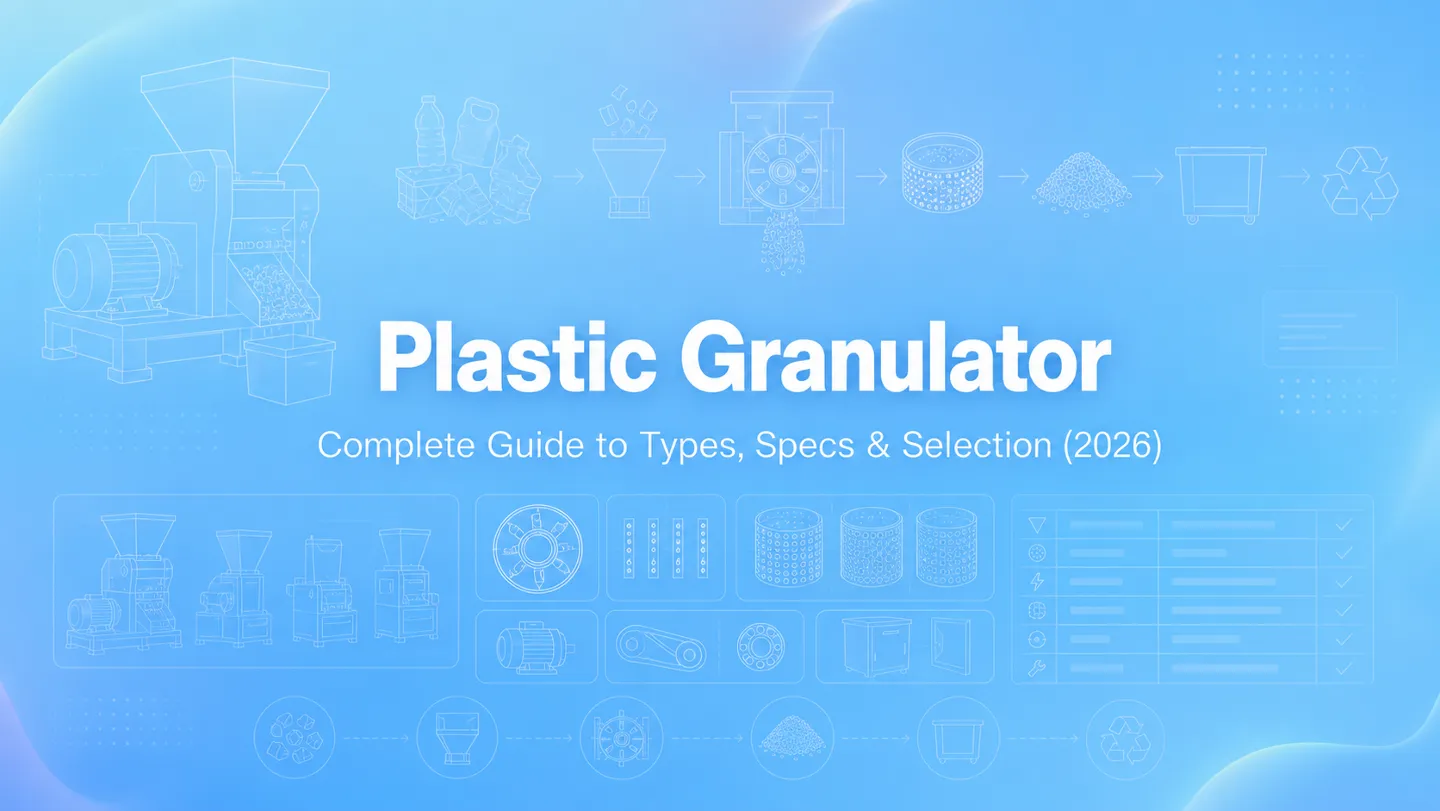
A Kunststoffgranulator Vermindert Kunststoffabfall - Laufrollen, Sprühschläuche, Flaschen, Rohre, Profile, Folie - in einheitliche 6–15 mm Schuppen (Regrind) zur Reinigung, Compoundierung oder direkten Extrusion bereit. Der richtige Granulator hängt von Ihrem Eingangsmaterial, der Durchsatzmenge und dem nachgelagerten Prozess ab; die falsche Wahl bedeutet geringe Kapazität, häufige Verstopfungen oder vorzeitige Schneidwerkzeugabnutzung, die die Betriebskosten verdoppelt. Dieses Leitfaden behandelt die 5 Haupttypen von Kunststoffgranulatoren, wichtige Spezifikationen, die zählen, materialbezogene Auswahl, Schneidwerkzeugmaterialabwägungen, Energiebenchmarks, Kapitalkostenstufen ($8.000–$200.000+), ein 5-Schritt-Selektionsrahmen, häufige Fehlerbehebungen, Zertifizierungen und regionale Preisdifferenzen.
Für tiefere Themenuntersuchungen siehe unsere spezialisierten Leitfäden zu Wahl von Kunststoffgranulatblättern, Wählen Sie den richtigen Granulator, Nass-Kunststoffgranulatoren, und Top 10 zu überprüfenden Spezifikationen. Dieser Artikel dient als umfassender Pfeilerreference, der alle diese Themen verbindet.
Schnelle Entscheidung: Granulator vs. Zerkleinerer vs. Schredder
Käufer verwechseln oft diese drei Maschinen. Das einfachste Entscheidungskriterium:
| Maschine | Eingangsgröße | Ausgabegröße | Anwendung |
|---|---|---|---|
| Kunststoffschredder | Große voluminöse Abfälle (Rohre, Fässer, Ballen, 1+ m Stücke) | 40–150 mm Späne | Primäre Größenreduktion (erste Stufe) |
| Kunststoffgranulator | Vorgekürzte Späne, Laufrollen, Flaschen, kleinere Teile (unter 200 mm) | 6–15 mm Schuppen | Zweiteilige Größe reduzieren (endgültige Schuppengröße) |
| Kunststoffbrecher | Mittlere Abfälle, oft hohle Teile (Überlappung mit beiden) | 10–30 mm Stücke | Brücke zwischen Schredder und Granulator; manchmal für dickewandige Rohre standalone verwendet |
Für die meisten Kunststoffrecyclinganlagen, die vorgereinigtes Material unter 200 mm Eingrößen verarbeiten (Injektionslaufrollen, Flaschenschuppen, zerkleinerte Rohrspäne), ist ein Kunststoffgranulator die richtige Wahl. Für überdimensionierte Abfälle (volle Rohre, Fässer, Ballen) beginnen Sie mit einem Schredder und füttern Sie den Granulator nachfolgend. Die Begriffe werden manchmal synonym verwendet - “Kunststoffzerkleinerer” und “Kunststoffgranulator” überlappen sich in der Produktnennung von Herstellern - aber die Funktionsdifferenz oben gilt in Produktionslinien.
Was ist ein Kunststoffgranulator?
Ein Kunststoffgranulator ist eine präzise Größenreduktionsmaschine, die Kunststoffschrott in einheitliche 6–15 mm Schuppen (Regrind) schneidet. Industrierechtzeitige Kunststoffgranulatoren (auch als Kunststoffgranulatormaschinen, Kunststoffgranuliermaschinen oder Kunststoffzerkleinerer in einigen Märkten) verwenden einen hochgeschwindigen Rotor mit Schneidmessern, die gegen feststehende Schneidklingen laufen, angetrieben von einem 7,5–110 kW Motor bei 400–800 U/min. Ein Lochblech unter dem Schneidraum kontrolliert die Ausgangsschuppengröße. Der Kunststoffregrind geht durch das Lochblech und wird in den nächsten Prozessschritt geleitet - Reinigung, Compoundierung, Trocknung oder Pelletierung.
Kunststoffgranulatoren unterscheiden sich von Kunststoffschreddern in zwei Hinsichten. Erstens behandeln Granulatoren kleinere Eingangsteile (unter 200 mm) bei höheren Rotorgeschwindigkeiten (400–800 U/min gegenüber 50–150 U/min für Schredder); zweitens erzeugen Granulatoren einheitliche, durch Lochblech gesteuerte Ausgang (6–15 mm), während Schredder variable Stücke (40–150 mm) erzeugen. Die meisten Kunststoffrecyclinganlagen verwenden beide: Schredder zuerst für die primäre Größe reduzieren, dann Granulator für die endgültige Schuppengröße, die für den nachfolgenden Extrusionsprozess erforderlich ist.
Wie ein Kunststoffgranulator funktioniert (4-Stufen-Prozess)
- Materialzuführung — Kunststoffschrott tritt durch einen Schüttkasten, einen Förderband oder eine direkte Verbindung neben dem Presswerk in den Schneidraum ein. Die Förderrate wird durch Sensoren oder durch den Bediener dosiert.
- Schneidwirkung — ein hochgeschwindiger Rotor (typischerweise 400–800 U/min) mit 3–6 Schneidmessern läuft gegen 2–3 feststehende Schneidklingen. Die Schereartige Schneidaktion schneidet Kunststoff in kleinere Stücke. Schneidwerkzeugabstand (der Abstand zwischen Rotormesser und Schneidklinge) ist präzise auf 0,2–0,3 mm eingestellt für saubere Schneidung ohne Metall-zu-Metall-Kontakt.
- Lochblechgröße — ein Lochblech (5–25 mm Lochdurchmesser) unter dem Schneidraum kontrolliert die Ausgangsschuppengröße. Material unter Lochblechgröße geht durch; überdimensionierte Stücke bleiben im Raum für zusätzliche Schnitte. Lochblechlochgröße bestimmt die endgültige Regrindspezifikation.
- Entladung — Schuppenschrott geht durch das Lochblech in einen Sammelbehälter oder einen pneumatischen Förderer, der es in den nächsten Prozessschritt transportiert (Reinigungslinie, Trocknungssystem oder Pelletieranlagenhopper).
Der gesamte Zyklus von Materialeintritt bis zum Schuppenausgang dauert 2–8 Sekunden, abhängig von der Härte des Materials und der Lochblechgröße. Typischer Durchsatz eines Kunststoffgranulators am Designpunkt beträgt 100–3.000 kg/h, abhängig von der Motorleistung, dem Rotordurchmesser und dem verarbeiteten Material.
5 Arten von Kunststoffgranulatoren
1. Zentraler Kunststoffgranulator
Ein zentraler Kunststoffgranulator behandelt Kunststoffschrott aus mehreren Produktionslinien, die an einem zentralen Ort gesammelt werden. Typische Kapazität 500–3.000 kg/h mit 30–110 kW Motor. Am besten geeignet für: Recyclinganlagen, MRF (Material Recovery Facilities), und große Produktionsstätten, wo Abfall aus vielen Quellen konsolidiert wird. Kapitalkosten: $15.000–$80.000 je nach Kapazität, Schneidwerkzeugmaterial und Automatisierungsgrad. Meistgenutzte Konfiguration in dedizierten Kunststoffrecyclingbetrieben.
2. Kunststoffgranulator neben dem Presswerk
Direkt neben einer Spritzgießmaschine oder Extrusionsmaschine installiert, verarbeitet dieser kompakte Granulator Schläuche und Sprüze sofort, während sie produziert werden. Typische Kapazität 50–300 kg/h mit 5,5–18,5 kW Motor. Betreibt bei niedrigerer Geschwindigkeit (300–500 U/min) für leiseren Betrieb und minimalen Staub, geeignet für Produktionsflächen. Investitionskosten: $5.000–$25.000. Am besten geeignet für: Spritzgießer, die ihren eigenen sauberen Schrott mit geschlossenen Kreislauf im Haus recyceln. Der Ausgangsflakes wird in die gleiche Spritzgießmaschine zurückgeführt – typische recycelte Anteile 15–30% gemischt mit unverarbeitetem Polymer.
3. Nassplastikgranulator
A nassplastischer Granulator gibt während des Betriebs Wasser in den Schneidkammer hinein. Das Wasser kühlt die Messer, spült Oberflächenverschmutzungen von den Flakes ab, reduziert Staub und verbessert die Schneideeffizienz bei schmutzigen oder verschmutzten Materialien. Typische Kapazität 500–2.500 kg/h mit 22–75 kW Motor. Am besten geeignet für: nachverbrauchte Kunststoffströme (Flaschen, Folie, Rohre mit Oberflächenverschmutzungen), PET-Flaschenflakes-Recycling und jede Operation, bei der das Eingangsmaterial Erde, Staub oder Etiketten hat, die von der Prozesswaschung profitieren. Investitionskosten: $20.000–$80.000 (höher als der trockene Granulator aufgrund der Wasserbewirtschaftung).
4. Starkes Plastikgranulator
handhabt dickenwandige oder harte Kunststoffabfälle – HDPE-Rohre, ABS-Automobilteile, PC-Platten, PVC-Rohre, Nylonkomponenten, starre Behälter. Verstärkter Rotorachse, größere Lager und gehärtete SKD-11 oder Karbidspitzenmesser verlängern die Lebensdauer bei harten Materialien. Typische Kapazität 800–3.500 kg/h mit 45–150 kW Motor. Am besten geeignet für: Rohr extrudierende Betriebe, Fassrecycler, Automobilkunststoffrückgewinnung. Investitionskosten: $35.000–$200.000 – der obere Bereich umfasst spezialisierte Konfigurationen wie die großem HDPE-Rohrzerkleinerer für industriellen Rohrabfall.
5. Spezialisiert: PVC-Granulator & Rohrzerkleinerer
PVC granulators require hardened blades (SKD-11 or carbide-tipped) and dust extraction to manage chlorine off-gassing during cutting. Rotor speed runs 25–35% lower than HDPE granulators (300–500 RPM) to prevent excessive fines. The same machine class includes pipe crushers — extra-wide feed openings for accepting pipe chips from upstream shredders. Capital cost: $25,000–$120,000 with proper PVC-rated configuration. Best for: PVC pipe recycling, vinyl flooring scrap, electrical conduit recovery.
Kriterien für Plastikgranulator-Spezifikationen
Herstellerdatenblätter listen 30+ Spezifikationen auf. Diese 8 sind diejenigen, die tatsächlich die Leistung bestimmen:
- Motorleistung (kW) – in der Regel 7,5–110 kW je nach Durchsatz. Faustformel: 1 kW pro 8–15 kg/h Kapazität für harte Kunststoffe; 1 kW pro 5–10 kg/h für harte Materialien (PVC, ABS, Nylon).
- Rotor Durchmesser (mm) – in der Regel 150–500 mm. Größerer Rotor = höherer Drehmoment aber niedrigere U/min. Für dickenwandiges Material, priorisieren Sie den Rotordurchmesser über die U/min.
- Rotor U/min – in der Regel 400–800 U/min für Standardgranulator; 300–500 U/min für schweres Gerät/PVC. Höhere U/min = mehr Schneidzyklen aber mehr Hitze und Lärm.
- Anzahl der Rotormesser – in der Regel 3–6 Messer. Mehr Messer = glatteres Schneiden aber kleinerer individueller Chip pro Schnitt.
- Anzahl der Schachtklingen – in der Regel 2–3. Der Schnittabstand (Messerabstand) zwischen Rotor und Schachtklingen muss 0,2–0,3 mm betragen, um ein sauberes Schneiden ohne Metallkontakt zu gewährleisten.
- Screen-Größe (mm) – in der Regel 5–25 mm Lochdurchmesser. Standardausgänge: 6 mm (Premium Pellet-Futter), 8 mm (Allzweck), 12 mm (schneller Durchsatz, größerer Flake), 16+ mm (nur Volumenreduzierung).
- Abmessungen der Schneidkammer – Breite und Tiefe bestimmen die maximale Eingabestückgröße. Für HDPE-Flaschen, typischer Kammerraum 350×500 mm; für Rohrabfälle, 600×800 mm oder größer.
- Durchsatzrating (kg/h) — verify the rating is for YOUR material at YOUR screen size. Manufacturer ratings are often best-case (clean rigid HDPE at 16 mm screen). Real-world throughput at 8 mm screen on contaminated material can be 30–50% lower.
Für eine detaillierte Liste über Schneidmesserhärte, Siebverschleißzuschlag, Motormomentreserven und PLC-Funktionen siehe unsere Top 10 technischer Spezifikationen für Plastikgranulator.
Material-spezifische Auswahl von Plastikgranulatoren
Die richtige Granulatorkonfiguration ändert sich erheblich durch den Eingangsmaterial. Die nachstehende Tabelle zeigt empfohlene Konfigurationen für gängige Kunststoffe an:
| Material | Bestes Granulatortyp | Klingenmaterial | Rotor U/min | Besondere Anforderungen |
|---|---|---|---|---|
| HDPE / PP starr | Zentral oder feucht | D2 Werkzeugstahl | 500–700 | Standardausstattung |
| PET-Flaschenflocken | Feuchtkautschukgranulator | D2 oder SKD-11 | 400–600 | Wasserinjektion zur Etikettenentfernung |
| PVC-Rohre und Profile | Starkes Gerät + Staubabsaugung | SKD-11 oder Hartmetall | 300–500 | Niedriger Drehzahlwert zur Reduzierung von Feinstaub + Staubabsaugungssystem |
| ABS / PC-Engineering | Starkes Gerät | SKD-11 | 400–600 | Verstärkter Rotor für hohen Stoß |
| Nylon (PA6, PA66) | Starkes Gerät | Hartmetallbestückt | 300–500 | Hartmetallmesser für abrasives Nylon-Füllmaterial |
| Gemischte festes Abfallmaterial | Zentral mit Sicherheitsschirm | SKD-11 | 400–600 | Metaldetektion vor dem Prozess obligatorisch |
| Film (PE, PP) | Nur Antiwickel-Rotor | D2 mit Filialschneidprofil | 600–800 | Standard Granulatormantel und Stillstand — verwenden Sie filmspezifisches Design |
| Rohstoffabfall (nach dem Zerkleinerer) | Starkes Rohrkrümmergerät | SKD-11 | 300–500 | Breite Fütterung für Chip-Handling |
Betriebsabläufe, die mehrere Materialien verarbeiten, sollten den Granulator für das anspruchsvollste Material im Mischungsmaterial konfigurieren. Der Wechsel zwischen Siebgrößen oder Messerkonfigurationen zwischen Materialien ist für den Bediener machbar, aber dauert 30–60 Minuten pro Änderung. Einzelmaterial-Granulatoren übertrumpfen immer Multi-Material-Modelle auf dem spezifischen Material, für das sie konfiguriert sind.
Plastik Zerkleinerer Messer: Materialien, Lebensdauer & Auswahl
Plastik Zerkleinerer Messer (auch Messer genannt) sind der Hauptabriebkomponente und der größte laufende Betriebskostenposten. Die Wahl des Messers beeinflusst den Durchsatz, die Ausgabequalität, den Energieverbrauch und die Wartungshäufigkeit. Drei Materialstufen für Messer decken die meisten Anwendungen ab:
- D2 Werkzeugstahl — Standardoption für die meisten Anwendungen von Plastikzerkleinerern. Härte HRC 58–62. Lebensdauer 600–1.200 Betriebsstunden auf HDPE/PP. Preis: $80–$300 pro Messer je nach Größe. Schärfbar 3–5 Mal vor dem Ersatz.
- SKD-11 Kaltwerkzeugstahl — Premium-Option für harte Materialien (ABS, PC, Nylon, PVC). Härte HRC 60–62. Lebensdauer 1.500–2.500 Stunden. Preis: $200–$600 pro Messer. Bessere Kantenhaltbarkeit bei abrasiven Materialien; empfohlen für jede Operation, die mehr als 1.000 kg/h verarbeitet.
- Keramikbeschlagene Messer — spezialisierte Option für hochabrasive Materialien (Glasfaserverstärkte Kunststoffe, kontaminierte Ströme). Lebensdauer 3.000–6.000 Stunden. Preis: $400–$1.200 pro Messer. Der Keramikschneidkantenauschnitt widersteht dem Verschleiß 3–5× besser als D2, kostet jedoch 2–4× mehr upfront.
Die Auswahl der Scherblätter (statische Schneidebalken) erfolgt nach denselben Materialien. Sowohl die Rotorblätter als auch die Scherblätter sollten Materialklasse entsprechen — das Verwenden von D2-Rotorblättern gegen SKD-11-Scherblätter führt zu ungleichmäßiger Abnutzung und verkürzt das Leben beider Komponenten.
Praktische Anleitung: Für erste Betriebsjahre auf Standard HDPE/PP beginnen Sie mit D2-Blättern, um Kapital zu verwalten. Wechseln Sie im zweiten Jahr zu SKD-11, nachdem Sie die tatsächliche Lebensdauer der Blätter an Ihrem Material gemessen haben — die typische Lebensdauerverlängerung von 3-5× trägt den Messerpreisunterschied in 6 Monaten aus. Für PVC, ABS oder Nylon-Operationen beginnen Sie ab Tag 1 mit SKD-11. Für eine umfassende Auswahlberatung einschließlich Messerabstandseinstellung und Nachschärfprozeduren siehe unsere Anleitung zur Auswahl von Kunststoffgranulatmessern.
Energieverbrauchsbenchmarks (kWh/Ton)
Der Energieverbrauch von Kunststoffgranulatmaschinen variiert 3–5× zwischen Materialien und Konfigurationen. Die nachstehenden Zahlen sind typische Benchmarks für ordnungsgemäß gewartete Anlagen, die nahe dem Designdurchsatz laufen:
| Material | Typischer Energieverbrauch (kWh/Ton) | Hinweise |
|---|---|---|
| HDPE fest (Flaschen, Fässer) | 40–60 | Niedrigster Energieverbrauch unter den festen Kunststoffen |
| PP fest (Kappen, Kisten) | 45–65 | Ähnlich wie HDPE |
| PET-Flaschenflocken | 50–75 | Wegen der Brüchigkeit etwas höher |
| PVC-Rohre und Profile | 70–110 | Niedrigere Umdrehungsgeschwindigkeit reduziert den Energieverbrauch pro Ton |
| ABS / PC (Technik) | 80–120 | Harte Materialien erhöhen die Belastung |
| Nylon (gefüllt) | 100–150 | Glasgefüllter verdoppelt den Basisenergieverbrauch |
| Gemischte festes Abfallmaterial | 60–90 | Abhängig vom dominierenden Material |
| Rohrreste (stark beanspruchend) | 70–100 | Dicker Wand erhöht den Motorlast |
For a 1 ton/h granulator running 4,000 hours per year on HDPE rigid waste at $0.10/kWh, annual energy cost is approximately $20,000–$24,000. For the same operation on PVC, energy cost rises to $28,000–$44,000. Energy efficiency improves significantly when granulators run near rated throughput — operating at 50% of rated capacity typically increases per-ton energy by 30–40% because fixed losses (idle motor, blower, controls) become a larger share of total consumption.
Investitionskostenstufen für Kunststoffgranulatoren
Plastic granulator pricing varies 25× across configurations. Three realistic tiers cover 95% of buyer decisions:
- Kompakt / direkt an der Druckmaschine: $5.000–$25.000 — Leistung: 50–300 kg/h, Motorleistung: 5,5–18,5 kW. Ideal für: Spritzgießer, die eigenen Abfall verwerten, kleine Produktionslinien sowie Labor- und F&E-Anwendungen.
- Mittlere Preisklasse: $15.000–$80.000 — Leistung: 500–2.000 kg/h, Motorleistung: 22–75 kW. Am besten geeignet für: spezialisierte Kunststoffrecyclingbetriebe, Sortieranlagen (MRFs) sowie die Verwertung von Produktionsabfällen in mittelgroßen Betrieben. Weltweit am häufigsten verkaufte Konfiguration.
- Schwerlast-Industrie: $35.000–$200.000+ — Leistung: 1.500–3.500 kg/h, 75–150-kW-Motor mit verstärkter Welle, hochwertige Messer, moderne SPS. Ideal für: Rohrrecyclinganlagen, PET-Rückgewinnungsanlagen mit hohem Durchsatz, Verarbeitung von Hartkunststoffen (ABS für die Automobilindustrie, PC-Platten).
Add 15–25% to equipment cost for installation: foundation work, electrical hookup, dust extraction system, conveyor connections to upstream/downstream equipment. Total project cost typically runs 1.2–1.5× the equipment sticker price.
5-stufiges Rahmenkonzept zur Auswahl von Kunststoffgranulatoren
Schritt 1: Eingabematerial und Quelle festlegen
Welcher Kunststoff wird in den Granulator gegeben? HDPE-Flaschen, PP-Angussstücke, PVC-Rohre, PET-Flocken, gemischter Hartkunststoff? Jedes Material erfordert unterschiedliche Messermaterialien, Rotordrehzahlen und Siebgrößen. Auch die Qualität des Ausgangsmaterials spielt eine Rolle – sauberer Industrieabfall ermöglicht den Einsatz von D2-Messern und einer Standardkonfiguration; verunreinigter Verbraucherabfall erfordert SKD-11-Messer, eine höhere Drehmomentreserve des Motors und möglicherweise den Nassbetrieb.
Schritt 2: Erforderlichen Durchsatz berechnen
Multiply your daily volume target by reasonable safety margin (1.3–1.5×). A line processing 8 tons/day over 8-hour shift needs 1,000 kg/h average, which means 1,300–1,500 kg/h rated capacity to handle peaks and material variability. Manufacturer-rated throughput is typically measured on ideal material; real-world capacity on YOUR specific material is often 60–80% of rating.
Schritt 3: Festlegen der Flockengröße
Die erforderliche Flockengröße richtet sich nach dem nachgelagerten Prozess. Für die Pelletierung von PET-Flaschen zu neuen Flaschen sind 6–8 mm erforderlich. Standard-rPellets in Spritzgussqualität sind für 8–10 mm geeignet. Bei der Rohrextrusion oder der Compoundierung großer Mengen können 12–15 mm verwendet werden. Eine kleinere Siebgröße verringert den Durchsatz um 15–30% – wählen Sie das größte Sieb, das Ihren nachgelagerten Spezifikationen entspricht.
Schritt 4: Standort- und Stromversorgungsbedingungen prüfen
Verfügbare Stellfläche prüfen (Granulatoren der mittleren Leistungsklasse benötigen 4–6 m²; Hochleistungsgranulatoren 8–12 m²), die Deckenhöhe (typischerweise 3–4 m), die elektrische Leistungsaufnahme (Motor + Hilfslasten bis zu 130 kW bei Hochleistungsgranulatoren) sowie die Lärmgrenzwerte (75–95 dB je nach Konfiguration). Bei Nassgranulatoren sind die Wasserversorgung (200–500 L/h) und die Abwasserableitungskapazität zu überprüfen.
Schritt 5: Vor dem Kauf einen Materialtest durchführen
Senden Sie 50–200 kg IHRER spezifischen Kunststoffabfälle zum Hersteller, um einen Testlauf durchzuführen. Überprüfen Sie den tatsächlichen Durchsatz, die Ausgabequalität, den Energieverbrauch und die Geräuschentwicklung anhand Ihres Materials – nicht anhand der Referenzprobe des Herstellers. Anbieter, die Materialtests ablehnen, deuten damit auf Kapazitätsprobleme hin. Eine umfassende Anleitung zum Kaufprozess finden Sie in unserem Kunststoffzerkleinerer Auswahlhandbuch.
Häufige Probleme bei Kunststoffgranulatoren und deren Behebung
Problem: Geringer Durchsatz trotz ausreichender Leistung
Ursachen: stumpfe Messer (am häufigsten), falscher Messerspalt (bei über 0,4 mm sinkt die Schneidleistung um 30–50%), falsche Siebgröße (zu klein für das Material) oder feuchtes/klebriges Material, das das Sieb verstopft. Lösungen: Klingen alle 600–1.200 Betriebsstunden überprüfen und nachschärfen; den Messspalt monatlich mit einer Fühlerlehre überprüfen; auf ein größeres Sieb umstellen, sofern die nachgeschaltete Anlage dies zulässt; bei feuchtem Aufgabematerial eine Vortrocknung vorsehen.
Problem: Übermäßiger Feinanteil (Pulver) im Endprodukt
Hier ist eine mögliche Übersetzung: „Ursachen: Zu hohe Drehzahl des Rotors im Verhälltnis zum Material, abgenutzte Messer, die statt zu schneiden zerdrücken, sowie brüchliches Material wie PET oder PVC bei der üblichen Drehzahl des Rotors.“․†„Lösungen: Die Drehzahl des Rotors um 15–25% Umdrehungen pro Minute reduzannya, bei brüchlichem Material; abgenutzte Messer ersetzen; eine Feinsiebanlage nachgeschaltet einbauen, um Staub von dem Recyclat zu trennen.“.
Problem: Häufige Auslösungen aufgrund von Motorüberlastung
Ursachen: zu große Einsatzstücke, Fremdkörper (Metallfragmente, Steine), verschlissene Antriebsriemen, für die tatsächliche Materialdichte zu kleiner Motor. Lösungen: Sicherstellen, dass die Größe der Eingabestücke unter 200 mm liegt; einen Metalldetektor vor der Anlage installieren (bei gemischten Abfällen zwingend erforderlich); Antriebsriemen alle 500 Betriebsstunden überprüfen; den Motor aufrüsten, wenn Material verarbeitet wird, das eine höhere Dichte als in der ursprünglichen Spezifikation angegeben aufweist.
Problem: Übermäßige Geräuschentwicklung und Vibrationen
Ursachen: verschlissene Rotorlager, unausgewuchteter Rotor (häufig aufgrund des Verschleißmusters der Rotorblätter), lockere Fundamentschrauben, gerissene Rotorwelle. Lösungen: Lager beim ersten Anzeichen von Verschleiß austauschen; Rotorblätter alle 200 Betriebsstunden drehen oder neu auswuchten; Fundamentschrauben monatlich überprüfen; Rotorwelle auf Risse untersuchen, wenn plötzlich Vibrationen auftreten.
Zertifizierungen und Sicherheitsstandards
Die Sicherheitsstandards für Kunststoffgranulatoren unterscheiden sich je nach Region. Für industrielle Einkäufer sind im Jahr 2026 fünf Zertifizierungen von Bedeutung:
- CE-Kennzeichnung (EU) — für alle in EU-Märkten verkauften Granulatoren erforderlich. Umfasst Maschinenrichtlinie 2006/42/EG, Niederspannungsrichtlinie und EMV-Richtlinie. Überprüfen Sie, ob das CE-Zertifikat echt ist (durch Dritten geprüft) und nicht selbstdeklariert.
- UL (US) — Zertifizierung durch Underwriters Laboratories für elektrische Sicherheit. Von den meisten US-Versicherern für industrielle Kunststoffrecyclingbetriebe erforderlich.
- OSHA-Konformität (US) — Granulatoren müssen den Maschinenschutznormen 29 CFR 1910 entsprechen: geschlossene Schnittkammer, verriegelte Zugangstüren, Notstopp erreichbar von der Bedienerposition, Abschaltung/Markierung (LOTO) für Wartung.
- ISO 12100 (Maschinensicherheit) — internationale Risikobewertungsstandard. Die meisten CE-zertifizierten Granulatoren sind auch ISO 12100-konform.
- ISO 14001 (Umweltmanagement) — für den Betrieb, nicht das Gerät. Von vielen großen industriellen Käufern von recycelten Pellets erforderlich — die ISO 14001-Zertifizierung Ihres Granulatorenherstellers unterstützt den Zertifizierungsprozess Ihrer Anlage.
Überprüfen Sie Zertifizierungen unabhängig — fordern Sie Zertifikatsnummern an und bestätigen Sie mit dem Herausgeber. Falsche CE-Kennzeichnungen sind im Granulatorenimportmarkt häufig; legitime Zertifikate haben einzigartige Nummern, die durch die Datenbank des Zertifizierungsinstituts überprüft werden können.
Regionale Preisvergleiche für Kunststoffgranulatoren
Der Preis für Kunststoffgranulatoren variiert 2–3× je nach Region. Gleichartige Spezifikationen erzeugen unterschiedliche Gesamtkosten je nach Herkunftsland, Fracht, Zöllen und Anforderungen an den After-Sales-Support:
| Herkunftsregion | Mittelklasse-Granulator (1 t/h, 45 kW) | Schwerlast-Granulator (2.5 t/h, 110 kW) | Überlegungen |
|---|---|---|---|
| China direkt | $15,000–$30,000 | $45,000–$90,000 | Niedrigster Preis, längste Lieferzeit (90–150 Tage), detaillierte Lieferantenbewertung erforderlich |
| Indien direkt | $12,000–$25,000 | $40.000–$80.000 | Billiger als China für einige Konfigurationen, etablierter Exportmarkt |
| Türkei / Osteuropa | $25,000–$50,000 | $70,000–$140,000 | Mittelständige Preise mit EU-CE-Zertifizierung, schnellerer Versand in EU-Märkte |
| Westliches EU (Deutschland, Italien) | $45,000–$90,000 | $120,000–$250,000 | Premium-Preise, 10+ Jahre Serviceunterstützung, vollständige CE/UL-Konformität, schnellerer Ersatzteilversand |
| Nordamerika | $50.000–$100.000 | $130.000–$280.000 | Premium-Preise, das stärkste lokale Servicenetzwerk, OSHA-konforme Konstruktionen |
Für die meisten industriellen Einkäufer außerhalb Chinas und Indiens bietet die Beschaffung aus der Türkei oder Osteuropa das beste Preis-Leistungs-Verhältnis – deutlich günstiger als Geräte aus der westlichen EU oder Nordamerika mit ähnlicher CE-Zertifizierung und mit schnelleren Lieferzeiten als bei Direktimporten aus China. Direktimporte aus China eignen sich gut für Einkäufer, die über das technische Fachwissen zur Qualitätsprüfung verfügen und bereit sind, längere Logistiklaufzeiten in Kauf zu nehmen.
Häufig gestellte Fragen
Was ist eine Kunststoffgranulmaschine?
Ein Kunststoffgranulator ist eine Präzisions-Zerkleinerungsmaschine, die Kunststoffabfälle in gleichmäßige, 6–15 mm große Flocken zerkleinert, die als „Regrind“ bezeichnet werden. Industriestandard-Kunststoffgranulatoren verwenden einen Hochgeschwindigkeitsrotor (400–800 U/min) mit 3–6 Schneidmessern, die gegen 2–3 feststehende Bettmesser arbeiten und von einem 7,5–110-kW-Motor angetrieben werden. Ein Lochsieb unterhalb der Schneidkammer regelt die Größe der ausgegebenen Flocken. Kunststoffgranulatoren werden in einigen Märkten auch als Kunststoffgranuliermaschinen, Kunststoffzerkleinerer oder Kunststoffbrecher bezeichnet – die Funktion ist dieselbe.
Worin besteht der Unterschied zwischen einem Kunststoffgranulator und einem Kunststoffschredder?
Kunststoffzerkleinerer verarbeiten großen Sperrmüll (Rohre, Fässer, Ballen mit einer Länge von über 1 Meter) und erzeugen bei niedrigen Rotordrehzahlen (50–150 U/min) Späne mit einer Größe von 40–150 mm. Kunststoffgranulatoren verarbeiten vorzerkleinerte Späne oder kleinere Teile (unter 200 mm) und erzeugen bei hohen Rotordrehzahlen (400–800 U/min) Flocken mit einer Größe von 6–15 mm. Die meisten Kunststoffrecyclinganlagen setzen beide Maschinen ein: zunächst den Zerkleinerer zur primären Zerkleinerung, anschließend den Granulator zur Erzielung der für die nachgelagerte Reinigung oder Extrusion erforderlichen Endflockengröße.
Was kostet ein Kunststoffgranulator?
Plastic granulator pricing has three tiers: compact/beside-the-press $5,000–$25,000 (50–300 kg/h, in-house injection scrap recycling); mid-range central $15,000–$80,000 (500–2,000 kg/h, dedicated recycling operations); heavy-duty industrial $35,000–$200,000+ (1,500–3,500 kg/h, pipe/drum/hard plastic recycling). Add 15–25% for installation. Direct-from-China pricing is 30–60% below Western EU/NA equivalents but with longer lead times and requires careful vendor evaluation.
Wie lange halten die Messer einer Kunststoffgranulierschnecke?
Klingen aus D2-Werkzeugstahl (Standard) halten bei HDPE/PP 600–1.200 Betriebsstunden und können vor dem Austausch 3–5 Mal nachgeschliffen werden ($80–$300 pro Klinge). SKD-11-Klingen (Premium) halten 1.500–2.500 Stunden bei $200–$600 pro Klinge – empfohlen für zähe Materialien (ABS, PC, Nylon, PVC) oder Durchsätze über 1.000 kg/h. Klingen mit Hartmetallspitzen für stark abrasive Materialien halten 3.000–6.000 Stunden bei $400–$1.200 pro Klinge. Siehe unser Anleitung zur Auswahl von Kunststoffgranulatmessern für Empfehlungen zu den einzelnen Materialien.
Was ist der Unterschied zwischen Nass- und Trockenplastikgranulatoren?
Ein Nassgranulator spritzt während des Betriebs Wasser in die Schneidkammer – das Wasser kühlt die Messer, wäscht Oberflächenverschmutzungen von den Flocken ab, reduziert die Staubentwicklung und verbessert die Schneidleistung bei verunreinigtem Material. Am besten geeignet für Post-Consumer-Ströme (Flaschen mit Etiketten, verschmutzte Rohrabfälle, gemischte Verunreinigungen). Ein Trockengranulator arbeitet ohne Wasser – geringerer Platzbedarf, keine Abwasserentsorgung, geeignet für sauberen postindustriellen Schrott. Die meisten PET-Flaschen-Recyclinganlagen verwenden Nassgranulatoren; beim Recycling von Spritzgussabfällen kommen meist Trockengranulatoren zum Einsatz. Siehe unsere Leitfaden für Nass-Kunststoffgranulatoren.
Kann ein Kunststoffgranulator PVC verarbeiten?
Yes, with proper configuration. PVC granulators require: SKD-11 or carbide-tipped blades (PVC is brittle and abrasive); lower rotor speed (300–500 RPM vs 600–800 for HDPE) to prevent excessive fines; integrated dust extraction to manage chlorine off-gassing during cutting; and acid-resistant materials of construction. Standard HDPE-configured granulators run on PVC at 25–35% lower throughput and wear blades 2–3× faster. For PVC-heavy operations, specify a PVC-rated configuration from purchase rather than trying to retrofit a standard granulator.
Welche Ausgangsflakengröße sollte eine Kunststoffgranulmaschine erzeugen?
Die Größe der Ausgangsflocken wird durch das unterhalb der Schneidkammer installierte Sieb bestimmt. Standardgrößen: 6 mm (Premium-Granulat für die „Bottle-to-Bottle“-Verarbeitung), 8 mm (Allzweck-rPellets in Spritzgussqualität), 10 mm (die meisten Waschanlagen), 12 mm (Compoundierung für die Rohrextrusion), 16+ mm (nur zur Volumenreduzierung, nicht für die direkte Extrusion). Ein feineres Sieb verringert den Durchsatz um 15–30% – wählen Sie das größte Sieb, das Ihren Anforderungen für den nachgelagerten Prozess entspricht.
Wie halte ich einen Kunststoffgranulator in Stand?
Täglich: Sichtprüfung der Schneidkammer, Überprüfung des Messerspaltes (0,2–0,3 mm), Überprüfung des Siebzustands. Wöchentlich: Überprüfung der Messerschärfe, Spannung des Antriebsriemens, Überwachung der Lagertemperatur. Monatlich: Vollständige Drehung der Messer/Schärfen bei Bedarf, Austausch des Siebs bei vergrößerten Perforationen, Überprüfung der Rotorauswuchtung. Vierteljährlich: Beurteilung des Lagerwechsels, vollständige Rotorinspektion. Jährlich: Komplette Rotorwartung, Motorinspektion, Überprüfung der elektrischen Anlage. Eine konsequente Wartung verlängert die Lebensdauer der Anlage von typischerweise 8–10 Jahren auf 12–15 Jahre und beugt unerwarteten Ausfällen vor, die 70%+ der gesamten Ausfallkosten ausmachen.
Abschluss
Die Wahl des richtigen Kunststoffgranulators hängt vom Ausgangsmaterial, dem Durchsatz, den Anforderungen an die Flockengröße sowie dem Betriebsumfang ab. Fünf Granulator-Typen decken die meisten Anwendungen ab: Zentralgranulatoren (Recyclinganlagen), Press-nahe Granulatoren (Spritzgussabfälle), Nassgranulatoren (verunreinigte Post-Consumer-Abfälle), Hochleistungsgranulatoren (Rohre/Hartkunststoffe) und Spezialgranulatoren für PVC. Die Investitionskosten liegen zwischen $5.000 und $200.000+; der Energieverbrauch beträgt je nach Material 40–150 kWh/Tonne. Die größten Fehler beim Kauf sind die Entscheidung auf Basis der Nennleistung statt der Ergebnisse von Materialtests, die Wahl von D2-Messerblättern, wenn das Material SKD-11 oder Hartmetall erfordert, sowie das Übersehen von Zertifizierungen (CE, UL, OSHA), die den Versicherungs- und Wiederverkaufswert bestimmen.
Energycle stellt das gesamte Sortiment an Kunststoffgranulatoren her – zentrale Granulatoren, Granulatoren für den Einsatz neben der Presse, Nassgranulatoren, Hochleistungsgranulatoren sowie spezielle PVC-Ausführungen mit einer Leistung von 100 kg/h bis 3.500 kg/h. Wenden Sie sich an unser Ingenieurteam Anhand Ihrer Materialspezifikationen, Ihres Durchsatzziels und Ihrer Anforderungen an die Flockengröße empfehlen wir Ihnen die passende Granulator-Konfiguration mit einem detaillierten Angebot, der Auswahl der Messer, der Siebgröße und einem Protokoll für Materialtests.
Industrieller Kunststoffgranulator: Wann Sie einen benötigen
Ein industrieller Kunststoffgranulator gehört zur Hochleistungsklasse der Granulatoren und ist für den kontinuierlichen Betrieb mit hohem Durchsatz in Recyclinganlagen und großen Spritzgussbetrieben ausgelegt. Im Vergleich zu Anlagen, die direkt an der Spritzgießmaschine installiert werden, hat ein industrieller Granulator eine Durchsatzleistung von 500–3.000 kg/h, verarbeitet sperrigen Abfall bis zu einer Größe von 800 mm ohne Vorzerkleinerung und verfügt über 75–250-kW-Motoren mit verstärkten Rotoren, die für starre Kunststoffe, Rohrstücke und Ballen aus Post-Consumer-Abfällen verarbeiten können.
Entscheiden Sie sich für einen industriellen Kunststoffgranulator, wenn einer der folgenden Punkte zutrifft:
- Durchsatz von über 500 kg/h dauerhaft — Die Anlagen neben der Druckmaschine und die zentralen Einheiten können nicht mithalten
- Gemischte Rohstoffe — Flaschen, Klumpen, Spülung, Rohre, Bleche – alles auf derselben Produktionslinie
- Rund-um-die-Uhr-Betrieb — ein Einsatzzyklus, der Industrielager, ein abgedichtetes Getriebe und eine gehärtete Schneidkammer erfordert
- Im nachgelagerten Bereich wird eine Granulieranlage beschickt — Industrielle Granulatoren zerkleinern das Material so gleichmäßig, dass es ohne erneutes Zerkleinern in einen Extruder eingespeist werden kann
Informationen zu technischen Daten, Investitionskosten und einem Vergleich der wichtigsten Konfigurationen im Industriebereich finden Sie in den Abschnitten „Investitionskostenstufen“ und „Materialspezifische Angaben“ weiter oben.
Komplette Recyclinganlagen mit Granulatoren
Granulatoren arbeiten selten allein. Hier sind die gängigsten Linienkonfigurationen, bei denen ein Granulator als Kernkomponente dient:
PET-Flaschen Recycling Linie
Ballenbrecher → Etikettenentferner → Nassgranulator → Heißwäsche → Reibungswäscher → Spülen → Entwässerung → Trocknung → Flockensortierung. Ergebnis: Saubere PET-Flakes für die Flaschenabfüllung oder Faserextrusion. Siehe unsere Auswahlhilfe für PET-Flaschengranulatoren Und Fallstudie zur PET-Linie in den Niederlanden.
PE/PP-Film Recycling Linie
Zerkleinerer → Nassgranulator → Reibwaschanlage → Schwimmbecken → Entwässerung → Trocknung → Pelletieren. Produkt: PE/PP-Granulat. Siehe unsere BOPP-Folien-Recyclinglinie Und Schneidverdichter-Granulieranlage.
Recyclinganlage für Hartkunststoffe
Zerkleinerer → Granulator → Waschanlage → Trockner → Farbsortierer → Pelletierer. Ergebnis: Saubere, formstabile Kunststoffgranulate, bereit für das Spritzgießen. Siehe unsere Leitfaden zum Granulierprozess von starrem PP/HDPE.
PVC-Rohr-Recyclinglinie
Brecher → Vertikalgranulator → Metallabscheider → Pulverisator → Mischgerät → Extruder. Ausgabe: rPVC-Komplex für neue Rohre und Profile. Unser PVC-Rohrgranulator Geeignet für Rohre bis zu einem Durchmesser von Ø600 mm.
Granulatoranlagen und Zubehör
Eine vollständige Granulatoranlage umfasst typischerweise folgende Komponenten:
- Metalldetektoren/Metalltrenner — Klingen vor Metallverunreinigungen schützen (obligatorisch für Post-Consumer-Abfallströme)
- Förderbänder oder pneumatische Zuführsysteme — automatisierte Materialhandhabung für zentrale Anlagen
- Gebläse- und Zyklonsysteme — Granulat aus der Maschine in Lagerbehälter entleeren
- Schalldichte Gehäuse — Reduzierung des Geräuschpegels auf <75 dB bei Installationen in der Nähe des Bedieners
- Staubabsaugungssysteme — Auffangen von Feinstaub aus der Luft, was insbesondere für die PVC-Verarbeitung von entscheidender Bedeutung ist
- Klingenschleifmaschinen — ermöglicht das Nachschärfen im eigenen Haus und reduziert so die Klingenkosten 60–70%
Einen umfassenden Überblick finden Sie in unserem Leitfaden für Granulatoranlagen und Zubehör.
Industrielle Anwendungen
Kunststoffgranulatoren werden in allen Sektoren eingesetzt, die Kunststoffe produzieren oder recyceln:
- Spritzguss — Durch die Wiederaufbereitung von Angussstücken und Ausschuss direkt an der Presse werden 100 % der Abfälle wieder in die Produktion zurückgeführt
- Blasformen — Abfälle und Grate von Flaschen, Behältern und Tanks
- Extrusion — Kantenschutz, Anlaufabfall und nicht spezifikationsgerechte Rohre, Profile und Bleche
- Thermoformen — Skelettreste aus der Becher-, Tablett- und Blisterverpackung
- Recyclinganlagen — Verarbeitung von Post-Consumer- und Post-Industrial-Kunststoffen bei 500–3.000 kg/h
- Automobilindustrie — Recycling von Stoßstangen, Armaturenbrett und Innenausstattung
- Konstruktion — Recycling von PVC-Rohren, Fensterprofilen und Dachmembranen
Detaillierte Anwendungshinweise nach Materialart finden Sie in unserer Granulatoren in Recyclinglösungen Überblick und Anwendungen von Folien bis hin zu dicken Platten.
Verwandte Ressourcen
- So wählen Sie die richtige Kunststoffgranuliermaschine aus
- Top 10 technische Spezifikationen für Kunststoffgranulatoren
- Kunststoff Granulator Schneidblatt Auswahlanleitung
- Feuchtkautschuk Granulator: Anwendungen und Einrichtung
- Kunststoff Zerkleinerer Auswahlanleitung
- Großdurchmesser HDPE-Rohr Zerkleinerer (Produkt)
- Feuchtkautschuk Granulator (Produkt)
- Integrierte Zerkleinerer-Granulator Maschine (Produkt)
- Kunststoff Recyclingmaschine: Kompletter Pfeiler Leitfaden
- Preisliste für Kunststoffrecyclingmaschinen
