

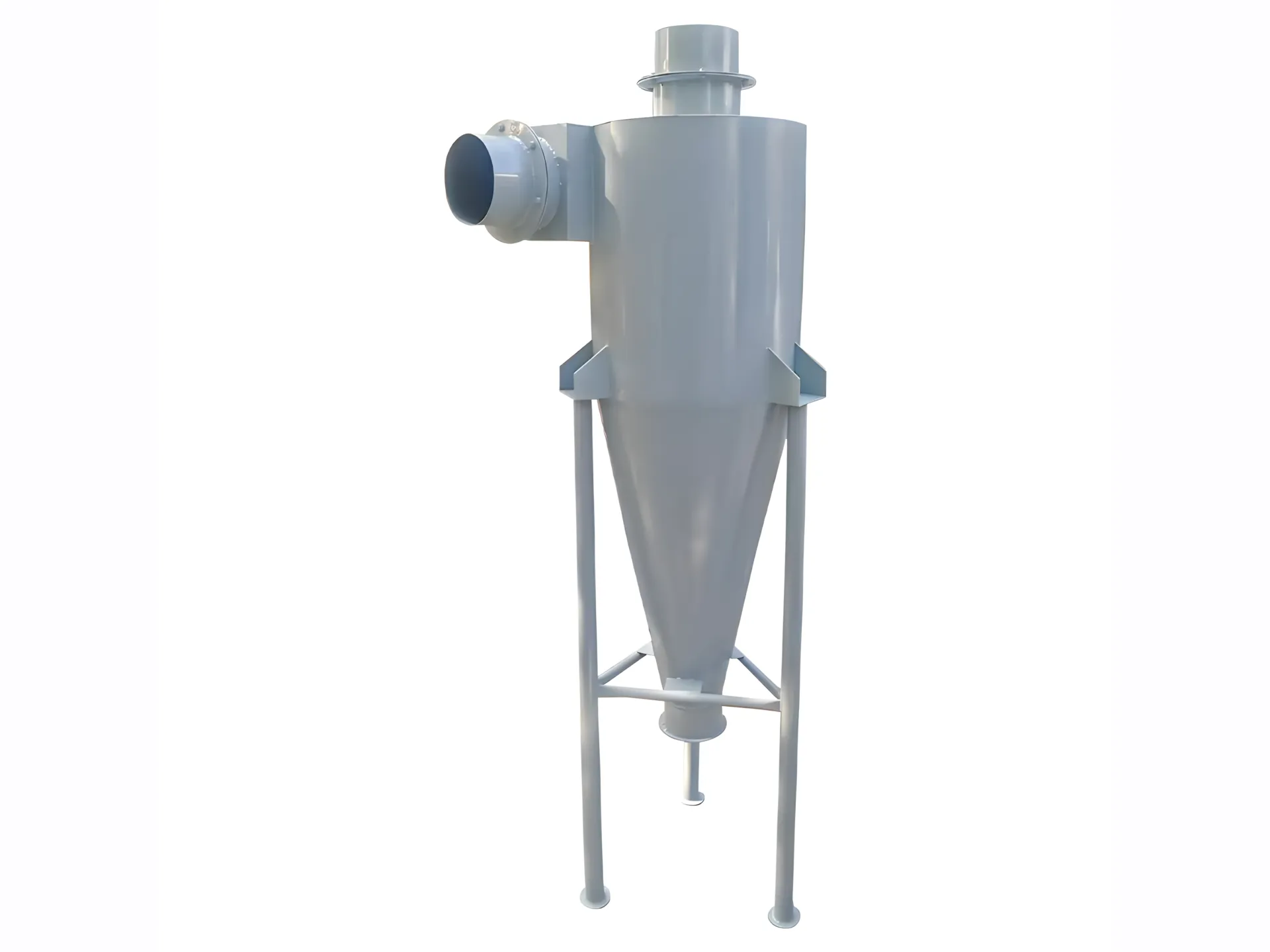
Cyclone separators in plastic recycling help remove dust, fines, labels, and lightweight contaminants from shredded or granulated materials. These systems use airflow and centrifugal force to clean plastic streams efficiently, supporting high-quality output in modern recycling operations.
Professionals in the industry rely on cyclones as a practical, dry-method solution that fits seamlessly into shredding, granulating, and pelletizing lines.
How Cyclone Separators Work
A cyclone separator creates a high-speed spinning airflow to sort particles by weight and size.
Shredded plastic (from a single-shaft shredder or granulator) mixed with air enters tangentially at the top. This forms a vortex that pushes heavier or larger particles outward against the walls. Friction slows them down, and they spiral to the bottom collection hopper.
Lighter materials, such as dust or thin films, stay in the inner upward vortex and exit through the top outlet, often to a secondary filter or another process stage.
This process requires no moving parts or filter media, making it reliable for continuous operation. Inlet velocities typically range from 15 to 25 m/s for optimal separation in plastic applications, as noted by manufacturers like Shini Plastics Technologies and Energycle Recycling Systems.
Types of Cyclone Separators
Not every cyclone is built the same. The body diameter and inlet design set a trade-off between how fine a particle the unit can catch (its cut point) and how much airflow it can move. Three configurations cover almost all plastic recycling lines.
- High-Efficiency (Small-Diameter) Cyclone — A narrow body and high inlet velocity spin the air faster, so it captures fine dust and angel hair down to roughly 5–10 microns. The cost is a higher pressure drop, meaning more fan energy.
- High-Throughput (Large-Diameter) Cyclone — A wider body moves large air volumes with a low pressure drop, ideal for high-CFM lines and coarse fines from rigid flake. It trades away some fine-particle capture (cut point near 20–40 microns).
- Multi-Cyclone (Multiclone) — A bank of small-diameter tubes running in parallel delivers high-efficiency capture while still handling a large total airflow. It suits plants that need both fine dust removal and high volume in one footprint.
| Cyclone Type | Best For | Typical Cut Point (D50) | Pressure Drop |
|---|---|---|---|
| High-Efficiency (small dia.) | Fine dust, angel hair | ~5–10 microns | Higher |
| High-Throughput (large dia.) | High airflow, coarse fines | ~20–40 microns | Lower |
| Multi-Cyclone (multiclone) | Fine capture at high volume | ~5–15 microns | Moderate–High |
Key Applications in Plastic Recycling
Recycling facilities use cyclone separators at several points in the process:
- Post-Shredding Cleanup (Air Separator) — They pull away paper labels, dirt, and fines from plastic flakes after initial size reduction.
- Dust Removal in Pelletizing Lines — During extrusion, cyclones capture airborne dust and angel hair (fine strands) to produce cleaner, more uniform pellets.
- Film and Flexible Plastics Handling — High-efficiency cyclones separate lightweight LDPE or PP films from heavier rigid pieces, especially in packaging waste streams.
- Pre-Separation for Large-Volume Waste — In systems processing plastic trim or production scrap, cyclones act as the first stage to handle fibrous or large-area materials before finer filtration.
These applications make cyclones a standard component in many plastic recycling setups, from small operations to large-scale plants.
Benefits of Using Cyclone Separators
Cyclone separators offer clear advantages that appeal to recycling professionals:
- Low Operating Costs → They consume minimal energy and need no replacement filters or consumables.
- Durability in Tough Conditions → Built from heavy-duty steel, they handle abrasive materials like shredded PET or ABS without frequent breakdowns.
- Improved Air Quality and Equipment Life → By capturing dust early, they reduce wear on downstream components and help maintain a cleaner facility environment.
- Dry Operation → Unlike water-based systems, cyclones avoid wastewater treatment and work well in water-sensitive processes.
- High Throughput → Properly sized units manage large air volumes while achieving 95%+ recovery of usable plastic material.
Facilities often pair cyclones with baghouse filters or electrostatic precipitators for even better results.
Design Considerations for Plastic Recycling
Choose the right cyclone based on your material and airflow needs.
- Inlet Velocity and Geometry: Higher speeds improve separation of fine dust but increase energy use.
- Cone and Hopper Design: Proper shaping prevents re-entrainment of light materials.
- Material-Specific Models: Use larger diameters for rigid plastics and high-efficiency designs for films to avoid clogging.
- Multi-Stage Setup: Combine multiple cyclones or add secondary filtration for stricter purity requirements.
Consult experienced suppliers to match cyclone size to your system’s CFM and dust load.
Limitations and Complementary Solutions
Cyclones excel at removing dust and labels but face challenges with certain tasks.
They struggle to separate plastics of similar density (like PP at 0.90 g/cm³ and LDPE at 0.92 g/cm³) because air provides limited buoyancy difference. For density-based sorting, facilities often turn to flotation tanks or hydrocyclones (liquid-based systems).
Very fine particles under 10-20 microns may escape capture. In such cases, add bag filters or electrostatic units downstream.
Many plants integrate cyclones with near-infrared (NIR) optical sorters or zig-zag air classifiers to achieve higher overall purity.
Frequently Asked Questions
How does a cyclone separator differ from a hydrocyclone in plastic recycling?
A standard cyclone uses air for dry separation of dust and light contaminants. A hydrocyclone uses water or liquid media for true density-based sorting, such as separating PET (heavier than water) from polyolefins.
What efficiency can I expect from a cyclone in removing dust?
Well-designed units capture over 97% of particles larger than 10-20 microns, depending on design and operating conditions.
Do cyclone separators help meet food-grade recycling standards?
Yes, by removing contaminants early, they contribute to higher material purity when combined with other technologies.
How do I maintain a cyclone separator?
Maintenance is straightforward—regularly empty the hopper and inspect for wear. No moving parts means minimal downtime.
What is the cut point (D50) of a cyclone separator?
The cut point, or D50, is the particle size a cyclone captures with 50% efficiency. For plastic recycling cyclones it typically falls between 5 and 20 microns. A smaller body diameter and higher inlet velocity lower the cut point so the unit catches finer dust, but this raises the pressure drop and fan energy.
Cyclone separator vs baghouse — which should I use?
They work best together, not as either-or. A cyclone is a low-cost pre-cleaner with no consumables that drops the bulk of coarse and medium dust. A baghouse (fabric filter) then polishes the air, capturing sub-micron particles for emissions compliance, but it needs periodic filter replacement. Most lines run the cyclone first to protect the baghouse and cut how often the bags are changed.
For professionals evaluating equipment options, cyclone separators provide a proven, cost-effective way to boost efficiency in plastic recycling lines. They deliver reliable performance where dust and contaminant removal matter most.
Interested in related equipment? Explore our guides on plastic shredders, granulators for recycling, or complete plastic recycling systems.
