

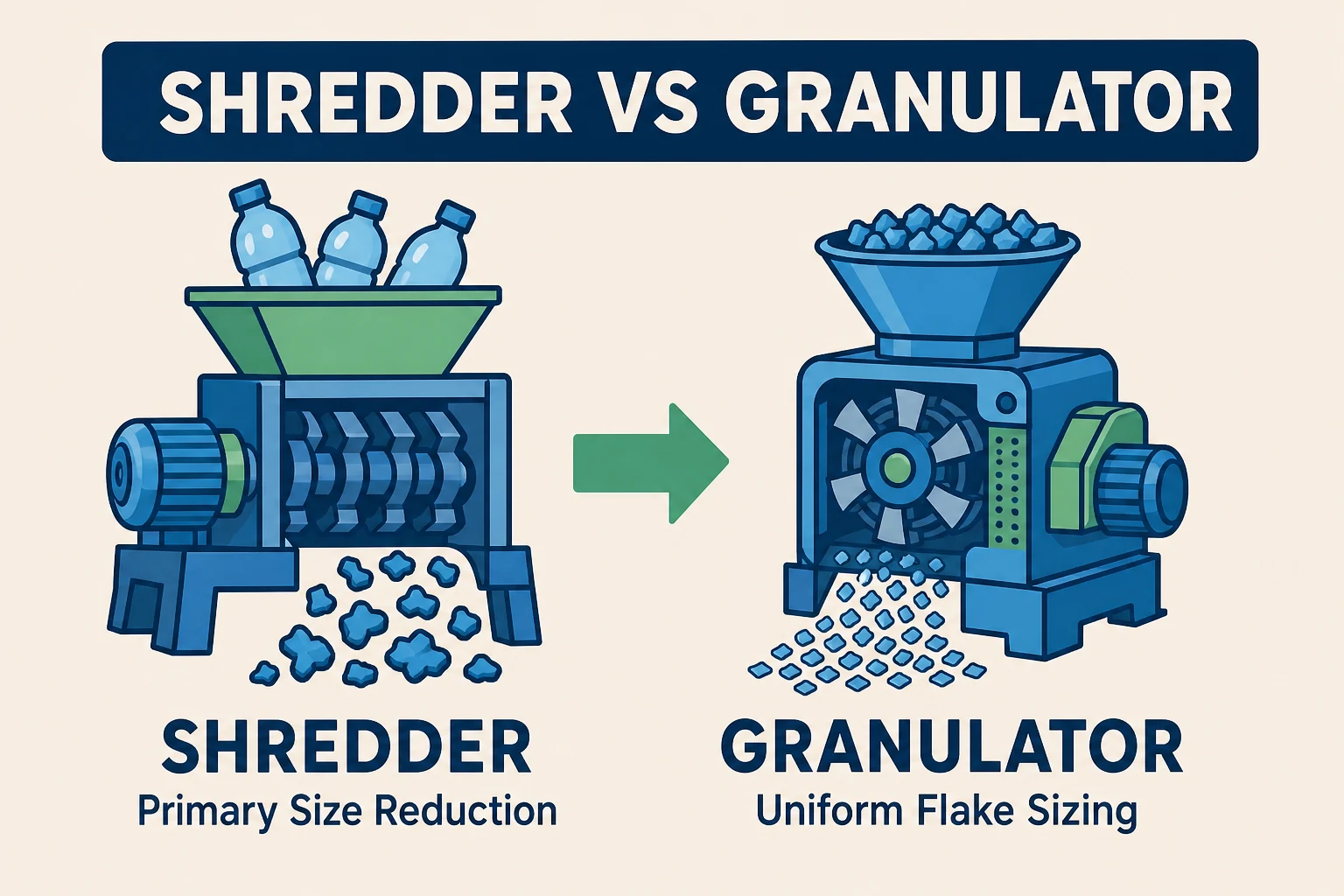
Shredders and granulators are both plastic size-reduction machines, but they are not interchangeable. A shredder is built to accept bulky, irregular, or difficult-to-feed scrap and reduce it into manageable pieces. A granulator uses faster knife action and a sizing screen to produce smaller, more uniform regrind.
The practical shredder vs. granulator decision starts with three questions: What does the material look like at the infeed? What particle size must leave the machine? And what will happen downstream? Choosing by motor power or machine name alone often leads to unstable feeding, excessive knife wear, or an output that does not suit the washing line.
This guide explains the mechanical differences, when one machine is enough, when a two-stage shredder–granulator line is justified, and where pelletizing fits afterward.
Quick answer: Choose a shredder for controlled primary reduction of bulky or irregular scrap. Choose a granulator for smaller, feedable material that must become uniform flakes or regrind. Use both when oversized input must be converted into a tightly controlled final particle size.
Shredder vs. Granulator: The Core Mechanical Difference
How a plastic shredder works
에이 단일 샤프트 플라스틱 파쇄기 normally uses a low-speed, high-torque rotor. A hydraulic pusher or controlled feeding system keeps bulky material in contact with the rotor cutters and counter knife. The machine repeatedly cuts the scrap until pieces are small enough to pass through its screen.
This design is well suited to items that are difficult to gravity-feed into a high-speed cutter, including:
- Plastic drums, pallets, crates, bumpers, and thick purgings
- Long pipes, profiles, sheets, and bulky molded parts
- Film, woven bags, fibers, and other flexible material when the rotor is designed for them
- Mixed shapes or baled scrap that require controlled feeding
Shredder output is usually a coarse, screen-controlled chip. The exact size depends on rotor geometry, screen opening, material behavior, and throughput target; it should not be treated as finished uniform regrind unless the application allows a coarse product.
플라스틱 그래뉼레이터 작동 원리
에이 플라스틱 분쇄기, also called a plastic crusher in many markets, uses a faster rotor fitted with knives. The rotor knives pass stationary bed knives with a controlled clearance, creating a repeated cutting or shearing action. Material remains in the chamber until it passes through the sizing screen.
Granulators are strongest when the feed can enter the cutting chamber consistently and the goal is smaller, more uniform flakes. Typical applications include bottles, small crates, injection-molding runners, pre-cut parts, and shredded rigid-plastic chips.
Terminology note: “Crusher” and “granulator” are often used interchangeably in plastics recycling. Compare the rotor speed, knife layout, feeding method, screen, and intended material—not only the name on the quotation.
Head-to-Head Comparison
| Selection factor | Plastic shredder | Plastic granulator / crusher |
|---|---|---|
| Primary role | Coarse reduction and feed stabilization | Fine sizing into more uniform flakes or regrind |
| Typical operating style | Lower speed, higher torque | Higher speed, precision knife clearance |
| 급송 | 수직으로 히드로릭 푸시어로 강제 공급됨 | 일반적으로 중력으로 공급되거나 보조됨 |
| 최적의 입력 | 불规则的, 장거리, 백화된, 공급이 어려운 스캔 | 작은, 일관된 재료가 안정적으로 캔버스에 들어감 |
| 일반적인 출력 | 초미세 칩, 일반적으로 수십 밀리미터 | 작은 스크린 제어된 파편, 일반적으로 6-20 mm |
| Output uniformity | 보통; 주로 원래 감소를 위해 목적됨 | 높음; 조절된 최종 크기에 목적됨 |
| 불规则的 고정 부품 | 최적의 맞춤 | 허프와 루터가 부품 크기에 맞게 설계되었을 때 가능 |
| 플라스틱 필름 | anti-wrapping film 루터와 잘 맞음 | 필름이나 습식 컷팅에 특별히 구성된 granulator가 필요 |
| 소음과 먼지 | 일반적으로 더 낮음, 더 느리게 컷팅하기 때문 | 일반적으로 더 높음, 더 빠르게 컷팅하고 더 작은 출력으로 인해 |
| 주요 경고 사항 | 루터 커터, 반대 날, 스크린, 푸시어 시스템 | 로터 키너, 베드 키너, 스크린, 베어링, 그리고 키너 Clearance |
| 표준 라인 위치 | 기본 크기 축소 | 세척, 분리, 재사용, 혹은挤出 전 최종 크기 조정 |
이 값들은 일반적인 기계 동작을 설명하지만, 대칭적인 규격은 아닙니다. 최종 선택은 가장 큰 입력 크기, 벽 두께, 포맨드, 오염, 목표 출력, 그리고 필요한 처리량에 기반해야 합니다.
잘못된 구매를 방지하는 다섯 가지 선택 규칙
규칙 1: 공급 지형에서 시작하지 않고 throughput로 시작하십시오
报价容量只有在机器可以持续接受材料时才有意义。 대형 공간 부분은 총 무게가 낮더라도 granulator 로터 위에 걸쳐질 수 있습니다. 장管的와 시트는 독립적인 수평이나 수직 공급 구성이 필요할 수 있습니다. 부피가 크고 불규칙한 공급은 일반적으로 shredder를 먼저 사용하는 것이 좋습니다.
작은 병, 런너, 캡, 그리고 미리 잘려진 고정 부품은 granulator에 직접 공급할 수 있습니다. 그런 경우, shredder를 추가하면 비용과 유지보수가 증가하지만 결과는 개선되지 않을 수 있습니다.
규칙 2: 기계 선택 전에 필요한 출력을 정의하십시오
목표가 저장, 운송, 혹은 제어된 운반을 위한 볼륨 감소만이 목표라면, 거친 shredder 출력이 충분할 수 있습니다. 재료가 세척 라인, 탱크, 중력 건조기, 배분 시스템, 혹은挤出기를 통과해야 한다면, 더 조이는 플라크 지형이 일반적으로 더 중요하며, granulator가 필요할 수 있습니다.
규칙 3: granulator를 공급 문제를 해결하는 데 강요하지 마십시오
granulator는 재료가 로터에 일정하게 도달할 때 최적의 성능을 발휘합니다. 과대 또는 불안정한 공급은 뛰어오르거나 걸쳐지고, 드라이브를 과부하시키고, 키너를 손상시킬 수 있습니다. shredder의 가치는 단순히 조각을 작은 것으로 만드는 것만이 아니라, 무작위 모양을 일정한 공급으로 변환하여 다음 기계가 예측 가능하게 처리할 수 있게 합니다.
규칙 4: 로터를 재료에 맞추십시오
고정된 HDPE, PP, ABS, 그리고 PVC 부품은 LDPE 필름, PP 라피아, 텍스터리 섬유, 혹은 라ubber와 같은 유연한 재료와 같은 방식으로 잘리지 않습니다. 유연한 재료는 일반적인 고속 로터에 둘러싸일 수 있지만, 이는 모든 granulator가 필름에 적합하지 않다는 의미는 아닙니다. 습식 granulator와 필름 특화 키너 구성은 올바르게 구성되면 유연한 스쳐를 처리할 수 있습니다.
공급자에게 실제 재료를 사용하여 시험을 요청하십시오, 가장 어려운 조각도 포함하여 - 단순하고 쉬운 샘플만이 아닙니다.
규칙 5: 오염을 보호 문제로 다루십시오
금속, 돌, 모래, 그리고 내장된 고정 장치는 키너의 수명을 단축시키고 심각한 손상을 유발할 수 있습니다. shredder는 일반적으로 granulator보다 어려운 공급을 더 용납할 수 있지만, 두 가지 기계는 금속 분리기로 다루어서는 안 됩니다.
적절한 마그넷, 금속 감지, 수동 분류, 혹은 오염물이 노출된 곳에 따른 하위 분리를 사용하여. 보호는 실제 오염 경로에 기반하여 설계되고, 손상에 가장 취약한 장비 이전에 배치되어야 합니다.
Shredder, Granulator, 혹은 둘 다 필요한가요?
granulator만 선택할 때:
- The incoming parts are small and consistent enough to feed without bridging
- You need uniform flakes for washing, blending, or direct internal reuse
- The feed is sorted and has a low risk of metal or abrasive contamination
- A beside-the-press unit can return clean runners directly to production
Choose a shredder alone when:
- The main goal is coarse volume reduction or controlled conveying
- The buyer accepts coarse chips rather than tightly sized flakes
- The material is bulky, irregular, long, flexible, or difficult to gravity-feed
- A downstream process can accept the shredder’s screened output
Choose a shredder plus granulator when:
- Input dimensions and shapes vary widely
- Large parts must become consistent flakes for washing or extrusion
- The granulator needs a stable, metered feed to maintain throughput
- You want independent control of primary reduction and final particle size
안 integrated shredder–granulator can combine both stages in a compact footprint. It can be attractive where floor space and internal conveying are limited. Separate machines offer more buffering, easier isolation for maintenance, and greater flexibility when feedstock or capacity changes.
Typical Plastic Recycling Line Configurations
Sorted bottles, small crates, and consistent rigid parts
Granulator → washing and separation → drying → reuse or extrusion
A granulator may be sufficient when parts fit the hopper and feed reliably. Add a shredder only if bales, oversized crates, or irregular items become part of the input stream.
Drums, pallets, bumpers, pipes, and thick purgings
Shredder → controlled transfer → granulator → washing or extrusion preparation
The shredder controls the difficult first cut. The granulator then produces the final flake size required by the next process.
Film, woven bags, raffia, and fibers
Film shredder or cutter-compactor → washing/drying as required → extrusion
Flexible materials need anti-wrapping rotors and stable feeding. A film-specific shredder is commonly used, while a wet or purpose-built granulator can be selected when smaller washed flakes are required. See the PE/PP 필름 파쇄기 for a dedicated flexible-material configuration.
Clean post-industrial runners and sprues
Beside-the-press granulator → direct controlled regrind return
Clean, single-polymer scrap may not require shredding, washing, or pelletizing. The acceptable regrind percentage depends on the product, molding process, contamination control, and quality specification.
pelletizing가 적용될 수 있는 부분
pelletizer는 shredder나 granulator의 대안이 아닙니다. 준비된 플라스틱을 녹이고, 녹은 물질을 필터링하여volatile material을 degassing을 통해 제거하고,opolymers를 일관된 펠릿으로 자르는 downstream extrusion system입니다.
목표 제품이 일관된, 흐름이 가능한 펠릿이 필요하거나, melt filtration과 compounding이 품질 기준의 일부인 경우 펠릿화를 추가합니다. 고객이 씻은 flakes를 받아들이거나, clean regrind가 내부 과정으로 직접 돌아갈 수 있는 경우 불필요할 수 있습니다.
pelletizing는 정리, 씻기, 건조를 대체하지 않습니다. non-melting solids는 적절한 melt filtration을 통해 포착될 수 있으며,volatile moisture나 gases는 배기로 통해 감소할 수 있지만, 불일치하는 polymers와 중한 오염은 여전히 상류에서 제어되어야 합니다. 전체 downstream 과정은 다음과 같습니다. plastic pelletizing 가이드.
유지보수 및 운영 비용 차이
| 유지보수 영역 | 파쇄기 | 그래뉼레이터 |
|---|---|---|
| 칼 상태 | 커팅 칼 가장자리, counter knife, fasteners, 및 rotor pockets를 검사 | 지정된 clearance로 날카로운 rotor와 bed 칼을 유지 |
| 스크린 | 파손, 튼화, 및 막힌 개구부를 검사 | 파손, 튼화, 열 축적, 및 과도한 fines를 검사 |
| Drive system | 기어박스, 토크 부하, 베어링, 및 힌지를 모니터링 | belt나 coupling, 베어링, 진동, 및 모터 부하를 모니터링 |
| 둔한 칼의 영향 | 저 출력, 높은 토크, 열, 불규칙한 출력 | 더 많은 fines, 열, 소음, 전력 요구, 및 나쁜 flake 품질 |
| 오염 감도 | Moderate, depending on cutter design | High because fast knife impacts can cause severe damage |
Do not choose sharpening intervals from a generic hour figure. Polymer type, fillers, sand, glass fiber, metal contamination, knife steel, rotor speed, and target particle size can change wear rates dramatically. Track motor load, output quality, knife clearance, and tons processed to build a maintenance interval from actual plant data.
안전 및 위험 관리
Both machines contain rotating cutters and stored mechanical energy. Equipment selection should include guarding, interlocked access, safe feeding, emergency stops, dust control, noise control, and documented lockout/tagout procedures.
- Guarding: Prevent access to cutters, drives, conveyors, and discharge points. Review OSHA machine-guarding guidance for US installations.
- Energy isolation: Lock out electrical, hydraulic, pneumatic, and stored rotational energy before clearing jams or servicing knives. See OSHA 잠금/태그아웃 지침.
- 소음: High-speed granulators commonly require stronger acoustic controls and hearing protection than low-speed shredders.
- Dust and fines: Provide extraction and housekeeping appropriate to the polymer, additives, and particle-size distribution.
What to Include in Your RFQ
A useful quotation needs more than “plastic shredder” or “plastic crusher.” Send the supplier:
- Polymer and product type: PP crates, HDPE drums, PVC pipe, ABS housings, LDPE film, and so on
- Maximum dimensions and wall thickness: Include photographs and the largest difficult item
- Feed condition: Loose, baled, nested, wet, dusty, hot, or cold
- 오염: Metal inserts, sand, stones, labels, moisture, and mixed polymers
- Target output: Maximum chip size or required flake-size range
- Throughput and duty cycle: kg/h, hours per day, and peak loading pattern
- Downstream process: Conveying, washing, separation, drying, direct reuse, or extrusion
- Site limits: Available power, footprint, headroom, dust collection, and noise requirements
Ask for a material trial when feed behavior is uncertain. A short test with representative scrap can reveal bridging, wrapping, fines generation, temperature rise, and realistic throughput before the equipment is ordered.
자주 묻는 질문
파쇄기와 그레뉼레이터의 주요 차이점은 무엇인가요?
A shredder provides low-speed, high-torque primary reduction for bulky or difficult-to-feed scrap. A granulator uses faster precision knife cutting and a sizing screen to produce smaller, more uniform flakes.
플라스틱 파이프를 쪼개는 것을 건너뛰고 직접 granulator에 고정 부품을 넣을 수 있나요?
Yes, when the parts fit the hopper, feed consistently, and remain within the granulator’s approved size and wall-thickness range. Large, hollow, thick, or irregular parts usually benefit from shredding first.
제가 항상 써드러와 그란ولا터를 모두 필요하나요?
No. 한 개의 granulator만으로도 일관된 작은 부품에 적합하며, shredder만으로도 두터운 볼륨 감소에 적합합니다. 두 단계는 큰 입력이 씻기, 분리, extrusion에 필요한 긴밀하게 크기 조절된 깃털로 변할 때 의미가 있습니다.
플라스틱 필름을 granulator가 처리할 수 있나요?
일반적인 고정형 플라스틱 그란ولا이저는 필름에 걸리거나 막힐 수 있습니다. 습식 그란ولا이저나 필름 특수 루터와 피드 시스템은 올바르게 구성되면 유연한 재료를 처리할 수 있습니다. 재료 검사는 권장됩니다.
출력 크기는 어떻게 요청해야 하나요?
Specify the size required by the next process. Coarse chips may be sufficient for transport or controlled feeding; washing, separation, drying, and extrusion often require smaller and more consistent flakes. Confirm the acceptable range with the downstream equipment supplier.
pelletizer가 shredder나 granulator와 어떻게 다릅니다?
pelletizer는 사이즈를 줄이는 대안이 아니라 하류 열 extrusion 시스템입니다. 준비된 플라스틱을 녹이고 설정에 따라 녹이를 필터링하고 탈가스한 후 일관된 펠릿으로 자릅니다.
Choose the Machine by Material Flow
The correct shredder vs. granulator decision follows the material through the plant: input geometry determines feeding, the next process determines output size, and contamination determines the protection system. A granulator is not automatically a “smaller shredder,” and a shredder is not automatically required before every granulator.
Need a line recommendation? Send Energycle your polymer, part photographs, maximum dimensions, contamination profile, target output size, and throughput. Our engineers can recommend a shredder, granulator, integrated system, or two-stage layout based on the actual material.
