

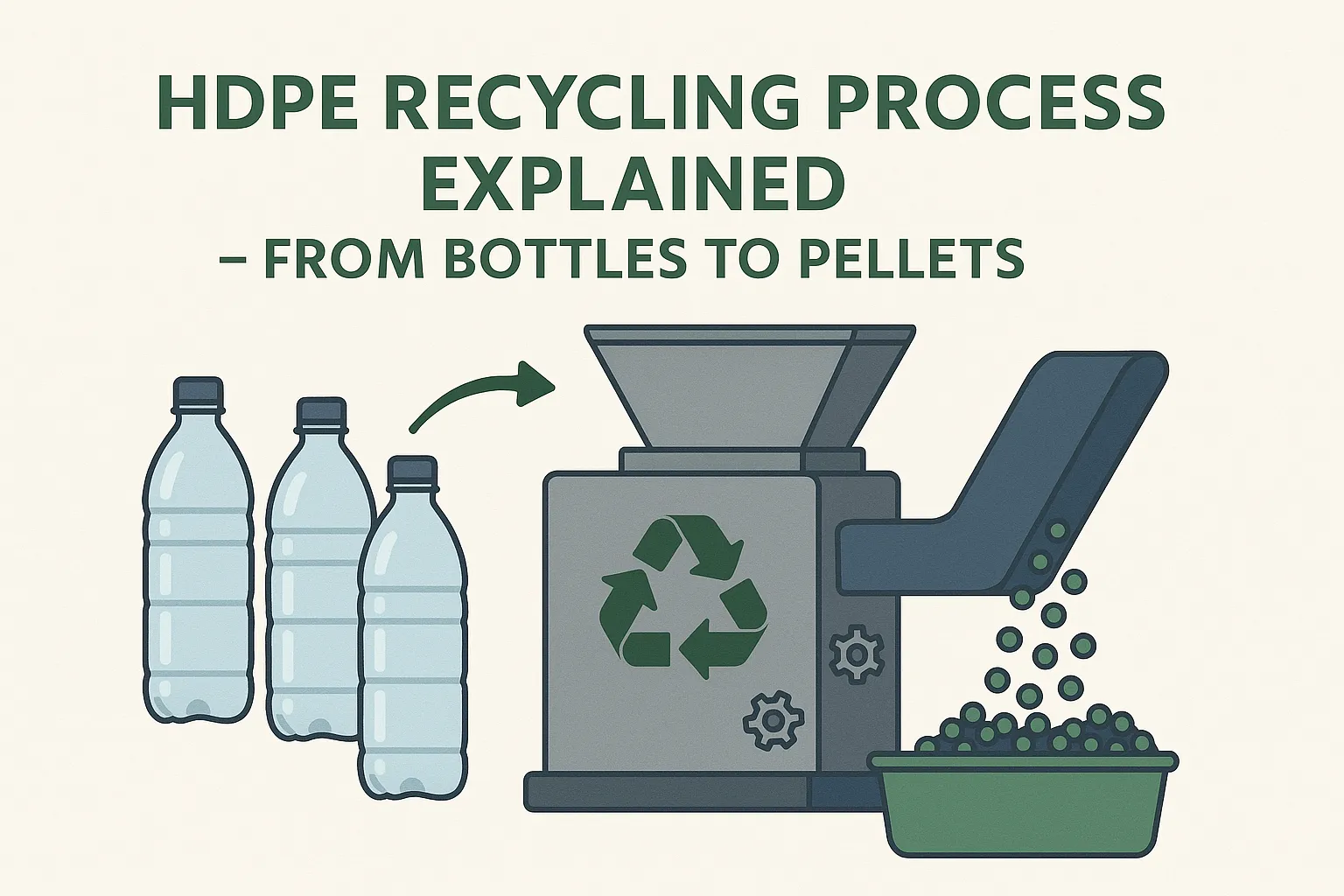
The HDPE recycling process converts sorted high-density polyethylene containers and rigid scrap into washed flakes or recycled pellets. A reliable line depends on feedstock control, staged contaminant removal and an output specification agreed with the buyer. Nominal throughput, purity and moisture figures are not meaningful unless the supplier also states the test material, sampling point and operating conditions.
What enters an HDPE recycling line?
Common feedstocks include milk and detergent bottles, household chemical containers, crates, drums, pipe scrap and production offcuts. These materials may share the HDPE resin family, but they can differ in colour, melt flow, additives, previous contents and contamination. Natural bottle-grade material is therefore often separated from coloured or mixed rigid HDPE when the downstream market requires a consistent product.
Packaging design affects the recycling process before equipment selection begins. Labels, closures, barrier layers, adhesives, inks and metal components can change sorting and washing performance. The Association of Plastic Recyclers maintains separate design guidance for natural HDPE rigid packaging 그리고 coloured HDPE rigid packaging.
HDPE recycling process: eight practical stages
- Receiving and inspection: document bale or loose-feed composition, moisture, dirt, metals, non-HDPE plastics and any containers that need special handling.
- Opening and controlled feeding: loosen compacted material and meter it onto a conveyor so operators and automatic sorters can see individual items.
- 정렬: remove metals, paper, film, PET, PVC, polypropylene and unsuitable coloured or multilayer articles. Optical sorting may support this stage, but the selected sensors and quality-control plan must match the stream.
- Size reduction: shred or granulate rigid articles into a form that the washing and separation equipment can handle consistently. Thick pipe or crates may need a different first-stage machine from thin-wall bottles.
- 세탁: use prewashing, friction washing, rinsing and controlled chemistry as required by dirt, product residue, labels and adhesive. Hot washing is an option for defined contamination, not a universal requirement.
- Density and other separation: float-sink equipment can separate floating polyolefins from denser contaminants. It cannot distinguish every PP/HDPE mixture or remove bonded layers, so upstream sorting remains important.
- Dewatering and drying: remove free and surface water to the limit required by storage, extrusion and the downstream product. State the test method and sample location in any guarantee.
- Extrusion, filtration and pelletizing: melt, homogenize, degas and filter the prepared material, then form pellets with a method suited to the polymer and planned production rate.
Equipment selection by process function
| Process function | 일반적인 장비 | Main selection question |
|---|---|---|
| Feed preparation | Debaler, conveyor, manual sorting station | Are the bales stable, traceable and safe to open? |
| Foreign-material removal | Magnet, eddy-current or optical sorter, inspection conveyor | Which contaminants must be removed before cutting? |
| 크기 감소 | Shredder, granulator or staged combination | What are the largest dimensions, wall thickness and required flake size? |
| Surface cleaning | Prewasher, friction washer, optional controlled hot wash | Which residue, adhesive and dirt must the wash remove? |
| 비중 분리 | 싱크-플로트 분리 탱크 | Which polymers and heavy contaminants are present, and where do they report? |
| Water removal | Centrifugal dryer, air or thermal drying where justified | What moisture limit does the next process require, and how will it be measured? |
| Melt preparation | 엑스트루더, 배기, 융해 필터 및 펠릿화기 | What melt flow, filtration and pellet form does the buyer require? |
Washing and separation decisions
Washing intensity should follow measured contamination. Clean post-industrial scrap may need limited cleaning, while post-consumer containers can require product-residue removal, label separation and repeated rinsing. Chemical concentration, water temperature and residence time should be set by trials and monitored because they affect operating cost, wastewater and material quality.
HDPE generally floats in water, which supports separation from denser PET, PVC, metals, glass and grit. However, polypropylene also floats, and filled or composite HDPE articles may behave differently. A float-sink tank is therefore one part of a separation system rather than proof of a universal purity level. A complete line layout is shown on our HDPE bottle recycling line 페이지.
Drying, extrusion and pelletizing
Mechanical dewatering should remove as much free water as practical before any heated stage. The final drying duty depends on flake geometry, storage time, ambient conditions and the extruder. Instead of accepting a generic moisture claim, agree on a test procedure, representative feedstock and the point where samples will be taken.
During extrusion, temperature profile, screw design, venting and melt filtration must match the contamination and melt-flow range. Strand and die-face systems can both pelletize recycled HDPE; the choice depends on throughput, melt stability, water handling, maintenance and preferred pellet form. See our overview of 플라스틱 펠릿화 시스템.
Quality checks for washed flake and pellets
| 확인하다 | What it reveals | Why buyers specify it |
|---|---|---|
| Polymer composition | HDPE consistency and incompatible-plastic contamination | Protects processing stability and mechanical performance. |
| Melt mass-flow rate | Flow behaviour under a stated test condition | Helps match material to blow moulding, injection moulding, pipe or other routes. |
| Density and ash | Polymer grade, fillers and inorganic contamination | Supports formulation and lot-to-lot control. |
| 수분 | Water present at the agreed sampling point | Reduces feeding, venting and storage problems. |
| Colour and odour | Source mix, thermal history and residual contamination | Determines the products and colours the recyclate can enter. |
| Metal and visible contamination | Sorting, washing and filtration performance | Protects downstream equipment and product appearance. |
Food-contact claims require a separate review
A standard HDPE washing and pelletizing line does not automatically produce food-contact material. The intended use, source control, collection system, decontamination process, challenge testing and jurisdiction all matter. In the United States, the FDA publishes chemistry guidance for recycled plastics in food packaging. Project owners should obtain regulatory advice and validate the specific process instead of treating a wash temperature as approval.
자주 묻는 질문
혼합색 HDPE가 함께 재활용될 수 있나요?
특정 혼합색상 제품으로 처리될 수 있지만, 일반적으로 자연색이나 엄격히 제어된 색상 기준을 충족시키기 어렵습니다. 투자 전에 목표 시장에 따라 색상을 정리하세요.
스inking-floating separation이 모든 non-HDPE 플라스틱을 제거할 수 있나요?
아니요. 선택된 액체 밀도에서 다른 성질을 보이는 재료를 제거합니다만, 폴리프로필렌이 HDPE와 함께 부는 경우나 결합이나 채색된 구조는 예상치 못한 행동을 보일 수 있습니다. 원재료 관리, 정리 및 품질 검사도 사용하세요.
Should every HDPE line include pelletizing?
No. Some buyers accept clean, specified flake, while other applications require filtered and compounded pellets. Choose the endpoint from customer requirements and economics rather than adding extrusion automatically.
Plan the line around a written output specification
Provide representative HDPE samples, contamination data, required saleable output, quality limits, utilities and site constraints before requesting a proposal. Energycle can then map the necessary sorting, washing, separation, drying and pelletizing stages without relying on unsupported universal performance or payback claims.
