

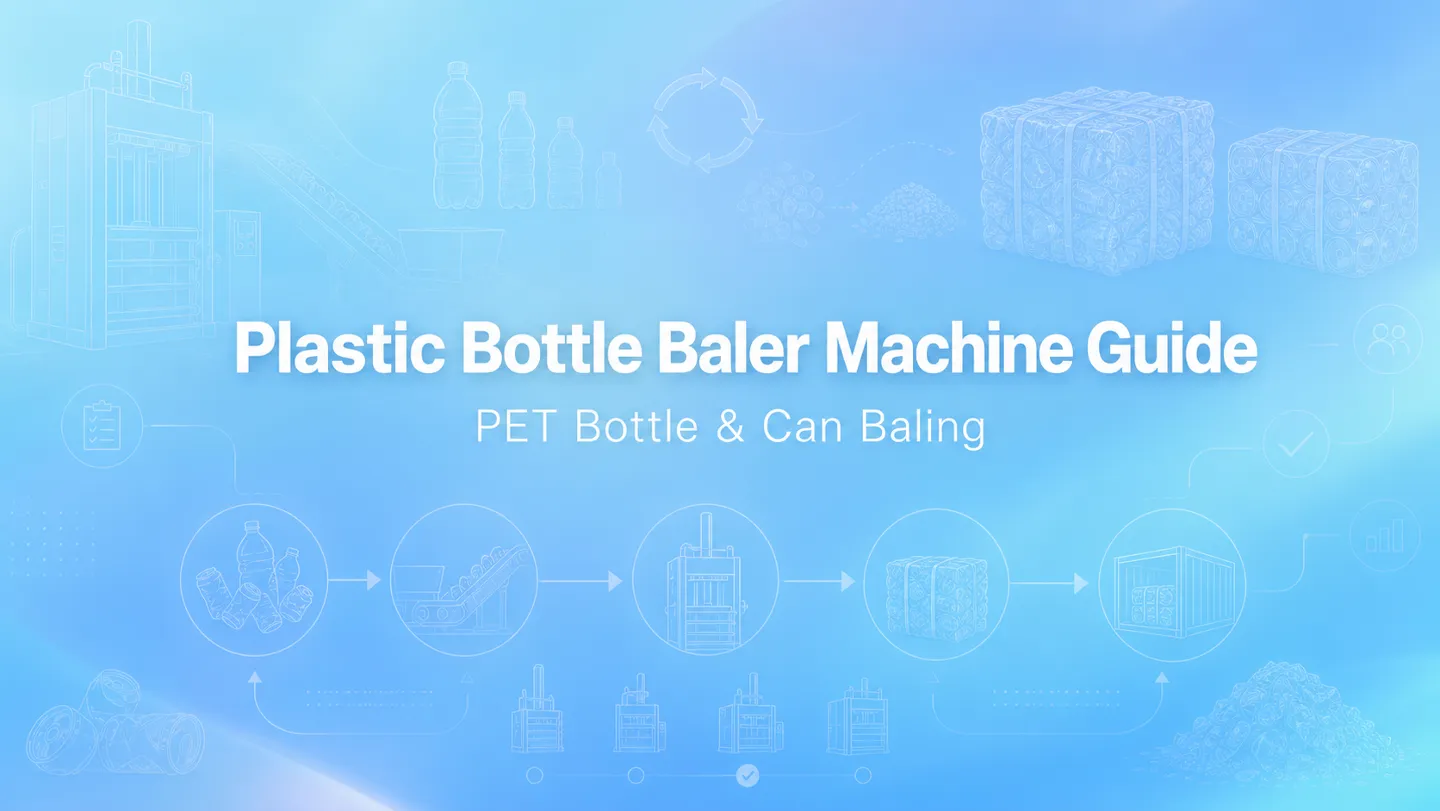
에이 plastic bottle baler machine compresses loose PET bottles, beverage containers, and aluminum cans into dense bales for easier storage, handling, sale, and transport. For recycling centers, beverage plants, MRFs, supermarkets, hotels, schools, and bottle collection sites, the right PET bottle baler can reduce bulky waste volume and make recyclable material easier to move through the recycling chain.
This guide explains how to choose a plastic bottle baler machine for PET bottles and cans by material, daily volume, automation level, bale size, bottle perforation needs, floor space, and ROI. If you are comparing broader baler options, also see our industrial baler machine range 그리고 hydraulic baler machine guide.
What Is a Plastic Bottle Baler Machine?
A plastic bottle baler machine is a hydraulic compression machine designed to press loose bottles and cans into compact bales. Instead of storing high-volume, low-weight bottles in bags or cages, operators feed the material into a chamber, compress it with hydraulic pressure, tie the bale with wire or straps, and move the finished bale with a pallet jack or forklift.
Common materials include PET beverage bottles, HDPE containers, plastic packaging, aluminum cans, and mixed lightweight recyclables. For facilities that mainly handle bottles and cans, a dedicated PET bottle and can baler helps improve bale stability and transport efficiency.
Why PET Bottles Need Specialized Baling
PET bottles are different from cardboard or paper because they are light, bulky, elastic, and often air-filled. If bottles are sealed or not flattened, they can rebound after compression and reduce final bale density. This is why PET bottle baling should consider press force, chamber design, feeding method, tying strength, and whether a bottle perforator or pre-crusher is needed.
- Air pockets: capped or sealed bottles trap air and resist compression.
- Spring-back: PET can rebound if the bale is not compressed and tied correctly.
- Low bulk density: loose bottles occupy large storage and transport volume.
- Mixed materials: many sites also process cans, HDPE bottles, film, or cardboard.
Main Types of PET Bottle Baling Machines
The best machine depends on your bottle volume, labor availability, and target bale output. In general, lower-volume sites use compact vertical balers, while recycling plants and high-volume collection centers use horizontal or automatic systems.
| 유형 | 가장 적합한 | Typical Feeding | 주요 장점 |
|---|---|---|---|
| Vertical PET bottle baler | Small collection sites, retail, hotels, schools | Manual feeding | Compact footprint and lower entry cost |
| 반자동 수평형 베일러 | Medium-volume recyclers and warehouses | Manual, conveyor, or loader feeding | Higher throughput with manageable investment |
| Fully automatic horizontal baler | MRFs, recycling plants, beverage factories | Conveyor feeding | Continuous operation and lower labor cost |
| Bottle and can baler | PET bottles, aluminum cans, beverage containers | Manual or conveyor feeding | Designed for lightweight recyclable containers |
Vertical vs Horizontal Plastic Bottle Baler
| 요인 | Vertical PET Bottle Baler | Horizontal PET Bottle Baler |
|---|---|---|
| Suitable volume | Low to medium | Medium to high |
| 지면 공간 | 콤팩트 | Larger layout, often with conveyor |
| Labor requirement | Higher manual labor | Lower labor when automated |
| 처리량 | Batch operation | Continuous or semi-continuous operation |
| Bale density | 보통의 | Higher and more consistent |
| Best users | Retailers, hotels, campuses, small collection points | Recycling centers, MRFs, bottle processors, factories |
| 투자 | 초기 비용 절감 | Higher investment but stronger ROI at volume |
If your site handles continuous bottle flow or wants to reduce manual feeding, a fully automatic horizontal hydraulic baler may be a better long-term choice. For medium-volume sites that want horizontal compression without full automation, an open gate semi-automatic horizontal baler can be a practical option.
Do PET Bottles Need to Be Perforated Before Baling?
For high-volume PET bottle recycling, a bottle perforator or pre-crusher is often recommended. Perforation releases trapped air, helps bottles collapse faster, improves bale density, reduces rebound, and makes the bale easier to tie. Low-volume operations may bale empty bottles directly, but sealed or capped bottles usually produce better results after perforation.
How to Choose by Material and Daily Volume
| 애플리케이션 | Recommended Configuration | 왜 |
|---|---|---|
| Small retail or hotel bottle waste | Vertical bottle baler | Compact, lower cost, suitable for batch handling |
| Community collection center | 반자동 수평형 베일러 | Handles higher daily volume with stronger bale output |
| PET bottle recycling plant | Horizontal baler with conveyor and perforator | Improves throughput, density, and labor efficiency |
| Beverage factory or MRF | Automatic PET bottle and can baling line | Supports continuous feeding and consistent bale quality |
| Mixed bottles, cans, paper, and packaging | Custom industrial baler selection | Machine should match material mix, bale target, and workflow |
Technical Specifications to Compare
Before requesting a quotation, compare more than machine price. Key specifications include press force, feed opening size, chamber size, bale size, bale weight, motor power, cycle time, tying method, control system, and machine dimensions. For PET bottles and cans, also ask whether the baler can be configured with a conveyor, perforator, safety guards, and local power supply.
Plastic Bottle Baler Price and ROI Factors
The price of a plastic bottle baler machine depends on size, hydraulic press force, automation level, feeding method, bale output, and optional equipment. A vertical baler is usually less expensive upfront, while a horizontal or automatic PET bottle baler can deliver better ROI when bottle volume, labor cost, and transport savings are high.
- Storage savings: compacted bales occupy far less space than loose bottles.
- Transport savings: higher bale density improves truck or container loading.
- Labor savings: conveyor feeding and automatic cycles reduce manual handling.
- Material value: clean, dense, stable PET bales are easier to sell and move.
- Workflow efficiency: organized bales improve site housekeeping and safety.
PET Bottle Baling Workflow
- Collect loose bottles or cans from the facility.
- Sort by material where required.
- Remove contaminants and drain liquids.
- Perforate or pre-crush bottles when higher density is needed.
- Feed material into the baler chamber or conveyor.
- Compress using hydraulic pressure.
- Tie the bale with wire or straps.
- Store, load, and transport the finished bales.
Common Buying Mistakes to Avoid
- Choosing only by price without calculating labor and transport savings.
- Ignoring bottle rebound and the need for perforation.
- Underestimating daily loose bottle volume.
- Selecting a bale size that does not match downstream buyers or container loading.
- Forgetting floor space, ceiling height, forklift access, and power supply.
- Buying a manual machine when conveyor feeding would reduce long-term labor cost.
Request a Custom PET Bottle Baler Recommendation
Energycle can recommend a suitable plastic bottle baler machine based on your material type, loose bottle volume, target bale size, power supply, available space, and automation requirements. For broader applications such as paper, cardboard, and mixed recyclables, compare related industrial baler machines or review our 폐지 포장기 options.
FAQ: Plastic Bottle Baler Machines
What is a plastic bottle baler machine?
A plastic bottle baler machine compresses loose PET bottles, beverage containers, and sometimes aluminum cans into dense, tied bales so they take less space and are easier to store, load, sell, and transport.
PET병을 압축하거나 구멍을 뚫지 않고 박스에 넣을 수 있나요?
Empty PET bottles can be baled directly in some low-volume operations, but perforating or pre-crushing helps release trapped air, improves bale density, reduces spring-back, and creates more stable bales.
Do I need a vertical or horizontal PET bottle baler?
직립식 PET 병 박스기는 공간이 제한적이고 수동으로 공급하는 저용량 사이트에 적합합니다. 수평식 PET 병 박스기는 재활용 센터, MRF, 음료 공장, 고용량 운영이 필요한 곳에 더 적합합니다. 이는 콘베이어 공급과 일관된 박스 출력이 필요하기 때문입니다.
일반 박스기가 플라스틱 병과 알루미늄 캔을 모두 다룰 수 있나요?
네, 많은 병과 캔 밀러가 압력력, 챔버 크기, 묶는 방법, 공급 구성이 재료 혼합에 맞을 때 PET 병과 알루미늄 캔을 처리할 수 있습니다.
플라스틱 복합기 가격에 영향을 미치는 요인은 무엇인가요?
Price depends on press force, automation level, feeding method, chamber size, bale size, motor power, conveyor or perforator options, control system, customization, and shipping requirements.
What information is needed for a PET bottle baler quotation?
Provide your material type, loose bottle volume per day or hour, bottle condition, target bale size and weight, available floor space, power supply, labor arrangement, and whether you need a conveyor or bottle perforator.
