

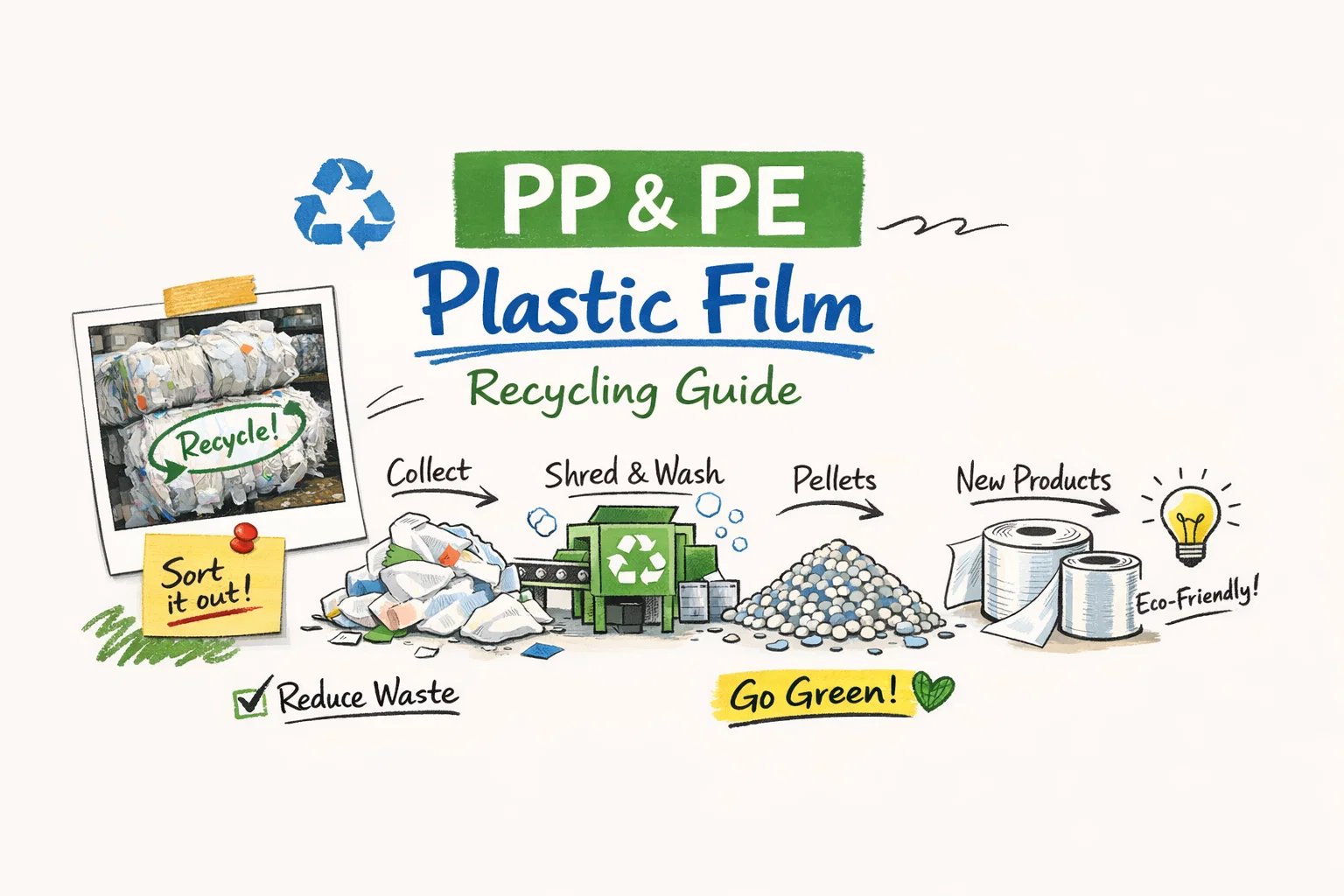
Plastic film made from PP (polypropylene) and PE (polyethylene) is one of the most difficult plastic waste streams to recycle efficiently. Although widely used in packaging, agriculture, and industrial applications, plastic film presents unique processing challenges that require a well-designed recycling approach.
This guide explains how PP/PE plastic film recycling works, the most common technical challenges, and how shredding and densifying fit into a modern recycling process, helping recycling operators, engineers, and investors make informed decisions before selecting equipment.
Why Is PP & PE Plastic Film Recycling So Challenging?
Compared with rigid plastics, plastic film behaves very differently during processing. The main difficulties include:
- Low bulk density
Film occupies large volumes, making storage and feeding inefficient. - Severe tangling and wrapping
Film easily wraps around shafts, rotors, and conveyors, causing blockages and downtime. - High moisture retention
After washing, thin film holds water on its surface, increasing drying difficulty. - Unstable feeding to downstream machines
Loose film cannot be fed consistently into extruders or pelletizers.
Because of these characteristics, plastic film recycling requires more than just basic shredding—it needs a process-oriented system design.
Standard PP & PE Plastic Film Recycling Process
Most industrial recycling plants follow a structured process to handle plastic film efficiently:
Sorting → Shredding → Washing → Dewatering → Densifying → Reprocessing
Each stage plays a specific role in stabilizing material flow and improving output quality.
The Role of Shredding in Plastic Film Recycling
Shredding is the first critical step in film size reduction. Unlike rigid plastics, film cannot be processed efficiently with standard crushers.
A properly designed plastic film shredder helps to:
- Reduce film into manageable pieces
- Prevent wrapping and bridging
- Enable uniform washing and dewatering
- Stabilize material flow between process stages
However, shredding alone does not solve the core problems of low density and unstable feeding.
Why Densifying Is Essential for Plastic Film
Densifying is the step that transforms loose, fluffy film into compact, high-density material.
A densifier typically uses controlled heat and mechanical force to:
- Increase bulk density dramatically
- Remove residual moisture
- Convert film flakes into agglomerated material
- Ensure consistent feeding into extruders or pelletizers
Without densifying, many recycling lines struggle with feeding instability, poor pellet quality, and reduced throughput.
Shredding vs. Densifying: Different Functions, One Workflow
| Process | Primary Function | Problem Solved |
|---|---|---|
| Shredding | Size reduction | Tangling, blockages |
| Densifying | Density increase | Feeding instability, moisture |
In practical recycling operations, shredding and densifying are complementary, not interchangeable. Together, they create a stable and efficient workflow for plastic film recycling.
For facilities that require continuous processing and stable output, an PP/PE plastic film shredding and densifying line can significantly improve operational efficiency.
You can see a typical system configuration here:
When Do You Need a Shredding and Densifying Line?
Not every recycling operation requires a full integrated line. The decision depends on material conditions and production goals.
You likely need shredding + densifying if:
- You process post-consumer PP/PE film with high moisture
- Your output feeds directly into pelletizing or extrusion
- You require continuous, automated operation
- You want to reduce storage volume and improve logistics
You may not need it if:
- Processing volumes are very small
- Film is pre-compacted or pre-agglomerated
- Material is used for low-demand applications
Common Mistakes in Plastic Film Recycling System Selection
Many recycling plants experience performance issues due to incorrect assumptions during equipment selection:
- Choosing rigid plastic crushers for film materials
- Focusing only on throughput, not moisture control
- Ignoring the role of densifying before pelletizing
- Underestimating film wrapping and feeding challenges
Avoiding these mistakes at the planning stage can save significant cost and downtime later.
From Process Understanding to Equipment Selection
Successful plastic film recycling starts with understanding the material, not buying machines first.
Before selecting equipment, clearly define:
- Film type (PP, LDPE, HDPE, mixed film)
- Contamination level and moisture content
- Target throughput and final application
- Degree of automation required
Once these factors are clear, selecting a suitable shredding and densifying solution becomes a logical next step rather than a guess.
The sections below go deeper into specifying, costing, and de-risking a PP/PE film shredding and densifying line.
Decision Framework: How to Specify a Film Shredding & Densifying Line
A three-axis decision: throughput capacity, feedstock condition, and downstream output target. Lock all three before requesting equipment quotes.
Step 1: Match Capacity to Daily Throughput
Capacity is rated in kg/h. Convert annual feedstock tonnage to a capacity tier by dividing annual tons by 250 working days × 16 production hours (two-shift operation), plus 20% headroom for downtime and feedstock surge. A plant processing 4,000 t/year of post-consumer film needs 4,000,000 ÷ (250 × 16) × 1.2 = 1,200 kg/h, rounded up to a 1,500 kg/h tier.
Step 2: Match Configuration to Feedstock Condition
Film feedstock falls into three contamination grades. Clean post-industrial film (factory off-cuts, color-sorted) needs only the basic shredding plus densifying module — cold-wash optional. Post-consumer flexible packaging film (curbside collection, MRF output) needs full sink-float separation plus friction wash. Heavily contaminated agricultural film (mulch film with soil, irrigation tape with mineral residue) needs an extended pre-wash, double-pass friction washing, and frequently a second sink-float stage to handle the soil load.
Step 3: Match Output to Downstream Use
The next stage of the recycling chain dictates what densifier output works. In-house pelletizing needs densified flake at 0.30–0.45 g/cm³ bulk density and under 5% moisture — ready for direct extruder loading. Sale to a third-party pelletizer needs densified flake at 0.40–0.55 g/cm³ for transport efficiency and consistent buyer specs. Direct sale as densified regrind needs higher bulk density (0.50–0.65 g/cm³) plus tighter moisture control (under 3%) to meet end-buyer warehousing specs. Confirm the buyer or downstream extruder specification in writing before sizing the line.
Decision Matrix
| Capacity | Clean post-industrial → densified flake | Post-consumer → in-house pelletizing | Heavily contaminated → densified for sale |
|---|---|---|---|
| 500 kg/h | Compact line, basic wash | Standard line + sink-float | Extended pre-wash + double friction |
| 1,000 kg/h | Standard line, basic wash | Standard line + sink-float + dryer | Extended pre-wash + double friction + 2-stage sink-float |
| 2,000 kg/h | Standard high-throughput line | Standard line + 2-stage wash + dryer | Full configuration + closed-loop water |
| 3,000 kg/h | High-throughput line + buffer silo | Full configuration + buffer silo | Full configuration + closed-loop water + buffer silo |
Configurations show typical Energycle setups. Closed-loop water is recommended for higher-capacity lines or water-stressed regions and adds to CapEx depending on configuration.
Film Line Cost: What Drives 3-Year Total Cost of Ownership
Purchase price is only part of the picture. Power, water, labor, and consumables typically add up to more than the initial equipment cost over three years, so two quotes that look close on price can diverge once running costs are included.
The components that swing total cost the most are wet-granulator blade life and friction-washer screen replacement, both of which depend heavily on feedstock cleanliness. Larger lines also amortize labor and overhead better, which is why operators with steady high-volume feedstock usually favor higher-capacity configurations.
| Cost component | When it applies | Main driver |
|---|---|---|
| Equipment (CapEx) | One-time | Capacity tier and configuration |
| Power | Continuous | Installed kW and local electricity tariff |
| Water | Continuous | Wash configuration; much lower with a closed-loop system |
| Labor | Continuous | Operators per shift; scales with capacity tier |
| Maintenance | Recurring | Run hours and service discipline |
| Wet granulator blades | Recurring | Feedstock contamination and abrasiveness |
| Friction washer screens | Recurring | Dirt and grit load in the feed |
| Squeezer / densifier wear parts | Recurring | Throughput and material hardness |
Swipe to see the full table →
Per-ton processing cost typically falls as capacity rises, because labor and overhead are spread across more output. This is why operators with confirmed high-volume feedstock often favor larger lines despite the higher purchase price — the running-cost saving can offset the difference over the first couple of years. Exact figures depend on your tariffs, feedstock, and run hours, so treat any TCO model as project-specific.
Hidden Costs Most Quotes Skip
- Civil works: foundations, drainage pit, and dewatering trench — a meaningful share of equipment cost
- Closed-loop water treatment: often required in water-scarce regions and recommended at higher capacities
- Electrical incoming: transformer upgrade and cabling, especially for greenfield sites
- First-year spare parts kit: usually quoted separately
- Operator training: on-site commissioning and operator training during start-up
- Customs and import duty: varies by destination country
Output Quality: Defects by Film Feedstock Type
Output bulk density and moisture are direct functions of feedstock condition. Knowing which defects appear with which feedstock prevents finger-pointing between equipment supplier and operator after commissioning.
Pelletizers and end-buyers reject densified film batches for inconsistent moisture, inadequate bulk density, or visible contamination. Each feedstock type generates a distinctive defect signature that the line configuration can mitigate — but only if specified upfront.
| Feedstock condition | Most common defect | Root cause | Mitigation |
|---|---|---|---|
| Clean post-industrial film | Static cling, irregular flake size | Dry shredding without wet stage | Add light water spray during cutting |
| Mixed post-consumer (clear + colored) | Color contamination in densified output | No upstream color sorting | Pre-sort by color before shredding |
| Mixed post-consumer with paper labels | Paper fiber in densified flake | Friction wash insufficient for adhesive labels | Add hot wash or extended friction stage |
| Agricultural film (mulch, irrigation) | Sand and soil contamination | Sink-float tank under-sized for mineral load | Add pre-wash drum + 2-stage sink-float |
| Greenhouse film (UV-degraded) | Brittle flake, excess fines | Polymer chain scission from sun exposure | Cannot recover top grade — route to lower-spec end use |
| Bale stored wet for months | Fungal contamination, odor in densified output | Wet bale stored at high humidity | Reject feedstock or add an intensive wash stage |
Swipe to see the full table →
These defect signatures assume a properly sized line run within its rated capacity; pushing a line beyond its rated throughput introduces additional defects regardless of feedstock.
The most consequential defect is inconsistent moisture in densified output. Film fed to a pelletizer with excessive residual moisture causes melt-flow inconsistency and gel formation in the extruded pellet. Plants targeting in-house pelletizing should specify the squeeze-drying stage with closed-loop temperature control, plus a downstream thermal dryer to reach the low, consistent moisture that moisture-sensitive end-buyers require.
Regional Adaptations for Emerging Markets
Western film line specifications fail predictably in emerging-market sites. Five engineering choices matter most across SE Asia, MENA, Africa, and LATAM.
Voltage and Frequency
Standard configurations ship at 380V/50Hz (China, Vietnam, Indonesia), 415V/50Hz (UK, Pakistan, India, much of Africa), or 440V/60Hz (Saudi Arabia, parts of LATAM). Specifying the wrong voltage means the entire motor and switchgear set arrives unusable — weeks of rework plus extra shipping. Always confirm voltage in writing on the proforma invoice.
Water Scarcity and Closed-Loop Recycling
MENA, parts of Australia, and water-stressed African regions cannot reliably supply the fresh water a once-through wash consumes per ton of output. A closed-loop water recycling system — sedimentation, screen filter, biological treatment, sometimes ultrafiltration — recovers the bulk of process water and sharply reduces fresh-water demand. It adds CapEx but typically pays back quickly where fresh water is expensive or rationed.
Spare Part Logistics
Lead time on a replacement granulator blade or friction-washer screen from China to East Africa runs several weeks by sea plus customs clearance. Plants far from the supplier should carry a larger on-site spare-parts buffer covering many months of consumables. Plants closer to the supplier (Vietnam, Indonesia, Philippines) can run leaner inventory with shorter re-order cycles.
Climate and Dust
Film shredding and densifying generates fine plastic dust that settles inside electrical cabinets. Specify an IP55 enclosure rating for control cabinets in arid regions (MENA, Northern Africa, parts of LATAM). Tropical regions (Indonesia, Philippines, parts of Brazil) need dehumidification on PLC enclosures to prevent condensation-induced contactor failure.
Operator Language and Training
The PLC HMI ships in English by default. For plants where shift operators do not read English, request Spanish, Arabic, Bahasa, French, or Vietnamese localization at the order stage. Adding it after installation typically requires a controls-engineer site visit. A two-language HMI (English plus local) covers both expat managers and local operators.
8 Common Pitfalls When Buying a Film Shredding & Densifying Line
Eight buying mistakes account for the majority of post-installation regret. Use this list as a self-audit before signing any equipment purchase order.
- Sizing for nameplate capacity, not realistic throughput. Nameplate kg/h assumes ideal feedstock. Real-world throughput on dirty post-consumer film runs well below nameplate, so size comfortably above your annual tonnage target.
- Skipping the sink-float stage to save on CapEx. Without sink-float, mineral and metal contamination passes through to the densifier and then to the pelletizer, causing gel formation and screen blockage. Adding sink-float later typically costs far more than specifying it upfront.
- Mixing components from multiple suppliers. Throughput mismatch between a shredder and a densifier from different suppliers often surfaces months into operation, when the densifier runs starved or overloaded. Buy integrated, or secure a written commissioning bond covering throughput loss.
- No factory acceptance test with your actual feedstock. A factory acceptance test (FAT) at the supplier’s plant — running at production rate with your feedstock type — catches equipment defects before shipping. Skipping the FAT trades a small travel cost for a much longer site-commissioning recovery.
- Underspecifying the squeeze-drying stage. Output moisture that is too high gets the densified flake rejected by most pelletizer feed specs. Specify squeeze-drying capacity with headroom over throughput, plus a downstream thermal dryer for moisture-sensitive end-buyers.
- Trusting the FOB quote as total cost. Budget a meaningful allowance for civil works, electrical incoming, water treatment, customs duty, and first-year spares. The all-in number is what matters for ROI calculation.
- Inadequate operator training contract. Standard contracts include several days of on-site commissioning. Film lines take longer to stabilize than rigid-plastic lines because the feedstock is more variable. Negotiate a remote-support clause covering the months after start-up.
- Ignoring the wet granulator blade specification. Blade material — D2 tool steel vs SKD11 vs HVOF-coated — determines the maintenance interval. Higher-grade blades last considerably longer at a higher price and usually pay back on higher-capacity lines.
Conclusion
PP and PE plastic film recycling is technically demanding, but highly achievable with the right process design.
By combining effective shredding, proper washing, and controlled densifying, recyclers can transform problematic film waste into valuable raw material for reuse.
This guide provides the technical foundation needed to evaluate recycling solutions objectively—before moving on to detailed equipment specifications and system configurations.
