

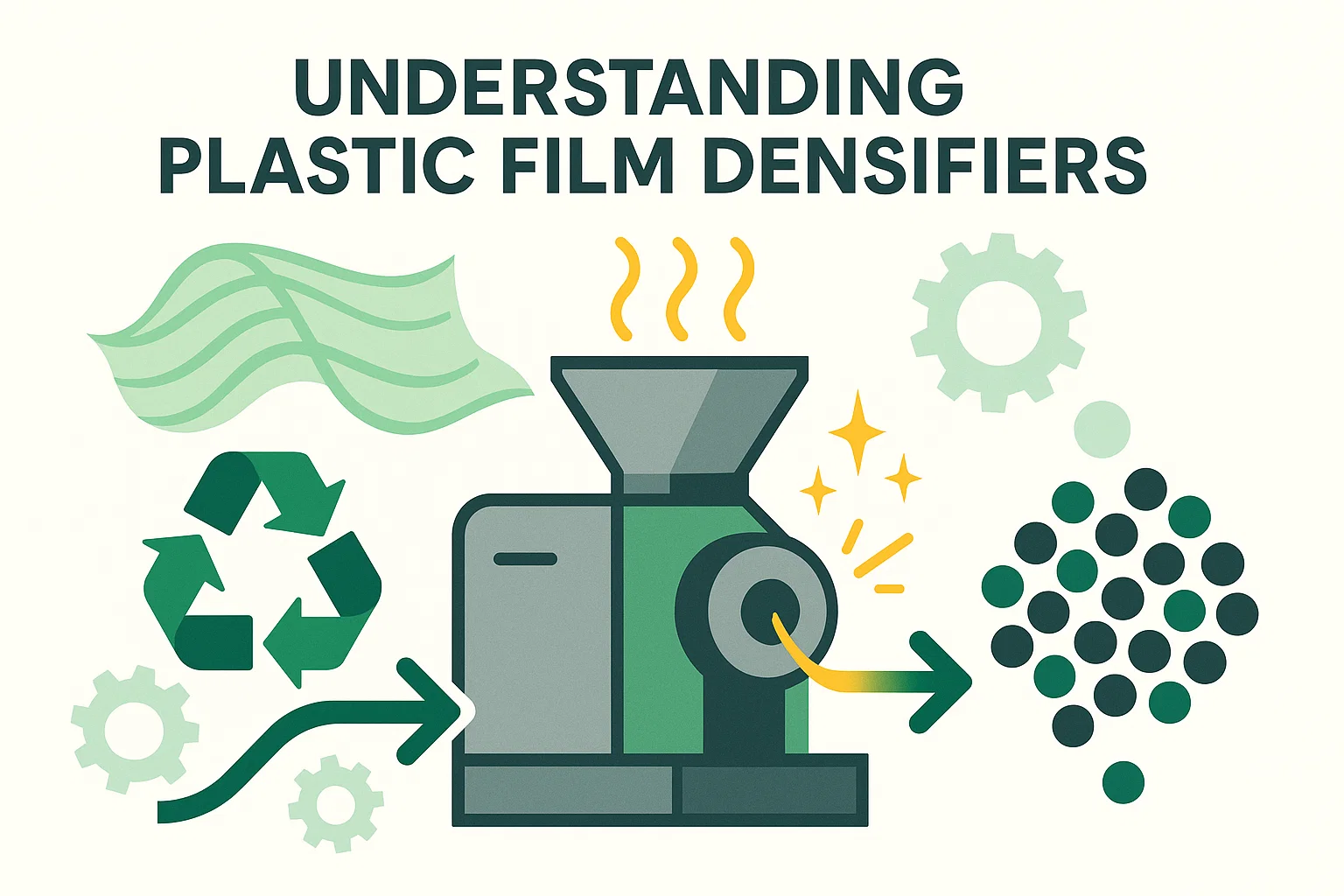
A plastic film densifier increases the bulk density of loose PE or PP film so it can be stored, conveyed and fed into downstream recycling equipment more consistently. “Densifier” is an umbrella term: suppliers may use it for a batch agglomerator, cutter-compactor, screw-press squeezer or another compaction system. These machines do not use the same mechanism or produce the same output.
Define the equipment type, feed condition and required discharge instead of selecting a machine from the word “densifier” alone.
Why lightweight film needs densification
Loose bags, packaging film and agricultural film have low and variable bulk density. They can bridge in hoppers, trap air, wrap around rotating parts and cause surging at an extruder. Washed film adds another issue: water occupies voids and makes feeding and melt processing less stable.
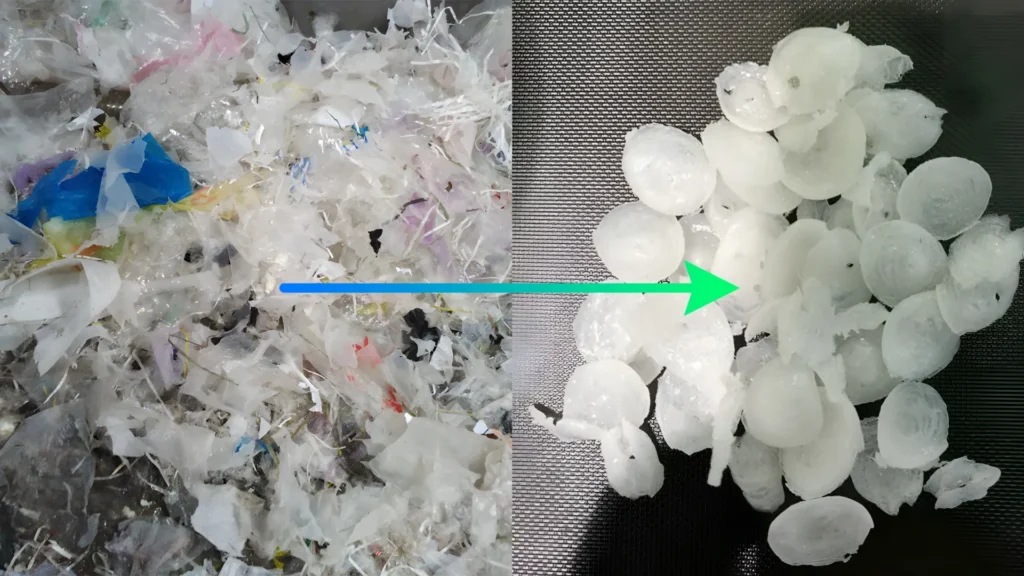
Densification can improve handling by reducing void space and creating a more uniform feed. It does not sort polymers, remove all contamination or automatically make saleable pellets. Those functions belong to the wider sorting, washing, drying, extrusion and quality-control process.
The main types of film densifier
| Equipment | Operating principle | Typical feed | Typical role |
|---|---|---|---|
| Batch agglomerator | High-speed cutting and friction heat, followed by controlled cooling | Relatively dry film, fibers and light regrind | Creates irregular, dense agglomerate |
| Cutter-compactor | Continuous cutting, heating and compaction ahead of an extruder | Dry or suitably prepared film scrap | Preconditions and force-feeds extrusion |
| Screw-press squeezer | Mechanical compression with water discharge and controlled heating | Washed wet PE/PP film | Dewaters and forms dense pieces for conveying or extrusion |
| Baler or cold compactor | Pressure without the same thermal conditioning | Loose dry film | Reduces handling volume for transport or storage |
These categories can overlap in commercial naming. Ask for a process drawing and a description of the discharge form before comparing quotations.
How an agglomerator or cutter-compactor works
- Metered feeding: film enters a cutting and mixing chamber at a controlled rate.
- Cutting and friction: rotating knives reduce the film and generate heat through mechanical work.
- Softening and compaction: the film contracts and combines into denser particles without following the same fully melted, filtered route as finished pellet extrusion.
- Cooling or continuous transfer: a batch unit discharges cooled agglomerate; an integrated cutter-compactor feeds conditioned material to an extruder.
Temperature, motor load, batch mass and cycle endpoint must match the polymer and machine. Excess heat can melt material onto the chamber or degrade it; insufficient conditioning leaves fluffy feed.
How a screw-press film squeezer works
- Wet film from the washing line is fed into the screw section.
- Compression expels free water through the designed drainage path.
- Mechanical work and controlled heat soften the film enough to form a denser discharge.
- The hot output is cut and conveyed to cooling, storage or a pelletizing line.
A squeezer combines mechanical dewatering and densification, but the achievable moisture and bulk density depend on polymer, film thickness, washing condition, contamination, feed stability and operating settings. Test representative material rather than relying on a universal percentage.
Practical benefits
More stable downstream feeding
Dense, controlled pieces contain less entrained air and generally feed more predictably than loose film. This can reduce bridging and surging when the receiving hopper, force feeder and extruder are designed for the discharge.
Combined dewatering and compaction
For washed PE or PP film, a screw-press squeezer can remove free water while increasing bulk density. It may reduce the load on a later thermal-drying stage, but the downstream moisture limit still has to be demonstrated.
Reduced handling volume
Densified material normally occupies less volume than loose film. The real storage or freight saving depends on the inlet and outlet bulk-density measurements, container loading method, transport distance and whether another handling step is introduced.
Better process integration
A correctly sized densifier can buffer variation between washing and extrusion. This benefit depends on controls, surge capacity and a balanced line; a large nameplate capacity does not correct an unstable upstream feed.
Suitable and unsuitable feedstocks
Common candidates include LDPE/LLDPE packaging film, HDPE bags, PP woven or nonwoven scrap, stretch film and selected agricultural film after sorting and cleaning. The exact material range depends on machine design.
Do not assume one setup can safely process PE, PP, PET fibers, PA and PVC together. Different polymers have different softening behavior and may be incompatible in the final melt. Metals, stones, glass, heavy paper, excessive sand and unknown multilayers should be controlled before densification. A densifier is not a polymer separator.
What to specify when selecting a densifier
- Polymer, film structure, print coverage, thickness range and source
- Input form, size, bulk density, moisture and contaminant profile
- Required hourly input under the stated feed condition
- Required discharge form, moisture and bulk-density test method
- Connection to washing, granulation, storage and pelletizing equipment
- Motor-load control, temperature monitoring and overload protection
- Knife, screw, barrel and screen materials and expected wear points
- Access for cleaning, changeover and lockout/tagout
- Utility demand measured at agreed operating conditions
- Acceptance test using representative production material
Capacity should be quoted with feed bulk density and moisture. A throughput measured on clean dry factory film is not directly transferable to dirty, wet agricultural film.
Densifier versus pelletizer
A densifier prepares material; a film pelletizing machine melts, homogenizes, vents, filters and cuts the polymer into pellets. Some integrated lines place a cutter-compactor directly before the extruder, so both functions appear in one system. Confirm whether the quotation includes melt filtration, degassing and final pellet cutting.
For washed film that needs dewatering, review the film squeezer dryer. For dry light scrap that needs batch conditioning, review the plastic film agglomerator. The detailed equipment comparison is covered in the agglomerator, compactor and screw-press densifier guide.
Commissioning checks
During an acceptance run, measure input mass and condition, stable throughput, discharge bulk density, moisture where relevant, motor load, temperature, stoppages and material loss. Then run the densified output through the intended downstream equipment and inspect pressure stability, filter loading and final product quality.
Calculate operating cost from the complete line and saleable yield. Avoid a quick return-on-investment claim based only on nominal volume reduction.
Frequently asked questions
Is a film densifier the same as an agglomerator?
Sometimes suppliers use the terms interchangeably, but “densifier” can also describe a cutter-compactor or screw-press squeezer. Confirm the operating mechanism and output.
Can a densifier process wet film?
A screw-press squeezer is designed for washed wet film. Many batch agglomerators and cutter-compactors require drier, better-controlled feed. Follow the specific equipment’s validated inlet condition.
Does densified film go directly into manufacturing?
Usually it is an intermediate feed for extrusion and pelletizing. Direct use depends on the product process and a demonstrated material specification.
