

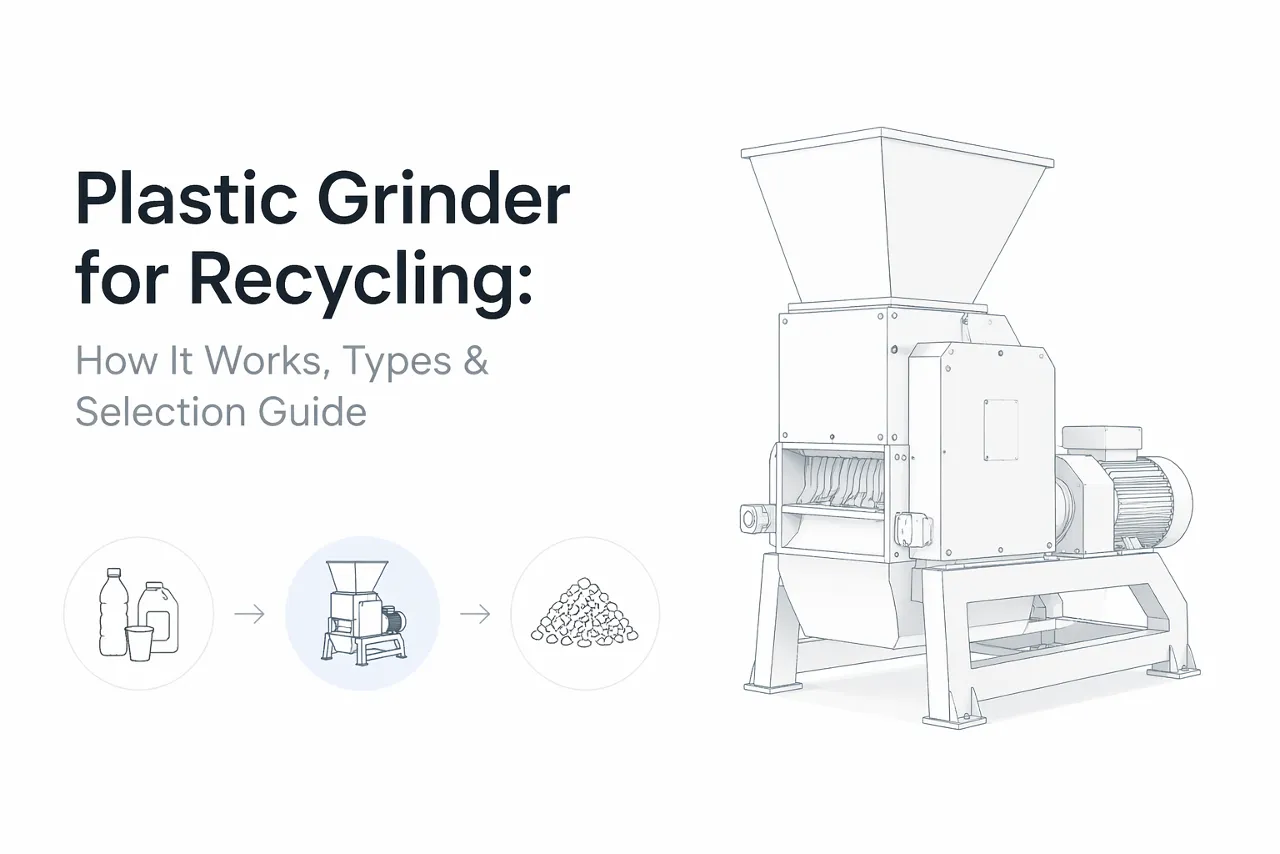
A plastic grinder for recycling turns plastic waste — bottles, pipes, crates, film, and profiles — into uniform granules small enough to feed directly into an extruder or pelletizer. Without this size-reduction step, most recycling lines cannot process incoming material at scale. This guide covers how the machine works, which types exist, what specifications actually matter, and how to match the right machine to your specific material and throughput requirement.
What Is a Plastic Grinder for Recycling?
A plastic grinder — also called a plastic granulator or plastic crusher across different markets — is a size-reduction machine that cuts bulk plastic waste into small, consistent particles, typically 4–25 mm in diameter. The output (called regrind or granulate) is clean-edged, free-flowing, and ready for the next stage: washing, compounding, or direct re-extrusion into new pellets.
The terms grinder, granulator, and crusher are used interchangeably in the plastic recycling industry, though there are technical distinctions:
- 과립기 — precision cutting at medium rotor speed (200–600 RPM), producing uniform granules with minimal dust; the standard final size-reduction step
- Grinder — higher-speed, more aggressive size reduction for tougher or bulkier feed materials
- 파쇄기 — primary reduction for very large or thick-walled pieces (drums, crates, thick pipe) before granulation; see our 플라스틱 분쇄기 기계 가이드 for a detailed breakdown
In practice, a single machine often handles all three functions. The choice of machine name rarely reflects a meaningful performance difference — what matters is rotor design, cutting speed, and screen size.
How a Plastic Grinder Works
All plastic grinders share the same operating principle: a rotating rotor fitted with cutting blades works against fixed stator blades to shear incoming plastic into progressively smaller pieces. The sequence has five stages:
- 밥을 먹이다 — Material enters the cutting chamber through a hopper, fed manually, by conveyor, or inline directly from a production line.
- Primary cutting — Rotor blades (moving) pass the stator blades (fixed) at close tolerance, shearing the plastic. Rotor speed ranges from 200–900 RPM depending on machine type and material.
- Regrinding — Pieces still too large to exit recirculate inside the cutting chamber and are cut again.
- Screen discharge — A perforated screen at the bottom of the chamber controls output particle size. Only particles small enough to pass through exit the machine. Standard screen hole diameters: 6, 8, 10, 12, 15, 20, 25 mm.
- 수집 — Output granules fall into a collection bin or are pneumatically conveyed to the next process stage (washer, dryer, extruder).
The screen is the primary size-control mechanism. Swapping the screen changes the output particle size without any other machine adjustment. Most commercial granulators allow tool-free screen changes in under five minutes.
Types of Plastic Grinders for Recycling
By Rotor Design
Rotor geometry determines what materials the machine handles most efficiently. The four most common designs are:
| 로터 타입 | Best Material | Typical Speed |
|---|---|---|
| Open rotor (spoke or pin) | Thick-walled rigid parts — HDPE pipes, ABS housings, PA components | 200–400 RPM |
| Closed rotor (staggered blades) | Thin-walled parts, purging material, flexible profiles | 300–600 RPM |
| Tangential feed rotor | Continuous inline grinding of runners and sprues from injection molding | 400–900 RPM |
| Double-shaft rotor | Mixed or contaminated baled plastic, bulky hollow containers | 50–150 RPM |
Wet Grinder vs. Dry Grinder
This distinction is underappreciated in most buying guides, yet it significantly affects output quality and downstream process compatibility.
Dry grinding is the standard operating mode. The cutting chamber runs without water. Output is dry granulate ready for immediate pelletizing or compounding. Heat build-up can degrade heat-sensitive resins (PVC, PET) at high throughput or with hard-to-cut materials.
Wet grinding introduces a controlled water flow into the cutting chamber during operation. Benefits include:
- Cooling prevents heat degradation of the resin
- Water flushes fine dust out of the chamber continuously
- Labels, dirt, and surface contamination are partially washed away during grinding
Wet grinding is standard in PET bottle recycling lines, where both heat sensitivity and label contamination are concerns — see our wet crushing advantages for PET bottles for a detailed comparison. The trade-off: wet output granulate must pass through a centrifugal dryer or hot-air dryer before downstream processing, adding capital and operating cost.
By Machine Size and Application
- Small / lab-scale grinders (7.5–22 kW): 50–300 kg/h throughput. Used in small recycling workshops, R&D labs, or inline with a single injection molding machine for sprue/runner recycling.
- Mid-range industrial grinders (22–90 kW): 300–1,000 kg/h. The workhorse of most plastic recycling facilities handling one or two consistent material streams.
- Heavy-duty industrial grinders (90–250+ kW): 1,000–5,000 kg/h. For large-scale plants processing mixed post-consumer waste, film bales, or high-volume pipe extrusion offcuts.
Material-Specific Recommendations
Not every plastic grinder works equally well on every resin type. Material properties — stiffness, melt temperature, shape, and contamination level — determine the correct machine configuration. Use this table as a starting point:
| 재료 | Main Challenge | Recommended Configuration |
|---|---|---|
| PET 병 | Heat-sensitive resin; label contamination; caps | Wet granulator, tangential feed rotor, 8–10 mm screen, metal detector upstream |
| HDPE/PP 경질 (crates, drums, thick pipe) | High impact loads; large input dimensions | Heavy-duty open rotor, 200–350 RPM, pre-shredding recommended for pieces over 500 mm |
| PE / PP film (packaging, agricultural) | Material wraps around rotor; feeding inconsistency | Anti-wrap rotor design, force-feed roller system, 10–15 mm screen, slower intake speed |
| PVC profiles and pipe | Chlorine off-gassing; rapid blade wear; fine dust | Closed rotor with hardened blades (SKD11 or carbide), dust extraction system, dry grinding only — see our PVC grinding vs. crushing guide |
| ABS / PS (electronics, housings) | Brittle fracture; metal contamination risk from e-waste | Metal detector upstream, slow-speed grinder, 6–8 mm screen, sound insulation enclosure |
| Nylon / engineering plastics | Tough and abrasive; heat build-up in chamber | Water cooling or wet grinding, tungsten carbide-tipped blades, 6–10 mm screen |
핵심 요약: If you process more than one material type on the same line, choose a granulator with quick-change screens and a rotor geometry suited to your most challenging material — then adjust screen size and feed rate for lighter materials.
Key Specifications to Evaluate Before You Buy
Manufacturer spec sheets often highlight peak capacity figures. Here is what the numbers actually mean in practice:
처리량 용량
Rated in kg/h, but always request capacity figures for your specific material and screen size. A machine rated at 600 kg/h on rigid HDPE regrind may deliver only 150–200 kg/h on flexible PE film. Ask for a material test or include a capacity guarantee in the purchase contract.
Cutting Chamber Width and Rotor Diameter
Chamber width determines the maximum input dimension the machine accepts without pre-cutting. Rotor diameter affects cutting energy: a larger-diameter rotor at the same RPM delivers higher blade peripheral speed and more shearing force. For pipe or profile recycling, confirm chamber width covers your largest cross-section.
Screen Hole Diameter
This is the direct control over output particle size. Standard options: 6, 8, 10, 12, 15, 20, and 25 mm. Most downstream extruders and compounders require 6–12 mm granulate — confirm your pelletizer’s feed specification before specifying the screen. Our plastic pelletizing machine guide covers the full downstream requirements.
모터 파워
Undersized motors cause repeated thermal shutdowns and shortened motor life. As a practical rule: for rigid plastics, allow 1 kW per 5–8 kg/h of rated throughput. For flexible or low-density material (film, foam), allow 1 kW per 10–15 kg/h. Always size for your peak throughput, not your average.
Blade Material and Replacement Cost
Blades are a consumable with a direct impact on operating cost. D2 tool steel blades (hardness HRC 58–62) handle most standard applications. For abrasive materials — glass-filled nylon, PVC, contaminated post-consumer waste — SKD11 or tungsten carbide insert blades extend service life by 3–5x but cost more upfront. Confirm blade replacement price and local availability before committing to a machine. For a detailed breakdown, see our guide to selecting plastic granulator blades.
Noise Level and Dust Control
Industrial granulators typically generate 85–100 dB(A) without enclosures. EU and US workplace safety regulations require hearing protection above 85 dB(A) and engineering controls above 90 dB(A). Ask for the machine’s measured sound pressure level at 1 m with the standard hopper installed — not the theoretical value. Dust extraction connection (typically 150–250 mm ducting) is essential for PVC, ABS, and any dry grinding of contaminated material.
Plastic Grinder vs. Shredder vs. Crusher: What’s the Difference?
These three machine types sit at different points in the size-reduction chain. Using the wrong one — or skipping one — creates bottlenecks and poor regrind quality.
| Plastic Grinder / Granulator | 플라스틱 파쇄기 | 플라스틱 분쇄기 | |
|---|---|---|---|
| 출력 크기 | 4–25 mm (screen-controlled) | 20–150 mm (coarse, irregular) | 10–80 mm (medium) |
| Output uniformity | High — consistent particle shape | Low — strips and chunks | 중간 |
| 처리량 범위 | 50–5,000 kg/h | 200–15,000+ kg/h | 100–3,000 kg/h |
| Primary role | Final size reduction for extrusion-ready regrind | Volume reduction of bulky waste; primary processing of mixed waste | Intermediate reduction between shredder and granulator |
| Typical position in line | Last size-reduction step before washing or extruding | First step — primary reduction | Between shredder and granulator |
For most post-consumer plastic recycling operations, the optimal sequence is: Shredder → Washer → Crusher → Granulator → Pelletizer. For clean industrial scrap — sprues, runners, pipe offcuts — a single granulator inline is sufficient. For a full equipment comparison, see our shredder vs. granulator vs. pelletizer selection guide.
Plastic Grinder Maintenance: What to Monitor
Maintenance determines both output quality and machine lifespan. Three areas require regular attention:
Blade Inspection and Sharpening
Dull blades produce irregular particle shapes, more fines, higher energy consumption, and heat build-up. Inspect blades every 200–500 operating hours depending on material abrasiveness — PVC and glass-filled resins wear blades 3–5x faster than clean HDPE or PP. Most granulator blades can be resharpened 3–5 times before replacement. Keep a spare set so the machine is never down during blade service.
Screen Inspection
Check the screen for cracks, deformation, or enlarged holes after every 500 operating hours. A damaged screen allows oversized particles to pass, directly contaminating your regrind and potentially causing blockages in downstream extruders. Keep at least two spare screens per machine — one installed, one ready.
Bearing Temperature and Lubrication
Rotor bearings operate under continuous high load. Monitor bearing temperature during operation — sustained readings above 80°C indicate inadequate lubrication, misalignment, or overload. Regrease according to the manufacturer’s schedule: typically every 500–1,000 hours for sealed bearings, more frequently in dusty or high-humidity environments. Always use the grease type specified by the bearing manufacturer — mixing grease types accelerates wear.
자주 묻는 질문
플라스틱 그리nder와 플라스틱 그란уля터의 차이점은 무엇인가요?
In the plastic recycling industry, the terms are used interchangeably. Both describe a machine that reduces plastic waste to small, screen-controlled particles using a rotor-and-stator cutting system. If a technical distinction is made: a granulator produces highly uniform granules at medium speed (200–600 RPM) with minimal fines, while a grinder may operate at higher speed for more aggressive size reduction of bulkier or tougher material. The machine function matters more than the label.
모든 플라스틱 유형을 처리할 수 있는 하나의 플라스틱 그리nder가 있습니까?
Most commercial granulators handle the six common recyclable plastics — HDPE, PP, PET, PVC, ABS, and PS — but material properties require different configurations. PET requires wet grinding to manage heat sensitivity; PE film needs an anti-wrap rotor and force-feed system; PVC requires hardened blades and dust extraction. A single granulator can be configured for multiple materials by swapping screens and adjusting feed rate, but it cannot be optimized for all materials simultaneously. Multi-material operations typically run material-dedicated machines or maintain a library of screen and blade configurations.
산업용 플라스틱 그라인더의 가격은 얼마인가요?
Entry-level granulators (7.5–15 kW) for sprue and runner recycling start at $3,000–$8,000 USD. Mid-range industrial units (22–55 kW, 300–800 kg/h) typically cost $15,000–$50,000. Heavy-duty systems for post-consumer recycling lines (90 kW+, 1,000+ kg/h) range from $60,000 to over $200,000 depending on rotor design, automation level, wet or dry configuration, and manufacturer. Request a formal quotation with specifications locked to your material type and throughput requirement — capacity-to-cost ratios vary significantly by configuration.
플라스틱 그라인더가 생성하는 출력 파티클 사이즈는 무엇인가요?
Output particle size is directly controlled by the screen installed in the cutting chamber. Standard screen hole diameters range from 6 mm (fine granulate for direct extrusion) to 25 mm (coarse regrind for pre-drying or washing). For feeding a standard single-screw or twin-screw extruder, 6–12 mm granulate is most common. Changing the screen — a five-minute operation on most machines — changes the output size. No other machine adjustment is needed.
Choosing the Right Plastic Grinder for Your Recycling Line
The right plastic recycling grinder is defined by three parameters: your input material, your required throughput, and your downstream process. Get these three inputs wrong and no amount of machine quality compensates.
Start with your material — its density, stiffness, contamination level, and heat sensitivity determine rotor type, blade material, screen size, and whether you need wet or dry grinding. Then size the motor and chamber width for your peak throughput, not your average. Finally, confirm the output particle size your downstream pelletizer or compounder requires and specify the screen accordingly. Our detailed plastic granulator selection guide walks through this process step by step.
Energycle manufactures industrial plastic granulators and plastic grinders for recycling lines handling everything from clean injection molding scrap to mixed post-consumer film and rigid waste. 재료 유형, 처리량 요구 사항, 원하는 출력 크기를 가진 with your material type, input dimensions, throughput target, and required output particle size — we will recommend the correct configuration and provide a formal quotation.
