

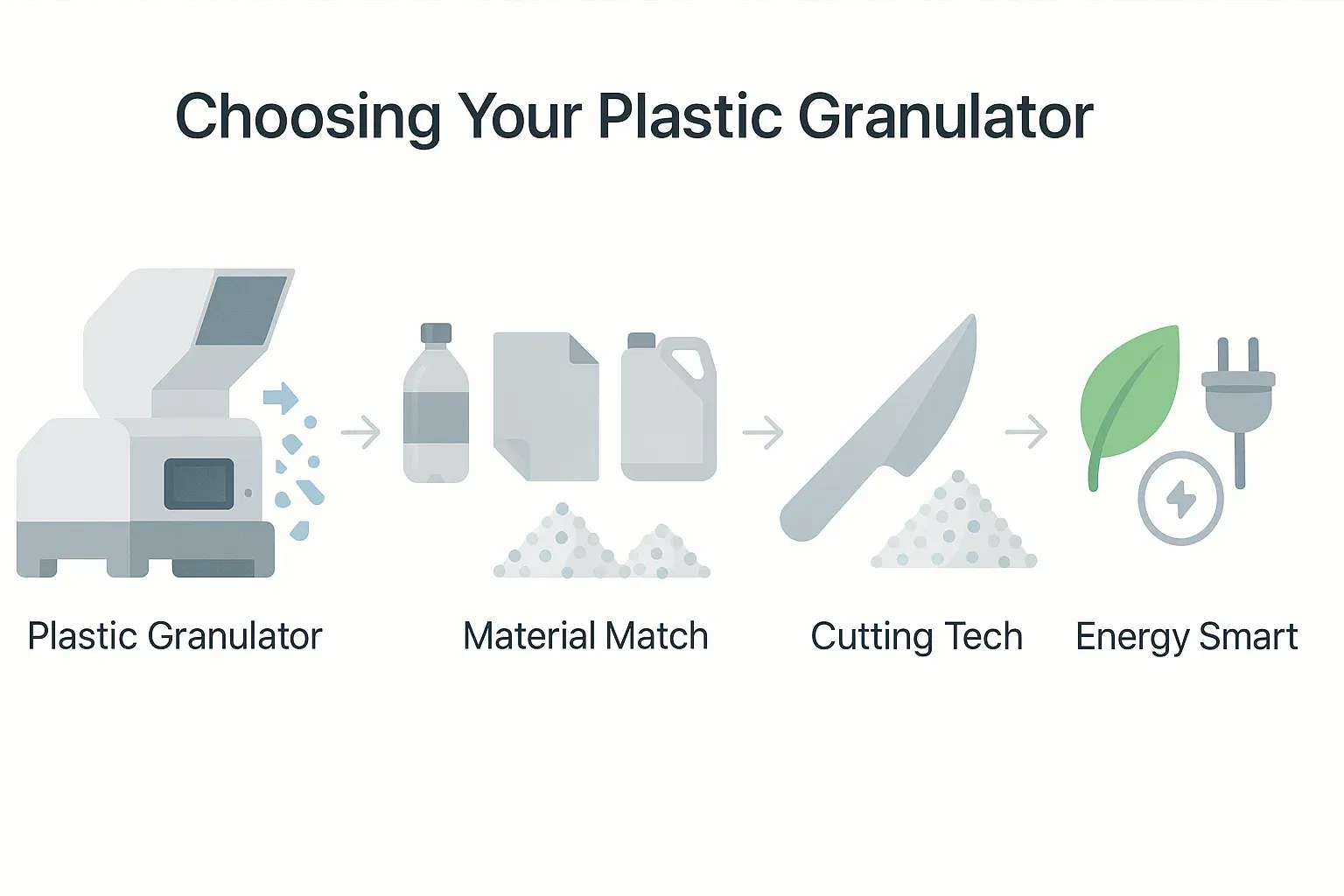
에이 플라스틱 분쇄기 reduces plastic scrap — runners, sprues, defective parts, bottles, containers, film, and pipe — into uniform regrind granules ready for reprocessing. Whether you run an injection molding shop that needs to reclaim runners in-line or a recycling facility processing 2,000 kg/h of post-consumer HDPE, the right granulator directly determines your material recovery rate, energy cost per kilogram, and final pellet quality. This guide covers every granulator type Energycle manufactures, with real specifications, a material-to-machine matching table, blade selection guidance, and a step-by-step framework for choosing the right unit for your operation.
플라스틱 분쇄기란 무엇인가?
A plastic granulator is a size-reduction machine that uses a rotating cutter assembly to chop plastic waste into small, consistent pieces called regrind or granules — typically 3–12 mm depending on screen size. The granulated output feeds directly back into extruders, injection molding machines, or pelletizing lines. Unlike shredders (which produce rough, irregular pieces for pre-processing), granulators deliver a finished particle size in a single pass, making them the final size-reduction step in most plastic recycling lines.
Every plastic granulator shares three core components: a cutting chamber with fixed bed knives and a rotating cutter shaft, a 화면 that controls output particle size, and a drive system (motor + gearbox or direct drive). The interaction between rotor speed, knife geometry, and screen hole diameter determines throughput, granule uniformity, and energy consumption.
플라스틱 그레뉼레이터는 어떻게 작동하나요?
The operating principle is straightforward: plastic material enters the cutting chamber through a feed hopper or conveyor. Inside, 3–9 rotating knives mounted on the rotor spin at 200–600 RPM, shearing material against 2–4 stationary bed knives. The scissor-cut action breaks plastic into progressively smaller pieces. Granules that reach the target size pass through a perforated screen at the bottom of the chamber; oversized pieces remain in the chamber for further cutting. For a detailed breakdown, see our how a plastic granulator works guide.
Key process parameters that affect output quality:
- Knife gap: 0.1–0.3 mm for rigid plastics, 0.3–0.5 mm for film — tighter gaps give cleaner cuts but wear faster
- Rotor speed: Higher RPM = finer granules but more heat and dust; lower RPM = coarser output but less degradation
- Screen size: Determines maximum particle dimension — 6 mm screens are standard; 3 mm for applications requiring fine regrind. See our screen size selection guide
- Feed rate: Overfeeding causes jams and uneven particles; underfeeding wastes energy
플라스틱 분쇄기 유형
Granulators are classified by size, mounting position, cutting method, and application. Here is a complete breakdown of every type, with specifications from Energycle’s production range.
Beside-the-Press Granulators
Compact units positioned next to injection molding or blow molding machines for immediate in-line regrind of sprues, runners, and defective parts. They operate at low noise levels (typically <80 dB) and process 20–150 kg/h. Beside-the-press models are the most common granulator type in molding facilities, returning regrind directly to the machine hopper with zero material handling.
Central Granulators
High-throughput machines that serve an entire production facility from a central location. Material is conveyed from multiple presses to one central granulator via pneumatic systems or belt conveyors. Throughput ranges from 200 kg/h to 2,000+ kg/h. These units handle everything from purge lumps to full rejected parts, and they connect to centralized material-handling systems with blowers, cyclones, and storage silos.
Heavy-Duty Granulators
Built for thick-wall parts, large containers, drums, automotive bumpers, and pipe. Heavy-duty granulators feature reinforced cutting chambers, higher motor power (30–132 kW), and wider feed openings. They typically include hydraulic ram feeders or conveyor infeed to handle bulky items. Our extra-large rigid plastic granulator models process parts up to 1,200 mm wide.
Wet Granulators
Designed to granulate and wash simultaneously. Water is injected into the cutting chamber during operation, which cools the material (preventing heat degradation), washes off labels/adhesive/dirt, and reduces dust. Wet granulators are standard in PET bottle recycling lines and dirty post-consumer plastic washing lines. They handle contaminated feedstock that would clog dry granulators and produce cleaner regrind in fewer process steps. Read more in our wet granulator use cases and setup guide.
Vertical Granulators
The rotor axis is vertical rather than horizontal, creating a gravity-fed design ideal for long, tubular materials like PVC pipe and window profiles. Material drops into the chamber and is cut as it falls, reducing the need for complex feeding mechanisms. See our vertical granulator for PVC pipe and profiles.
Integrated Shredder-Granulators
Combination machines with a low-speed shredder stage feeding directly into a high-speed granulator stage. One machine replaces two, saving floor space and eliminating inter-machine conveyors. Best for mixed, bulky post-consumer waste where a single-pass granulator would jam. Our integrated shredder-granulator models handle throughputs of 300–1,500 kg/h.
Granulator Type Comparison
Use this table to quickly match your application to the right granulator type:
| 유형 | 처리량 | 모터 파워 | 가장 적합한 | 피드 오프닝 |
|---|---|---|---|---|
| Beside-the-Press | 20–150 kg/h | 2.2–7.5 kW | Runners, sprues, small rejects | 200×250 – 400×500 mm |
| Central | 200–2,000 kg/h | 15–75 kW | Multi-machine facility, mixed scrap | 500×600 – 1200×1500 mm |
| Heavy-Duty | 500–3,000 kg/h | 30–132 kW | Drums, bumpers, pipe, thick-wall parts | 800×1,000 – 1,500×2,000 mm |
| 젖은 | 300–2,000 kg/h | 22–90 kW | PET 봉지,(dirty) 소비 후 쓰레기 | 500×600 – 1,000×1,200 mm |
| 가로형 | 100–800 kg/h | 7.5–37 kW | PVC 파이프, 프로파일, 장관형 쓰레기 | Ø300 – Ø600 mm |
| 셔터-그란ولا이저 | 300–1,500 kg/h | 30–110 kW | 대량 혼합 쓰레기, 단일 회전 처리 | 600×800 – 1,200×1,500 mm |
재료-그란ولا이저 매칭 가이드
다른 플라스틱은 다른 단단도, 녹는 온도, 파괴 행동이 있습니다. 재료에 맞는 그란ولا이저를 선택하지 않으면 과도한 미세한 입자, 열 저해, 또는 조기에 날이 닳는 문제가 발생합니다. 고객 base에서 500+ 설치에 기반하여 우리가 추천하는 것은 다음과 같습니다:
| 재료 | 추천 그란ولا이저 | 화면 크기 | 주요 고려 사항 |
|---|---|---|---|
| PET 병 | 습식 과립기 | 12–14 mm | 수냉은 결정화를 방지하고 라벨을 제거합니다. See PET 봉지 그란ولا이저 가이드 |
| HDPE/PP 고정형(crate, drum) | 중앙 또는 중무장형 | 8–10 mm | 고출력 강도는 중요한 루터 인어시아가 필요합니다 |
| PE/PP 필름 | 중앙 및 경사식 공급 | 8–12 mm | 필름은 루터에 감싸지기 때문에 개방형 루터 디자인을 사용하세요. See film-to-thick-plate 가이드 |
| PVC 파이프 | 수직형 과립기 | 6–8 mm | Low-speed cutting prevents PVC heat degradation. See PVC pipe granulator guide |
| Injection Runners/Sprues | Beside-the-Press | 6 mm | Match to press cycle time; low noise critical in molding halls |
| Automotive Bumpers | Heavy-Duty + Ram Feeder | 10–14 mm | Metal inserts require metal detection upstream |
| Mixed Post-Consumer | 셔터-그란ولا이저 | 10–14 mm | Two-stage design handles unpredictable feedstock |
| Rubber/Tire | 타이어 분쇄기 | 2–6 mm | Steel wire separation needed. See tire granulator specs |
Plastic Granulator Blades: Selection and Maintenance
Blades are the single most important wear component on any granulator. Blade material, geometry, and maintenance schedule directly affect cut quality, energy consumption, and operating cost. With “plastic granulator blades” being one of the most searched terms in this category (966 impressions/quarter in our data), here is what buyers need to know.
Blade Material Comparison
| 블레이드 소재 | Hardness (HRC) | 가장 적합한 | Regrind Interval | 상대적 비용 |
|---|---|---|---|---|
| D2 공구강 | 58–62 | General-purpose (PE, PP, ABS) | Every 500–800 hours | 1× (baseline) |
| SKD-11 | 60–63 | Abrasive materials (glass-filled, mineral-filled) | Every 800–1,200 hours | 1.3× |
| 텅스텐 카바이드 | 70+ | Extreme abrasion (fiberglass, carbon fiber) | Every 2,000+ hours | 4–6× |
| HSS (M2/M42) | 62–65 | High-speed cutting of soft plastics | Every 400–600 hours | 1.5배 |
For detailed guidance on blade selection and cost factors, read our blade selection guide 그리고 blade material cost analysis. We also supply 교체용 블레이드 그리고 blade grinding machines for in-house resharpening.
Blade Maintenance Best Practices
- Check knife gap weekly — gap should be 0.1–0.5 mm depending on material; use feeler gauges
- Rotate or regrind when output shows rough edges or increased fines — most blades allow 5–8 regrinds before replacement
- Remove metal contaminants upstream — even small metal pieces destroy blade edges instantly
- Keep blade bolts at specified torque — loose blades cause uneven wear and chamber damage
- Log blade hours — establish your facility-specific regrind intervals based on actual wear patterns
For a complete maintenance program, see our granulator maintenance and troubleshooting guide 그리고 regular maintenance tips.
5-Step Selection Framework
Use this framework when specifying a plastic granulator for your operation. We developed it from 15+ years of project engineering experience across 500+ installations worldwide.
Step 1: Define Your Material and Application
List every material type you will process (PE, PP, PET, PVC, ABS, nylon, etc.), the form (bottles, film, pipe, molded parts, mixed bales), and whether it is clean in-house scrap or dirty post-consumer waste. This determines the granulator type and whether you need wet or dry operation.
Step 2: Calculate Required Throughput
Measure your actual scrap generation rate in kg/h. For beside-the-press units, match to press cycle time and shot weight. For central granulators, sum all machine scrap rates and add 30% surge capacity. Undersizing causes jams and overheating; oversizing wastes capital and energy.
Step 3: Specify Output Size
Determine the regrind particle size your downstream process requires. Injection molding typically needs 3–6 mm regrind; extrusion can accept 6–12 mm; pelletizing lines work with 8–14 mm input. Screen hole diameter controls this directly — refer to our screen size and output quality analysis.
Step 4: Evaluate Operating Environment
Consider noise limits (beside-the-press units near operators need <80 dB), dust control requirements, available floor space, ceiling height for feeding, electrical supply (3-phase voltage and available amperage), and whether the granulator connects to a centralized vacuum or pneumatic conveying system.
Step 5: Compare Total Cost of Ownership
Purchase price is 30–40% of total cost over 5 years. Factor in energy consumption (kWh per kg of throughput), blade replacement and resharpening costs, screen replacement frequency, planned maintenance labor, and spare parts availability. A granulator that costs 15% more upfront but uses 25% less energy per kilogram pays for itself within 18 months at typical industrial electricity rates. For detailed cost analysis, see our granulator price factors guide 그리고 펠릿 제조기 비용 분석.
Granulator vs. Shredder vs. Pelletizer: When to Use Each
These three machines serve different stages of the recycling process, and many operations use two or all three in sequence. Here is a clear comparison:
| 매개변수 | 분쇄기 | 과립기 | 펠렛화기 |
|---|---|---|---|
| 출력 크기 | 20–100 mm (coarse) | 3–14 mm (uniform) | 2–5 mm pellets |
| 목적 | Pre-size reduction of bulky items | Final size reduction to regrind | Melt and reshape into pellets |
| 속도 | 15–60 RPM (low speed, high torque) | 200–600 RPM (high speed) | Screw-driven extrusion |
| Typical Position in Line | First stage | Second stage (after shredder) or standalone | Third stage (after washing/drying) |
| Output Reuse | Needs further processing | Direct reuse in molding/extrusion or feed to pelletizer | Market-ready pellets |
For a full comparison with selection rules, read our dedicated shredder vs. granulator vs. pelletizer guide. Also see granulator vs. grinder comparison 그리고 pelletizer vs. granulator differences.
Complete Recycling Lines with Granulators
Granulators rarely work alone. Here are the most common line configurations where a granulator serves as a core component:
PET Bottle Recycling Line
Bale breaker → label remover → wet granulator → hot wash → friction washer → rinse → dewatering → drying → flake sorting. Output: clean PET flakes for bottle-to-bottle or fiber extrusion. See our PET bottle granulator selection guide 그리고 Netherlands PET line case study.
PE/PP Film Recycling Line
Shredder → wet granulator → friction washer → sink-float tank → dewatering → drying → 펠릿화. Output: PE/PP pellets. See our BOPP film recycling line 그리고 cutter compactor granulating line.
경질 플라스틱 재활용 라인
Shredder → granulator → washer → dryer → color sorter → 펠렛화기. Output: clean rigid plastic pellets ready for injection molding. See our rigid PP/HDPE pelletizing process guide.
PVC Pipe Recycling Line
Crusher → vertical granulator → metal separator → pulverizer → mixer → extruder. Output: rPVC compound for new pipe and profiles. Our PVC 파이프 조립기 handles pipes up to Ø600 mm diameter.
Technical Specifications Buyers Should Check
Before ordering any plastic granulator, verify these 10 critical specifications:
- Cutting chamber dimensions (width × depth) — determines maximum part size you can feed
- Number of rotor knives and bed knives — more knives = finer cut per revolution
- Rotor type — open rotor (for film/flexible), closed rotor (for rigid), staggered (general purpose)
- Motor power (kW) — must match throughput × material toughness
- Screen diameter and hole size — determines output particle size
- Knife material and hardness (HRC) — must match material abrasiveness
- Noise level (dB at 1m) — critical for beside-the-press applications
- Safety features — hopper interlock, emergency stop, overload protection
- Access for maintenance — tilt-back hopper, swing-open chamber, tool-free screen changes
- Specific energy consumption (kWh/kg) — the real efficiency metric
Troubleshooting Common Granulator Problems
Even well-selected granulators encounter operational issues. Here are the most common problems and their causes, based on our service team’s field data:
| 문제 | 가능성 있는 원인 | 해결책 |
|---|---|---|
| Excessive fines/dust | Worn blades or too-large knife gap | Regrind or replace blades; adjust gap to 0.1–0.3 mm |
| Motor overload/tripping | Overfeeding or wrong material for machine size | Reduce feed rate; check for metal contamination |
| Uneven granule size | Damaged screen or one blade shorter than others | Inspect screen for holes; measure all blade lengths |
| Excessive heat in chamber | Dull blades tearing instead of cutting; screen partially blocked | Sharpen blades; clean screen; reduce feed rate |
| Unusual vibration/noise | Loose blade bolts or unbalanced rotor | Torque all bolts to spec; check rotor balance |
| Material bridging in hopper | Film or flexible material tangling above rotor | Install agitator; switch to tangential feed design |
For detailed troubleshooting procedures, see our granulator troubleshooting guide.
Granulator Equipment and Accessories
A complete granulator installation typically includes these support components:
- Metal detectors/separators — protect blades from metal contamination (mandatory for post-consumer streams)
- Conveyor belts or pneumatic feeding systems — automated material handling for central installations
- Blower and cyclone systems — evacuate granules from the machine to storage bins
- Soundproof enclosures — reduce noise to <75 dB for operator-adjacent installations
- Dust collection systems — capture airborne fines, especially critical for PVC processing
- Blade grinding machines — enable in-house resharpening, reducing blade costs 60–70%
For a comprehensive overview, see our granulator equipment and accessories guide.
산업 응용 분야
Plastic granulators serve every sector that produces or recycles plastic:
- Injection molding — beside-the-press regrind of runners and rejects returns 100% of scrap to production
- Blow molding — trim and flash from bottles, containers, and tanks
- 압출 — 엣지 트림, 시작 시 낭비, 및 불량 파이프, 프로파일, 및 시트
- Thermoforming — 컵, 트레이, 및 블리스터 생산에서의 스케ルト 낭비
- Recycling facilities — 500–3,000 kg/h의 소비자 후 및 산업 후 플라스틱 처리
- 자동차 — 범퍼, 패널, 및 인테리어 트림 재활용
- 건설 — PVC 파이프, 창문 프로파일, 및 지붕 막질 재활용
For detailed application guidance by material type, read our granulators in recycling solutions overview and applications from film to thick plate.
Getting Started with Energycle
Energycle은 전체 범위의 플라스틱 분쇄기 그리고 플라스틱 펠렛화기, plus complete turnkey recycling lines. With 500+ installations across 60+ countries, we provide:
- Free material testing — send us your samples and we test on our machines to verify throughput and output quality
- Custom engineering — granulators configured to your exact material, throughput, and output specifications
- Complete line design — from shredding through granulation to pelletizing, including washing and drying
- After-sales support — spare parts, blade resharpening, remote troubleshooting, and on-site service
재료 유형, 처리량 요구 사항, 원하는 출력 크기를 가진 with your material type, throughput requirement, and desired output size — we will recommend the right granulator configuration and provide a detailed quotation within 48 hours.
자주 묻는 질문
플라스틱 그란ولا이저와 플라스틱 쇼더의 차이점은 무엇인가요?
그라니ュ레이터는 고속 회전 날(200–600 RPM)을 사용하여 사이즈망을 통해 일관된 3–14 mm 크기의 granules를 생산합니다. 쇼더는 낮은 속도, 높은 토큰의 컷터(15–60 RPM)를 사용하여 재료를 20–100 mm 크기의 거친 조각으로 자릅니다. 쇼더는 첫 단계의 크기 줄이기로 두꺼운 물건을 처리하며, 그라니ュ레이터는 재정리에 필요한 최종 일관된 파티클 크기를 생산합니다.
플라스틱 granulator의 가격은 얼마인가요?
소형 프레스 근처 그란ولا이저는 $3,000–$8,000에서 시작됩니다. 중앙 그란ولا이저는 처리량과 기능에 따라 $15,000–$80,000 사이에 있습니다. 강력한 산업 모델은 $50,000–$200,000 이상으로 운영됩니다. 5년간의 총 소유 비용은 — 에너지, 날, 스크린, 유지보수를 포함하여 — 일반적으로 구매 가격의 2–3배입니다.
플라스틱 granulator 날이 얼마나 자주 교체되어야 합니까?
표준 D2 도구 강 날이 PE/PP를 처리할 때 500–800 운영 시간마다 다시 갈아야 합니다. 유리나 광물 채운 재료는 이를 200–400 시간으로 줄입니다. 대부분의 날은 완전한 교체가 필요하기 전에 5–8 번 재가공될 수 있습니다. 더 단단한 날 재료(SKD-11이나 탄소화물)를 투자하면 가소성 응용 프로그램에서의 간격을 2–4배로 연장할 수 있습니다.
제 생산 라인에 필요한 크기의 granulator는 어떤 것이 좋을까요?
Match the granulator’s rated throughput to your scrap generation rate plus a 20–30% margin for surges. Also verify the feed opening can accept your largest material pieces. For injection molding, calculate: (shot weight × rejection rate × shots/hour) = scrap kg/h. For recycling lines, measure bale-opening or shredder output rate.
PVC를 무결점으로 처리할 수 있는 granulator가 있습니까?
네, 하지만 열 발생을 최소화하는 슬로우 스피드나 직립형 granulator 설계가 필요합니다. PVC는 140°C 이상에서 히드로젠 클로라이드 가스를 방출합니다. 저 회전수 절단, 충분한 통풍, 먼지 유출은 필수적입니다. PVC용으로는 표준 고속 granulator를 피하세요 — 마찰열은 재료 품질 저하와 절단 공간에서 부식 조건을 유발합니다.
플라스틱 granulator의 에너지 소비량은 얼마인가요?
Specific energy consumption ranges from 0.03–0.08 kWh per kg for soft plastics (PE film) to 0.08–0.15 kWh per kg for rigid engineering plastics (nylon, polycarbonate). A central granulator processing 500 kg/h of HDPE at 0.06 kWh/kg consumes approximately 30 kW — roughly $2.50–$4.00/hour at typical industrial electricity rates.
제 공granulator에서 소음을 줄이는 방법은 무엇인가요?
네 가지 접근 방법: (1) 소음 방지 케이스 설치 — 소음을 15–20 dB 감소시킵니다. (2) 저속 그란ولا이저 설계 사용 — 소음 원천에서 소음을 줄입니다. (3) 날이 날카롭게 유지하십시오 — 날이 가라앉으면 재료를 끊어서 더 많은 소음과 진동이 발생합니다. (4) 진동 흡수 패드에 그란ولا이저를 설치하십시오. 내장형 소음 방지 기능이 있는 프레스 근처 모델은 1 미터에서 80 dB 이하로 운영됩니다.
플라스틱 granulator가 필요로 하는 유지보수는 무엇인가요?
Daily: clear the cutting chamber of residual material and inspect for metal contamination. Weekly: check knife gap with feeler gauges and inspect screen condition. Monthly: lubricate bearings, check belt tension, inspect electrical connections. Every 500–800 hours: regrind or rotate blades. Annually: full inspection including rotor balance check and bearing replacement if needed. See our complete maintenance checklist.
관련 자료
- Plastic Granulators — Product Range
- Plastic Pelletizers — Product Range
- 플라스틱 그레뉼레이터는 어떻게 작동하나요?
- Shredder vs. Granulator vs. Pelletizer Selection Guide
- 플라스틱 그란ولا이터 블레이드 선택 방법
- 그란ولا이터 스크린 크기 선택 가이드
- 그란ولا이터 유지보수 및 문제 해결
- 그란ولا이터 가격 요인 설명
- 봉진 및 소음 문제 해결
- 그란ولا이터와 그리nder 비교
- 산업용 분쇄기: 원리 및 응용 분야
- 펠렛라이터와 그란ولا이터 차이
- 플라스틱 펠렛타이저란 무엇인가?
- 그란레이터 적용: 필름에서 두께가 높은 판
- Granulator Equipment and Accessories
- 플라스틱 재활용 기계: 전체 가이드
