

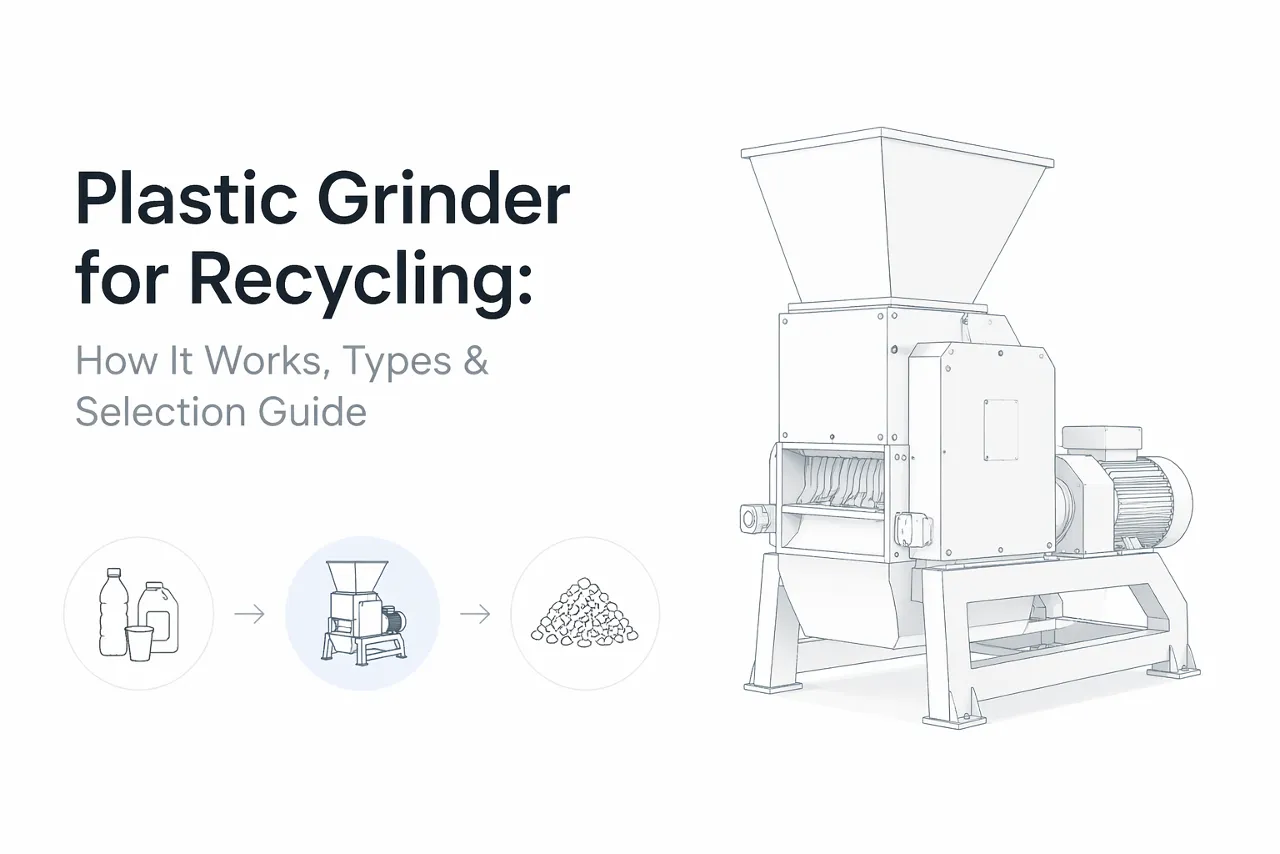
A plastic grinder for recycling turns plastic waste — bottles, pipes, crates, film, and profiles — into uniform granules small enough to feed directly into an extruder or pelletizer. Without this size-reduction step, most recycling lines cannot process incoming material at scale. This guide covers how the machine works, which types exist, what specifications actually matter, and how to match the right machine to your specific material and throughput requirement.
What Is a Plastic Grinder for Recycling?
U kunt een plastic grinder gebruiken om bulk plastic afval in kleine, uniforme deeltjes te verkleinen, bijvoor granulaat met een diameter van 4–25 mm. Het product dat hierbij ontstaat, regrind, heeft schone randen en stroomt gemakkelijk, zodat het direct kan worden gebruikt voor het volgende processtap, zoals wassen, mengen of direct opnieuw extruderen tot nieuwe pellets.
In de plasticsrecyclingindustrie worden termen als ‘grinder’ en ‘granulator’ soms door elkaar gebruikt, hoewter er technische verschillen bestaan tussen deze apparaten.</|
- Granulator — precision cutting at medium rotor speed (200–600 RPM), producing uniform granules with minimal dust; the standard final size-reduction step
- Grinder Uitstekende keuze voor toepassingen waar hoge snelhere en krachtige vergruizing van grote of zwaw materiaalstromen is vereist. Deze apparatuur biedt een stabiele prestatie over lange tijd en zet bovendn energie besparen door efficiëntere processtromen.
- Breker voorbeeld hieronder voor een voorbeeld van een dergelijke toepassing.</|hy-Assistant gids voor kunststof brekermachine for a detailed breakdown
Uitstekende vraag. Het is belangrijk om te bien dat de benaming van de apparaattype heeft weinig invloed op de prestaties, terwijl de keuze van het rotorontwerp, de snijsnelheid en de grootte van het zeefmechanisme een veel grotere invloed hebben. In de praktijk vervult één apparaat vaak meerdere functies tegelijk.
How a Plastic Grinder Works
All plastic grinders share the same operating principle: a rotating rotor fitted with cutting blades works against fixed stator blades to shear incoming plastic into progressively smaller pieces. The sequence has five stages:
- Voer — Material enters the cutting chamber through a hopper, fed manually, by conveyor, or inline directly from a production line.
- Primary cutting — Rotor blades (moving) pass the stator blades (fixed) at close tolerance, shearing the plastic. Rotor speed ranges from 200–900 RPM depending on machine type and material.
- Regrinding De stukken die nog te groot zijn om uit te komen, circuleren opnieuw door de snijkamer en worden opnie wsneden.
- Screen discharge — A perforated screen at the bottom of the chamber controls output particle size. Only particles small enough to pass through exit the machine. Standard screen hole diameters: 6, 8, 10, 12, 15, 20, 25 mm.
- Collectie — Output granules fall into a collection bin or are pneumatically conveyed to the next process stage (washer, dryer, extruder).
The screen is the primary size-control mechanism. Swapping the screen changes the output particle size without any other machine adjustment. Most commercial granulators allow tool-free screen changes in under five minutes.
Types of Plastic Grinders for Recycling
By Rotor Design
Rotor geometry determines what materials the machine handles most efficiently. The four most common designs are:
| Rotortype | Best Material | Typical Speed |
|---|---|---|
| Open rotor (spoke or pin) | Thick-walled rigid parts — HDPE pipes, ABS housings, PA components | 200–400 RPM |
| Gesloten roter (gestapelde messen) | Dunwandige onderdelen, spoelmaterialen, flexibele profielen | 300–600 tpm |
| Tangentiële voedingsrotor | Continu inline schuren van runners en spruistukken van injectiegieterijen | 400–900 tpm |
| Dubbele asrotor | Gemengde of besmette gestapelde plastic, ruwe houten containers | 50–150 tpm |
Vochtige molen vs. droge molen
Deze onderscheiding wordt in de meeste aankoopgidsen onvoldoende gewaardeerd, maar het beïnvloedt aanzienlijk de kwaliteit van het product en de compatibiliteit van het downstream proces.
Droge malen is de standaard bedrijfsmodus. De snijruimte loopt zonder water. Het product is een droog granulaat klaar voor onmiddellijke pelletisatie of compounding. Opbouw van warmte kan gevoelige thermoplasten (PVC, PET) bij hoge doorvoer of met moeilijk te snijden materialen aantasten.
Vochtige malen introduceert een gereguleerde waterstroom in de snijruimte tijdens de bedrijfsvoering. Voordelen zijn:
- Koeling voorkomt warmteafbraak van het hars
- Water spoelt fijn stof continu uit de ruimte
- Etiketten, vuil en oppervlaktebesmettingen worden gedeeltelijk weggespoeld tijdens het malen
Vochtige malen is standaard in PET-flesrecyclinglijnen, waar zowel warmtegevoeligheid als etiketbesmetting een probleem zijn - zie onze vochtige knijpersvoordelen voor PET-flessen voor een gedetailleerde vergelijking. Het nadeel: het vochtige granulaat moet door een centrifugaaldroger of warmte-luchtdroger gaan voordat het downstream proces, wat kapitaal- en bedrijfskosten toevoegt.
Op basis van machinegrootte en toepassing
- Kleine / laboratoriumschaal malen (7,5–22 kW): 50–300 kg/h doorvoer. Gebruikt in kleine recyclingwerkplaatsen, R&D-laboratoria of inline met een enkele injectiegieterij voor runner/sprue recycling.
- Middelgrote industriële malen (22–90 kW): 300–1.000 kg/h. De werkpaard van de meeste plasticrecyclinginstallaties die één of twee consistente materiaalstromen verwerken.
- Zware industriële malen (90–250+ kW): 1.000–5.000 kg/h. Voor grote schaalplanten die gemengde post-consumerafval, filmbalen of hoge volumes buis-extrusieafval verwerken.
Materiaalspecifieke aanbevelingen
Niet elke plastic maler werkt even goed op elk soort resin. Materiaal eigenschappen - stijfheid, smelttemperatuur, vorm en vervuiling niveau - bepalen de juiste machine configuratie. Gebruik deze tabel als uitgangspunt:
| Materiaal | Hoofd uitdaging | Aanbevolen configuratie |
|---|---|---|
| PET-flessen | Heat-sensitive resin; label contamination; caps | Wet granulator, tangential feed rotor, 8–10 mm scherm, metaaldetector voorafgaand |
| HDPE / PP stijf (kratten, drums, dikke buis) | Hoog impact laden; grote inputmaten | Zware open rotor, 200–350 RPM, voorafgaande shredding aanbevolen voor stukken boven 500 mm |
| PE / PP-film (verpakking, landbouw) | Materiaal omwikkelt zich om de rotor; onregelmatige voeding | Anti-wrap rotor ontwerp, force-feed roller systeem, 10–15 mm scherm, langzamere inname snelheid |
| PVC-profielen en buis | Chlorine afzuiging; snelle mes slijtage; fijne stof | Gesloten rotor met verharde messen (SKD11 of carbide), stofafzuigingssysteem, alleen droog malen — zie onze PVC-malen vs. knijpen gids |
| ABS / PS (elektronica, behuizingen) | Broekse breuk; risico op metaalvervuiling van e-waste | Metaaldetector voorafgaand, slow-speed maler, 6–8 mm scherm, geluidsisolatie kast |
| Nylon / engineering plastics | Tough en slijtvast; warmteopbouw in de kamer | Waterkoeling of nat malen, wolframcarbide getande messen, 6–10 mm scherm |
Belangrijkste conclusie: Als je meer dan één materiaaltype op dezelfde lijn verwerkt, kies dan een granulator met snelle wisselbare schermen en een rotor geometrie die geschikt is voor je meest uitdagende materiaal — pas dan de schermgrootte en voedings snelheid aan voor lichtere materialen.
Belangrijke Specificaties om te Overwegen voor Aankoop
Fabrikant specificatiesheets benadrukken vaak piek capaciteit cijfers. Hier is wat de cijfers in de praktijk eigenlijk betekenen:
Doorvoercapaciteit
Gewaardeerd in kg/h, maar vraag altijd capaciteit cijfers voor jouw specifieke materiaal en schermgrootte. Een machine die 600 kg/h is gewaardeerd op vast HDPE hergebruik kan slechts 150–200 kg/h leveren op flexibel PE-film. Vraag om een materiaaltest of inclusief een capaciteitsgarantie in de aankoopovereenkomst.
Scherfkamer Breedte en Rotor Diameter
De kamerbreedte bepaalt de maximale invoerdimensie die de machine accepteert zonder voorbewerking. De roterdiameter beïnvloedt de snijenergie: een roter met een grotere diameter bij dezelfde RPM levert een hogere bladperifere snelheid en meer slijpende kracht. Voor recycling van buizen of profielen, bevestig dat de kamerbreedte uw grootste doorsnede dekt.
Schermgatdiameter
Dit is de directe controle over de uitvoerpartikelgrootte. Standaard opties: 6, 8, 10, 12, 15, 20 en 25 mm. De meeste downstream extruders en compounders vereisen 6–12 mm granulaat — bevestig de voerspecificatie van uw pelletizer voordat u het scherm specificeert. Onze [naam van het product] handleiding voor kunststofgranuleermachines dekt de volledige downstream vereisten.
Motorvermogen
Ondermaatse motoren veroorzaken herhaaldelijke thermische uitschakelingen en verkorte levensduur van de motor. Als een praktische regel: voor harde plastics, laat 1 kW per 5–8 kg/h van het geratificeerde doorvoervolume toe. Voor flexibele of laagdenstige materialen (film, foam), laat 1 kW per 10–15 kg/h toe. Sizeer altijd naar uw piekdoorvoer, niet naar uw gemiddelde.
Bladmateriaal en vervangingskosten
Bladen zijn een verbruiksgoed met een directe impact op de bedrijfskosten. D2 gereedschapsstaalbladen (hardheid HRC 58–62) zijn geschikt voor de meeste standaard toepassingen. Voor korrosieve materialen — gevuld nylon, PVC, vervuild post-consumer afval — SKD11 of wolframcarbide inzetbladen verlengen de levensduur met 3–5x maar kosten meer in het begin. Bevestig de prijs van de bladvervanging en de lokale beschikbaarheid voordat u een machine koopt. Voor een gedetailleerde uitleg, zie onze gids over het kiezen van plastic granulatorbladen.
Geluidsniveau en stofbeheer
Industriële granulators genereren meestal 85–100 dB(A) zonder enclosures. EU- en US-werkpleksveiligheidsregels vereisen gehoorscherming boven 85 dB(A) en ingenieurscontrole boven 90 dB(A). Vraag naar het gemeten geluidsniveau op 1 m met de standaard emmer geïnstalleerd — niet de theoretische waarde. Stofafzuigingsverbinding (meestal 150–250 mm leiding) is essentieel voor PVC, ABS en elk droog malen van vervuild materiaal.
Plastic Grinder vs. Shredder vs. Crusher: Wat is het verschil?
Deze drie machine types bevinden zich op verschillende punten in de verkleiningsketen. Het gebruik van het verkeerde type — of het overslaan van een type — creëert knelpunten en slechte herverwerkingskwaliteit.
| Plastic Grinder / Granulator | Plastic versnipperaar | Kunststofbreker | |
|---|---|---|---|
| Uitgangsgrootte | 4–25 mm (schermgecontroleerd) | 20–150 mm (ruw, onregelmatig) | 10–80 mm (medium) |
| Uitvoeruniformiteit | Hoog — consistente deeltjesvorm | Laag — strips en klonten | Medium |
| Doorvoerspanne | 50–5,000 kg/h | 200–15,000+ kg/h | 100–3,000 kg/h |
| Hoofdrol | Eindverkleining voor extrusieklaar herverwerkingsmateriaal | Volumedaling van volumineus afval; primaire verwerking van gemengd afval | Tussenverkleining tussen shredder en granulator |
| Typische positie in de lijn | Laatste verkleiningsstap voordat wassen of extruderen | Eerste stap — primaire verwerking | Tussen shredder en granulator |
De ideale volgorde voor de meeste toepassingen op het gebied van recycling van post-conideel plastic is als volgt: Shredder → Washer → Crusher → Granulator → Pelletizer. pagina’s over recycling systemen. onze pagina’s over recycling systemen. shredder vs. granulator vs. pelletizer selection guide.
Plastic Grinder Maintenance: What to Monitor
Maintenance determines both output quality and machine lifespan. Three areas require regular attention:
Blade Inspection and Sharpening
Dull blades produce irregular particle shapes, more fines, higher energy consumption, and heat build-up. Inspect blades every 200–500 operating hours depending on material abrasiveness — PVC and glass-filled resins wear blades 3–5x faster than clean HDPE or PP. Most granulator blades can be resharpened 3–5 times before replacement. Keep a spare set so the machine is never down during blade service.
Screen Inspection
Check the screen for cracks, deformation, or enlarged holes after every 500 operating hours. A damaged screen allows oversized particles to pass, directly contaminating your regrind and potentially causing blockages in downstream extruders. Keep at least two spare screens per machine — one installed, one ready.
Bearing Temperature and Lubrication
Rotor bearings operate under continuous high load. Monitor bearing temperature during operation — sustained readings above 80°C indicate inadequate lubrication, misalignment, or overload. Regrease according to the manufacturer’s schedule: typically every 500–1,000 hours for sealed bearings, more frequently in dusty or high-humidity environments. Always use the grease type specified by the bearing manufacturer — mixing grease types accelerates wear.
Veelgestelde vragen
Wat is het verschil tussen een plastic maler en een plastic granulaatmachine?
In the plastic recycling industry, the terms are used interchangeably. Both describe a machine that reduces plastic waste to small, screen-controlled particles using a rotor-and-stator cutting system. If a technical distinction is made: a granulator produces highly uniform granules at medium speed (200–600 RPM) with minimal fines, while a grinder may operate at higher speed for more aggressive size reduction of bulkier or tougher material. The machine function matters more than the label.
Kan één plastic granulaatmachine alle plasticsoorten verwerken?
Most commercial granulators handle the six common recyclable plastics — HDPE, PP, PET, PVC, ABS, and PS — but material properties require different configurations. PET requires wet grinding to manage heat sensitivity; PE film needs an anti-wrap rotor and force-feed system; PVC requires hardened blades and dust extraction. A single granulator can be configured for multiple materials by swapping screens and adjusting feed rate, but it cannot be optimized for all materials simultaneously. Multi-material operations typically run material-dedicated machines or maintain a library of screen and blade configurations.
Wat kost een industriële plastic maler?
Entry-level granulators (7.5–15 kW) for sprue and runner recycling start at $3,000–$8,000 USD. Mid-range industrial units (22–55 kW, 300–800 kg/h) typically cost $15,000–$50,000. Heavy-duty systems for post-consumer recycling lines (90 kW+, 1,000+ kg/h) range from $60,000 to over $200,000 depending on rotor design, automation level, wet or dry configuration, and manufacturer. Request a formal quotation with specifications locked to your material type and throughput requirement — capacity-to-cost ratios vary significantly by configuration.
Wat is de uitvoerpartikelgrootte van een plastic malermachine?
Output particle size is directly controlled by the screen installed in the cutting chamber. Standard screen hole diameters range from 6 mm (fine granulate for direct extrusion) to 25 mm (coarse regrind for pre-drying or washing). For feeding a standard single-screw or twin-screw extruder, 6–12 mm granulate is most common. Changing the screen — a five-minute operation on most machines — changes the output size. No other machine adjustment is needed.
Uitstekende keuze voor uw recyclinglijn: onze geavanceerde plastic shredders en granulators zijn ontwormd om hoge prestaties, stabiele bedrijfsduur en energie-efficiëntheid te garanderen. Onze apparatuur voldoft aan de strengste Europese normen voor recyclingapparatuur. Deze machines zijn ideaal voor het verwerken van post-consumer plastic en post-industriële afvalstromen.</|hy-Assistant
The right plastic recycling grinder is defined by three parameters: your input material, your required throughput, and your downstream process. Get these three inputs wrong and no amount of machine quality compensates.
Start with your material — its density, stiffness, contamination level, and heat sensitivity determine rotor type, blade material, screen size, and whether you need wet or dry grinding. Then size the motor and chamber width for your peak throughput, not your average. Finally, confirm the output particle size your downstream pelletizer or compounder requires and specify the screen accordingly. Our detailed plastic granulator selection guide walks through this process step by step.
Uitstekende keuze voor industriële afvalplastic verwerking. Energycle levert hoogwaardige plastic granulators en grinders die geschikt zijn voor recyclinglijnen die te maken hebben met allerlei soorten afvalplastic, zoals schoon injectiegietafval en gemengde post-conbrander film en starre kunststof afval. Neem contact op met ons ingenieurs-team U kunt een verzoek om offerte sturen door uw materiaalsoort, invoerafmetingen, gewenste doorlooptijd en gewenste afmeting van de eindkorrels te specificeren. Op die manier kunnen wij de meest geschikte configuratie aanbevelen en een officieel offerteformulier toesturen.
