



Horizontal Balers for Waste Paper, Cardboard and Recyclables
Presse à balles horizontale semi-automatique
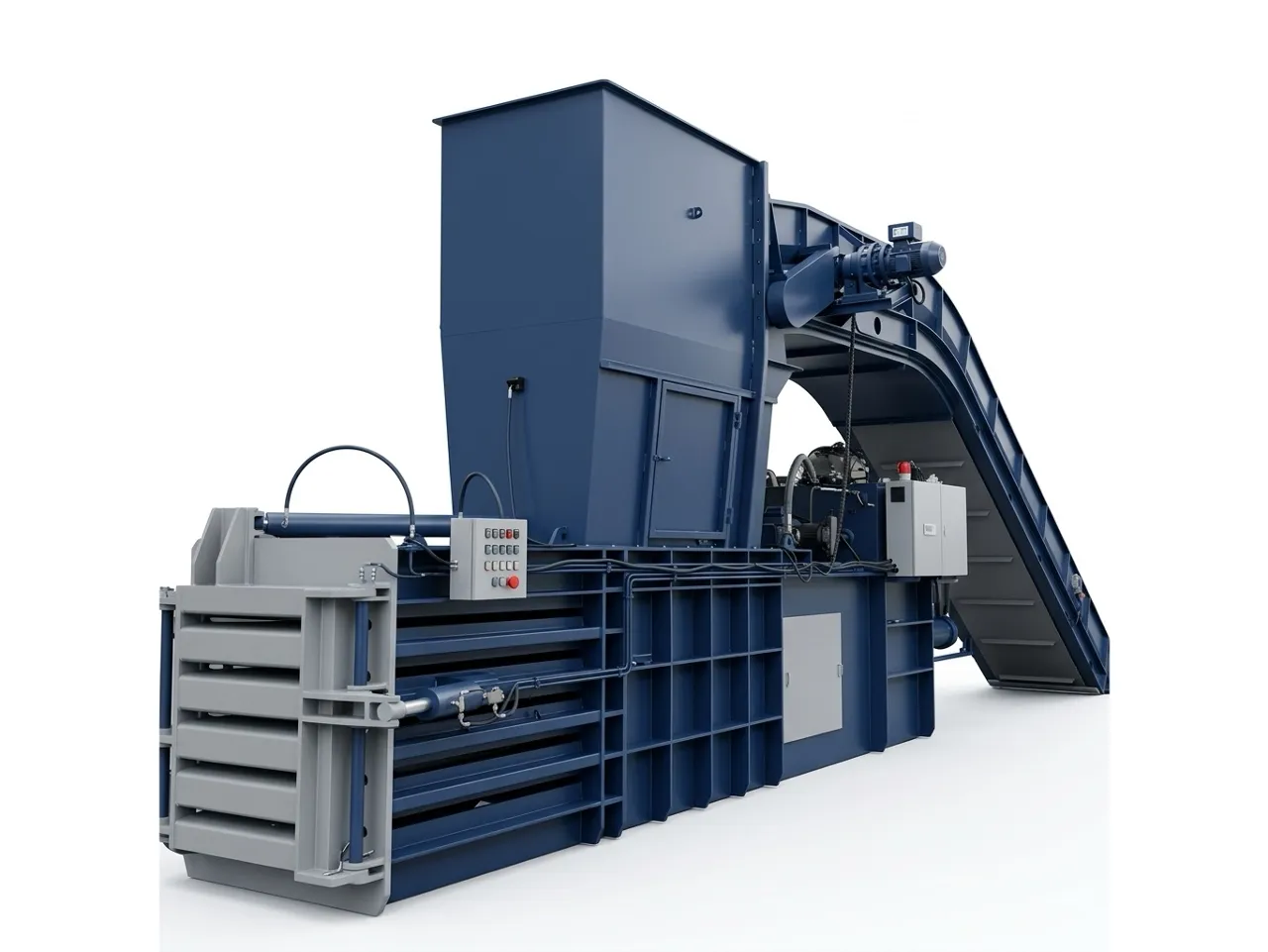
Semi-automatic horizontal balers for waste paper, OCC, cardboard and selected plastic recycling applications. Compare seven WB and WS models with 30–100 ton pressing force, different chamber sizes and bale dimensions. Feeding, controls, tying and discharge arrangements are specified for your material and production needs; semi-automatic operation still requires operator involvement in tying and handling.

Choose a Horizontal Baler Around Your Material and Bale Requirements
Compare the WB and WS model specifications below, then confirm the feeding, tying and discharge configuration for your site. Throughput depends on the material and operating cycle, not pressing force alone.
Bale Discharge Matched to the Model
Open-gate discharge is available on the configurations shown. Confirm the gate arrangement, operating clearance and bale removal method for the selected model.
A Range of Chamber and Bale Sizes
The range covers compact 30–40 ton models and larger 60–100 ton machines. Match loose material volume, feed opening and finished bale dimensions to your operation.
Optional Scrap Collection Integration
For suitable paper trims and lightweight production scrap, an optional cyclone or collection system can feed the baler. Material suitability and integration are confirmed during selection.
Cutting Configuration for Paper Trims
A double-cutting configuration can assist with paper trims and cardboard offcuts. Confirm its availability and suitability for the selected model and feedstock.
Bales Sized for Storage and Transport
Select bale dimensions and tying arrangements around your handling equipment and buyer requirements. Bale density varies with the material, moisture and operating settings.
Controls and Hydraulic Configuration
Manual and PLC-based control configurations are selected to suit the model and work cycle. Confirm the controls, safety interlocks and operator tasks in the final proposal.
Matériaux et industries typiques
Paper and cardboard are core applications. PET bottles and PP/PE film require a suitable model, tying arrangement and feed preparation; confirm the configuration for each material rather than assuming one setup handles every stream.
Plantes de carton et de carton
Permet de compacter les chutes de carton, les restes de carton ondulé et les déchets de carton ondulé en balles plus denses, plus faciles à stocker et à expédier.
Imprimeries et usines de papier
Convient aux papiers journaux, magazines, papiers découpés et autres déchets fibreux similaires qui s'accumulent en continu pendant la production.
Recyclage des bouteilles en PET
For bottle collection and recycling sites, subject to confirmation of bottle condition, feeding, bale density and tying requirements.
Traitement des films PP et PE
Utile pour les chutes de film, les déchets de découpe et les déchets d'emballage lorsque la réduction du volume et une organisation plus propre de l'usine sont prioritaires.
Consolidation des déchets industriels
For factories and recycling centers consolidating sorted recyclable streams. Keep different materials in separate bales when required by downstream buyers.
Mise à niveau intermédiaire de l'automatisation
Souvent choisie comme étape intermédiaire entre le pressage vertical manuel et les systèmes horizontaux entièrement automatisés alimentés par convoyeur.
Fonctionnement du processus de mise en balles horizontale semi-automatique
Cette machine compacte les matériaux recyclables en vrac en balles prêtes à être transportées, avec une structure de fonctionnement plus simple qu'une presse à balles entièrement automatique.
Alimenter le matériau
Load loose paper, cardboard or an approved recyclable stream into the feed opening. Manual, conveyor or cyclone feeding depends on the agreed configuration.
Compress Horizontally
The hydraulic ram compacts the material through repeated strokes. Controls and operator tasks depend on the selected model.
Reach the Bale Size
Build the bale to the required dimensions. The WB models list fixed reference bale dimensions; the WS models list a variable length L.
Attachez la balle
The operator completes manual or assisted tying as specified. Semi-automatic does not mean fully automatic wire tying.
Discharge and Handle
Release and remove the tied bale using the selected discharge arrangement. Keep gate access and handling clearance in the equipment layout.
Compare Semi-Automatic, Fully Automatic and Vertical Balers
Compare the operating method as well as hourly volume. A larger semi-automatic model can suit substantial throughput, provided the site can support feeding, tying and bale handling.
| Facteur de décision | Presse à balles horizontale semi-automatique | Presse à balles horizontale entièrement automatique | Presse à balles verticale PET |
|---|---|---|---|
| Meilleure adaptation | Opérations de taille moyenne avec un flux recyclable constant | Grands sites continus avec un tonnage journalier élevé | Sites de petite et moyenne taille avec chargement par lots |
| Niveau d'automatisation | Hydraulic compression with manual or assisted tying | Automatic tying with configured feeding and discharge | Manutention et ligature plus manuelles |
| Méthode d'alimentation | Alimentation directe ou alimentation assistée par cyclone en option | Chargement continu par convoyeur | Chargement manuel par lots |
| Empreinte et complexité | Depends on model, infeed equipment and bale handling space | Empreinte et complexité du système maximales | Solution la plus compacte |
| Quand choisir | Lorsque vous avez besoin d'une solution plus performante que le pressage vertical sans automatisation complète | Lorsque le débit à grande échelle et la réduction de la main-d'œuvre le justifient | Lorsque le volume reste modéré et que l'espace est limité |
Faites défiler horizontalement pour voir le tableau complet.
Caractéristiques techniques
Compare seven semi-automatic horizontal baler models for waste paper, cardboard and approved recyclable streams. Values are reference specifications; confirm the final machine configuration and achievable output for your material.
WB Models — Reference Bale Dimensions
| Modèle | RTM300WB7070 | RTM400WB7280 | RTM600WB10080 | RTM1000WB11085 | RTM1000WB110110 |
|---|---|---|---|---|---|
| Pression | 30 tonnes | 40 tonnes | 60 tonnes | 100 tonnes | 100 tonnes |
| Puissance motrice principale | 11 kW | 11 kW | 15 kW | 30 kW | 30 kW |
| Temps de cycle | — | 19 s | 23 s | 36 s | 42 s |
| Réservoir de pétrole | — | 240 L | 380 L | 1460 L | 1600 L |
| Nombre de courroies | 3 lignes | 4 lignes | 4 lignes | 4 lignes | 5 lignes |
| Ouverture du flux | 700 x 690 mm | 1000 x 700 mm | 1200 x 980 mm | 1400 x 1050 mm | 1800 x 1050 mm |
| Taille de la chambre | — | 2200 x 700 x 780 mm | 2400 x 980 x 780 mm | 3000 x 1050 x 830 mm | 3700 x 1050 x 1050 mm |
| Taille de la balle | 900 x 700 x 700 mm | 1000 x 720 x 800 mm | 1000 x 1000 x 800 mm | 1300 x 1100 x 850 mm | 1600 x 1100 x 1100 mm |
| Densité des balles pour OCC | 400 - 500 kg/m³ | 400 - 500 kg/m³ | — | — | — |
| Débit | 0,5 - 1 tonne/h | 0,5 - 1 tonne/h | 1 à 2 tonnes/h | 1,5 à 3 tonnes/h | 2 à 6 tonnes/h |
| Poids de la machine | 4 tonnes | 4 tonnes | 5,2 tonnes | 12 tonnes | 18 tonnes |
| Dimensions hors tout | 4200 x 1100 x 1900 mm | 5500 x 1100 x 2000 mm | 6100 x 1400 x 2000 mm | 7450 x 1600 x 2300 mm | 8200 x 1600 x 3500 mm |
Faites défiler horizontalement pour voir le tableau complet.
WS Models — Variable Bale Length
| Modèle | RTM400WS7280 | RTM1000WS110125 |
|---|---|---|
| Pression | 40 tonnes | 100 tonnes |
| Puissance motrice principale | 11 kW | 55 kW |
| Nombre de courroies | 4 lignes | 5 lignes |
| Ouverture du flux | 1000 x 690 mm | 2080 x 1076 mm |
| Taille de la balle | L x 720 x 800 mm | L x 1100 x 1250 mm |
| Densité des balles pour OCC | 350 - 450 kg/m³ | 400 - 500 kg/m³ |
| Débit | 0,5 - 1 tonne/h | 5 à 8 tonnes/h |
| Poids de la machine | 5 tonnes | 16,5 tonnes |
| Dimensions hors tout | 4800 x 1500 x 2000 mm | 9100 x 2500 x 4300 mm |
Faites défiler horizontalement pour voir le tableau complet.
L denotes variable bale length. A dash means that the value is not listed and must be confirmed. OCC density values apply to corrugated cardboard, not every material. Throughput depends on feed density, moisture, feeding consistency, tying time and bale handling. RTM400WB7280 is also listed as RTM-400WB7280; it is shown once here.
Baler Configurations
Reference equipment photos. The final gate, infeed and discharge arrangement depends on the selected model and configuration.
Regardez la presse à balles en action
Aperçu rapide du fonctionnement de la presse à balles horizontale semi-automatique pour la collecte des déchets et la formation des balles en milieu industriel.
Foire aux questions (FAQ)
Questions fréquemment posées par les usines lors de l'évaluation d'une presse à balles horizontale semi-automatique.
Yes. Waste paper, OCC, carton offcuts and paper trims are core applications. Select the feed opening, chamber and bale dimensions around the size and volume of your material. PET bottles and PP/PE film require confirmation of the model and configuration.
The WB table lists reference bale dimensions for each model. The WS table uses L for variable bale length. The tables do not imply that gate design, controls or discharge arrangements are identical; confirm these details in the final proposal.
No. These machines require operator involvement in manual or assisted tying and bale handling. Manual or PLC-based controls can be specified by model, but the control system alone does not make tying fully automatic.
An optional cyclone or scrap collection system can be considered for suitable paper trims and lightweight scrap. Conveyor feeding may also be specified. Material characteristics, collection volume and plant layout must be checked before integration.
The equipment photos include an open-gate configuration. Gate design, bale release and handling clearance must be confirmed for the selected WB or WS model rather than assumed to be identical across the range.
The listed figures are reference values. Actual throughput depends on material bulk density, moisture, feeding consistency, tying time and handling. The listed OCC density ranges apply to corrugated cardboard and should not be used as guaranteed values for plastic film, bottles or other materials.
Share your material type and photos, hourly or daily volume, maximum feed size, required bale dimensions and density, shift pattern, power supply and available space. Also specify the feeding method, control preference and any collection equipment to be integrated.
Vous avez besoin de la presse à balles horizontale adaptée à votre débit ?
Indiquez-nous le type de matériau, la cadence de production horaire, le volume de balles souhaité et l'agencement de votre installation. Nous vous aiderons à déterminer si cette presse à balles horizontale semi-automatique ou une ligne entièrement automatique est la solution la plus adaptée.