

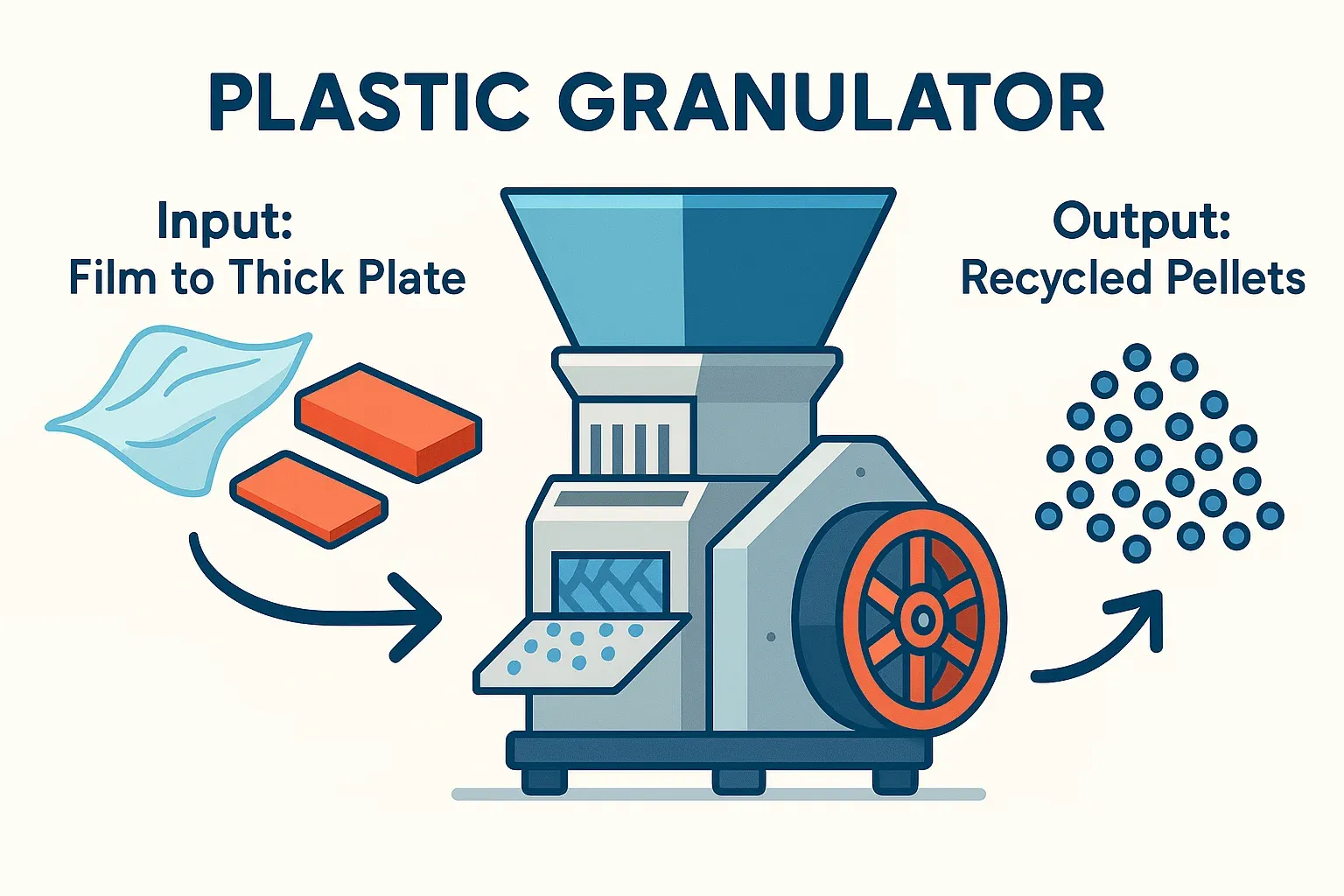
Plastični granulator može procesuirati film, butele, oblikovane dijelove, ploču i neke deble otpadke, ali jedan dizajn rotora i zalihe neće izvršavati jednako dobro na svakom obliku. Geometrija materijala određuje kako ulazi u rezni prostor, kako noževi reagiraju na njega i jesu li strojevi proizvodeći kontrolirani ponovno izrađeni materijal ili nestabilne načele. Ovaj vodič mapira uobičajene oblike plastičnih materijala na karakteristike granulatora koje su važne.
Što čini plastični granulator
Granulator koristi rotirajuće nože protiv fiksnih noževa postavljenih na postelju kako bi izrezao plastični materijal na čestice. Mreža zadržava prevelike materijale sve dok nisu dovoljno male da napuste prostor. Rezultat se obično naziva ponovno izrađeni materijal ili čestice; nije gotov pelotnički materijal osim ako sledi poseban proces extrudiranja i pelotizacije.
Granulacija može biti glavni korak smanjivanja veličine za butele, oblikovane dijelove i proizvođački otpad. Vruća cijev, velike odlagane masine, balonirani film ili debeli profili mogu prvo zahtjevati sjeckalica za plastiku da bi se stvorio kontrolirani unos za granulator. Izbor između jednostavnog granuliranja i procesiranja s kombinacijom reznika i granulatora je često važniji nego dodavanje motorne snage neskladnom stroju.
Karta aplikacija: film do debelog pločice
| Oblik ulaza | Glavni problem obrade | Karakteristike za procijenjivanje | Mogući prethodni korak |
|---|---|---|---|
| Loši film i torbe | Niska gustoća, omotavanje i valovi unosa | Kontrolirani unos, geometrija oštrim reznicima, detalji za sprječavanje omotavanja, efikasna evakuacija | Otvaranje balona, sortiranje ili prerezanje |
| Rigidi butele i kontejneri | Prazni dijelovi trzaju i propadaju nepredvidivo | Geometrija zalihe, tangencijalni prostor, suha ili vlažna konfiguracija, zaštitu od metala | Debaliranje, uklanjanje etiketa i sortiranje |
| Oblikovani dijelovi, izlaznici i kutije | Promjenljiva deblina zida i udarna načela | Otvor za unos, inercija rotora, postavljanje noževa i pristup mreži | Robočki ili konvejni unos |
| Ploča i ivica | Neprekidne trake mogu trzati ili premoštiti | Roll feeder ili naprezni unos, zaštićeni ulaz i sinkronizirane kontrole | Reza na dužinu kad je potrebno |
| Deblja ploča, profil i odlagane masine | Visoki načelni opterećenje, udar i rizik zastoja | Odluka o pregranuliranju, otvaranje prostora, moment, kugloznica i konstrukcija rotora | Jedno- ili dvoosnovni reznik |
Thin film and flexible packaging
Film is difficult because it is light and has a large surface area. It may float in a hopper, wrap around the rotor ends or arrive in sudden clumps. A high catalogue throughput based on rigid regrind says little about performance on loose film.
Evaluate the complete feeding arrangement: bale opener, conveyor, nip or roll feeder, hopper angle and the logic that stops the infeed during an overload. Knife geometry should create a controlled shearing action, while rotor-end seals and clearances should limit wrapping. The discharge or pneumatic evacuation system must remove light regrind without allowing it to recirculate unnecessarily.
Washed film introduces water and contamination. A wet granulator can help control heat and loose dirt, but it must be designed for drainage and corrosion resistance. If the objective is stable extrusion feeding after washing, a filmski stješnjivač sušilica or densification step may be required after granulation.
Bottles and hollow rigid containers
PET and HDPE bottles compress when the rotor contacts them. Hopper and chamber geometry should prevent repeated bounce-back and provide a consistent bite. Tangential-feed designs are often considered for bulky hollow parts, but performance still depends on bottle size, bale preparation, screen opening and feed control.
PET bottle processing may use water in the chamber as part of a washing line. HDPE containers may be granulated dry or wet depending on contamination and the downstream process. In either case, upstream metal removal and sorting protect the knives and reduce non-target resin in the output. See the dedicated Vodič za odabir granulatora PET boca for trial and acceptance criteria.
Oblikovani dijelovi, izlaznici i kutije
Injection-molding scrap can range from small runners to large housings and thick start-up pieces. Measure the largest part in three dimensions and identify inserts, fasteners or glass reinforcement. The feed opening must accept the actual part without unsafe manual pushing or uncontrolled kickback.
For beside-the-press work, low noise, dust control, easy color-change cleaning and a small footprint may be priorities. Central recycling systems place more emphasis on sustained throughput, material transport and rapid access for screens and knives. Abrasive fillers can change the knife material, wear protection and sharpening interval required.
Sheet, edge trim and continuous strip
Continuous sheet and edge trim need a controlled feed rate. A roll feeder or nip system can synchronize material entry with the granulator, reduce whipping and prevent the chamber from receiving a large loop at once. The inlet must be guarded for the final installation and should not allow an operator to reach the cutting zone.
Sheet thickness alone does not determine motor size. Width, polymer toughness, feed speed, number of layers, temperature and the required particle size all affect the load. A production trial should reproduce the maximum width and the fastest normal line speed.
Thick plate, profiles and purgings
Thick pieces require a reliable bite and can create high shock loads. Do not select a machine from maximum wall thickness alone. Record part dimensions, mass, polymer, temperature, fillers and whether the piece is solid or hollow. A large purge may exceed the safe infeed size even if its material is technically cuttable.
Pre-shredding is often the practical route when parts are too large, irregular or heavy for controlled granulator feeding. A shredder reduces them at lower speed, and the granulator then produces the final particle size. This staged arrangement may provide steadier loading and easier automation than attempting to force every piece directly into a high-speed cutting chamber.
Where direct granulation is appropriate, assess rotor construction, knife retention, bearings, drive protection, screen support and access for lifting heavy components. An extra-large rigid plastic granulator should be evaluated with the actual largest piece, not a smaller demonstration sample.
Screen size and output quality
The screen sets the maximum discharge path, but it does not create a perfectly uniform particle. Knife sharpness, gap, rotor speed, polymer behavior and recirculation also shape the distribution. Smaller openings can increase residence time, power demand, heat and fines; larger openings can release pieces that are too coarse for washing or extrusion.
Define the acceptable particle-size distribution and fines fraction, then measure them during the trial. The granulator screen-size guide explains how to move from a downstream requirement to a testable screen choice.
Capacity and motor selection
Nameplate motor power cannot be converted into a universal kg/h figure. Usable throughput depends on feed geometry, bulk density, screen, blade condition and the amount of oversize recirculation. Ask for sustained results from a representative test, including normal and peak current, stoppages and the mass of acceptable output—not only material fed into the hopper.
Size the machine with the upstream and downstream line. A granulator that repeatedly fills a washer or pneumatic conveying system beyond its stable rate creates a new bottleneck. A buffer and controlled feed may deliver a better line result than a larger cutting chamber.
Safety and maintenance checks
- Interlocked access doors and guards appropriate to the feed method
- Protection against unexpected restart and a documented energy-isolation procedure
- Sigurna metoda zaključavanja rotora za rad s nožem i ekranom
- Sigurni točki za izvlačenje i prostor za uklanjanje taljaca, ekran i noževa
- Metalna zaštitu prikladnu za rizik ulaznog materijala
- Kontrola prašine, buke i vlažnog procesa prikladna za instalaciju
- Dostupne delove za izmjenjivanje, upute za nošenje i usluge podrške
Lepši način za usporedbu granulatora
Naručite svakom dobavljaču istu opis materijala, maksimalnu veličinu dijela, zahtjevnu izlaznost, potrebne usluge i raspored linije. Testirajte predstavni lot, zatim usporedite prihvatljivu količinu izlaza, raspodjelu čestica, finu, energiju po tuni, vrijeme čišćenja i primijećeni izgaranje. Širi Vodič za odabir plastičnog granulatora uključuje pitanja za komercijalnu i tehničku procjenu.
Pravilno prilagođeni granulator nije stroj koji tvrdi procesirati najširu listu plastičnih materijala. To je konfiguracija koja sigurno dovozi, proizvodi zahtjevni regranat i integrira se s sljedećom operacijom pod stvarnim uvjetima materijala u tvornici.
Česta pitanja
Mogu li jedan granulator procesuirati i film i tanki ploču?
Neki strojevi mogu procesirati više od jedne vrste, ali sustav za ulaz, rotor, noževi i mreža mogu biti potrebno promijeniti. Provjerite oboje materijale u posebnim ispitivanjima i usporedite kvalitet izlaznih proizvoda, ne samo to da stroj može ih izrezati.
Kada bi trebalo instalirati raper prije granulatora?
Razmislite o predrezanju kada je otpad prevelik, nepravilan, teški ili teško sigurno izmjeriti u granulator. Rezancer stvara kontrolirani unos; zatim granulator postavlja konačnu veličinu ponovno izrađenog materijala.
Je li veći motor uvijek povećanje kapaciteta granulatora?
Broj ulaganja, geometrija rotora, površina mreže, stanje noža i ispuštanje uzdužnog toka mogu ograničiti izlaz. Kapacitet treba mjeriti s predstavnom materijalom i zahtjevnom mrežom.
