

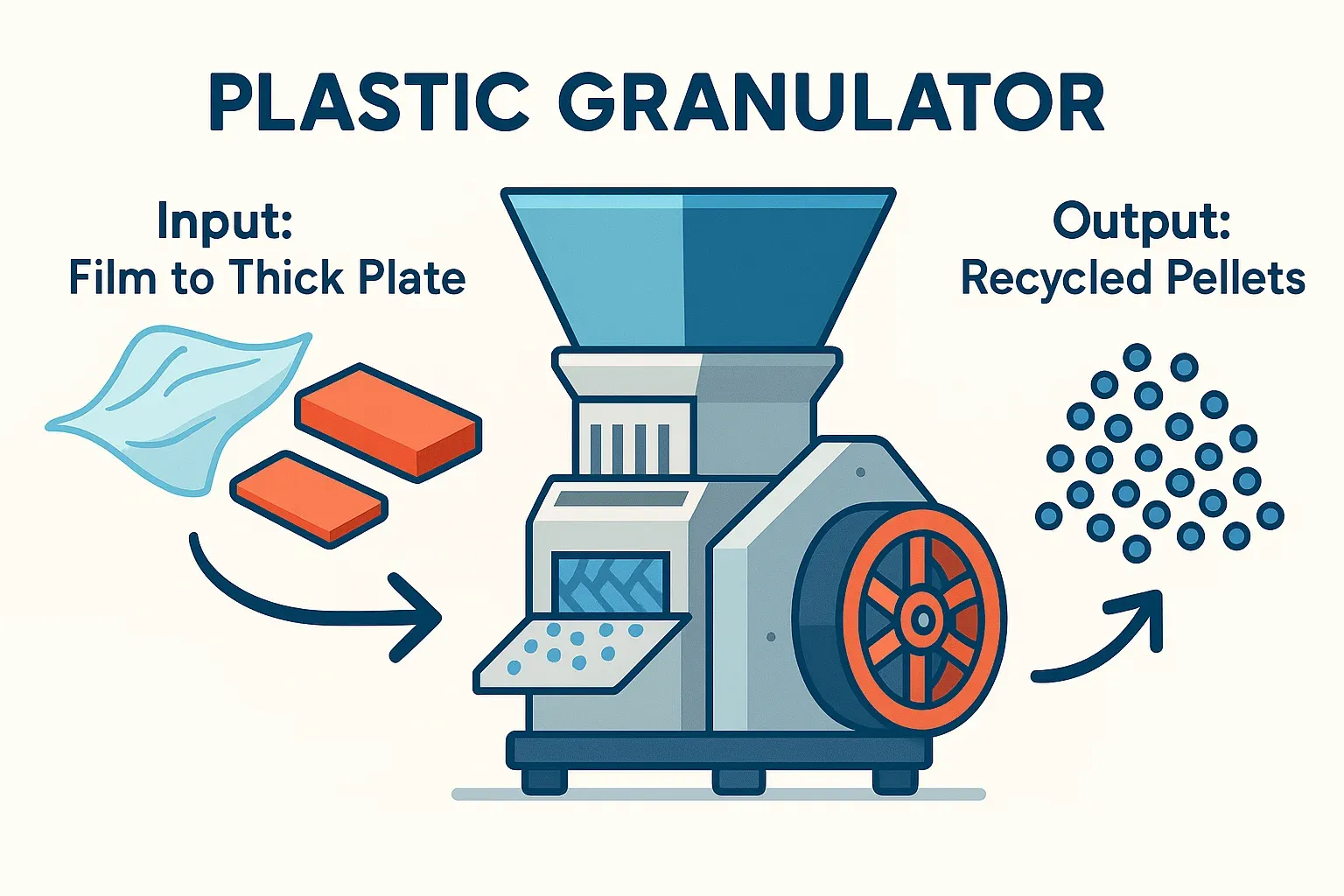
Een plastic granulator kan film, flessen, gietdelen, plaat en sommige dikke afvalstukken verwerken, maar niet elke rotor- en hopperspecificatie presteert even goed op alle vormen. De materiaalgeometrie bepaalt hoe het in de snijkamer komt, hoe de messen erin engageeren en of de machine een gestuurde herverwerking of onstabiele lading produceert. Deze gids koppelt gebruikelijke plasticvormen aan de granulatorkenmerken die belangrijk zijn.
What a plastic granulator does
Een granulator gebruikt draaiende messen tegen vaste bedmessen om plastic te snijden in deeltjes. Een zeef behoudt overschotmateriaal totdat het klein genoeg is om de kamer te verlaten. Het resultaat wordt meestal herverwerking of schors genoemd; het is geen afgerond granulaat tenzij een aparte extrusie- en granulaatproces volgt.
Granulatie kan de primaire stap voor het verminderen van de maat van flessen, gietdelen en productieafval zijn. Opgezwolle buizen, grote ontluchtingen, gebaleide film of dikke profielen kunnen eerst een plastic versnipperaar nodig hebben om een gestuurde voeding voor de granulator te creëren. Het kiezen tussen eenstuks granulatie en shredder-plus-granulatorverwerking is vaak belangrijker dan het toevoegen van motorvermogen aan een ongeschikte machine.
Application map: film to thick plate
| Feed form | Main handling problem | Features to evaluate | Possible upstream step |
|---|---|---|---|
| Loose film and bags | Low bulk density, wrapping and feed surges | Controlled feed, scissor-cut geometry, anti-wrap details, effective evacuation | Bale opening, sorting or pre-cutting |
| Rigid bottles and containers | Hollow parts bounce and collapse unpredictably | Hopper geometry, tangential chamber, wet or dry configuration, metal protection | Debaling, label removal and sorting |
| Molded parts, runners and crates | Variable wall thickness and impact load | Feed opening, rotor inertia, knife mounting and screen access | Robotic or conveyor feeding |
| Sheet and edge trim | Continuous strips can whip or bridge | Roll feeder or nip feed, guarded inlet and synchronized controls | Length cutting where required |
| Thick plate, profile and purgings | High bite load, shock and stalling risk | Pre-shredding decision, chamber opening, torque, bearing and rotor construction | Single- or double-shaft shredding |
Thin film and flexible packaging
Film is moeilijk omdat het licht is en een groot oppervlak heeft. Het kan in een hopper drijven, zich om de rotoruiteinden wikkelen of in plotseling klonten aankomen. Een hoog catalogusvermogen gebaseerd op een rigide herverwerking zegt weinig over de prestaties op losse film.
Evalueer de volledige voedingsopstelling: balopener, transportband, knijper of rolvoeder, hoppershoek en de logica die de invoer stopt tijdens een overbelasting. De mesgeometrie moet een gestuurde snijactie creëren, terwijl de rotoruiteinddichtingen en spelingen het omslingeren moeten beperken. Het afvoersysteem of het pneumatische afvoersysteem moet licht herverwerkingsmateriaal verwijderen zonder dat het onnodig hercirculeert.
Wassen film voegt water en vervuiling toe. Een natte granulator kan helpen om warmte en losse vuil te controleren, maar hij moet ontworpen zijn voor drainage en corrosiebestendigheid. Als het doel stabiele extrusievoeding na het wassen is, kan een folie persontwateraar droger of verdikkingstraject nodig zijn na de granulatie.
Flessen en holle harde containers
PET- en HDPE-flessen comprimeren wanneer de as erbij raakt. De geometrie van de hopper en de kamer moet het herhaaldelijke terugbollen voorkomen en een consistente bijting bieden. Tangentiële voedingsontwerpen worden vaak overwogen voor volumineuze holle onderdelen, maar de prestaties zijn nog steeds afhankelijk van de flesgrootte, balbereiding, schermopening en voedingscontrole.
Het verwerken van PET-flessen kan water in de kamer gebruiken als onderdeel van een wasslijn. HDPE-containers kunnen droog of nat worden granuleerd afhankelijk van de vervuiling en het downstream-proces. In elk geval beschermen upstream het verwijderen van metaal en sorteren de messen en verminderen ze ongewenste resines in de uitgang. Zie de Selectiegids voor PET fles granulator voor proef- en acceptatiecriteria.
Molded parts, runners and crates
Restgootsmateriaal voor injectiegieterij kan variëren van kleine runners tot grote behuizingen en dikke start-up stukken. Meet het grootste deel in drie dimensies en identificeer inleggingen, bevestigingen of glasvezerversterking. De voeropening moet het werkelijke deel accepteren zonder onveilige handmatige druk of onbeheerste terugslag.
Voor naast-de-press werk kunnen lage geluidsniveaus, stofbeheersing, eenvoudige kleurverversingsreiniging en een klein voetafdruk prioriteiten zijn. Centrale recyclingssystemen leggen meer nadruk op voortdurende doorvoer, materiaaltransport en snelle toegang voor schermen en messen. Schurende vulstoffen kunnen het mesmateriaal, slijtbescherming en de slijpinterval veranderen.
Blad, randafval en continue strip
Continu blad en randafval vereisen een gereguleerde voersnelheid. Een rolvoeder of knijpsysteem kan de materiaaltoegang synchroniseren met de granulator, het slingeren verminderen en voorkomen dat de kamer ooit een groot lint ontvangt. De inlaat moet beveiligd zijn voor de uiteindelijke installatie en mag een operator niet toestaan om de snijzone te bereiken.
De dikte van het blad alleen bepaalt niet de motorgrootte. Breedte, polymerkwaliteit, voersnelheid, aantal lagen, temperatuur en de vereiste korrelgrootte beïnvloeden allemaal de belasting. Een productietest moet de maximale breedte en de snelste normale lijnsnelheid reproduceren.
Dikke plaat, profielen en purgings
Dikke stukken vereisen een betrouwbare bijt en kunnen hoge schokladingen veroorzaken. Kies geen machine alleen op basis van de maximale wanddikte. Neem de afmetingen, massa, polymeren, temperatuur, vulstoffen en of het stuk volledig of hol is op. Een grote spoel kan de veilige invoergrootte overschrijden, zelfs als het materiaal technisch gezien snijbaar is.
Voorverwerking is vaak de praktische route wanneer onderdelen te groot, onregelmatig of zwaar zijn voor gecontroleerde granulatorinvoer. Een shredder verkleint ze bij lagere snelheid, en de granulator produceert vervolgens de uiteindelijke korrelgrootte. Deze gestage opstelling kan een stabielere belading en eenvoudiger automatisering bieden dan het proberen van elk stuk direct in een hoge snelheidssnijcavity te dwingen.
Waar directe granulatie geschikt is, beoordeel de constructie van het roterend mes, mesretentie, kogellagers, bescherming van de aandrijving, ondersteuning van het zeilsysteem en toegang voor het tillen van zware onderdelen. Een extra grote stijve kunststof granulator moet worden geëvalueerd met het daadwerkelijke grootste stuk, niet met een kleinere demonstratiesample.
Zeilmateriaal en uitvoerkwaliteit
Het zeil bepaalt de maximale afvoerweg, maar het creëert geen perfect uniforme korrel. Mesverzering, spatiëring, roterende snelheid, polymergedrag en recirculatie beïnvloeden ook de verdeling. Kleinere openingen kunnen de verblijfsduur, vermogensbehoefte, warmte en fijnstof verhogen; grotere openingen kunnen stukken vrijgeven die te ruw zijn voor wassen of extrusie.
Definieer de aanvaardbare deeltjesgrootteverdeling en de fractie van fijnstof, meet deze vervolgens tijdens het proeftraject. De granulator schermgroottegids verklaart hoe je van een downstream-eis overgaat naar een testbare schermkeuze.
Capaciteit en motorkeuze
De naamplaatmotorvermogen kan niet worden omgezet in een universele kg/h-getal. De bruikbare capaciteit hangt af van de voedingsgeometrie, de massa dichtheid, het scherm, de messenconditie en de hoeveelheid oversize recirculatie. Vraag om duurzame resultaten van een representatief test, inclusief normaal en piekstroom, stilstanden en het gewicht van de aanvaardbare uitvoer—niet alleen het materiaal dat in de hopper wordt gevoerd.
Sizeer de machine met de upstream- en downstreamlijn. Een granulator die herhaaldelijk een wasmachine of een pneumatische transportinstallatie overbelast tot beyond zijn stabiele snelheid, creëert een nieuwe knelpunt. Een buffer en een gecontroleerde voeding kunnen een betere lijnresultaat leveren dan een grotere snijruimte.
Veiligheid en onderhoudscontroles
- Geïntegreerde toegangsdeuren en beschermingen geschikt voor de voedingsmethode
- Bescherming tegen onverwachte herstart en een gedocumenteerde energie-isolatieprocedure
- Een veilige rotorvergrendelingsmethode voor mes- en schermwerk
- Veilige hefpunten en ruimte om het hopper, scherm en messen te verwijderen
- Metalbescherming geschikt voor het risico op feedstock
- Stof, geluid en natte-procescontrole geschikt voor de installatie
- Beschikbare slijtage onderdelen, scherf-instructies en serviceondersteuning
Een betere manier om granulators te vergelijken
Geef elke leverancier dezelfde materiaalbeschrijving, maximale onderdelenmaat, vereiste uitvoer, nutsvoorzieningen en lijnindeling. Test een vertegenwoordigend batch, dan vergelijk de aanvaardbare doorvoer, deeltjesverdeling, fijnstof, energie per ton, schoonmaaktijd en waargenomen slijtage. Het bredere plastic granulator selection guide bevat vragen voor commerciële en technische evaluatie.
Een correct afgestemde granulator is niet de machine die beweert de breedste lijst van plastics te kunnen verwerken. Het is de configuratie die veilig voedt, de vereiste herverwerkingsstof produceert en integreert met de volgende operatie onder de werkelijke materiaalomstandigheden in de fabriek.
Gewone vragen
Kan een granulaatmachine zowel film als dikke plaat verwerken?
Sommige machines kunnen meer dan één vorm verwerken, maar het voedselsysteem, de rotor, de messen en het zeef kunnen mogelijk moeten worden aangepast. Valideer beide materialen in aparte proeven en vergelijk de kwaliteit van het product, niet alleen of de machine ze kan snijden.
Wanneer moet een shredder worden geïnstalleerd voordat een granulator?
Overweeg voorvermalen als het afval te groot, onregelmatig, zwaar of moeilijk veilig in te doseren in de granulaatmachine is. De shredder creëert een gereguleerde voeding; de granulaatmachine stelt dan de uiteindelijke hervermalde maat in.
Is een hogere vermogensmotor altijd een toename van de granulaatcapaciteit?
Geen. Voeding, roterende geometrie, zeefoppervlakte, mesconditie en afvoer naar beneden kunnen de uitvoer beperken. Capaciteit moet worden gemeten met representatief materiaal en de vereiste zeef.
