

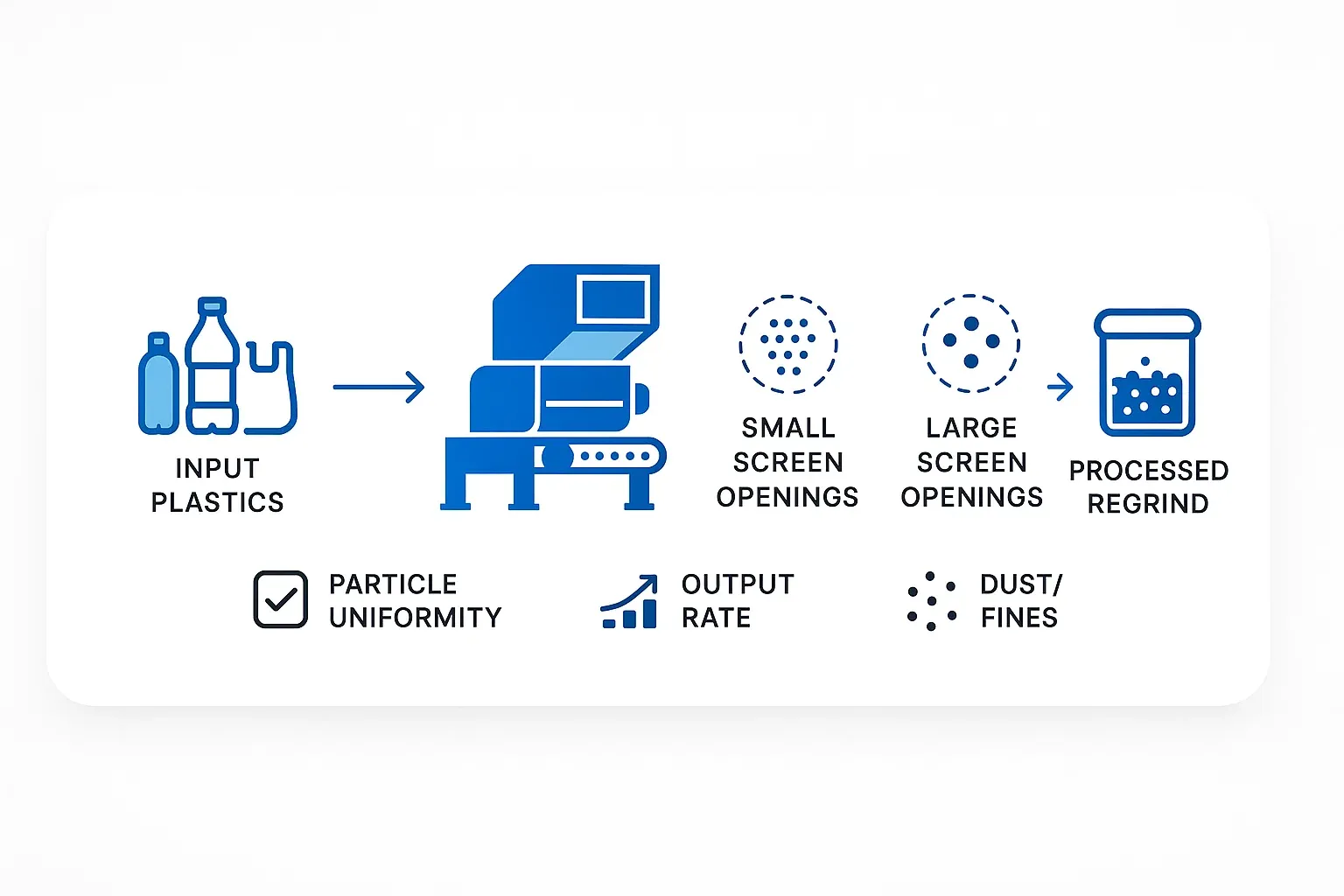
The correct plastic granulator screen is the one that produces an acceptable particle-size distribution for the next process at a stable operating load. Hole diameter matters, but it is not the whole specification. Hole shape, open area, plate thickness, material, support and condition all affect how quickly regrind leaves the cutting chamber.
This guide provides a selection workflow for buyers and plant engineers. For a deeper explanation of what changes when openings become smaller or larger, see how granulator screen size influences output quality.
Start with the downstream requirement
Do not begin by asking for the supplier’s “standard” screen. Define what the regrind must do next:
- Pranje: particles must move through washers, separation tanks and dryers without excessive fines or oversized pieces.
- Extrusion or molding: regrind must feed consistently and mix with any other material used in the recipe.
- Secondary size reduction: the first machine may only need a controlled intermediate piece.
- Sale as regrind: the customer may specify a sieve distribution, maximum dimension, fines limit and contamination limit.
Write the requirement as a measurable distribution instead of one nominal size. A screen with round holes does not make spherical particles of that diameter. Thin flakes, shards and elongated pieces can pass depending on their orientation, so the output must be sampled and sieved or otherwise measured.
Inputs that determine screen choice
Ponašanje polimera
Brittle plastics tend to fracture, while ductile or flexible materials can stretch, fold or smear. Heat-sensitive material may soften when residence time and friction increase. Filled or reinforced polymers may be more abrasive. These behaviors affect fines, screen wear and the useful operating range.
Feed form and maximum size
Film, bottles, molded parts, runners, sheet, pipe and purgings load the rotor differently. The screen cannot correct an unsuitable hopper or cutting chamber. Very large or thick parts may need pre-shredding before a granulator can produce the final regrind safely and consistently.
Rotor, knives and gap
Rotor speed, knife geometry, number of cuts per revolution and rotor-to-bed-knife gap influence particle shape before it reaches the screen. A worn or incorrectly set knife can create tails and heat even with the expected screen installed. Evaluate screen trials only after the cutting system is in a known condition.
Required line throughput
A smaller opening normally keeps material in the chamber longer, but the capacity effect is material- and machine-specific. Feed consistency, screen open area, evacuation and recirculation can become the limiting factors. Require sustained net output from the intended feedstock rather than a general percentage increase or reduction.
Screen dimensions to specify
Hole size and shape
Round holes are common and provide a clear nominal diameter. Other shapes may be used for particular particle forms or open-area requirements. The supplier should explain the intended discharge behavior and provide a drawing, not only a verbal size.
Screen opening is a starting variable, not a guaranteed maximum particle dimension. A smaller nominal hole usually shifts the distribution smaller, but the final result must be measured with the actual resin and knife condition.
Otvoreni prostor
Open area is the total hole area divided by the active screen area. Two screens with the same hole diameter can have different open area because of pitch and pattern. More open area can improve discharge, but strength, support and wear must remain adequate.
When comparing quotations, ask for the active dimensions, hole pattern, pitch and calculated open-area percentage. A drawing prevents confusion about borders, mounting zones and areas blocked by supports.
Plate thickness and material
Plate thickness, steel grade, heat treatment and support determine how the screen resists impact and fatigue. A thick plate may be more robust but changes the passage geometry. Wet service, corrosive contamination and abrasive fillers may require different material or wear protection. Confirm compatibility with the existing machine and fastening system.
Praktični proces početnog ekrana
- Definirajte cilj. Zabilježite zahtjevnu raspodjelu čestica, granicu finih, količinu i proces ispod toka.
- Opisite ulaz. Uključite polimer, oblik proizvoda, dimenzije, debljinu, gustinu, vlagu i kontaminaciju.
- Provjerite omot stroja. Potvrdite proizvođačev odobreni raspon mreže, konstrukciju ploče i podršku.
- Odaberite dvije ili više probnih mreža. Ograničite očekivani rezultat umjesto da pretpostavljate da je jedan prijedlog iz kataloga konačan.
- Testirajte pod uslovima koji odgovaraju. Održavajte konzistentne pripreme ulaza, veličinu serije, stanje noža i metodu uzorkovanja.
- Odaberite iz mjerenog trokuta. Odaberite najveću otvoru koja se pouzdano slaže s veličinom i kvalitetom ispod toka, uz održavanje prihvatljive opterećenosti stroja i sigurnosti.
Zadnja točka izbjegava neovisnu recirkulaciju. To nije pravilo da se koristi najveća dostupna mreža; to je metoda za izbjegavanje finer mreže nego što zahtijeva specifikacija proizvoda.
Što mjereni tijekom probnog perioda
| Mjerenje | Zašto je to važno |
|---|---|
| Neto prihvatljiv izlaz | Odvojiti proizvodljivu ili upotrebljivu ponovno izrađenu masu od količine ulaza i odlučaka |
| Raspodjela veličine čestica | Pokazuje prevelike čestice, ciljnu frakciju i finu umjesto samo prosjeka |
| Normalni i vrhunski motorski strujni tok | Reveals load stability and overload risk |
| Material and chamber temperature | Identifies heat buildup or softening |
| Dust and fines | Affects handling, yield, cleaning and downstream melt quality |
| Stoppages and interventions | Captures bridging, wrapping and screen blinding |
| Screen and knife condition | Provides a wear baseline and exposes contact or abnormal loading |
Run long enough to reach stable operation and sample at several times. A short demonstration can miss screen blinding, heat accumulation or feed variation.
Material-specific cautions
Film and flexible plastics
Small holes do not solve rotor wrapping or poor feeding. They can increase residence time and heat. Review hopper, rotor-end design, knife gap and evacuation together. Washed film may require wet granulation and a later squeezing step.
Bottles and rigid containers
Check whether the flake size suits washing, label separation and drying. For PET, use a representative mix of bottle sizes, labels and closures. The Vodič za granulaciju PET boca covers the complete selection and acceptance process.
Thick parts and purgings
High shock loads and slow feeding may dominate the result before the screen does. Confirm whether a shredder should make an intermediate piece. Do not reduce the screen opening to compensate for a rotor that cannot engage the feed consistently.
Abrazivne ili punjene plastike
Glass, mineral filler, grit and metal contamination can accelerate wear. Measure hole growth, cracking and knife condition at planned intervals. Screen material and replacement frequency belong in the operating-cost comparison.
Common screen-selection mistakes
- Pretpostavljajući da je promjer otvora jednak najvećoj duljini svake izlazne čestice
- Poređenje veličine otvora bez poređenja otvorenog prostora i konstrukcije ploče
- Testiranje mreža s različitim stanjem noža ili pripremom ulaza
- Izvješćivanje ulaza taljerice umjesto neto prihvatljive izlazne količine
- Korištenje manjeg otvora kako bi se popravilo loše dozirano, omotavanje ili glupi noži
- Zanemarujući kapacitet pranja, prijenosa ili extruderskog opreme nizvodno
- Nastavak rada s puklim, oblikovanim ili nepravilno postavljenim mrežama
Održavanje i kontrola promjena
Inspekcija mreža za pukotinama, deformacijom, proširenim otvorima, zaslonom i iznošenjem oko podupora. Slijedi postupak izolacije, blokiranja rotora i izvlačenja proizvođača prije otvaranja komore. Zabilježi ID postavljene mreže, sati ili tona procesiranih i razlog zamjene.
Kada se mreža mijenja, obratite ju se kao promjena procesa. Zabilježite novu raspodjelu čestica, opterećenje i temperaturu umjesto da pretpostavljate da se još uvijek primjenjuju starije postavke. Sačuvajte crteže mreže i povijest inspekcije s specifikacijom rada granulatora.
Povzetak izbora veličine mreže
Odaberite iz zahtjeva nizvodnih čestica, potvrdite odobrenu konstrukciju stroja i testirajte više otvora s predstavnom ulaznom hranom. Mreža bi trebala biti specifikovana po geometriji otvora, otvorenom prostoru, ploči i podupori—not samo promjerom. Završno odlučivanje bi trebalo biti podržano mjerenom kvalitetom izlazne čestice, stabilnim opterećenjem i prihvatljivom iznošenjem.
Pregled dostupnih plastični granulatori samo nakon što je jasno specifikacija ulaza i izlaza; stroj i mreža moraju biti procjenjeni kao jedinstven sustav rezanja.
Česta pitanja
Kakvu veličinu ekrana bi trebao koristiti u granulatoru za plastični material?
Nema univerzalne veličine. Definirajte raspodjelu čestica na donjem dijelu i isprobajte kandidatske mreže s stvarnim materijalom, stanjem noža i načinom doziranja.
Je li veći zaslon uvijek povećanje količine proizvodnje?
Nikada nije. Često smanjuje recirkulaciju, ali doziranje, geometrija rotora, otvoreni prostor i izlaz mogu još uvijek ograničiti izlaz. Mjerite trajni neto prihvatljiv izlaz tijekom kontrolirane ispite.
Je promjer otvora mreže najveća veličina čestica?
Broj. Mogu proći tanki ili produženi čestice ovisno o orijentaciji. Provjerite cjelokupnu raspodjelu izlaznog distributivnog sustava uz uzorkovanje i mjerenje.
