

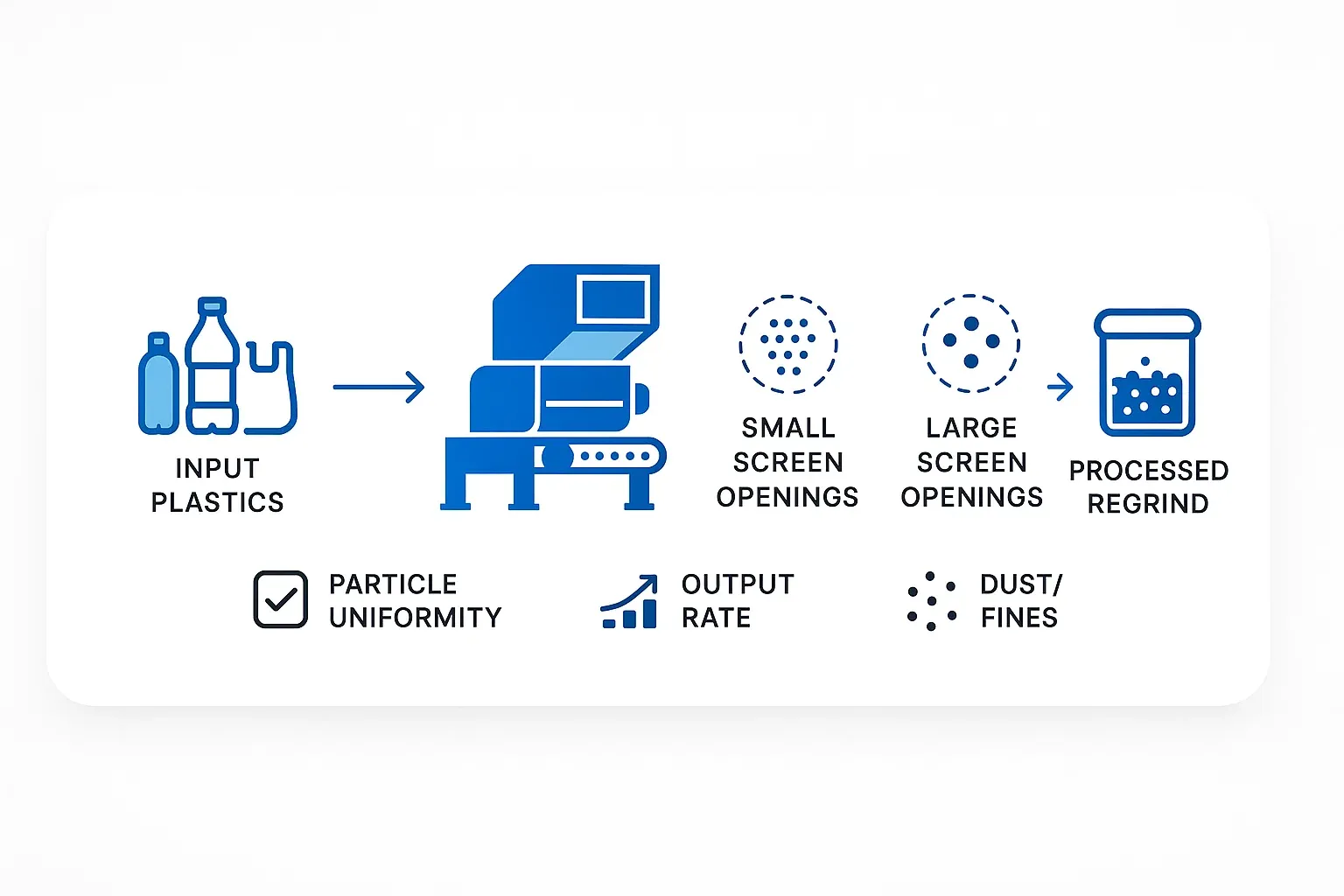
The correct plastic granulator screen is the one that produces an acceptable particle-size distribution for the next process at a stable operating load. Hole diameter matters, but it is not the whole specification. Hole shape, open area, plate thickness, material, support and condition all affect how quickly regrind leaves the cutting chamber.
This guide provides a selection workflow for buyers and plant engineers. For a deeper explanation of what changes when openings become smaller or larger, see how granulator screen size influences output quality.
Start with the downstream requirement
Do not begin by asking for the supplier’s “standard” screen. Define what the regrind must do next:
- Washing: particles must move through washers, separation tanks and dryers without excessive fines or oversized pieces.
- Extrusion or molding: regrind must feed consistently and mix with any other material used in the recipe.
- Secondary size reduction: the first machine may only need a controlled intermediate piece.
- Sale as regrind: the customer may specify a sieve distribution, maximum dimension, fines limit and contamination limit.
Write the requirement as a measurable distribution instead of one nominal size. A screen with round holes does not make spherical particles of that diameter. Thin flakes, shards and elongated pieces can pass depending on their orientation, so the output must be sampled and sieved or otherwise measured.
Inputs that determine screen choice
Polymer behavior
Brittle plastics tend to fracture, while ductile or flexible materials can stretch, fold or smear. Heat-sensitive material may soften when residence time and friction increase. Filled or reinforced polymers may be more abrasive. These behaviors affect fines, screen wear and the useful operating range.
Feed form and maximum size
Film, bottles, molded parts, runners, sheet, pipe and purgings load the rotor differently. The screen cannot correct an unsuitable hopper or cutting chamber. Very large or thick parts may need pre-shredding before a granulator can produce the final regrind safely and consistently.
Rotor, knives and gap
Rotor speed, knife geometry, number of cuts per revolution and rotor-to-bed-knife gap influence particle shape before it reaches the screen. A worn or incorrectly set knife can create tails and heat even with the expected screen installed. Evaluate screen trials only after the cutting system is in a known condition.
Required line throughput
A smaller opening normally keeps material in the chamber longer, but the capacity effect is material- and machine-specific. Feed consistency, screen open area, evacuation and recirculation can become the limiting factors. Require sustained net output from the intended feedstock rather than a general percentage increase or reduction.
Screen dimensions to specify
Hole size and shape
Round holes are common and provide a clear nominal diameter. Other shapes may be used for particular particle forms or open-area requirements. The supplier should explain the intended discharge behavior and provide a drawing, not only a verbal size.
Screen opening is a starting variable, not a guaranteed maximum particle dimension. A smaller nominal hole usually shifts the distribution smaller, but the final result must be measured with the actual resin and knife condition.
Open area
Open area is the total hole area divided by the active screen area. Two screens with the same hole diameter can have different open area because of pitch and pattern. More open area can improve discharge, but strength, support and wear must remain adequate.
When comparing quotations, ask for the active dimensions, hole pattern, pitch and calculated open-area percentage. A drawing prevents confusion about borders, mounting zones and areas blocked by supports.
Plate thickness and material
Plate thickness, steel grade, heat treatment and support determine how the screen resists impact and fatigue. A thick plate may be more robust but changes the passage geometry. Wet service, corrosive contamination and abrasive fillers may require different material or wear protection. Confirm compatibility with the existing machine and fastening system.
A practical starting-screen process
- Define the target. Record the required particle distribution, fines limit, throughput and downstream process.
- Describe the feed. Include polymer, product form, dimensions, thickness, bulk density, moisture and contamination.
- Check the machine envelope. Confirm the manufacturer-approved screen range, plate construction and support.
- Select two or more trial screens. Bracket the expected result rather than assuming one catalogue recommendation is final.
- Test under matched conditions. Keep feed preparation, batch size, knife condition and sampling method consistent.
- Choose from the measured trade-off. Select the largest opening that reliably meets the downstream size and quality requirement, provided machine load and safety remain acceptable.
The last point avoids unnecessary recirculation. It is not a rule to use the largest screen available; it is a method for avoiding a finer screen than the product specification requires.
What to measure during the trial
| Measurement | Why it matters |
|---|---|
| Net acceptable output | Separates saleable or usable regrind from feed rate and rejects |
| Particle-size distribution | Shows oversize, target fraction and fines rather than an average alone |
| Normal and peak motor current | Reveals load stability and overload risk |
| Material and chamber temperature | Identifies heat buildup or softening |
| Dust and fines | Affects handling, yield, cleaning and downstream melt quality |
| Stoppages and interventions | Captures bridging, wrapping and screen blinding |
| Screen and knife condition | Provides a wear baseline and exposes contact or abnormal loading |
Run long enough to reach stable operation and sample at several times. A short demonstration can miss screen blinding, heat accumulation or feed variation.
Material-specific cautions
Film and flexible plastics
Small holes do not solve rotor wrapping or poor feeding. They can increase residence time and heat. Review hopper, rotor-end design, knife gap and evacuation together. Washed film may require wet granulation and a later squeezing step.
Bottles and rigid containers
Check whether the flake size suits washing, label separation and drying. For PET, use a representative mix of bottle sizes, labels and closures. The PET bottle granulator guide covers the complete selection and acceptance process.
Thick parts and purgings
High shock loads and slow feeding may dominate the result before the screen does. Confirm whether a shredder should make an intermediate piece. Do not reduce the screen opening to compensate for a rotor that cannot engage the feed consistently.
Abrasive or filled plastics
Glass, mineral filler, grit and metal contamination can accelerate wear. Measure hole growth, cracking and knife condition at planned intervals. Screen material and replacement frequency belong in the operating-cost comparison.
Common screen-selection mistakes
- Assuming hole diameter equals the maximum length of every output particle
- Comparing hole size without comparing open area and plate construction
- Testing screens with different knife condition or feed preparation
- Reporting hopper feed instead of net acceptable output
- Using a smaller opening to fix poor feeding, wrapping or dull knives
- Ignoring the capacity of washing, conveying or extrusion equipment downstream
- Continuing to run a cracked, deformed or incorrectly seated screen
Maintenance and change control
Inspect screens for cracks, deformation, enlarged holes, blinding and wear around supports. Follow the manufacturer’s isolation, rotor-locking and lifting procedure before opening the chamber. Record the installed screen ID, hours or tonnes processed and the reason for replacement.
When a screen changes, treat it as a process change. Record the new particle distribution, load and temperature instead of assuming the previous settings still apply. Keep screen drawings and inspection history with the granulator’s operating specification.
Screen-size selection summary
Choose from the downstream particle requirement, confirm the machine-approved construction and test more than one opening with representative feed. A screen should be specified by hole geometry, open area, plate and support—not diameter alone. The final decision should be supported by measured output quality, stable load and acceptable wear.
Browse available plastic granulators only after the feed and output specification is clear; the machine and screen must be evaluated as one cutting system.
Frequently asked questions
What screen size should I use in a plastic granulator?
There is no universal size. Define the downstream particle distribution and test candidate screens with the actual material, knife condition and feed method.
Does a larger screen always increase throughput?
Not always. It often reduces recirculation, but feeding, rotor geometry, open area and discharge can still limit output. Measure sustained net acceptable output during a controlled trial.
Is screen-hole diameter the maximum particle size?
No. Thin or elongated particles can pass depending on orientation. Verify the full output distribution by sampling and measurement.
