

Selecting the right plastic granulator blades determines your facility’s throughput, energy consumption, and long-term maintenance costs. For operators processing everything from virgin polymers to contaminated post-consumer waste, knowing how to select plastic granulator blades prevents catastrophic edge chipping and excessive downtime. In our experience testing various setups across recycling plants, matching the blade’s material science to your specific feedstock increases efficiency and drops the Total Cost of Ownership (TCO). This guide breaks down exact material profiles, design configurations, and the critical hardness versus toughness trade-off to help you configure a superior granulation process.
The Core Trade-Off: Plastic Granulator Blade Hardness vs. Toughness
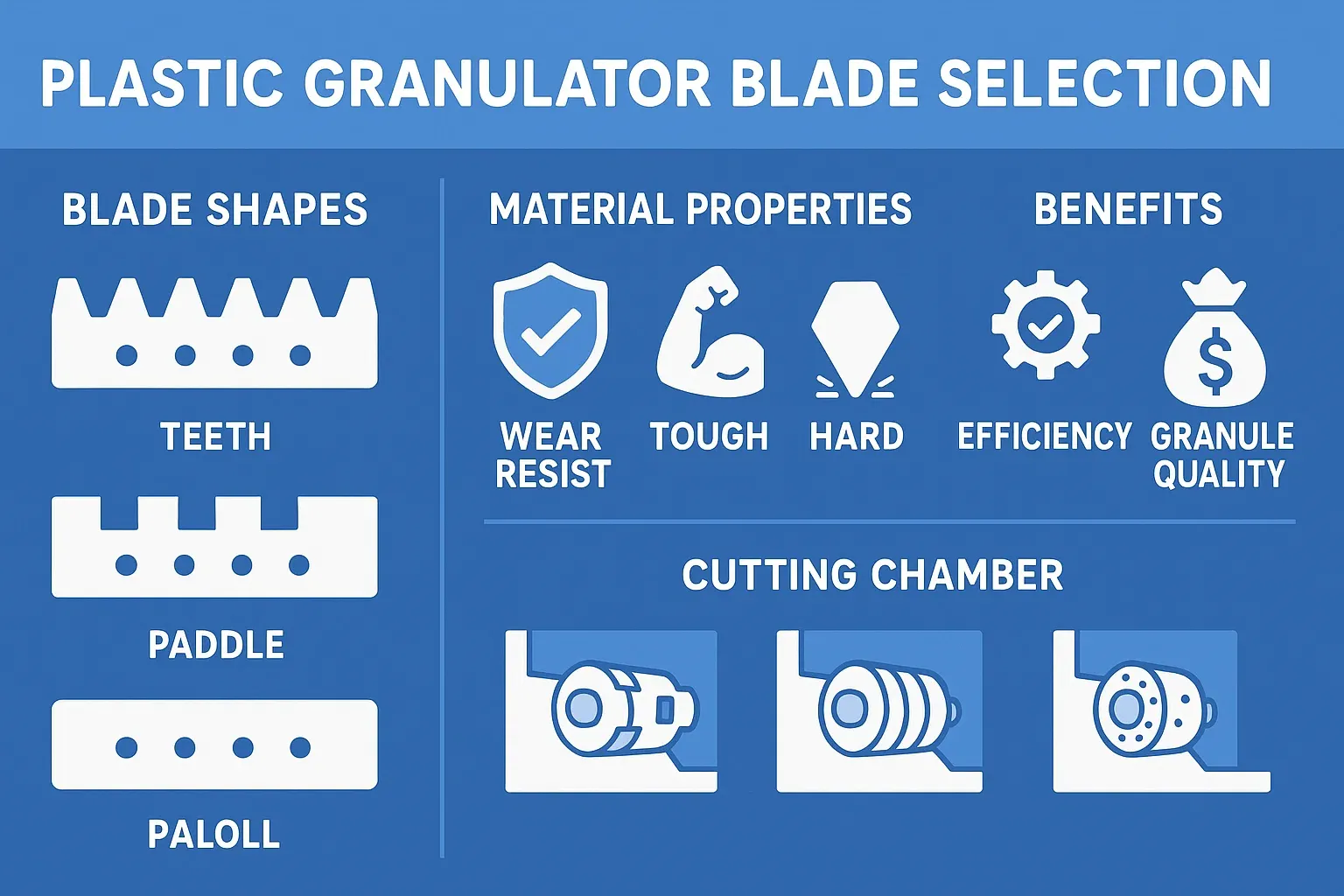
The hardness versus toughness trade-off is the fundamental principle that defines blade durability against impact resistance. Hardness measures a blade’s ability to resist wear and stay sharp, while toughness determines its ability to absorb shock without fracturing.
When processing clean, abrasive materials like glass-filled nylon, prioritize high hardness to maintain edge retention. However, if your feedstock contains unexpected metal contaminants, selecting the hardest blade will cause catastrophic chipping. For post-consumer waste streams, balancing moderate hardness with high toughness prevents fracture and extends the blade’s operational life.
Analyzing the Best Granulator Blade Materials
Choosing the optimum alloy directly impacts your operational runtime. Here are the specific material profiles we recommend based on industrial applications.
SKD11 (D2 Tool Steel)
SKD11 is a high-carbon, high-chromium tool steel that serves as the industry standard for general-purpose plastic granulation. Rated at 58–62 HRC (Rockwell Hardness), this material offers excellent wear resistance for processing standard polymers like PE, PP, and ABS. It remains the most cost-effective solution for clean feedstock environments.
High-Speed Steel (M2)
High-Speed Steel (HSS) is an upgraded alloy that maintains its hardness at elevated temperatures. Because friction generates significant heat during continuous granulation, HSS prevents thermal softening. We recommend this material for high-speed production lines dealing with engineering plastics where downtime proves extremely costly.
Carburo di tungsteno
Tungsten Carbide is an ultra-hard composite material engineered for highly abrasive polymers. According to our wear tests, carbide-tipped blades last 5 to 8 times longer than standard SKD11 steel. While carrying a higher upfront cost, they drastically reduce replacement frequency for operations processing mineral-filled plastics or fiberglass.
| Materiale della lama | Durezza | Resistenza | Costo relativo | Il migliore per |
|---|---|---|---|---|
| SKD11 / D2 acciaio utensile | HRC 56–60 | Bene | Linea di base | Rimacinato di plastica generale; il valore di default dell'industria |
| High-Speed Steel (M2) | HRC 62–65 | Moderare | Più alto | Pellicole sottili e fibre che richiedono un taglio affilato e duraturo |
| Carburo di tungsteno (affilato) | HRA 88+ | Bassa (fragile) | Il più alto | Compositi riempiti di vetro e altamente abrasivi, solo alimentazione pulita |
Choosing Granulator Blade Designs and Configurations
The physical geometry of your cutting chamber determines material flow and energy draw. Selecting the right knife arrangement ensures optimal throughput for bulky or dense plastics.
Staggered Blade Layouts
A staggered blade layout is a stepped arrangement of cutting knives that provides multiple, sequential cutting points rather than a single full-width strike. This configuration reduces motor load and produces uniform plastic regrind, making it excellent for thick-walled materials.
Paddle and Teeth Blades
Teeth blades are serrated knives designed for coarse grinding of bulky items, tearing through large plastic clumps. Conversely, paddle blades operate with a scissor-like shearing action. Both designs improve material ingestion, ensuring that dense plastics reduce smoothly rather than jamming the rotor.
Essential Alignment and Maintenance Rules
Proper maintenance guarantees that your premium blades perform as intended. Inspecting physical clearances prevents quality degradation.
Setting the Proper Blade Gap
The rotor-to-bed blade gap is the clearance distance between the moving and stationary knives. According to equipment manufacturers, setting this gap between 0.1mm and 0.2mm minimizes energy consumption and prevents the creation of excessive dust fines. A misaligned gap increases motor friction and degrades output quality.
Sharpening Schedules and Upgrades
Dull blades generate excess heat that melts rather than cuts the plastic. Establishing a precise sharpening schedule maintains consistent throughput. If your operations require highly durable replacements, sourcing high-performance lame per macchine per il riciclaggio provides carbide and custom-alloy solutions designed for extreme wear resistance.
Final Recommendations for Your Operation
Selecting plastic granulator blades requires auditing your specific feedstock, identifying the right balance of hardness and toughness, and maintaining tight physical tolerances. Prioritize SKD11 for clean waste, and switch to Tungsten Carbide or High-Speed Steel for abrasive lines. By matching the blade material to your plastic stream, you will maximize throughput, decrease energy spikes, and permanently lower your equipment operating costs.
