

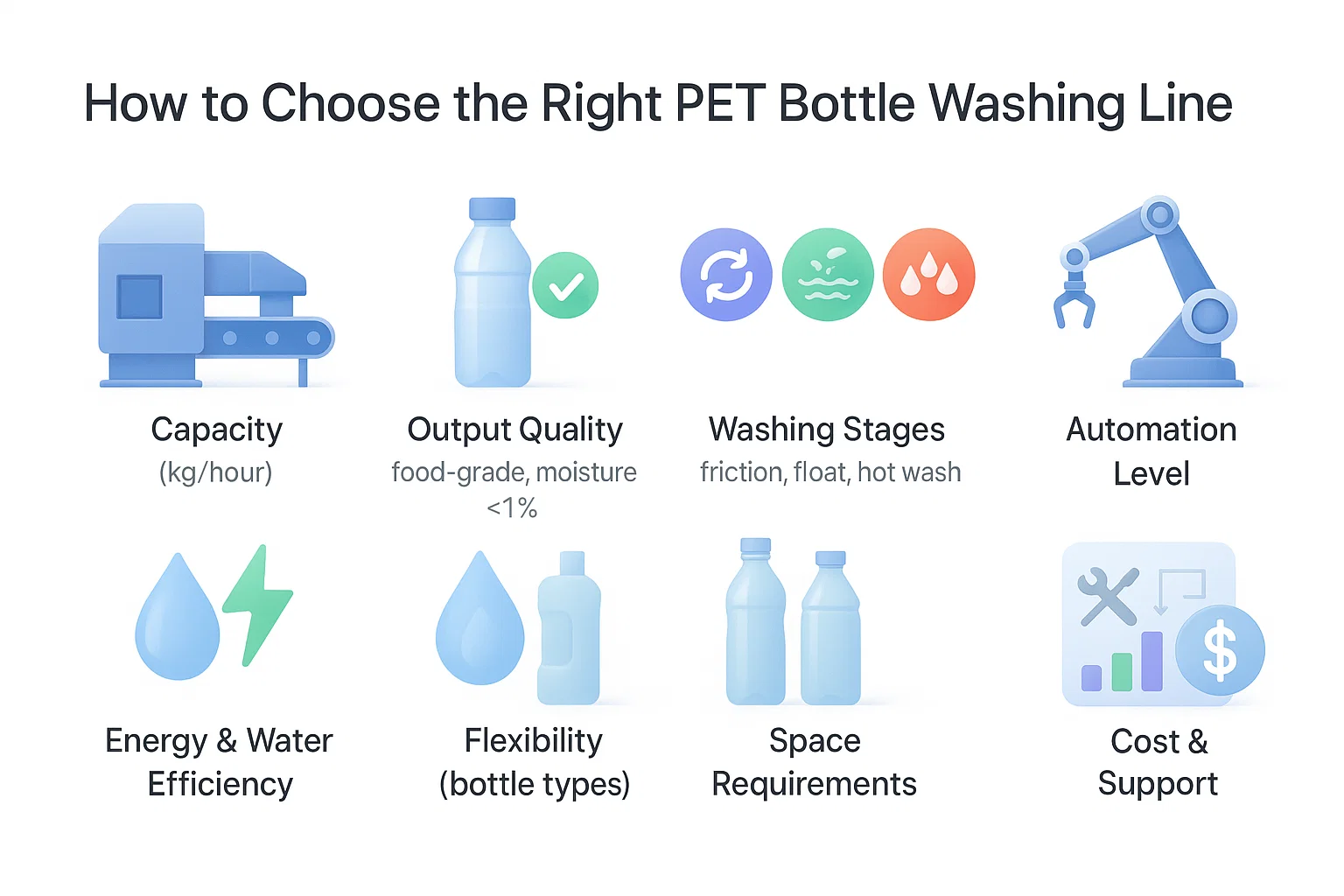
De keuze van de capaciteit van de PET-fleswasmachine begint met de benodigde verkooptable flake-output, niet met het grootste naamplaatje van een leverancier. De samenstelling van de basisstof, het afvalpercentage, de geplande bedrijfstijd, de sorteerprestatie en de traagste procesfase bepalen de bruikbare capaciteit. Een lijn van uitgangspunten voor schone flessen kan zijn outputdoel missen wanneer het natte balen bevat met doppen, etiketten, vloeistof, vuil en niet-PET-items.
Definieer welke capaciteit je vergelijkt
Leveranciers kunnen capaciteit beschrijven als besmette flesinput, natte flake op een tussenstaat, droge flake-output of de mechanische rating van een machine. Deze cijfers zijn niet inwisselbaar. Geef zowel de ontwerpvoedingsgraad als de gegarandeerde verkooptable output op, samen met de aangenomen basisstof- en outputspecificaties.
| Capaciteitstermijn | Wat het zou moeten betekenen | Vraag voor de offerte |
|---|---|---|
| Ingangscapaciteit | Massa van de ontvangen PET-flesbasisstof die het gedefinieerde procesgebied binnenkomt | Bevat deze massa vocht, vloeistof, doppen, etiketten en vuil? |
| Tussenstaatscapaciteit | Massa die een benoemde machine of fase passeert | Is het materiaal nat of droog, en welke verontreinigingen blijven over? |
| Verkooptable output | Droge PET-flake die voldoet aan de schriftelijke koperSpecificatie | Welke monstername- en testmethoden bepalen de acceptatie? |
| Naamplaatjerating | Fabrikantbeoordeling voor één machine onder de vermelde omstandigheden | Welke testmateriaal en belasting zijn gebruikt, en kunnen nabijgelegen stadia het ondersteunen? |
| Geplande output | Verkooptable productie over de geplande schift, dag of jaar | Welke beschikbaarheid, schoonmaak- en omschakelassumpties zijn inbegrepen? |
Voedingsstof meten voordat de apparatuur wordt geschaald
Verzamel representatieve monsters over leveranciers, seizoenen en verzamelsystemen. Meet de PET-flesinhoud, doppen en ringen, etiketten, niet-PET-inhouders, metaal, fijnstof, vuil, achtergebleven vloeistof en vocht. Noteer kleur en doorschijnend PET afzonderlijk wanneer de koper een specifieke flake-stream vereist.
De samenstelling van de bal beïnvloedt zowel het massa-balans als de apparatuurlast. Twee ton ingaande balen produceren niet noodzakelijkerwijs twee ton PET-flake. De Vereniging van Plastic Recyclers’ ’ PET vast ontwerp richtlijnen ook laat zien waarom etiketten, lijm, sluitingen, kleur en barrièrecomponenten in het proces moeten worden overwogen.
Bereken de benodigde ingangsgraad uit de verkooptable output
Gebruik de gemeten verkooptable opbrengst en de geplande bedrijfsbeschikbaarheid om de benodigde voedingsgraad voor een productiedoel te schatten.
Benodigde ontwerpinput = doelverkooptable output ÷ verkooptable opbrengst ÷ geplande beschikbaarheid
Voor een illustratieve berekening alleen, stel dat het doel 800 kg van specificatieflake per geplande uur is, proefgegevens tonen een verkooptable opbrengst van 0.75 en een geplande beschikbaarheid over het schema van 0.85. De berekende ontwerpinput is 800 ÷ 0.75 ÷ 0.85, of ongeveer 1,255 kg/h. Vervang deze aannames met uw eigen proef- en bedrijfsgegevens; ze zijn geen Energycle prestatiegarantie.
Houd het water dat uit nat materiaal wordt verwijderd en de verontreinigingen die van de lijn worden afgekeurd, gescheiden in het massa-balans. Een lagere outputmassa kan juiste verwijdering van vuil en niet-PET-materiaal weergeven in plaats van slechte herwinning.
Elke fase op dezelfde ontwerpbasis afmeten
Een lijn kan het doel niet behouden als zijn sorteerstation, labelverwijderaar, granulator, hete wasser, scheidingsvat, droger of inpaksystemen een continue bottleneck vormen. Vraag elke leverancier om de snelheid, materiaaltoestand en buffermarge bij elke fase te vermelden.
| Fase | Capaciteitsveroorzaker | Algemene afmetingsrisico's |
|---|---|---|
| Kraan openen en voeden | Kraanvorm, dichtheid en leveringspatroon | Surges die sorteren en afmetingsvermindering overbelasten |
| Sorteren | Besmettingsgraad, itempresentatie en vereiste zuiverheid | Conveyor snelheid gebruiken zonder de sorteerwerkbelasting te controleren |
| verkleining van afmetingen | Flesgeometrie, mesconditie, zeef en voedingsnelheid | De granulator alleen op schoon materiaal waarderen |
| Reinigen | Resten, lijm, chemie, temperatuur en verblijftijd | Verblijftijd verkorten om doorvoersnelheid te verhogen |
| Scheiding | Tanklading, korrelvorm, skimming en afvoer van afgekeurde korrels | Besmetting op piekrates doorgeven |
| Drogen | Inkomend water, korrelgrootte en vereiste uiteindelijke toestand | Vochtigheidsgraad opgeven zonder een monstername-methode |
| Opslag en inpakking | Massadichtheid, silovolume en inpakcyclus | Een vol silo of een trage inpakstation toestaan om de lijn te stoppen |
Wassingsfases afstemmen op de uitvoerspecificatie
Koud wassen kan geschikt zijn voor relatief schoon materiaal voor een gedefinieerde industriële uitgang. Materiaal met moeilijke lijm, olie of productresten kan gecontroleerd hete wassen, chemische dosering en aanvullende spoeling nodig hebben. Deze keuzes beïnvloeden verblijftijd, verwarming, waterbehandeling en de praktische lijncapaciteit.
De geschiktheid voor voedselcontact kan niet alleen door hete wassen worden vastgesteld. Dit vereist broncontrole, een geverifieerd recyclingproces, testen en een specifieke bevoegdheidsregulatorische beoordeling. Definieer de bedoelde markt voordat je een lijnconfiguratie aanvraagt in plaats van een “voedselveiligheids”-etiket toe te voegen aan een algemene uitgangsdoelstelling.
Controleer de capaciteit van de nutsvoorzieningen bij piekoperatieve condities
Elektrische voeding, proceswater, warmte, comprimeerde lucht, afvoer en afvalwaterbehandeling moeten tegelijkertijd de vraag ondersteunen. Een correct afmetende machine kan nog steeds productie verliezen wanneer de waterdruk daalt, een verwarmingselement de procesconditie niet kan handhaven of sludgeafvoer de circulatie onderbreekt.
Vraag apart de aangesloten belasting en geschatte operationele vraag. Bevestig waterkwaliteit, recirculatiestappen, verwarmingbron, afvoerlimieten en ontwerpcriteria voor de omgeving. De PET-flesrecyclinginstallatie overzicht toont de modules die moeten worden opgenomen in deze nutsbalans.
Droogcapaciteit vereist een gedefinieerde vochtigheidstest
Mechanische ontwatering verwijdert vrij oppervlaktewater en vermindert de taak van de lucht of thermische droging in de keten. Het resultaat verandert met korrelgrootte, voedingsnelheid, drogerconditie en inkomend water. Definieer waar het monster wordt genomen, hoe het wordt afgehandeld en welke vochtigheidstest wordt gebruikt.
Onze gids voor centrifugaire droogers voor PET-waslijnen legt de variabelen uit die deze fase beïnvloeden. Kies geen droger alleen op basis van motorvermogen of een onvoorwaardelijke vochtigheidspercentage.
Mogelijkheid tot bediening, schoonmaak en onderhoud
Geplande productie moet rekening houden met opstarten, afsluiten, productwijzigingen, schoonmaak, inspectie, mesdiensten, zeilmaintenance en geplande onderhoudsbeurten. Gebruik operationele records van een vergelijkbaar proces indien beschikbaar. Onze PET-fleswaslijn onderhoudshandleiding lijst de controles die beschikbaarheid beïnvloeden.
Bufferen helpen korte onderbrekingen op te vangen, maar overmatige buffers kunnen een fase die continu te klein is niet corrigeren. Bevestig hoe de lijn reageert wanneer sorteren wordt onderbroken, een spoelbak moet worden schoongemaakt of het inpakken stopt.
Prestatieacceptatiecontrolelijst
- Vertegenwoordigend testmateriaal en gedocumenteerde samenstelling.
- Inkomend tempo en verkooptwaardige droge korreluitvoer afzonderlijk vermeld.
- Uitvoerlimieten voor polymervervuiling, kleur, vochtigheid, fijnstof en residuen.
- Testduur lang genoeg om stabiele bediening en normale materiaalvariatie in te sluiten.
- Monsterslocaties, frequentie, laboratoriummethoden en verantwoordelijken.
- Beschikbare nutsvoorzieningen en personeel tijdens het testproces.
- Gedefinieerde behandeling van opstartmateriaal, afval, water en niet-normaal uitvoer.
Na het bepalen van de ontwerpsnelheid, kan de afzonderlijke handleiding voor Prijsfactoren van een PET fleswaslijn worden gebruikt om offertebereik te vergelijken zonder capaciteit en prijsintentie te vermengen.
Gewone vragen
Moet de capaciteit van de PET-waslijn worden gemeten bij de in- of uitgang?
Beide moeten worden vermeld. De inlaadcapaciteit definieert de basis voor de voeding, terwijl de droge verkoopbare uitvoer aangeeft wat de installatie kan verkopen onder de overeengekomen feedstock- en kwaliteitsvoorwaarden.
Hoeveel overcapaciteit zou een PET-lijn moeten hebben?
Er is geen universele percentage. De toelaatbaarheid moet de variatie in de inkomende stof, de traagste fase, het schoonmaken, geplande beschikbaarheid en toekomstige productieplannen weerspiegelen in plaats van een willekeurige marge.
Kan één capaciteitstest elke flesstroom vertegenwoordigen?
Nummer Bale samenstelling, verontreiniging, vochtigheid, etiketten en kleur kunnen de opbrengst en het laadniveau beïnvloeden. Gebruik representatief materiaal en vermeld het aanvaarde feedstock bereik.
Vraag een capaciteitsgebonden procesbeoordeling aan
Stuur Energycle vertegenwoordigende balgegevens, doelmatige verkooptwaardige korreluitvoer, kwaliteitslimieten, bedieningsschema, nutsvoorzieningen en locatiebeperkingen. We kunnen een massa-balans en stapsgewijze capaciteitsbasis opstellen voordat we een procesvoorstel voorbereiden.
