

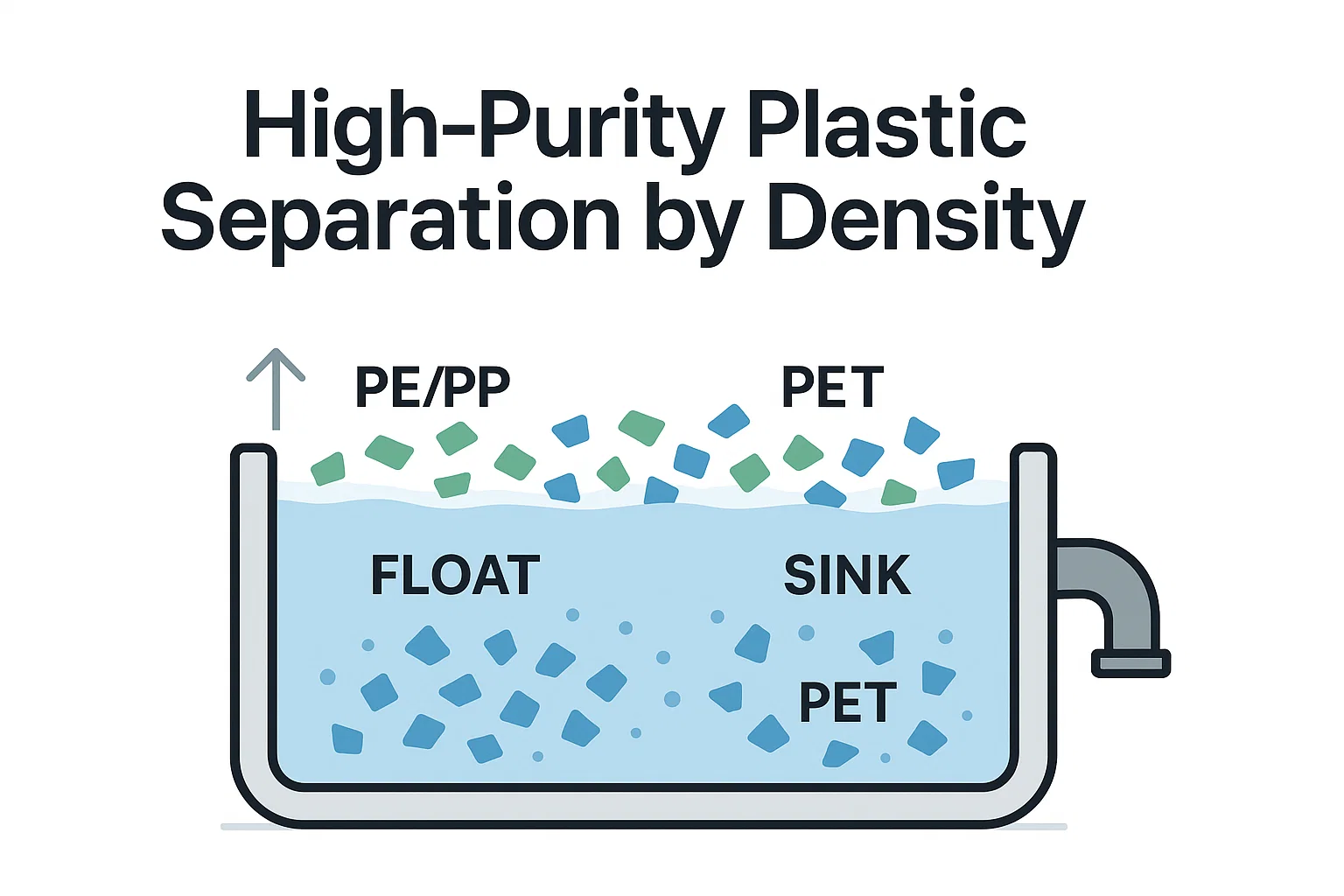
A sink-float separation tank sorts plastic particles according to their effective density in a chosen liquid. In a water-based system, many PP and PE particles float while denser PET, PVC, metals, glass and grit sink. The tank is useful for defined material pairs, but it cannot identify every polymer or guarantee purity without upstream sorting, washing and process control.
How sink-float separation works
Buoyancy determines whether a particle rises or sinks. A particle with an effective density below the process liquid tends to float; a particle with a higher effective density tends to sink. Water is the usual medium for many rigid-plastic and film-washing lines, although specialized applications may change liquid density.
“Effective density” matters because real waste is not a laboratory resin sample. Fillers, labels, trapped air, moisture, food residue, bonded layers and particle shape can change behaviour. Water temperature and dissolved solids can also alter the process. Use material trials and output testing rather than assuming that a resin-code chart predicts every particle.
Which plastics can a water tank separate?
| Material group | Typical behaviour in water | Important limitation |
|---|---|---|
| Unfilled PE and PP | Often float | They generally cannot be separated from each other by a simple water tank. |
| PET and PVC | Often sink | They can report to the same sink fraction and need other sorting methods. |
| Metals, glass and grit | Usually sink | Heavy material can increase wear and must be discharged reliably. |
| Foamed plastics | May float because of cellular structure | Coatings, water uptake and broken cells can change behaviour. |
| Filled or composite plastics | Variable | Mineral filler or bonded layers may reverse the expected result. |
| Labels and closures | Depends on polymer, ink, adhesive and construction | Design and contamination determine whether they separate cleanly. |
The Association of Plastic Recyclers provides design guidance for PET rigid packaging, natural HDPE packaging and PE flexible packaging. These resources show why attachments, labels, adhesives and multilayer structures must be considered alongside the main resin.
Main tank zones and their functions
A separation tank must wet the material, create sufficient residence time and remove float and sink fractions without remixing them. The exact design varies, but the process usually includes the following functions.
- Feed distribution: spreads material across the tank and prevents one dense plug from bypassing separation.
- Wetting and agitation: releases trapped air and surface contamination without driving both fractions into the same discharge.
- Residence zone: gives particles time to rise or settle under representative flow conditions.
- Float removal: paddles, screws or skimmers move the floating fraction toward dewatering.
- Sink discharge: a bottom screw or conveyor removes heavy material before it accumulates and disturbs the tank.
- Water management: screens, settling or filtration control suspended solids and keep the liquid suitable for the separation task.
The equipment page for Energycle’s sink-float separation tank covers available machine configurations. This article focuses on process decisions and troubleshooting.
Prepare material before the tank
Consistent particle size improves wetting, residence and discharge. Very large pieces may trap air or bridge; excessive fines can remain suspended and increase water-treatment load. Granulator screen, knife condition and feed control therefore affect separation even though they sit upstream.
Prewashing and friction washing should remove loose dirt, oils, paper and adhesive where they interfere with density behaviour. A tank is not a replacement for washing. Metals and hazardous items should be removed before size reduction when possible to protect both the cutting equipment and the tank system.
Set flow, agitation and residence time
High flow can carry sinking contaminants into the float discharge, while low flow can allow material to accumulate. Excessive agitation may remix fractions or keep dense fines suspended. Insufficient agitation can leave particles stuck together or allow trapped air to make dense pieces float temporarily.
Set the system using representative material and sample both outlets. Adjust feed rate, water level, paddle or screw speed, bottom discharge and recirculation together. A change that improves one fraction may reduce recovery in the other, so track mass balance as well as purity.
Measure purity and recovery separately
Purity describes how much of the desired material is present in an output fraction. Recovery describes how much of the desired material entering the process reaches that fraction. A tank can produce a very clean float fraction by rejecting too much usable PE, or high recovery by carrying excess contamination forward.
Use a defined sampling method, dry basis where appropriate and a representative run duration. Report the feed composition, liquid condition, throughput and particle-size range with the result. A universal “purity” number without those conditions is not a useful equipment guarantee.
Common separation problems
| Symptom | Possible causes | Checks |
|---|---|---|
| Heavy contamination in float output | Trapped air, excessive flow, bonded structures, overfeeding or poor wetting | Reduce feed surges, inspect agitation and classify contaminants by material and form. |
| Usable PE or PP in sink output | Fillers, attached dense components, waterlogging or material trapped in the bottom discharge | Inspect the items, test effective density and check discharge operation. |
| Material accumulation | Inadequate sink discharge, blocked screen, poor geometry or oversized feed | Isolate safely, clear the cause and verify upstream size control. |
| Unstable separation | Variable feed, water level, solids, temperature or recirculation flow | Trend these variables and separate feedstock changes from equipment faults. |
| Excess carry-over water | Skimmer setting, discharge geometry or insufficient downstream dewatering | Balance material removal with the next dewatering stage. |
Applications in PET and HDPE bottle recycling
In a PET bottle line, the PET flake commonly reports to the sink fraction while many PE or PP caps and rings float. PVC and other dense plastics may sink with PET, which is why bottle and flake sorting remain important. See the complete PET bottle recycling process and our article on PVC contamination in PET recycling.
In an HDPE bottle line, the desired HDPE commonly floats while denser contaminants sink. PP can float with HDPE and may need source control or another separation method when the buyer limits it. The revised HDPE recycling process guide explains how the tank fits into the full line.
Safety and maintenance
Guard paddles, screws, chains and discharge equipment. Before cleaning a jam or entering any hazardous area, follow the site’s energy-isolation and confined-space assessment procedures as applicable. OSHA’s lockout/tagout guidance provides a baseline for hazardous-energy control.
Inspect bearings, seals, chains, paddles, screws, bottom wear, screens and water lines. Remove settled material before it changes the effective tank volume or damages the discharge. Maintenance frequency should follow feed contamination, operating records and the installed machine manual.
Frequently asked questions
Can a sink-float tank separate PE from PP?
Not reliably in a simple water system because both commonly float. A required PE/PP split needs source control or another validated sorting method.
Can sink-float separation remove PVC from PET?
Not reliably because both commonly sink in water. PVC control should include bottle or flake sorting and quality testing before melt processing.
Does adding salt improve every separation?
No. Changing liquid density may help a defined material pair, but it adds corrosion, monitoring, rinsing, wastewater and operating considerations. Test the actual feed before changing the medium.
Test both output fractions
Send Energycle representative material, particle-size data, feed composition and required float and sink specifications. A suitable configuration should be based on trials and a measurable mass balance rather than a resin chart alone.
