

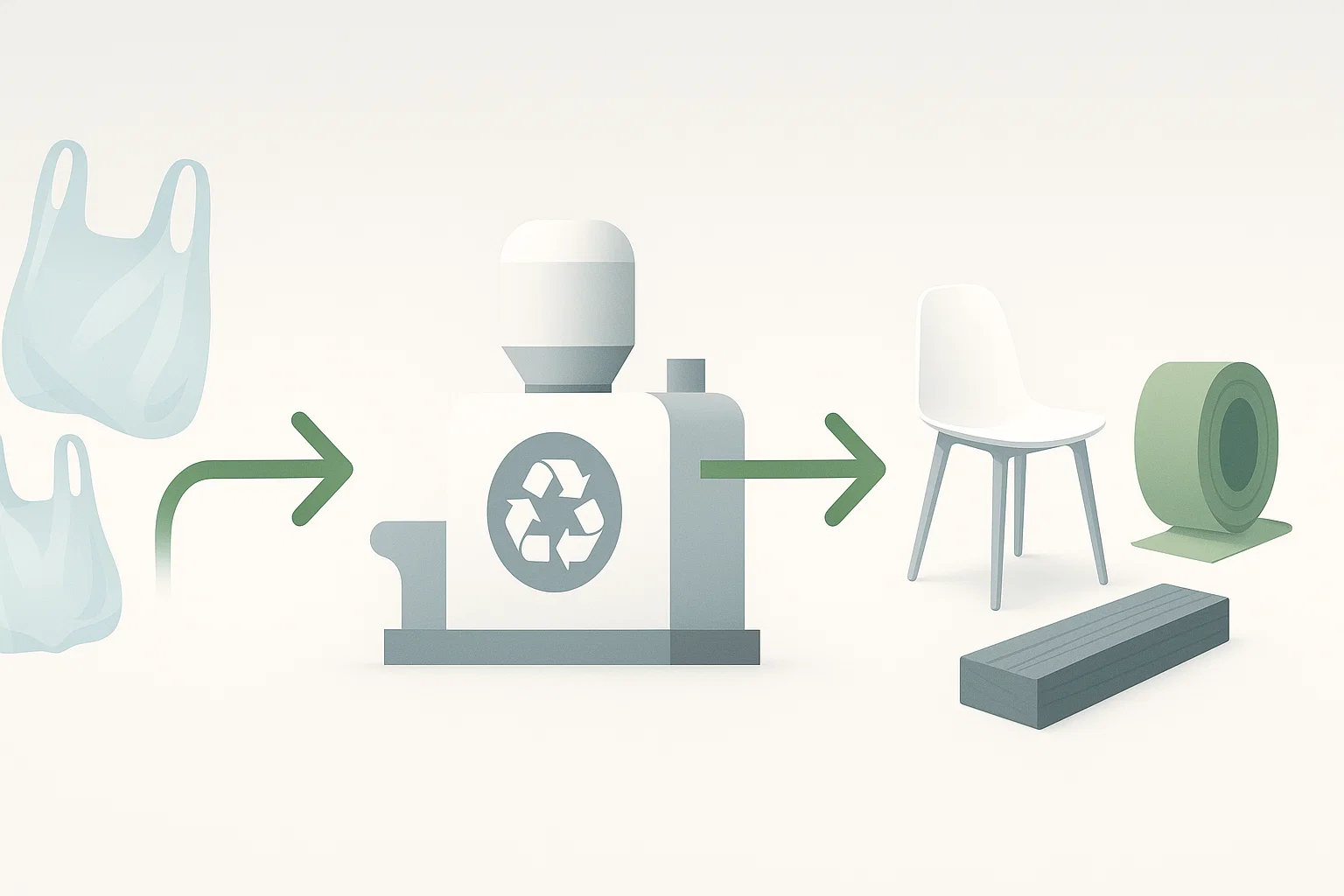
Recycled plastic bags do not become one universal material. Their next use depends on the bag’s polymer, construction, color, printing, contamination and the quality of the recovered resin. Most carrier and produce bags are polyethylene (PE), but multilayer structures, labels, adhesives and non-PE components can limit mechanical recycling.
For a recycler, the right question is not simply “Can this bag be recycled?” It is: “Can this collected stream be sorted and processed into a pellet or agglomerate that meets a specific buyer’s specification?”
First identify the film stream
Check the material rather than relying on appearance. LDPE, LLDPE and HDPE films can often be processed together within a qualified PE stream, while PP film, PVC, PET, PA and barrier layers behave differently. The APR guidance for PE flexible packaging also shows why layers, paper, inks, adhesives and closures must be evaluated rather than assuming every flexible package is equivalent.
| Incoming material | Main control point | Likely recycled form |
|---|---|---|
| Clean post-industrial PE film | Keep grades and colors segregated | Regrind, agglomerate or pellets |
| Retail or collection-point bags | Remove receipts, rigid items, paper and non-PE film | Washed flakes or pellets |
| Agricultural film | Control soil, moisture, crop residue and stones | Washed, filtered recycled PE |
| Printed or laminated packaging | Test layers, ink, adhesive, odor and melt filtration | Application-limited recycled compound |
A polyethylene symbol or supplier declaration is useful, but it does not guarantee that a mixed collection load will produce acceptable resin. Sampling and a production trial are still necessary.
What recycled plastic bags can become
New bags and non-food film
Consistent recycled PE may be used in refuse sacks, shipping film, construction film, agricultural products and other flexible applications. Whether it can return to thin blown film depends on melt stability, gels, contamination, odor, color and the mechanical properties required by the converter. Recycled content should be set by trial rather than assumed to be a one-for-one replacement for virgin resin.
Rigid products
Some recycled film resin is used in bins, crates, boards, profiles, pallets and outdoor products. These applications may tolerate darker color or a wider melt-flow range than demanding film, but each product still needs impact, stiffness, weathering and dimensional checks. Composite lumber is one possible outlet; it is not an automatic destination for every film stream.
Compounds and blended products
A compounder may blend recycled PE with virgin polymer, compatibilizers, fillers, color masterbatch or stabilizers. Compounding can tune a formulation, but additives cannot correct uncontrolled polymer mixing or remove contamination. The recycler and buyer should agree which properties are adjusted and which contaminants are prohibited.
Specialty applications after qualification
Manufacturers also evaluate recovered film in membranes, molded components and certain textile-like products. These are application-specific developments, not proof that an ordinary bag bale is ready for the same use. Food contact, medical products and other regulated applications require the applicable authorization, traceability and process controls.
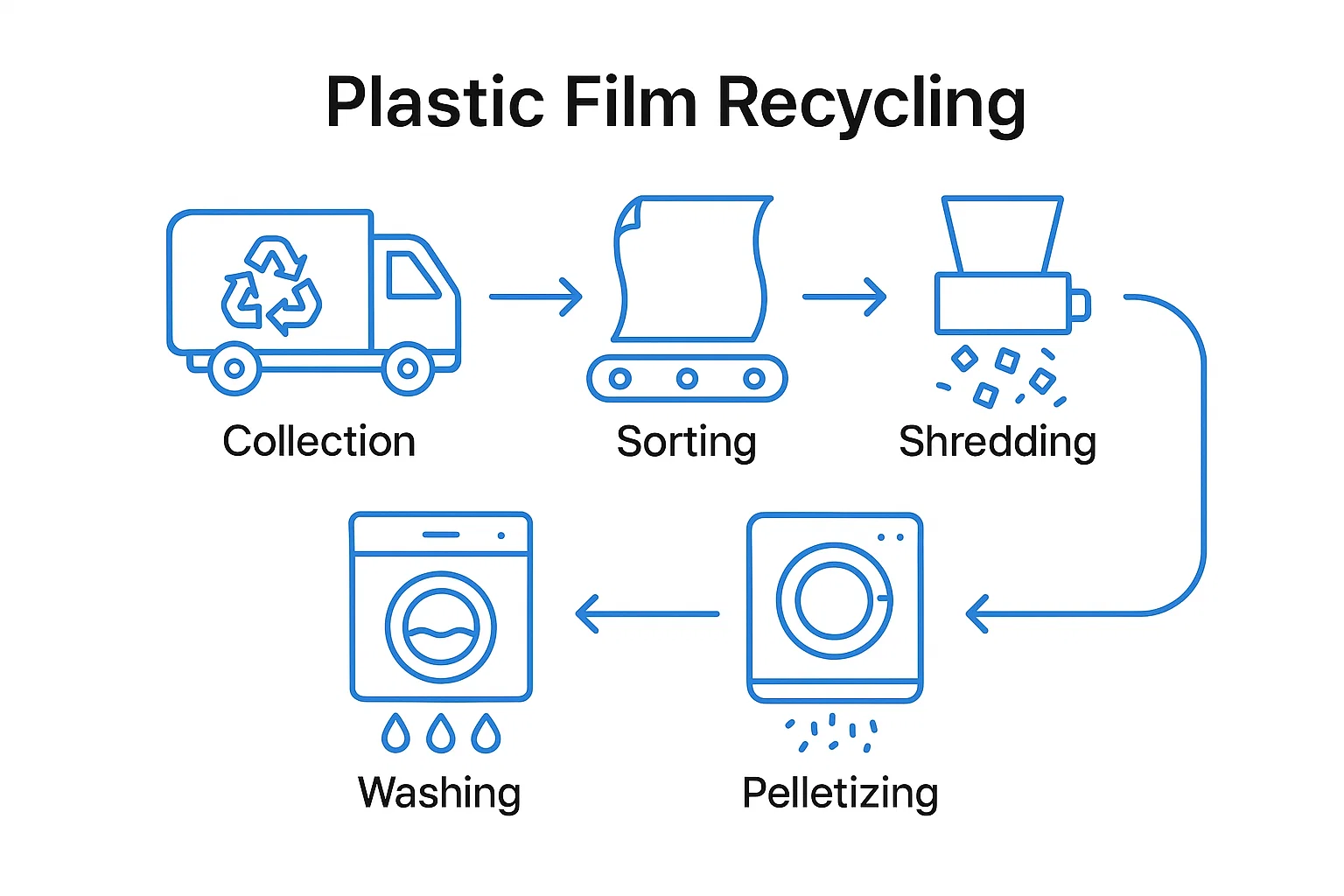
How bags become usable recycled resin
- Define the feedstock. Record collection source, polymer, color, printing, contamination and expected volume.
- Open and meter bales. Film is light and elastic, so controlled feeding helps prevent bridging and overload.
- Sort. Remove rigid plastics, metals, paper, PVC, incompatible multilayers and other unwanted material.
- Reduce size. A shredder or wet granulator prepares the film for washing without creating an uncontrolled mass of wrapped material.
- Wash and separate. Friction and rinse stages remove loose soil and residues. Density separation can remove sinking contaminants, but it does not separate PE from PP because both generally float in water.
- Dewater and dry. Mechanical squeezing and thermal drying are selected according to the material and the extruder’s moisture tolerance.
- Densify and pelletize. Light flakes may require agglomeration, compaction or force feeding. Extrusion, venting and melt filtration then produce a controlled pellet.
- Qualify each lot. Test the properties the converter needs before approving an end use.
Equipment choices that change the result
A complete PE film washing line should be configured from actual feed samples. Dirty agricultural film needs different pre-cleaning and wear protection from clean factory film. Printed post-consumer packaging may need stronger washing, odor evaluation, venting and filtration.
Size reduction may use an industrial shredder followed by a wet granulator. A high-speed friction washer provides mechanical cleaning, while a screw press or film squeezer reduces water and increases bulk density. The film pelletizing system must then match throughput, moisture, printing, volatile load and filter-change frequency.
Do not size the line from the headline motor rating alone. Evaluate feed bulk density, contamination mass balance, expected yield, wastewater treatment, operator access, knife and screen wear, and the downstream buyer’s pellet specification.
How to decide whether an end market is realistic
- Confirm polymer composition with supplier records and suitable identification tests.
- Measure dirt, paper, metal, moisture and incompatible-polymer content.
- Run the proposed wash, dry, extrusion and filtration sequence on a representative sample.
- Measure melt flow, ash, moisture, contamination, color, odor and mechanical properties as required.
- Send production-scale pellets to the converter for a controlled trial.
- Calculate usable yield and total conversion cost, not only the bale or pellet price.
Contact Energycle with feed photos, composition, contamination, target throughput and intended pellet use when you need a film recycling line assessment.
Frequently asked questions
Are all plastic bags recyclable in the same process?
No. PE bags can be compatible with a PE film stream, but multilayers, PVC, PET, PA, paper, adhesives and heavy contamination can change or prevent the intended recycling route.
Can recycled bag pellets be made into new bags?
They can when the pellets meet the film converter’s requirements for contamination, melt behavior, color, odor and mechanical performance. The acceptable recycled-content level must be validated for the specific product.
What information is needed to select a film recycling line?
Provide the polymer mix, source, bale form, contamination, moisture, printing, hourly input, available utilities, discharge requirements and the target specification for flakes or pellets.
