

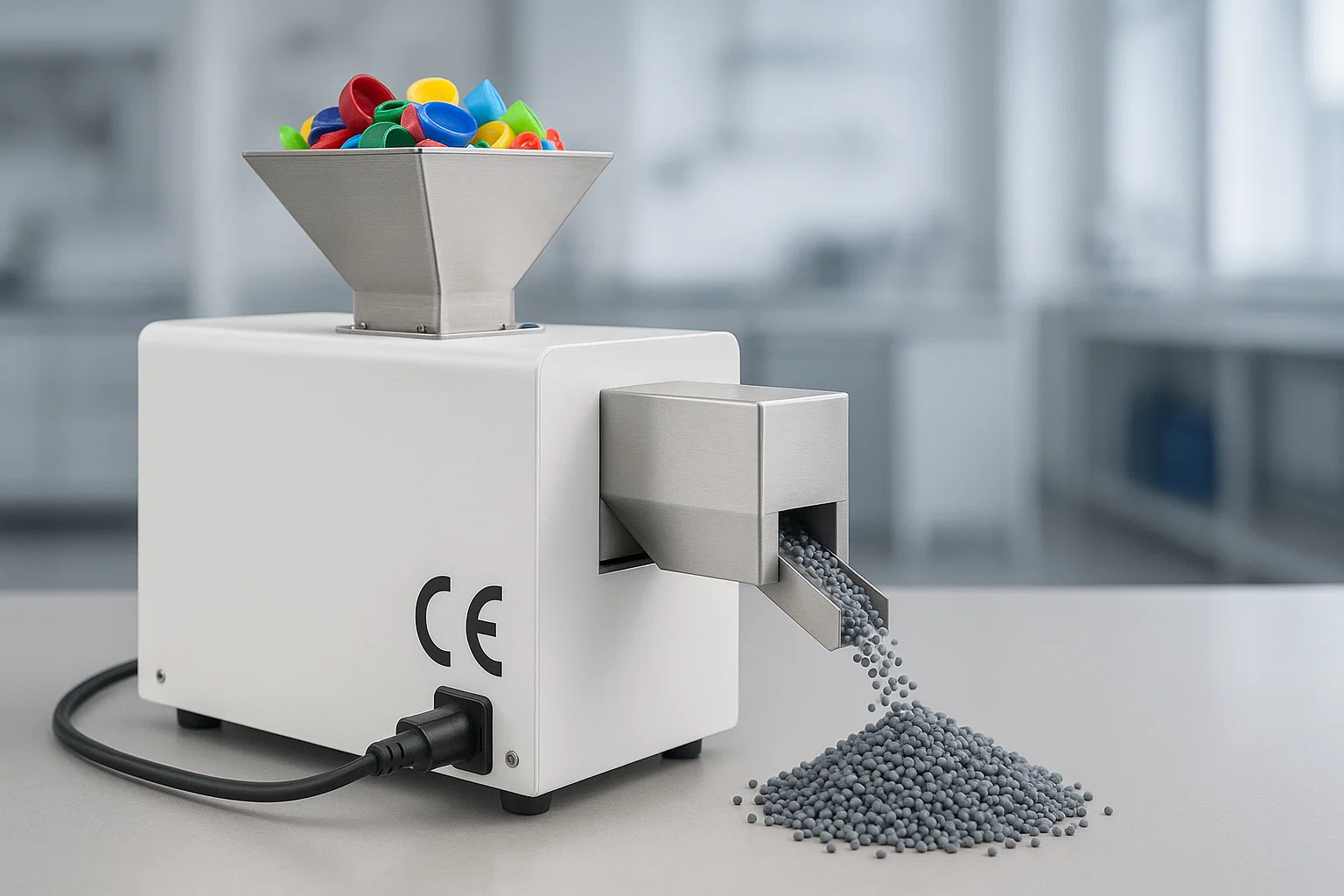
A request for a “220V plastic recycling machine” usually means a compact machine that can operate from a local low-voltage supply. In Europe, however, buyers should not assume that 220V describes every site or that a standard outlet can power industrial recycling equipment. Confirm the site’s nominal voltage, phase, frequency, available current, earthing arrangement and protective devices before a machine is specified.
220V, 230V and 400V: what the buyer actually needs to know
Many European low-voltage systems are described as 230V phase-to-neutral and 400V phase-to-phase at 50Hz, but the available service and connector still depend on the country and facility. “220V” is also used informally in enquiries and on equipment listings. The name alone does not confirm compatibility.
| Question | Why it matters |
|---|---|
| Single-phase or three-phase? | A motor and control panel built for one supply cannot be connected to another merely because one voltage number looks similar. |
| What is the measured nominal supply and tolerance? | Motors, heaters, contactors and controls must remain within their specified range. |
| How much current and short-circuit capacity are available? | A site may have the correct voltage but insufficient capacity for starting and continuous load. |
| What frequency is supplied? | Motor speed, cooling and some electrical components depend on frequency. |
| What earthing and protection are installed? | Protective devices and the machine panel must be coordinated with the site. |
Ask a qualified local electrical professional to provide these values. A photograph of a wall outlet is not an adequate electrical specification.
Which recycling machines may suit a single-phase supply?
Single-phase power is most plausible for genuinely small auxiliary machines, laboratory equipment and compact granulators with limited installed load. Suitability still depends on motor starting current, duty cycle, material and the available branch circuit.
A washing line, large shredder, high-output granulator, thermal dryer or pelletizing system usually combines several motors, pumps, heaters and conveyors. Such equipment commonly needs an industrial three-phase service. Splitting a complete line across ordinary outlets is not a safe substitute for an engineered power distribution system.
Browse the plastic granulator range and industrial plastic shredders by material and required output first; electrical configuration follows the selected mechanical load.
Do not size the machine by voltage alone
Voltage does not indicate throughput. A useful specification starts with the feed and required output:
- polymer and product form;
- largest dimensions, wall thickness and bulk density;
- contamination, moisture and previous use;
- required particle or pellet specification;
- hourly input availability and planned operating hours;
- upstream and downstream equipment;
- permitted noise, dust and floor loading.
Motor power is then selected for the cutting or processing duty. Confirm continuous current, starting method, service factor, cable route and ambient conditions rather than choosing the largest motor that appears to fit the nominal voltage.
Check the complete electrical load list
Request a load schedule, not only the main motor rating. Include conveyors, hydraulic unit, blower, pump, heater, screen changer, control transformer and auxiliary sockets. The supplier should identify which loads can start together and provide the maximum demand and recommended upstream protection for engineering review.
Variable-frequency drives can control compatible motors and may manage acceleration, but they are not universal voltage or phase converters. A transformer changes voltage but does not solve insufficient service capacity, frequency mismatch, protection coordination or an unsuitable motor. Any conversion must be designed as part of the complete machine system.
CE marking is not a generic “CE certificate”
CE marking is the manufacturer’s declaration that the product meets the applicable EU requirements. It is not an independent quality award and does not guarantee a machine’s output. The European Commission’s CE marking guidance explains the manufacturer’s responsibilities, including conformity assessment, technical documentation and an EU declaration of conformity.
For machinery, identify every applicable legal act and harmonised standard for the supplied configuration. The EU’s machinery legislation page should be checked for the current transition from the Machinery Directive to the Machinery Regulation. Electrical equipment may also fall within the scope of the Low Voltage Directive, depending on the product and applicable rules.
Before accepting a machine, review the declaration of conformity, instructions in the required language, circuit drawings, risk-reduction measures, guarding, emergency stops and the identification on the nameplate. If machines are combined into a line at the buyer’s site, responsibility for the conformity of the assembly must also be resolved.
Installation questions for a European facility
| Area | Information to agree before shipment |
|---|---|
| Supply | Voltage, phase, frequency, maximum demand and permissible voltage drop |
| Connection | Fixed wiring or plug, connector type, isolator position and cable entry |
| Protection | Upstream breaker, residual-current protection where applicable, overload and short-circuit coordination |
| Environment | Indoor or outdoor use, temperature, humidity, dust, water and hazardous-area assessment |
| Documentation | Manual, drawings, parts list, declaration and required languages |
| Commissioning | Rotation checks, safety-function tests, no-load test and material acceptance test |
When a compact machine makes sense
A compact machine can be appropriate for clean production scrap, sample preparation, test batches or low-volume internal regrind. It is less suitable when the feed requires sorting, washing, drying and melt filtration as a complete process. Reducing size does not remove oil, labels, incompatible resin or hazardous residue.
Calculate value using saleable output and verified product quality. Include labour, knife and screen wear, electricity, dust collection, rejects, maintenance and any further washing or extrusion. Avoid assuming that on-site grinding automatically creates material suitable for the original application.
Request these documents before ordering
- machine nameplate data and full electrical load list;
- single-line diagram and circuit drawings;
- motor and drive specifications;
- layout, service clearances and anchoring loads;
- guarding and safety-function description;
- applicable declaration and technical-document list;
- acceptance-test conditions for the buyer’s material;
- spares, consumables, warranty boundaries and service responsibilities.
Our European recycling plant equipment guide covers broader line-planning issues beyond the power supply.
Frequently asked questions
Can a 220V machine plug into any European outlet?
No. Confirm nominal voltage, phase, frequency, current, connector, earthing and protection at the installation point. The machine’s starting and continuous demand must fit the engineered circuit.
Is 220V enough for an industrial washing or pelletizing line?
The voltage label alone does not answer this. Complete lines have multiple motors and sometimes heaters, and commonly require an industrial three-phase supply sized from a full load schedule.
Does a CE mark prove that a recycling machine is high quality?
No. CE marking is a declaration of conformity with applicable EU requirements, not a performance or quality award. Buyers should separately verify material trials, capacity basis, output specification and service support.
Send site and material data together
When requesting a machine from Energycle, provide the site’s electrical schedule and photographs of the installation area together with representative feed and output requirements. That allows the plastic recycling machine configuration and its electrical system to be reviewed as one project.
