

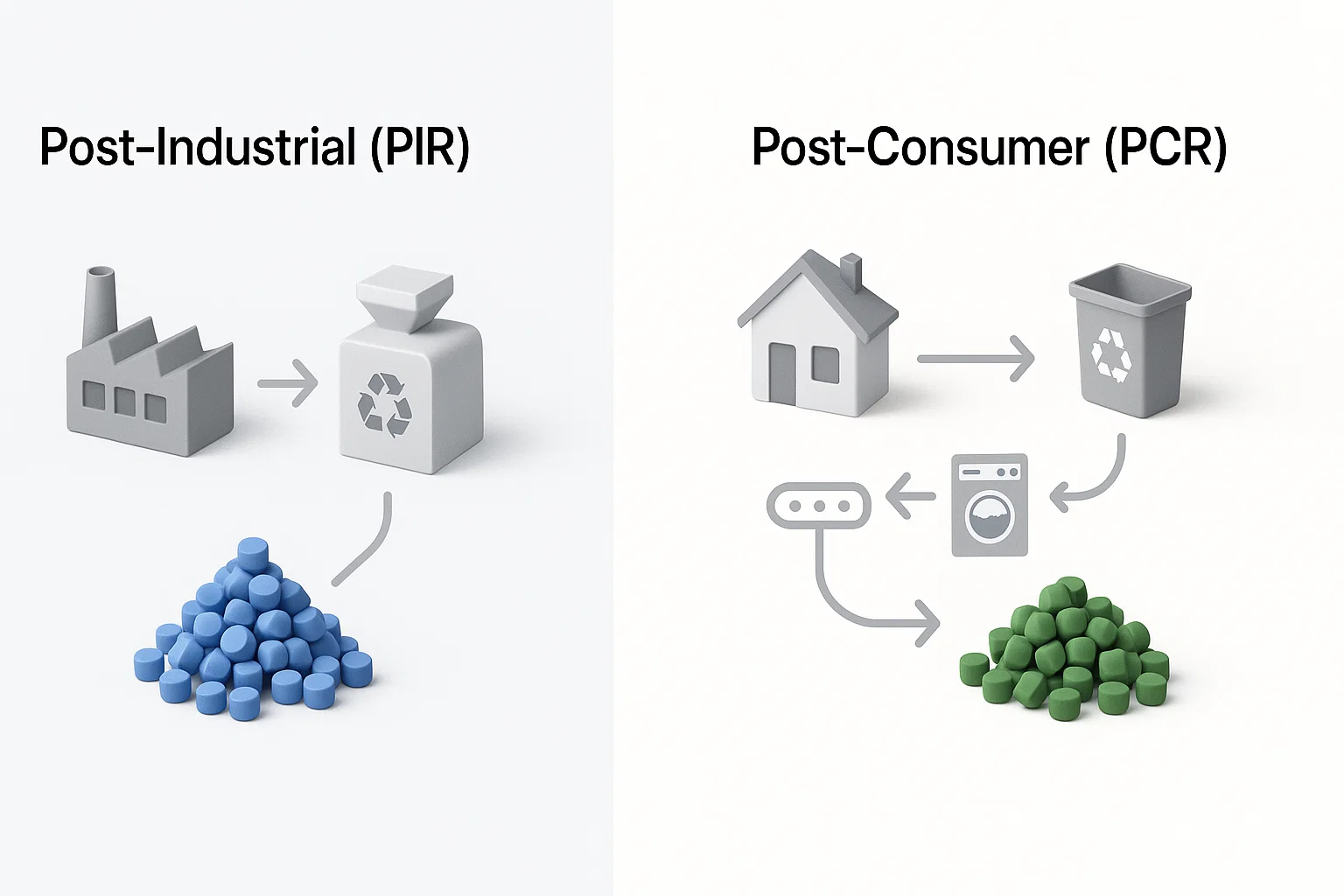
Post-industrial recycled (PIR) and post-consumer recycled (PCR) plastic pellets can both replace virgin resin in suitable products, but source labels do not define performance by themselves. The buyer needs a material specification, traceability, batch test data and a conversion trial for the intended application.
PIR usually comes from manufacturing scrap generated before a product reaches the end user. PCR comes from products recovered after consumer or commercial use. Neither term guarantees a single polymer, cleanliness, food-contact suitability or a fixed environmental benefit.
PIR and PCR are source categories
A clean, segregated molding runner may be a predictable PIR feed. A mixed floor sweep containing several grades is also industrial scrap but has a different risk. Likewise, deposit-return PET bottles may form a controlled PCR stream, while mixed household film can be far more variable.
Define recycled content using the standard, regulation or customer method that applies to the claim. Distinguish internal rework from material that left the process and returned through recycling. Procurement and marketing teams should use the same documented definition.
Typical advantages and limitations
| Factor | PIR pellets | PCR pellets |
|---|---|---|
| Source traceability | Often easier when scrap is captured from one plant and grade | Depends on collection and sorting system |
| Composition consistency | Can be high, but mixed production scrap remains variable | Often needs stronger incoming inspection and blending |
| Contamination | Usually lower in controlled scrap | May include labels, residues, other polymers, odors and degradation |
| Processing route | May bypass washing when clean and documented | Often requires sorting, washing, drying and stronger filtration |
| Recycled-content claim | Acceptance depends on the applicable standard or program | Often specifically requested by policy or brand commitments |
| End-use qualification | Must meet product specification | Must meet product specification and any source-related requirements |
Benefits when the grade is properly qualified
Recovering controlled factory scrap
Segregated production scrap can reduce disposal and virgin-resin demand. When polymer grade, color and contamination are known, it may be processed in-house or by a recycler and blended back at a validated rate. The economic result depends on scrap volume, yield, equipment, labor, energy, quality loss and the value of the alternative disposal route.
Meeting recycled-content requirements
PCR may help a product meet a customer or legal recycled-content target when the material and chain of custody satisfy the applicable rules. The required source, calculation, certification and evidence vary by market. A resin purchase should not rely on the word “PCR” without documentation.
Reducing dependence on virgin resin
Qualified recycled pellets can diversify supply and reduce virgin material use. Price may be lower or higher than virgin resin depending on polymer, quality, certification, color, availability and demand. PCR does not always trade at a premium, and PIR is not always cheaper.
Supporting a measured environmental improvement
Recycling can avoid waste and virgin production, but the result depends on collection, yield, utilities, transport and the product displaced. Use a relevant life-cycle method and actual supply-chain data before publishing percentage energy or emissions savings.
Quality limitations to control
Polymer and grade mixing
Different polymers may be incompatible in the melt. Even within one polymer family, melt flow, molecular weight, copolymers and additives can vary. Blending can smooth batch variation, but it does not make incompatible inputs equivalent.
Contamination and filtration
Paper, aluminum, glass, grit and unmelted polymers can create black specks, screen changes and defects. Melt filtration removes particles above the selected level; it cannot remove every odor, dissolved contaminant, pigment or incompatible polymer.
Thermal and service history
Heat, oxygen, UV exposure, moisture and previous use can change polymer properties. Another extrusion pass may add degradation if temperature, residence time and shear are not controlled. There is no universal number of recycling cycles that preserves performance for every polymer and product.
Color and odor
Mixed colored feed limits the colors that can be produced without heavy pigment. Product residues, printing and degradation may create odor. Washing, venting and additives can help in some streams but should be validated by sensory or analytical tests appropriate to the customer.
Regulated applications
Food contact, medical, potable-water, automotive safety and other controlled applications require product-specific evidence. A pellet is not suitable merely because its base polymer matches the virgin resin. Source, process, migration, traceability and regulatory authorization may all matter.
Pellet specification for buyers
A useful certificate and purchasing specification may include:
- Polymer and grade or agreed blend
- PIR/PCR definition, percentage and chain-of-custody evidence
- Melt flow or viscosity measure and test condition
- Moisture, ash and volatile content
- Contamination, black-speck and metal limits
- Density, filler and additive information where relevant
- Color coordinates and odor requirement
- Mechanical properties tied to the intended product
- Pellet size, bulk density and fines
- Lot identification and sampling plan
Test methods and tolerances should be written. Terms such as “high quality,” “almost virgin” or “food grade” are not specifications.
How manufacturers qualify recycled pellets
- Review documentation. Confirm source, process, formulation, certificates and change-control procedure.
- Test incoming lots. Use the agreed sampling plan and material tests.
- Run a controlled conversion trial. Record feeding, pressure, temperature, filter load, cycle stability and rejects.
- Test the product. Measure the properties and regulatory requirements that matter in service.
- Set a validated blend range. Do not assume that 100% recycled content is suitable for every product.
- Monitor production. Track lot variation, defects and supplier changes.
How recycling equipment affects pellet quality
PCR preparation may use a complete plastic washing system with sorting, size reduction, washing and drying. Clean PIR may use a shorter route. In both cases, a plastic pelletizer must be matched to feed form, moisture, volatile load and filtration requirement.
Industrial shredders and plastic granulators control feed size but do not make a mixed polymer stream pure. Sorting and source control remain the first quality operations.
PIR or PCR: which should you choose?
Choose the grade that passes the product’s technical, regulatory and commercial requirements. PIR can be an efficient route for controlled internal scrap. PCR can meet post-use recycled-content goals and create demand for collected material. A manufacturer may use both in different products or formulations.
Compare total usable cost rather than pellet price alone: include drying, filtration, rejects, downtime, testing, color correction and yield. The least expensive quoted resin can be the most expensive after conversion losses.
Frequently asked questions
Is PIR always cleaner than PCR?
No. Segregated factory scrap is often cleaner, but mixed or poorly handled industrial scrap can be contaminated. Qualification should use source records and test data.
Can recycled plastic pellets replace virgin resin one for one?
Only when conversion and product tests support it. The suitable blend depends on polymer consistency, contamination, properties and the end-use requirements.
Are PCR pellets always more expensive than PIR?
No. Price depends on resin, quality, certification, color, region, supply and demand. Compare total usable cost at the manufacturing line.
