

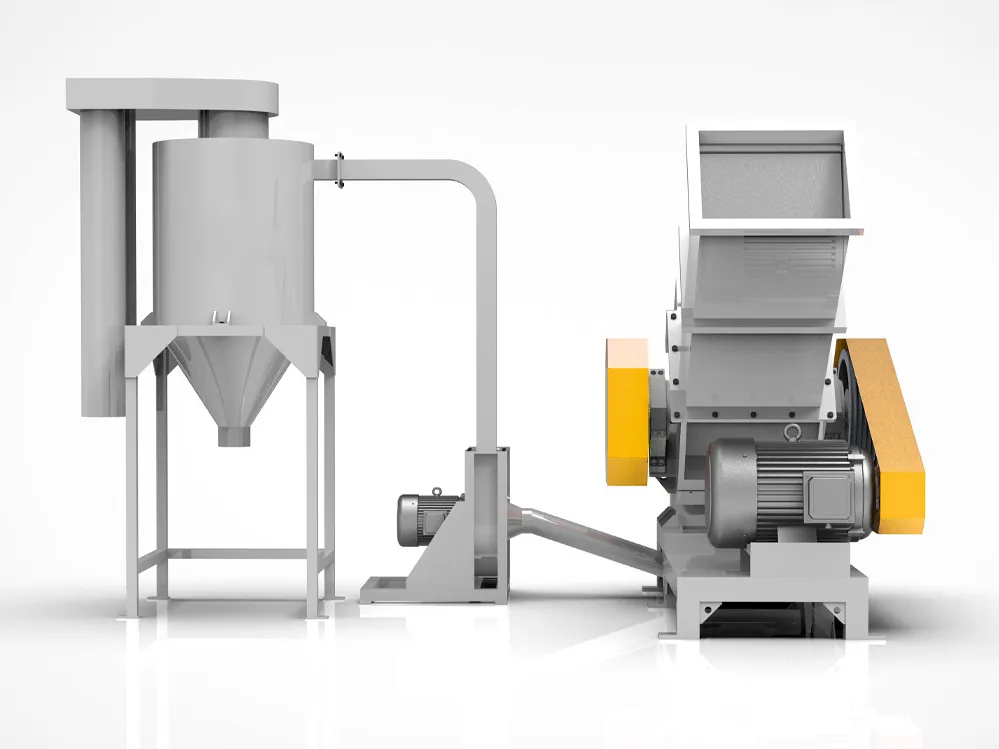
A PVC profile crusher uses a feeding and cutting arrangement suited to long rigid profiles, pipe, and conduit. It can reduce manual pre-cutting when the material fits the selected machine’s approved length, cross-section, and wall-thickness limits.
In this article, standard crusher means a general-purpose, knife-based plastic granulator for rigid scrap. It remains a practical option for short or pre-cut pieces within its approved feed limits. The choice depends on feed dimensions, contamination, required regrind, handling time, floor layout, and changeover needs.
PVC Profile Crusher vs Standard Crusher
| Selection point | Profile or pipe crusher | Standard granulator |
|---|---|---|
| Feed geometry | Long pipe, conduit, window profiles, and trim | Short pieces, sprues, containers, and pre-cut rigid scrap |
| Feeding method | Long-feed opening or vertical/horizontal guided feed | Top hopper sized for pieces that fit safely |
| Primary benefit | Reduces pre-cutting within the approved feed limits and controls long-part entry | Handles varied short rigid-plastic pieces within the hopper and rotor limits |
| Main design question | Part support, feed orientation, rotor engagement, and anti-kickback protection | Hopper size, batch consistency, rotor type, and screen access |
| Typical limitation | Less flexible for unrelated bulky shapes | Long parts may bridge, protrude, or require pre-cutting |
Why Long PVC Profiles Need Different Feeding
Long scrap changes how material reaches the rotor. Unsupported profiles can whip, bridge across a hopper, or contact the cutting chamber unevenly. Purpose-built machines guide the part into the cutting zone and keep the operator away from the feed path. The feed opening, rotor, bed knives, guards, and drive must work as one system; a wider opening alone does not create a profile crusher.
Vertical and horizontal layouts solve different installation problems. A vertical-feed design can use gravity and reduce manual pre-cutting for selected profiles. A horizontal design can support long pipe along a conveyor or trough. Compare the available floor height, line direction, part length, lifting method, and how rejects will be removed safely.
When a Standard Crusher Is the Better Choice
A standard granulator can be the practical choice when PVC scrap is already cut to consistent dimensions or when the plant processes several short rigid-plastic products. It may simplify hopper loading and product changeover. It should not be fed long parts that extend outside the guarded system unless the manufacturer has designed and approved that method.
Do not compare machines only by motor power or nominal throughput. Rotor geometry, knife arrangement, screen area, feed opening, flywheel effect, drive protection, material temperature, and actual part dimensions determine whether the machine can maintain a stable bite and controlled discharge.
Material and Quality Factors
Rigid PVC profiles can contain calcium carbonate, impact modifiers, pigments, seals, metal reinforcement, glass, rubber, and attached hardware. Remove metal and incompatible materials before granulation where possible. Unknown legacy formulations may require a compliance review before the regrind is returned to a product.
Dust control depends on sharp knives, correct clearance, controlled feeding, screen selection, extraction, and housekeeping. A special-purpose crusher does not automatically create less dust or more consistent regrind. Measure particle-size distribution, fines, metal carryover, temperature, current, and downstream melt quality during the trial.
Compare Total Processing Cost
Compare the cost per tonne of usable regrind using the same PVC feedstock and output requirements. Include the preparation and handling stages as well as the crusher itself.
- Pre-cutting and loading: Record the labor, cutting equipment, and handling time needed to prepare and feed long profiles. A dedicated profile crusher may reduce these steps when the parts fit its approved feed limits. A standard granulator can remain economical when scrap already arrives as suitable short pieces.
- Measured energy: Compare electricity used by the equipment included in each proposed system, including any pre-cutting, conveyors, and extraction. Divide measured kWh by tonnes of usable regrind to calculate kWh/t. Motor rated power alone does not show energy consumption per tonne.
- Maintenance and downtime: Include knife sharpening and replacement, screen service, cleaning, and time spent clearing stoppages. Compare wear and service intervals using the same material and output specification.
- Purchase cost and utilization: Include the required feeding, guarding, and dust-control equipment in each quotation. Evaluate the investment against expected operating hours, changeovers, and verified labor or processing savings.
For a plant with a steady supply of long PVC profiles, reduced preparation and handling may justify a dedicated machine. For varied short scrap or intermittent production, a standard granulator may be the more practical investment. Use sample trials and plant operating data to compare the alternatives.
Buyer Specification Checklist
- Feed envelope: maximum length, width, diameter, wall thickness, weight, flexibility, and bundle size.
- Composition: PVC type, filler, seals, reinforcement, metal, moisture, dirt, and temperature.
- Output: target regrind size, fines limit, throughput range, and downstream washing or extrusion.
- Installation: floor height, conveyor direction, loading device, access, dust system, sound control, and utilities.
- Service: knife access, screen change, rotor cleaning, wear parts, bearings, protection devices, and safe jam removal.
- Trial data: mass throughput, current, temperature, vibration, particle distribution, fines, and wear condition.
Review Energycle’s vertical PVC pipe and profile crusher alongside the wider range of plastic granulators and crushers. A sample test should reproduce the longest and heaviest normal feed, not only small offcuts.
Frequently Asked Questions
Can a standard crusher process PVC profiles?
Yes, if their dimensions and wall thickness fall within the selected granulator’s approved feed limits, with pre-cutting where needed. Full-length profiles require a machine and feeding system designed for those parts. Confirm the maximum length, cross-section, and wall thickness with the manufacturer.
Does a profile crusher always produce less dust?
No. Dust depends on formulation, knife condition, clearance, screen, feed rate, extraction, and repeated cutting. Verify it with the actual material.
Should throughput be the main buying criterion?
No. Safe feeding, stable particle size, metal control, maintenance access, energy use, and downstream quality can be more important than a nominal maximum rate.
Related Technical Guides
- PVC types and grinding requirements
- Calcium carbonate and PVC grinding performance
- PVC grinding versus crushing
Choose from the Real Feed Geometry
Send Energycle drawings or samples showing the longest profile, largest pipe, wall thickness, reinforcement, target regrind, and loading method. Our team can review suitable feed arrangements and granulator configurations against the same test criteria.
