

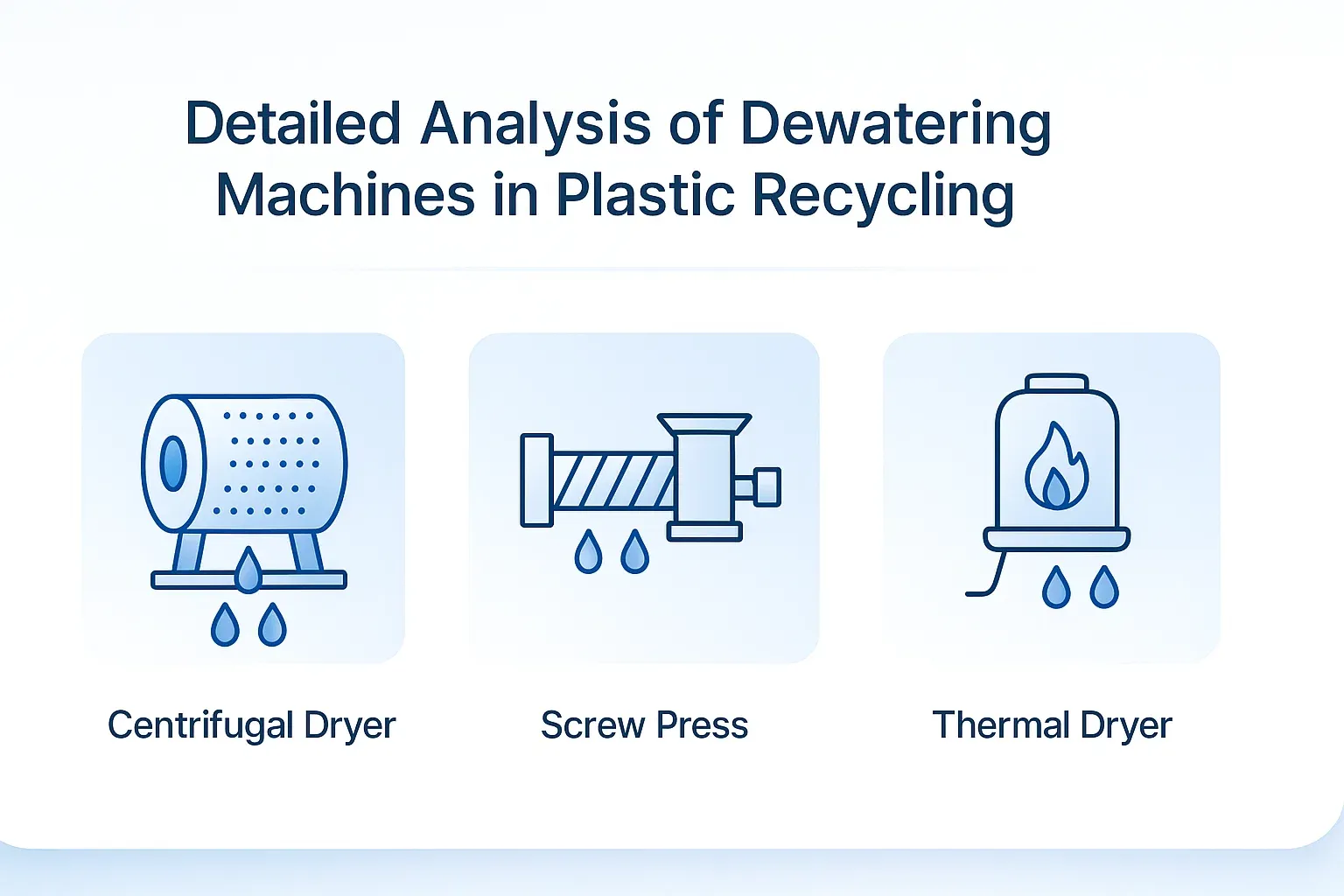
A plastic dewatering machine mechanically removes water from washed plastic flakes, film, or regrind before they enter thermal drying, pelletizing, or extrusion. Without it, your recycling line either spends 4–6× more on energy (trying to evaporate water thermally) or produces off-spec output. This guide covers the three main types of plastic dewatering machines, their target materials, specifications, and a 5-step selection framework for sizing the right unit for your recycling line.
For the broader drying process — including thermal drying, crystallization, and full system design — see our plastic drying system pillar guide. For PET-specific moisture targets, see the PET flake dryer guide.
What Is a Plastic Dewatering Machine?
A plastic dewatering machine is a mechanical water-removal device that takes washed plastic at 30–70% moisture and discharges it at 2–15% moisture, depending on machine type and material. It is the bridge between the washing line and the thermal drying or extrusion stages of any plastic recycling operation.
The reason every production-grade recycling line uses a plastic dewatering machine comes down to energy economics. Removing 1 kg of water mechanically (centrifugal or screw press) takes 30–60 kWh per ton of plastic processed. Evaporating the same water thermally takes 250+ kWh per ton. Skipping mechanical dewatering and trying to dry flakes thermally directly from the washer is the single most common cause of overspending on energy in plastic recycling — see our centrifugal vs. thermal drying energy comparison for the calculations.
A typical recycling process places the plastic dewatering machine in stage 3:
1. Collection & Sorting — Plastic waste is gathered and separated by polymer type (PET, HDPE, LDPE, PP, PVC).
2. Washing — Sorted plastics are washed to remove dirt, food residue, labels, and adhesives.
3. Mechanical Dewatering — A plastic dewatering machine removes free water from the washed material at low energy cost.
4. Thermal Drying — A hot air dryer evaporates residual surface moisture if the application requires it.
5. Pelletizing or Extrusion — Dry plastic is melted and converted to pellets or directly extruded into new products.
Inlet moisture varies dramatically by material: rigid plastic flakes (PET, HDPE, PP) leave the friction washer at 30–40% moisture; plastic films at 50–70%. The plastic dewatering machine reduces this to 2–5% for rigid flakes (centrifugal) or 8–15% for film (screw press), preparing the material for the next stage.
3 Types of Plastic Dewatering Machines
The plastic recycling industry uses three distinct dewatering technologies, each engineered for specific material characteristics and throughput requirements.
1. Centrifugal Plastic Dewatering Machine
A centrifugal plastic dewatering machine spins washed flakes at 800–1,500 RPM inside a perforated screen drum. Centrifugal force throws water radially through the screen while plastic flakes discharge dewatered. Two configurations exist: vertical (compact, sub-1 ton/h) and horizontal (higher capacity, more uniform output). For the orientation comparison, see our horizontal vs. vertical centrifugal dewatering machine guide.
• Best Material: Rigid plastic flakes — PET bottle flakes, HDPE crate regrind, PP injection scrap, ABS housings
• Outlet Moisture: 2–5% (depending on material and rotor speed)
• Throughput: 200–3,500 kg/h
• Motor Power: 22–90 kW
• Capital Cost: $8,000–$45,000 USD
The centrifugal plastic dewatering machine is the default choice for any rigid plastic recycling line. It cannot handle film effectively because long flexible material wraps around the rotor paddles and stalls the machine.
2. Film Squeezer / Screw Press Plastic Dewatering Machine
For PE and PP film, a screw press or film squeezer plastic dewatering machine compresses water out by mechanical pressure. A rotating screw conveys wet film through a tapered chamber, building pressure against a perforated screen and forcing water to exit through the perforations. The film is simultaneously densified into a continuous strand or briquette ready for the downstream agglomerator or extruder.
• Best Material: PE/PP film, LDPE agricultural film, PP woven bags, raffia, soft plastics
• Outlet Moisture: 8–15% (combined with thermal stage typically required)
• Throughput: 300–2,500 kg/h
• Motor Power: 30–110 kW
• Capital Cost: $15,000–$80,000 USD
For high-volume film operations above 1.5 ton/h, a high-speed plastic film centrifugal dewatering machine with anti-wrap rotor design is the alternative — combines centrifugal speed with film-compatible rotor geometry.
3. Heavy-Duty Screw Press Plastic Dewatering System
For mixed waste, contaminated streams, or pre-dewatering of bulky materials, a heavy-duty screw press plastic dewatering machine handles inputs that would jam a centrifugal unit. The slower compression action (30–80 RPM screw rotation) tolerates rocks, metal fragments, and irregular pieces that occasionally pass through pre-screening.
• Best Material: Mixed contaminated waste, pre-dewatering of bulky baled materials, paper-plastic composites
• Outlet Moisture: 10–25% (always followed by additional dewatering or drying)
• Throughput: 500–3,000 kg/h
• Motor Power: 22–90 kW
• Capital Cost: $20,000–$100,000 USD
Each plastic dewatering machine type addresses a different material challenge. Choosing the right one depends on input material form (rigid vs. film), throughput, target outlet moisture, and contamination level.
Plastic Dewatering Machine Comparison Table
| Type | Mechanism | Outlet Moisture | Throughput | Best For |
|---|---|---|---|---|
| Centrifugal | High-speed rotor (800–1,500 RPM) inside perforated screen | 2–5% | 200–3,500 kg/h | PET, HDPE, PP rigid flakes |
| Film Squeezer | Tapered screw compression against screen | 8–15% | 300–2,500 kg/h | PE/PP film, LDPE agricultural film, raffia |
| Screw Press | Slow compression for contaminated/mixed streams | 10–25% | 500–3,000 kg/h | Mixed waste, pre-dewatering, paper-plastic |
Why Every Recycling Line Needs a Plastic Dewatering Machine
1. Cuts Energy Cost by 4–6×
Mechanical water removal uses 30–60 kWh per ton of plastic. Thermal evaporation of the same water mass uses 250+ kWh per ton. For a 1 ton/h line running 4,000 hours per year at $0.10/kWh, installing a plastic dewatering machine saves $80,000–$100,000 annually compared to thermal-only drying.
2. Reduces Material Weight 50–60% Before Transport
Example: 1 ton of dry plastic at 70% inlet moisture = ~3,330 kg of wet material. After dewatering to 20% moisture, total weight drops to 1,250 kg — a 62% reduction. This translates directly to lower fuel cost, smaller transport vehicles, and reduced handling labor.
3. Prevents Extruder Damage and Quality Defects
Wet flakes entering an extruder cause vent moisture issues, melt instability, vapor explosions in the screw barrel, and visible defects in the output (silver streaking, voids, brittleness). For PET specifically, residual moisture above 50 ppm at the extruder feed throat causes hydrolytic IV degradation — the polymer becomes weaker and hazier per pass.
4. Removes Light Contaminants Along With Water
Centrifugal plastic dewatering machines also expel label fragments, fines, and dirt particles through the perforated screen along with the water. This polishes the flake stream and reduces contamination load on downstream equipment.
5. Enables Modular Line Design
A plastic dewatering machine creates a buffer point in the line — flakes can be stored briefly between dewatering and thermal drying without quality degradation, enabling batch operation and CIP cleaning gaps without idling the entire line.
5-Step Plastic Dewatering Machine Selection Framework
Step 1 — Identify Material Form. Rigid flakes (PET, HDPE, PP, ABS) → centrifugal plastic dewatering machine. Film (PE, PP, LDPE) → film squeezer or anti-wrap centrifugal. Mixed/contaminated → heavy-duty screw press for primary dewatering.
Step 2 — Calculate Peak Throughput. Recycling lines run in batches with cleanup gaps. Peak feed rate is typically 1.5–2× daily-average. A line processing 10 tons over an 8-hour shift has peak feed near 1,500–1,800 kg/h. Size the dewatering machine for peak, not average.
Step 3 — Specify Target Outlet Moisture. For HDPE/PP direct extrusion, 3–5% is acceptable. For PET pelletizing or any sub-1% moisture target, the dewatering machine outlet must be ≤4% to keep thermal stage size manageable. Every additional percentage point of dewatering outlet moisture adds 60–80 kWh/ton of thermal load.
Step 4 — Match Construction Material to Polymer. SS304 stainless steel for PET (food-contact), carbon steel acceptable for HDPE/PP, acid-resistant alloys for PVC (chlorine off-gassing). Mismatched construction causes premature corrosion and contaminates the output stream.
Step 5 — Verify Maintenance Access. Vertical centrifugal plastic dewatering machines have top-access (30-minute screen change). Horizontal units require end-cover removal (1–2 hours, two technicians). Screw presses need access to the screw chamber for blockage clearing. Match maintenance complexity to your in-house capability.
Common Problems and Solutions
Outlet Moisture Above Spec. Cause: dull or worn screen, undersized motor, or peak throughput exceeded. Solution: inspect and replace the perforated screen, verify motor amp draw at peak load, confirm machine is rated for your peak throughput (not your average).
Flake Breakage During Dewatering. Cause: rotor speed too high for material (especially PET, which is brittle). Solution: reduce rotor speed to 1,000–1,200 RPM for PET, switch to horizontal configuration for lower-speed dewatering, verify screen perforation size matches flake dimensions.
Film Wrapping Around Rotor. Cause: standard centrifugal plastic dewatering machine being used on film material. Solution: switch to film squeezer or anti-wrap film centrifuge designed for flexible material.
Excessive Energy Cost. Cause: undersized dewatering machine forcing the thermal stage to evaporate bulk water. Solution: upgrade to a higher-capacity plastic dewatering machine, or run two units in series before the thermal stage. Centrifugal-stage moisture should be 2–5%, not 8–10%.
Frequently Asked Questions
What is a plastic dewatering machine?
A plastic dewatering machine is a mechanical water-removal device used in plastic recycling lines to reduce moisture in washed flakes or film from 30–70% (post-wash) down to 2–15% (depending on machine type and material) before thermal drying or direct extrusion. The three main types are centrifugal dewatering machines for rigid flakes, film squeezers for flexible film, and heavy-duty screw presses for mixed contaminated streams.
How does a plastic dewatering machine save energy?
Mechanical water removal uses 30–60 kWh per ton of plastic. Thermal evaporation of the same water mass uses 250+ kWh per ton — roughly 4–6× more. Installing a plastic dewatering machine before a thermal dryer typically saves $80,000–$100,000 per year for a 1 ton/h line running 4,000 hours annually. The capital cost of a centrifugal dewatering unit pays back in 6–18 months for most production lines.
What moisture level can a plastic dewatering machine achieve?
Centrifugal plastic dewatering machines achieve 2–5% outlet moisture on rigid flakes (PET, HDPE, PP) in a single pass. Film squeezers reach 8–15% on flexible films. Heavy-duty screw presses for mixed waste typically discharge at 10–25%. For lower moisture targets (sub-1%), mechanical dewatering is followed by a thermal drying stage — see our plastic drying system guide.
How much does a plastic dewatering machine cost?
Vertical centrifugal plastic dewatering machines cost $8,000–$18,000 USD for 200–1,000 kg/h capacities. Horizontal centrifugal units cost $15,000–$45,000 for 800–3,500 kg/h. Film squeezers cost $15,000–$80,000. Heavy-duty screw press dewatering systems cost $20,000–$100,000. Final price depends on motor power, rotor diameter, construction material, and automation level.
Centrifugal dewatering vs. screw press: which is better?
It depends entirely on material form. Centrifugal plastic dewatering machines achieve lower outlet moisture (2–5% vs. 10–25%) and use less energy per ton, but cannot handle film. Screw presses handle film, mixed waste, and contaminated streams that would jam a centrifugal unit, but discharge at higher moisture and need a downstream stage. For rigid flakes, choose centrifugal. For film and mixed waste, choose screw press or film squeezer.
Do I need a thermal dryer after my plastic dewatering machine?
For HDPE/PP destined for low-spec extrusion (pipe, pallet), no — centrifugal dewatering at 3–5% moisture is sufficient for most HDPE/PP extruders. For PET (any grade), film with extrusion-grade output, or any application requiring sub-1% moisture, a thermal dryer is required after the plastic dewatering machine. See our PET flake dryer guide for PET-specific moisture targets by end application.
Conclusion
A plastic dewatering machine is the cheapest water-removal step in any plastic recycling line — typically 4–6× lower energy cost per kg of water removed compared to thermal drying. Specify it based on input material form (rigid flake vs. film vs. mixed), peak throughput, target outlet moisture, and downstream process requirement. For rigid flakes, choose a centrifugal unit; for film, a squeezer or anti-wrap centrifuge; for contaminated mixed streams, a heavy-duty screw press.
Energycle manufactures the full range of plastic dewatering machines for recycling lines from 200 kg/h to 3,500 kg/h: centrifugal plastic dewatering machines, film squeezers, high-speed film centrifugal units, and screw press dewatering systems. Contact our engineering team with your material type, throughput target, and downstream process — we will recommend the right plastic dewatering machine and integrate it with your existing or planned washing line or drying system.
Related Plastic Dewatering & Drying Equipment
- Centrifugal Dewatering Machine for Plastic Flakes
- High-Speed Plastic Film Centrifugal Dewatering Machine
- Plastic Film Squeezer / Densifier
- Screw Press Dewatering System
- Thermal Dryer for Plastic Recycling
- Plastic Drying System: Complete Pillar Guide
- Horizontal vs Vertical Centrifugal Dewatering Machine
- PET Flake Dryer: Complete Guide
- Centrifugal vs. Air Drying Energy Comparison
