

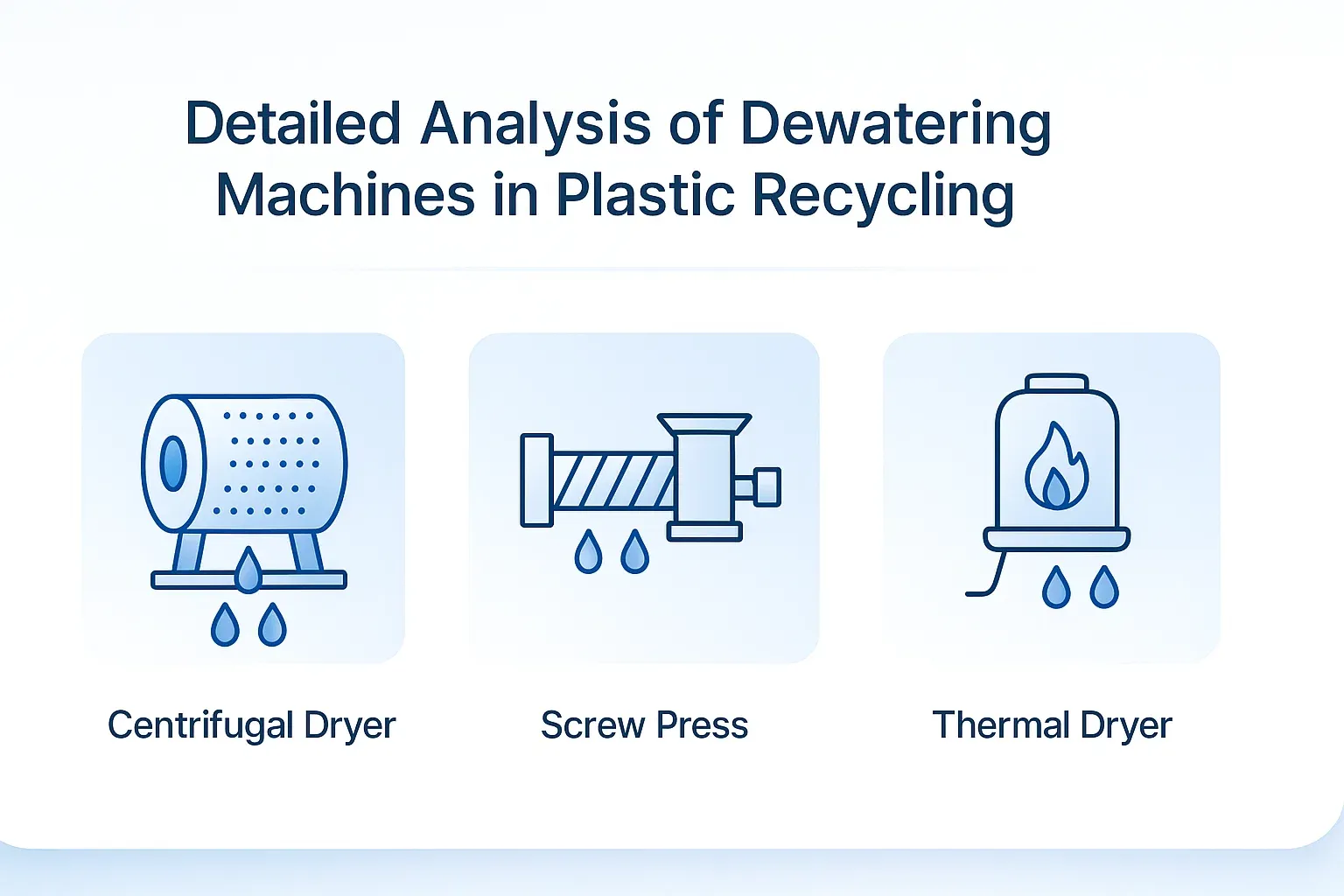
Une machine à déshydrater en plastique élimine l'eau libre des paillettes lavées ou des plastiques flexibles avant le séchage thermique, l'extrusion ou le stockage. L'élimination mécanique de l'eau est généralement préférable à l'évaporation de toute l'eau de lavage avec de la chaleur, mais il n'existe pas de chiffre universel de taux d'humidité à la sortie, d'énergie ou de capacité. Les résultats changent en fonction de la forme des particules, de l'eau d'entrée, de la contamination, de l'état du tamis et de la stabilité de l'alimentation.
Ce guide compare les sécheurs centrifuges, les centrifugeuses à film, les machines à presser et les presses à vis, puis montre comment spécifier un test d'acceptation pour la ligne de recyclage réelle.
Le déshydratage n'est pas la même chose que le séchage final
Évaporation mécanique sépare l'eau libre ou légèrement tenue par la force centrifuge, le drainage et la compression. Séchage thermique fournit de la chaleur et du flux d'air pour évaporer l'humidité restante. Les deux étapes peuvent être utilisées ensemble lorsque le processus aval nécessite un matériau plus sec que l'équipement mécanique ne peut pas fournir de manière constante.
Le taux d'humidité à la sortie doit toujours indiquer le matériau, le débit, le point d'échantillonnage et la méthode de test. Un nombre mesuré sur des paillettes rigides propres ne peut pas être transféré à des films imprimés ou des sacs tissés. Pour l'extrusion en PET, le besoin de conditionnement final est également différent de l'élimination de l'eau de surface après le lavage ; utilisez le guide de séchage des paillettes en PET pour cette route spécifique au matériau.
Quatre catégories d'équipements de déshydratation
| Équipement | Forme typique de l'alimentation | Action principale | Limites importantes |
|---|---|---|---|
| Machine de déshydratation centrifuge | Paillettes rigides en PET, HDPE, PP et similaires | Le rotor à haute vitesse déplace le matériau contre un tamis percé et expulse l'eau | Le film flexible peut s'enrouler ou passer de manière inconstante à moins que la machine ne soit conçue pour cela |
| Sécheur centrifuge de film | Coupe le film PE/PP et les paillettes flexibles sélectionnées | Rotor, pales et tamis adaptés pour les matériaux légers et flexibles | La taille de l'alimentation, l'enroulement et la charge du tamis doivent être testés |
| Pressoir à film | Film PE/PP lavé, raphia et matériaux tissés | La compression à vis élimine l'eau et augmente la densité volumique | La forme de sortie et la chaleur doivent convenir au chargeur d'extrudeur |
| Pressoir à vis | Flux humide volumineux ou mélangé sélectionné | Compression lente contre un tamis de drainage | Peut être une étape de déshydratation primaire plutôt qu'une étape finale de contrôle de l'humidité |
Déshydratation centrifuge pour les paillettes rigides
UN machine d'essorage centrifuge utilise généralement un arbre tournant ou un rotor à l'intérieur d'un panier percé. L'eau passe à travers le tamis tandis que les paillettes voyagent vers le point de déchargement. Il est couramment appliqué après le lavage et le rinçage par friction des plastiques rigides.
Les variables de sélection incluent le diamètre et la longueur du rotor, la surface ouverte du tamis, l'arrangement des pales, la vitesse, le moteur, les surfaces en contact avec le matériau, le drainage de l'eau et l'accès pour le nettoyage. Les paillettes d'alimentation devraient être caractérisées par la distribution de taille, la densité, la forme et la contamination. Les étiquettes, les fibres et les particules fines peuvent boucher un tamis ou s'accumuler là où les paillettes rigides propres passeraient normalement.
Mesurez la vibration et la température des paliers pendant un essai prolongé. L'équilibre du rotor et l'état du tamis affectent à la fois la fiabilité et la constance de l'humidité. Une démonstration à vide courte ne peut pas établir les performances.
Déshydratation du film flexible
Les films se plient, captent l'eau de surface et ont une faible densité volumique. Ils peuvent s'enrouler autour de composants tournants ou arriver en vagues. Un centrifuge spécifique aux films nécessite un forme d'alimentation, un rotor et un arrangement de décharge développés pour le matériau flexible ; un sécheur à plaque rigide ne devrait pas être supposé pouvoir le gérer.
UN machine à presser les films plastiques utilise la compression par vis pour drainer l'eau et compacter le matériau. Cela peut améliorer le conveyage ultérieur et l'alimentation de l'extrudeuse. Le rendement utile n'est pas simplement la densité la plus élevée possible : des pièces trop grandes, fusionnées ou irrégulières peuvent être mal alimentées.
Comparez la distribution d'humidité, la densité volumique, la taille des pièces de sortie, la charge du moteur et la stabilité de l'alimentation de l'extrudeuse. Le guide de densité volumique du compacteur de film explique pourquoi une masse d'entrée humide ne devrait pas être utilisée pour prétendre à un rapport de compression non défini.
Le déshydratation par vis-press
UN système d'essorage par presse à vis applique une compression progressive tout en que le liquide quitte par un tamis ou une zone de drainage. Il peut être utilisé pour des aliments qui bénéficient d'un traitement à basse vitesse ou comme une première étape mécanique avant un autre sécheur.
Spécifiez le matériau et le risque de rejet avec soin. Les fibres, les films, les mélanges papier-plastique et les éclats interagissent différemment avec le tamis et la zone de pression. Vérifiez l'accès au tamis, la protection contre l'usure, le drainage, la limitation du couple et la manière dont les bouchons sont enlevés en toute sécurité.
Comment calculer la charge réelle d'eau
Les pourcentages d'humidité peuvent être rapportés sur une base humide ou sèche. La spécification doit nommer la base. Sur une base humide :
L'humidité = masse d'eau ÷ masse totale du matériau humide × 100.
Si la débit massique du plastique sec est connu, l'inlet et l'Outlet humidité peuvent être convertis en kilogrammes d'eau entrant et sortant par heure. Ce bilan massique est plus utile pour dimensionner le prochain sécheur thermique qu'un pourcentage seul.
Par exemple, le même pourcentage d'humidité de sortie représente une charge d'évaporation différente à des débits de solides sèches différents. De même, une ligne qui perd du plastique fin avec l'eau séparée peut sembler éliminer plus de masse sans produire plus de produit sec accepté. Mesurez l'eau, les solides plastiques et les rejets séparément.
Énergie mécanique par rapport à l'énergie thermique
L'évaporation de l'eau nécessite une chaleur considérable, donc l'élimination de l'eau libre mécaniquement avant une étape thermique est généralement raisonnable. Cependant, un multiplicateur fixe tel que “quatre à six fois moins cher” n'est pas une garantie universelle de machine. La comparaison dépend du kilogramme d'eau éliminé, de l'efficacité du moteur, de la méthode de chauffage, des pertes d'air, de la récupération de chaleur et des prix des services publics locaux.
Comparez les systèmes en utilisant :
- kWh d'électricité par tonne de plastique sec accepté
- Énergie thermique ou carburant par tonne
- Kilogrammes d'eau éliminés mécaniquement et thermiquement
- Perte de plastique dans les drains, fines ou poussière
- Maintenance, nettoyage de l'écran et arrêt programmé prévu
Le Comparaison entre séchage mécanique et séchage par air Fournit un cadre, mais l'économie du projet devrait utiliser des données de ligne mesurées et les coûts locaux actuels.
Cadre de sélection en six étapes
1. Définir le matériau
Enregistrer le résine, forme rigide ou flexible, distribution de particules, humidité entrante, densité volumique, température et contamination. Inclure le matériau le plus défavorable, pas seulement l'échantillon le plus facile.
2. Définir les exigences à la aval
Indiquer si la sortie va à un séchage thermique, à l'entreposage, à un alimentateur d'extrudeuse ou à la vente directe. Spécifier l'humidité, la forme des particules et la densité volumique avec des méthodes d'essai.
3. Calculer le débit de solides sèches
La capacité devrait être basée sur le plastique sec et l'eau attendue en entrée. Le seul débit quotidien moyen peut cacher des pics provenant du lavage en lot. Mesurer le débit maximum stable que la ligne à l'amont délivrera.
4. Associer l'équipement au comportement des particules
Utiliser des centrifugeuses à plaques rigides pour des plaques compatibles, des conceptions spécifiques aux films ou des compresseurs pour les alimentations flexibles, et des presses à vis où le rôle du matériau et du déshydratage le justifie. Valider les flux ambigus par des essais.
5. Vérifier l'installation et la maintenance
Confirmer la fondation, le drainage, l'accès, la levée, le bruit, la protection, le verrouillage du rotor, les écrans de rechange et les roulements. L'équipement humide nécessite également des dispositions appropriées à la corrosion et au nettoyage en fonction de la chimie du lavage.
6. Convenir d'un essai d'acceptation
Définir le lot d'alimentation, la durée de l'essai stable, la fréquence d'échantillonnage et les résultats d'acceptation ou de refus avant l'achat. Inclure les arrêts et le temps de nettoyage, pas seulement l'échantillon d'humidité le meilleur.
Mesures de l'essai d'acceptation
- Débit de masse de plastique sec et total de l'alimentation humide
- Humidité d'entrée et de sortie utilisant la même méthode déclarée
- Eau collectée et solides plastiques perdus avec elle
- Courant moyen et pointe, vibration et température des roulements
- Densité volumique de sortie et forme des particules pour les matériaux flexibles
- Arrêts, bouchage des écrans, envelopement et interventions manuelles
- Temps pour ouvrir en toute sécurité, nettoyer, inspecter l'écran et redémarrer
Dépannage par symptôme
L'humidité de sortie augmente
Vérifier la charge d'eau entrante, le débit d'alimentation, le bouchage des écrans, le drainage, la condition du rotor ou de la vis et les changements de taille du matériau. Ne pas supposer que le moteur est sous-dimensionné avant que ces variables ne soient mesurées.
Enveloppe de film ou pont d'alimentation
Revoir la taille de coupe, le hachoir, le dosage, les détails du bout du rotor et si l'équipement est conçu pour les matériaux flexibles. Réduire le débit d'alimentation peut stabiliser un test mais ne résout pas une mauvaise configuration.
L'augmentation de la vibration
Arrêtez et inspectez selon la procédure du fabricant. Un dépôt inégal, des écrans endommagés, un contact du rotor, l'usure des paliers ou un déséquilibre peuvent créer un risque mécanique sérieux.
Le chargeur de sécheur thermique reste élevé
Établissez un équilibre massique de l'eau. La cause peut être un déshydratation mécanique instable, un niveau d'eau d'entrée supérieur, un échantillon d'humidité incorrect, des fuites d'air ou des pertes de chaleur - et non pas simplement une puissance insuffisante du moteur de déshydratation.
Intégrez complètement le système de séchage
Une machine de déshydratation doit être adaptée aux convoyeurs, laveuses, traitement de l'eau et la prochaine étape de séchage ou d'extrusion. Le guide du système de séchage en plastique couvre la conception complète du système, tandis que le aperçu du système de lavage en plastique montre où l'élimination mécanique de l'eau s'insère dans une ligne.
Choisissez parmi l'élimination de l'eau mesurée, la production acceptée et la stabilité descendante. Les catalogues d'humidité, de capacité et de fourchettes de prix sans les conditions d'essai ne constituent pas une base d'achat fiable.
Questions fréquemment posées
Quelle est la meilleure machine de déshydratation pour les copeaux de plastique rigide ?
Une machine centrifuge de déshydratation est couramment utilisée, mais le rotor, le tamis et la capacité doivent être testés avec la taille réelle des copeaux, la contamination et la charge d'eau entrante.
Doit-on utiliser un centrifugeur ou un compacteur pour le film lavé ?
Cela dépend de la forme du film et du processus suivant. Un centrifuge spécifique au film élimine l'eau, tandis qu'un compacteur compresse également le matériau. Comparez l'humidité, l'emballage, la densité volumique et l'alimentation de l'extrudeuse dans les essais.
Est-ce qu'un sécheur thermique est toujours nécessaire après le déshydratation mécanique ?
Non. Il est nécessaire lorsque la spécification de humidité à la sortie ne peut pas être respectée de manière constante par le seul équipement mécanique. La décision doit suivre les exigences du matériau et du processus final.
