

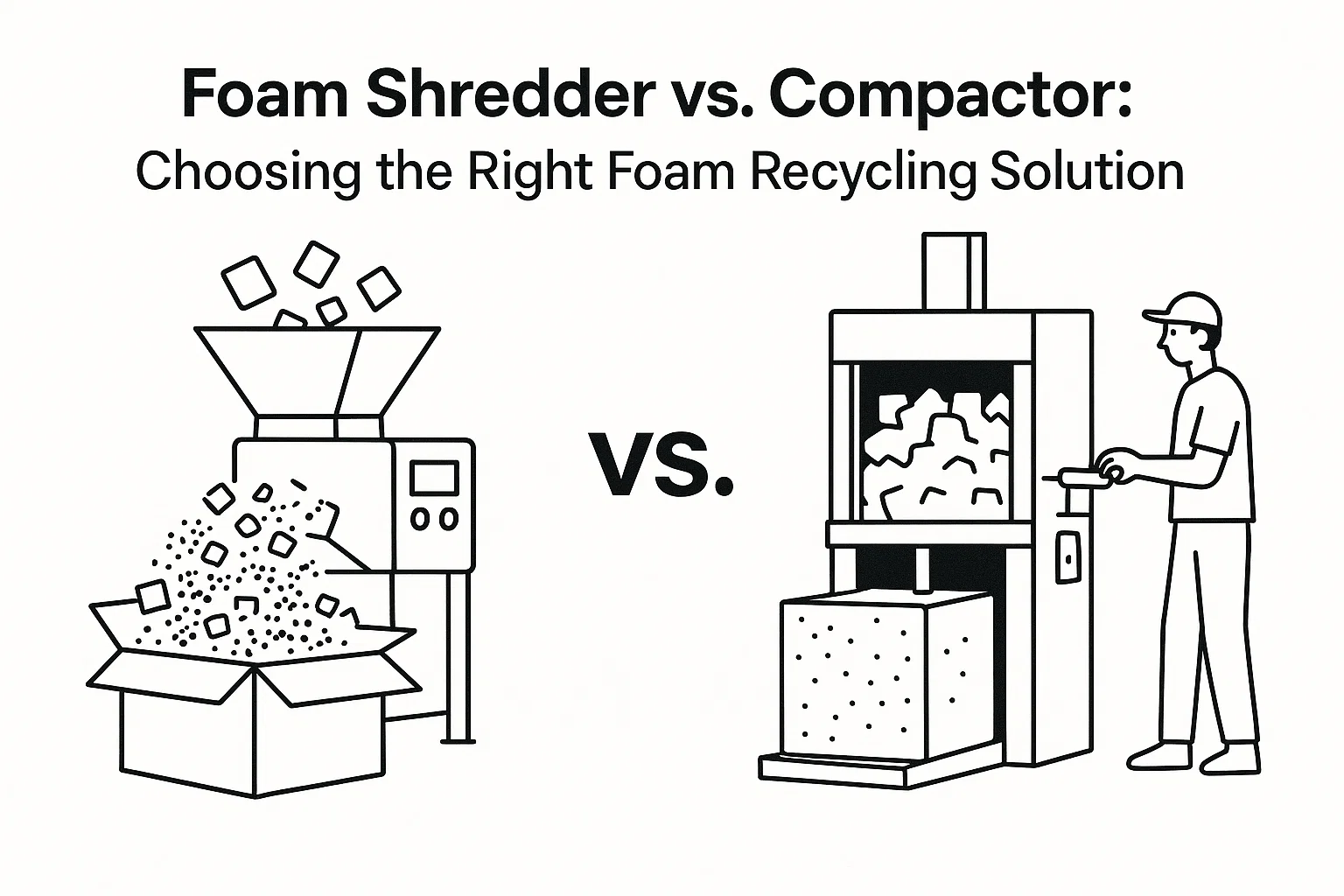
Expanded Polystyrene (EPS/Styrofoam) is mostly air by volume, so logistics often dominate the economics: a 53-foot trailer full of loose EPS can be volume-limited long before it is weight-limited. In many scenarios, recycling becomes financially viable only after densification. This guide compares three common solutions: Shredding, Cold Compaction, and Thermal Densification.
Related equipment: single shaft shredder.
Start with the Required Output, Not the Machine Name
A shredder, cold compactor and hot-melt densifier solve different parts of the foam-recycling problem. The right choice depends on the foam type, contamination level, monthly volume, available utilities and—most importantly—the form accepted by the downstream recycler.
Before selecting equipment, confirm whether the buyer accepts loose flakes, cold-compacted blocks, hot-melt ingots or pellets, and ask about limits for moisture, labels, tape, food residue and mixed polymers. Configure the equipment around that specification and the site’s actual operating conditions.
Foam Shredders: Size Reduction Before Reuse or Densification
A foam shredder breaks bulky pieces into smaller, more uniform flakes. It can improve feeding consistency, reduce manual handling and prepare material for a compactor, densifier or pelletizing line. Shredding alone removes little trapped air, so the output may still be uneconomical to transport over long distances.
Shredding is generally suitable when a facility reuses clean flakes on site, feeds them into another recycling stage or needs to manage irregular molded packaging before densification. Blade arrangement, screen size, feed opening and dust control should be selected for the foam grade and downstream particle size.
EPS, EPE, EPP, XPS and flexible polyurethane foam have different mechanical and thermal behavior. Mixing incompatible grades can reduce output value even when a shredder can physically process them.
Cold Compactors: Mechanical Volume Reduction Without Melting
A cold compactor normally combines size reduction with screw or hydraulic compression. It removes trapped air and forms blocks or logs without intentionally melting the polymer, making the output easier to stack, store and transport.
Cold compaction is often considered for clean EPS packaging waste from appliance plants, distribution centers and fish-processing facilities. Free water, food residue, tape, labels and foreign objects can still affect feeding, block stability, hygiene and buyer acceptance.
Actual motor power and throughput depend on feed density, piece size, moisture, required block dimensions and machine configuration. Energycle systems are sized for each project rather than selected from one universal capacity figure.
For a dedicated cold-press solution, see the EPS foam compactor machine.
Hot-Melt Densifiers: Dense Ingots for Longer-Distance Handling
A hot-melt densifier applies controlled heat and mechanical pressure to suitable foam and discharges a dense ingot. The output can reduce transport volume further and may be preferred by some downstream processors.
Thermal processing requires closer attention to electrical capacity, temperature control, ventilation, hot-surface guarding and start-up and shutdown procedures. Moisture and contaminants can cause unstable processing, odor, residue, inconsistent ingots or buyer rejection.
Review the EPS foam melting machine when the buyer prefers hot-melt ingots and the site can support the required utilities.
When Pelletizing Is the Required Final Step
Compacted blocks and hot-melt ingots are transportable intermediate products; they are not automatically finished recycled resin. Pellet production may add controlled feeding, extrusion, melt filtration, degassing and pellet cutting.
For this route, evaluate an EPS foam pelletizing line separately from the initial volume-reduction equipment.
Practical Comparison
| Selection factor | Foam shredder | Cold compactor | Hot-melt densifier |
|---|---|---|---|
| Primary function | Reduce piece size | Mechanically remove air and form blocks or logs | Thermally densify material into ingots |
| Typical output | Loose flakes | Cold-compacted blocks or logs | Dense solidified ingots |
| Common role | Pre-processing or on-site reuse | Storage and transport volume reduction | High-density preparation for an approved buyer |
| Utilities to confirm | Electrical supply and dust collection | Electrical supply; hydraulics where applicable | Electrical supply, ventilation and thermal-safety provisions |
| Key feed limitation | Mixed polymers and foreign objects | Moisture, contamination and unstable feed | Moisture, incompatible polymers and heat-sensitive contamination |
| Buyer check | Will loose flakes be accepted locally? | What block form and contamination level are accepted? | What ingot quality and polymer grade are accepted? |
How to Choose Between Them
- Identify the polymer: separate EPS from EPE, EPP, XPS, PU foam and non-foam plastics.
- Characterize the feed: record source, piece size, moisture, labels, adhesives and contamination.
- Confirm the outlet: obtain the recycler’s acceptance requirements before specifying the machine.
- Measure real generation: use representative shift, week and seasonal data.
- Check the site: review floor space, feeding method, labor, electrical supply, ventilation and storage flow.
- Run a material test: verify feeding behavior and output quality with representative samples when possible.
There is no universal volume threshold at which one technology becomes the correct answer. Transport distance, disposal charges, labor, electricity, buyer specifications and operating hours vary by project.
FAQ
Can wet fish boxes be processed in a foam densifier?
Wet or food-contaminated fish boxes should not be fed into a thermal densifier unless the supplier and site procedure explicitly permit it. Free water can cause unstable thermal processing and poor ingot quality. Cold compaction may be more suitable after cleaning and draining, but the buyer’s contamination limits must still be confirmed.
Does cold compaction degrade EPS?
Cold compaction does not intentionally melt EPS, so it adds less thermal history than hot-melt processing. Output quality still depends on contamination, frictional heat, forming pressure and storage; downstream testing determines buyer acceptance.
References
[1] “EPS Recycling Logistics,” Expanded Polystyrene Industry Alliance. EPS Recycling Logistics
