

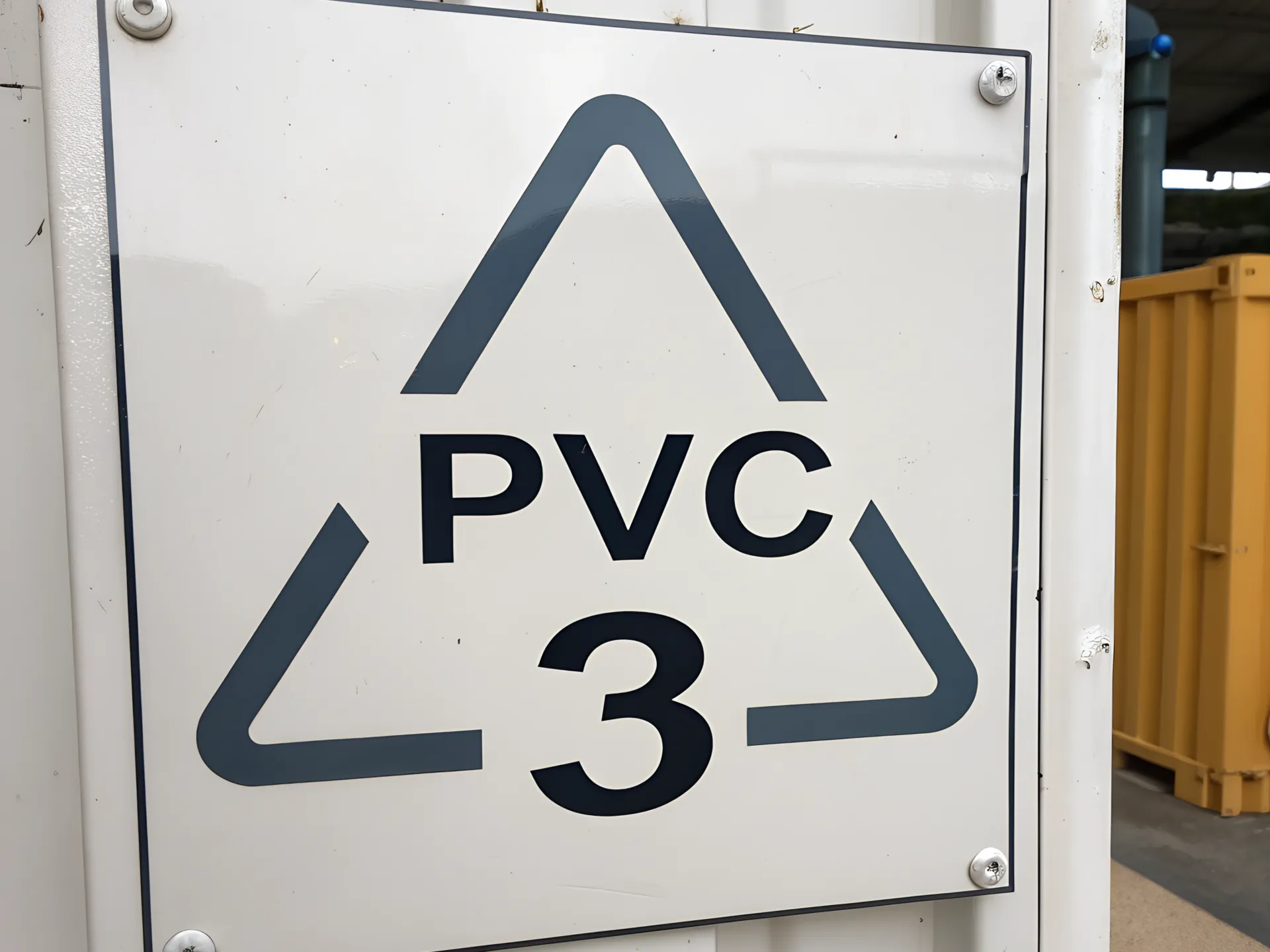
PVC is identified by resin identification code 3, usually accompanied by the abbreviation PVC or V. The code identifies the plastic resin family; it does not mean that a product is accepted in curbside collection or recyclable in every local system.
ASTM D7611 states that resin identification codes are used to identify the plastic resin in a manufactured article. The standard’s purpose is classification, not a recyclability guarantee. That distinction is especially important for PVC because rigid pipe, flexible flooring, cable insulation and multilayer packaging can contain very different formulations.
What does plastic code 3 mean?
Code 3 refers to polyvinyl chloride. Common applications include:
- Rigid pressure and drainage pipe
- Window profiles, siding and other construction products
- Sheet, flooring and wall coverings
- Cable insulation and flexible hose
- Selected packaging, cards and coated fabrics
These products do not form one interchangeable recycling stream. Rigid and flexible PVC use different additives and have different end-use histories. A recycler needs the product type, formulation where available, contamination and target recycled grade—not only the number 3.
Why the resin code is not a recycling instruction
Collection and recycling depend on local markets and facilities. A code can help sort material after it has entered an appropriate system, but it cannot show whether:
- The local program accepts that PVC product
- The article contains compatible additives or attachments
- The stream is sufficiently clean and homogeneous
- A processor and end market exist for the resulting material
- The product is safe and lawful to handle in the intended route
Consumers should follow the official rules of their municipality or collection provider. Do not place a code 3 item in a bin simply because it carries a triangular mark.
Rigid and flexible PVC need different controls
Rigid PVC
Pipe, profile and sheet scrap can be attractive when it is collected separately and its formulation is known. Clean production offcuts may be sorted, reduced in size, metal-protected and reprocessed with relatively little washing. Post-use construction products require removal of metal, rubber, glass, seals, fasteners and other materials.
Flexible PVC
Flexible products may contain plasticizers and other formulation-specific additives. Cable, flooring, hose and coated textiles also introduce copper, fibers, adhesives or backing materials. These streams should be characterized and processed separately unless a documented end-product specification permits blending.
A result that works for rigid window-profile scrap should not be applied to flexible cable compound. The PVC varieties and grinding guide explains how formulation and product form change size reduction.
Why PVC contamination matters in other plastics
PVC is an unwanted contaminant in many PET and polyolefin streams. It behaves differently during heat processing and can reduce product quality at low concentrations. Sorting should therefore remove PVC articles and fragments before extrusion.
In PET bottle recycling, labels, sleeves and look-alike containers need particular attention. The PVC-in-PET contamination guide covers detection, sorting and process controls for that application.
PVC additives and legacy material
PVC formulations can contain stabilizers, plasticizers, fillers, pigments and processing aids. Their type and concentration vary by product, age and region. Recyclers should not infer a formulation from code 3 alone.
Legacy construction products may contain substances restricted in newer products. Where relevant, use supplier documentation, product age, source segregation and laboratory testing. Regulatory requirements can limit the recycled material’s next application even when mechanical processing is technically possible.
For European operations, the EU lead limits for PVC recyclers provides a focused compliance overview. Current legal requirements should always be checked for the plant and intended product.
A typical mechanical recycling route
A controlled rigid-PVC stream may follow:
source segregation → manual and automated sorting → metal removal → shredding or crushing → washing where required → drying → fine grinding or controlled regrind production → blending and reprocessing to specification.
The route changes with pipe, profile, sheet, cable or flexible products. A PVC pipe and profile crusher handles primary size reduction for compatible rigid items, while other products may need cable separation, delamination or different cutting equipment.
Heat history must be controlled during grinding and extrusion. Appropriate ventilation, dust control, guarding and process monitoring are part of the equipment specification.
How recyclers verify a code 3 stream
- Define the product family. Separate pipe, profile, sheet, flooring, cable and packaging.
- Confirm composition. Use supplier records, identification technology and testing where needed.
- Remove attachments. Control metals, seals, labels, backing, textiles and other polymers.
- Establish the target grade. Define particle size, contamination, formulation and next application.
- Run representative trials. Measure yield, separation, temperature, dust and reprocessed properties.
- Check regulatory fit. Verify that the recovered formulation is permitted for the intended market.
Responsible handling for households and businesses
For household items, check the official local collection list or ask the waste authority about PVC. If code 3 is not accepted, use an authorized specialist program where one exists. Do not burn PVC in an open fire or uncontrolled appliance.
Businesses with pipe, profile, flooring, cable or production scrap should keep streams separate and retain information about source and formulation. A specialist PVC recycler can then evaluate a cleaner and more traceable material than mixed general waste.
PVC recycling in context
PVC can be mechanically recycled in suitable controlled streams, but “fully recyclable” and a fixed number of recycling cycles are not responsible universal claims. Material degradation, additive history, contamination and the next-product specification determine whether another processing cycle is suitable.
See PVC recycling explained for a broader process overview and the PVC recycling equipment guide for the differences between regrind, granules and powder routes.
Frequently asked questions
What is the recycling code for PVC?
PVC uses resin identification code 3, often shown with PVC or V. It identifies the resin family but does not guarantee local collection or recyclability.
Can PVC marked with code 3 be recycled?
Some controlled PVC streams can be mechanically recycled. Acceptance depends on the product, formulation, contamination, local processor and end market.
Can PVC and PET be recycled together?
No. PVC is a serious contaminant in PET recycling and should be removed through source control and sorting before heat processing.
