

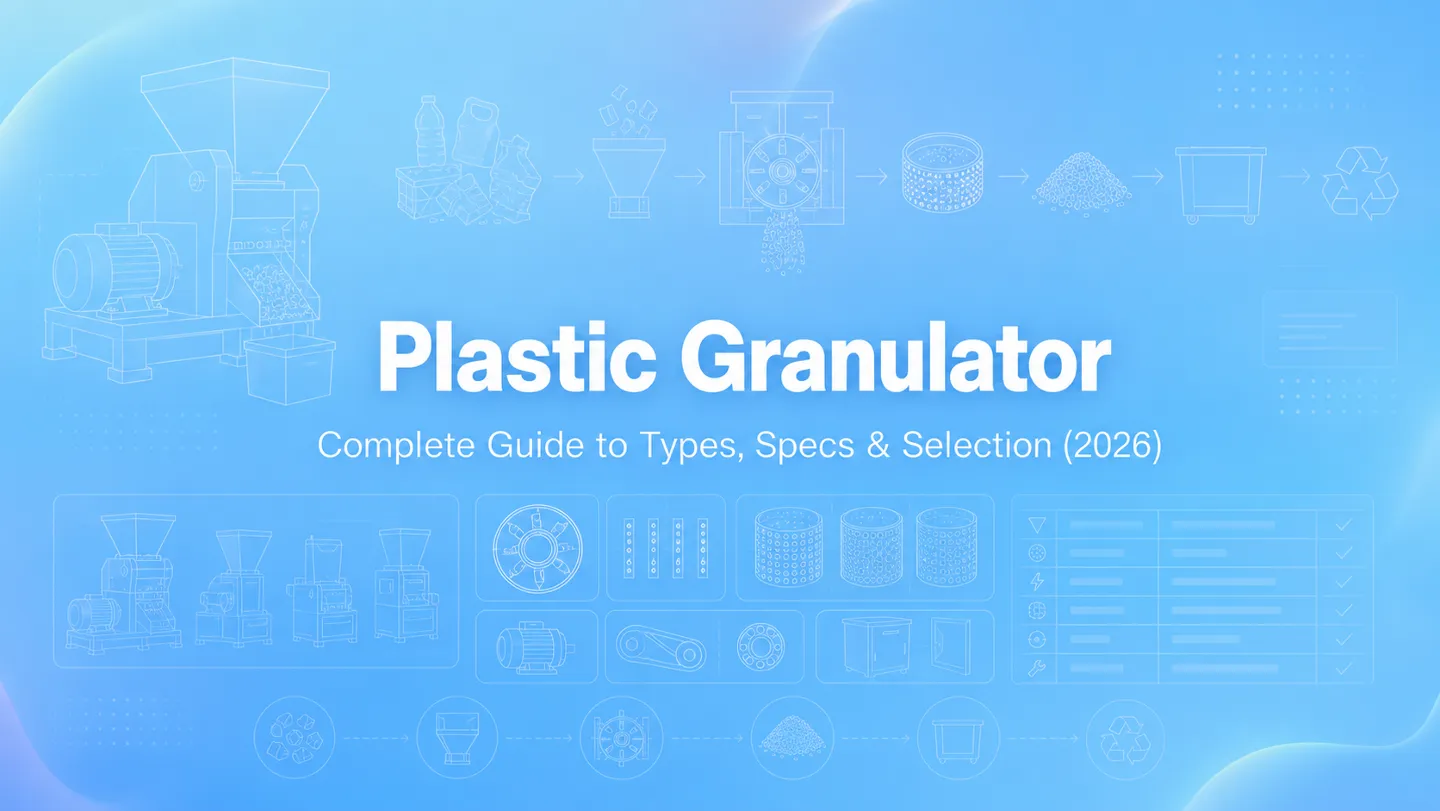
A granulador de plástico reduce los residuos plásticos -bandejas, bebederos, botellas, tubos, perfiles, film- en copos uniformes de 6-15 mm (denominados triturado) listos para el lavado, la composición o la extrusión directa. El granulador adecuado depende del material de entrada, el rendimiento y el proceso posterior; una elección equivocada significa baja capacidad, atascos frecuentes o un desgaste prematuro de las cuchillas que duplica el coste operativo. Esta guía cubre los 5 tipos principales de granuladores de plástico, las especificaciones clave que importan, la selección específica del material, las ventajas y desventajas del material de las cuchillas, los puntos de referencia energéticos, los niveles de coste de capital ($8.000-$200.000+), un marco de selección en 5 pasos, la resolución de problemas comunes, las certificaciones y las diferencias regionales de precios.
Si desea profundizar en algún subtema, consulte nuestras guías especializadas sobre selecting plastic granulator blades, elegir la máquina granuladora adecuada, granuladores de plástico húmedo, y 10 especificaciones que debe comprobar. Este artículo es el pilar de referencia que conecta todos estos temas.
Decisión rápida: Granuladora vs Trituradora vs Trituradora
Los compradores suelen confundir estas tres máquinas. La regla de decisión más sencilla:
| Máquina | Tamaño de Entrada | Tamaño de salida | Caso práctico |
|---|---|---|---|
| Triturador de plástico | Residuos voluminosos grandes (tubos, bidones, balas, piezas de más de 1 m) | virutas de 40-150 mm | Reducción de tamaño primaria (primera etapa) |
| Granulador de plástico | Virutas pretrituradas, correderas, botellas, piezas más pequeñas (menos de 200 mm) | Copos de 6-15 mm | Reducción secundaria de tamaño (tamaño final de los copos) |
| Trituradora de plástico | Residuos de tamaño medio, a menudo piezas huecas (solapamiento con ambos) | trozos de 10-30 mm | Puente entre la trituradora y el granulador; a veces se utiliza de forma independiente para tubos de pared gruesa. |
Para la mayoría de las líneas de reciclado de plástico que procesan material preclasificado de menos de 200 mm de tamaño de entrada (canales de inyección, escamas de botellas, virutas de tuberías trituradas), un granulador de plástico es la elección correcta. Para residuos de gran tamaño (tuberías llenas, bidones, balas), comience con una trituradora y alimente el granulador a continuación. A veces los términos se utilizan indistintamente - “trituradora de plástico” y “granuladora de plástico” se solapan en la denominación de los productos de los distintos fabricantes-, pero la distinción de funciones mencionada anteriormente es válida en las líneas de producción.
¿Qué es un granulador de plástico?
Un granulador de plástico es una máquina de reducción de tamaño de precisión que corta los desechos de plástico en copos uniformes de 6-15 mm denominados triturado. Los granuladores de plástico estándar de la industria (también comercializados como máquinas granuladoras de plástico, máquinas granuladoras de plástico o trituradoras de plástico en algunos mercados) utilizan un rotor de alta velocidad con cuchillas de corte que pasan contra cuchillas de lecho fijo, accionadas por un motor de 7,5-110 kW a 400-800 RPM. Una criba perforada situada debajo de la cámara de corte controla el tamaño de los copos de salida. El plástico triturado sale por la criba y pasa a la siguiente fase del proceso: lavado, compuesto, secado o granulado.
Los granuladores de plástico difieren de las trituradoras de plástico en dos aspectos. En primer lugar, los granuladores manipulan piezas de entrada más pequeñas (menos de 200 mm) a velocidades de rotor más altas (400-800 RPM frente a 50-150 RPM de los trituradores); en segundo lugar, los granuladores producen una salida uniforme controlada por tamiz (6-15 mm) mientras que los trituradores producen trozos variables (40-150 mm). La mayoría de las líneas de reciclado de plásticos utilizan ambas: primero la trituradora para la reducción primaria de tamaño y después la granuladora para el tamaño final de los copos requerido por la extrusión posterior.
Cómo funciona un granulador de plástico (proceso en 4 fases)
- Alimentación de material - La chatarra de plástico entra en la cámara de corte a través de una tolva, un transportador o una conexión directa junto a la prensa. La velocidad de alimentación se controla mediante sensores o mediante la dosificación del operario.
- Acción de corte - un rotor de alta velocidad (normalmente 400-800 RPM) que lleva de 3 a 6 cuchillas de corte pasa contra 2-3 cuchillas de bancada fija. La acción de corte en forma de tijera corta el plástico en trozos más pequeños. La separación entre cuchillas (el espacio entre la cuchilla del rotor y la cuchilla de la bancada) se ajusta con precisión a 0,2-0,3 mm para un corte limpio sin contacto metal con metal.
- Dimensionado de la pantalla - Una criba perforada (5-25 mm de diámetro de agujero) situada debajo de la cámara de corte controla el tamaño de los copos de salida. El material por debajo del tamaño de la criba pasa a través de ella; las piezas de mayor tamaño permanecen en la cámara para cortes adicionales. El tamaño del orificio de la criba determina la especificación del triturado final.
- Descargar - El triturado de copos sale a través de la criba hacia un recipiente de recogida o un transportador neumático que lo transporta a la siguiente fase del proceso (línea de lavado, sistema de secado o tolva de alimentación del granulador).
El ciclo completo, desde la entrada del material hasta la descarga de los copos, dura entre 2 y 8 segundos, dependiendo de la dureza del material y del tamaño de la criba. El rendimiento típico del granulador de plástico en el punto de diseño es de 100-3.000 kg/h dependiendo de la potencia del motor, el diámetro del rotor y el material procesado.
5 tipos de granuladores de plástico
1. Granulador central de plástico
Un granulador central de plástico manipula los desechos de plástico de varias líneas de producción recogidos en una ubicación centralizada. Capacidad típica de 500-3.000 kg/h con un motor de 30-110 kW. Ideal para: instalaciones de reciclado, MRF (instalaciones de recuperación de materiales) y grandes plantas de fabricación en las que se consolidan residuos de muchas fuentes. Coste de capital: $15.000-$80.000 en función de la capacidad, el material de las cuchillas y el nivel de automatización. Configuración más común en operaciones dedicadas al reciclado de plástico.
2. Granulador de plástico "al lado de la prensa
Instalado directamente junto a una máquina de moldeo por inyección o extrusión, este granulador compacto procesa canales y bebederos inmediatamente después de su producción. Capacidad típica de 50-300 kg/h con motor de 5,5-18,5 kW. Funciona a baja velocidad (300-500 RPM) para un funcionamiento más silencioso y un polvo mínimo adecuado para el entorno de la planta de producción. Coste de capital: $5.000-$25.000. Ideal para: moldeadores por inyección que procesan su propia chatarra limpia con reciclaje interno en circuito cerrado. La escama de salida vuelve a alimentar la misma máquina de moldeo - índices típicos de contenido reciclado 15-30% mezclado con polímero virgen.
3. Granulador de plástico húmedo
A granulador de plástico húmedo inyecta agua en la cámara de corte durante el funcionamiento. El agua enfría las cuchillas, lava la contaminación superficial de las escamas, reduce el polvo y mejora la eficacia del corte en material sucio o contaminado. Capacidad típica 500-2.500 kg/h con motor de 22-75 kW. Ideal para: flujos de plástico postconsumo (botellas, film, tuberías con suciedad superficial), reciclaje de escamas de botellas de PET y cualquier operación en la que el material de entrada tenga suciedad, polvo o etiquetas que se beneficien del lavado en proceso. Coste de capital: $20.000-$80.000 (más alto que el granulador en seco debido a la gestión del agua).
4. Granuladora de plástico resistente
Los granuladores de plástico para trabajos pesados manipulan residuos de plástico duro o de paredes gruesas: tubos de HDPE, piezas de automóvil de ABS, láminas de PC, tubos de PVC, componentes de nailon y envases rígidos. El eje del rotor reforzado, los cojinetes de mayor tamaño y las cuchillas endurecidas SKD-11 o con punta de carburo prolongan la vida útil en materiales duros. Capacidad típica 800-3.500 kg/h con motor de 45-150 kW. Ideal para: plantas de extrusión de tubos, recicladoras de bidones, recuperación de plásticos de automoción. Coste de capital: $35.000-$200.000 - el rango superior cubre configuraciones especializadas como la large-diameter HDPE pipe crusher para residuos de tuberías industriales.
5. Especializado: Granuladora y trituradora de tubos de PVC
Los granuladores de PVC requieren cuchillas endurecidas (SKD-11 o con punta de carburo) y extracción de polvo para manejar la liberación de cloro durante el corte. La velocidad del rotor opera 25–35% más baja que los granuladores de HDPE (300–500 RPM) para evitar finos excesivos. La misma clase de máquina incluye trituradoras de tubería — aberturas de alimentación extraanchas para aceptar trozos de tubería de trituradoras de arriba. Costo de capital: $25,000–$120,000 con configuración adecuada para PVC. Mejor para: reciclaje de tubería de PVC, desechos de pavimentos de vinilo, recuperación de conductos eléctricos. — verificar que la calificación sea para su material en su tamaño de pantalla. Las calificaciones del fabricante son a menudo el mejor caso (HDPE rígido limpio a 16 mm de pantalla). El rendimiento real en una pantalla de 8 mm en material contaminado puede ser 30–50% menor.
Especificaciones importantes del granulador de plástico
Las fichas técnicas de los fabricantes enumeran más de 30 especificaciones. Estas 8 son las que realmente determinan el rendimiento:
- Potencia del motor (kW) - normalmente 7,5-110 kW en función del rendimiento. Regla empírica: 1 kW por cada 8-15 kg/h de capacidad para plásticos rígidos; 1 kW por cada 5-10 kg/h para materiales resistentes (PVC, ABS, nailon).
- Diámetro del rotor (mm) - normalmente 150-500 mm. Rotor más grande = par más alto pero RPM más bajas. Para material de pared gruesa, priorizar el diámetro del rotor sobre las RPM.
- RPM del rotor - Normalmente 400-800 RPM para granuladores estándar; 300-500 RPM para servicio pesado/PVC. RPM más altas = más ciclos de corte, pero más calor y ruido.
- Número de palas del rotor - Normalmente de 3 a 6 cuchillas. Más cuchillas = corte más suave pero virutas más pequeñas por corte.
- Número de cuchillas - típicamente 2-3. La holgura de corte (separación entre cuchillas) entre el rotor y las cuchillas de la bancada debe ser de 0,2-0,3 mm para un cizallamiento limpio sin contacto metálico.
- Tamaño de la pantalla (mm) - normalmente 5-25 mm de diámetro de agujero. Rendimientos estándar: 6 mm (alimentación de pellets premium), 8 mm (uso general), 12 mm (rendimiento más rápido, copos más grandes), 16+ mm (sólo reducción de volumen).
- Dimensiones de la cámara de corte - La anchura y la profundidad determinan el tamaño máximo de la pieza de entrada. Para botellas de HDPE, la cámara típica es de 350×500 mm; para restos de tuberías, 600×800 mm o más.
- Rendimiento (kg/h) Verifique la calificación para su material en su tamaño de pantalla. Las calificaciones del fabricante son a menudo el mejor caso (HDPE rígido limpio a 16 mm de pantalla). El rendimiento real en una pantalla de 8 mm en material contaminado puede ser 30–50% menor.
Para obtener una lista de comprobación más detallada sobre la dureza de las cuchillas, el margen de desgaste de la criba, la reserva de par del motor y las características del PLC, consulte nuestro top 10 granulador de plástico especificaciones técnicas.
Selección de granuladores de plástico para materiales específicos
La configuración correcta del granulador cambia significativamente según el material de entrada. La siguiente tabla muestra las configuraciones recomendadas para los plásticos más comunes:
| Material | Mejor tipo de granulador | Material de la hoja | RPM del rotor | Requisitos especiales |
|---|---|---|---|---|
| HDPE / PP rígido | Central o húmeda | Acero D2 | 500–700 | Configuración estándar |
| Escamas de botellas PET | Granulador de plástico húmedo | D2 o SKD-11 | 400–600 | Inyección de agua para la eliminación de etiquetas |
| Tubos y perfiles de PVC | Deshumidificación pesada + extracción de polvo | SKD-11 o carburo | 300–500 | RPM más bajo para reducir finos + sistema de polvo |
| Ingeniería ABS/PC | Deshumidificación pesada | SKD-11 | 400–600 | Rotor reforzado para impacto alto |
| Nylon (PA6, PA66) | Deshumidificación pesada | Cortador con punta de carburo | 300–500 | Cuchillas de carburo para rellenos abrasivos de nylon |
| Residuos sólidos mixtos | Central con pantalla de seguridad | SKD-11 | 400–600 | Detección de metales obligatoria en el flujo ascendente |
| Película (PE, PP) | Rotor anti-enrollamiento solo | D2 con perfil de corte de película | 600–800 | Cubiertas y paros estándar del granulador — usar diseño específico de película |
| Desperdicios de tubería (post-cortador) | Cortador de tubería pesado | SKD-11 | 300–500 | Alimentación amplia para manejo de virutas |
Operaciones de procesamiento de múltiples materiales deben configurar el granulador para el material más exigente en la mezcla. Cambiar el tamaño de la malla o la configuración de las cuchillas entre materiales es factible para el operador, pero toma 30–60 minutos por cambio. Los granuladores dedicados de un solo material siempre superan a los unidades de múltiples materiales en el material específico para el que están configurados.
Cuchillas de Granulador de Plástico: Materiales, Vida Útil y Selección
Las cuchillas de granulador de plástico (también llamadas cuchillas) son el componente de desgaste primario y el mayor artículo de costo operativo continuo. La selección de la cuchilla afecta la producción, la calidad de la salida, el consumo de energía y la frecuencia de mantenimiento. Tres niveles de material de cuchilla cubren la mayoría de las aplicaciones:
- Acero D2 — opción estándar para la mayoría de las aplicaciones de granulador de plástico. Dureza HRC 58–62. Vida útil 600–1,200 horas de operación en HDPE/PP. Costo: $80–$300 por cuchilla dependiendo del tamaño. Afilable 3–5 veces antes de reemplazo.
- Acero de herramienta SKD-11 frío de trabajo — opción premium para materiales duros (ABS, PC, nailon, PVC). Dureza HRC 60–62. Vida útil 1,500–2,500 horas. Costo: $200–$600 por cuchilla. Mejor retención de borde en materiales abrasivos; recomendado para cualquier operación procesando más de 1,000 kg/h.
- Cuchillas con punta de carburo — opción especializada para materiales altamente abrasivos (nailon relleno de vidrio, plásticos reforzados con fibra, corrientes contaminadas). Vida útil 3,000–6,000 horas. Costo: $400–$1,200 por cuchilla. El borde de corte de carburo resiste el desgaste 3–5 veces mejor que el D2, pero cuesta 2–4 veces más en el costo inicial.
La selección de la cuchilla de mesa (barra de corte fija) sigue los mismos materiales. Tanto las cuchillas del rotor como las cuchillas de la mesa deben coincidir con la clase de material — usar cuchillas de rotor D2 contra cuchillas de mesa SKD-11 provoca un desgaste desigual y acorta la vida útil de ambos componentes.
Guía práctica: para las operaciones del primer año en HDPE/PP estándar, comience con cuchillas D2 para gestionar el capital. Cambie a SKD-11 en el segundo año una vez que haya medido la vida útil real de las cuchillas en su material — la extensión de la vida útil de 3-5 veces generalmente amortiza la diferencia de costo de las cuchillas en 6 meses. Para operaciones con PVC, ABS o nailon, comience con SKD-11 desde el primer día. Para una guía completa de selección de cuchillas incluyendo la configuración del espacio de cuchilla y los procedimientos de afilado, vea nuestra guía de selección de cuchillas para granulador de plástico.
Índices de Consumo de Energía (kWh/Ton)
El consumo de energía de los granuladores de plástico varía 3–5 veces entre materiales y configuraciones. Los números siguientes son benchmarks típicos para equipos bien mantenidos que funcionan cerca de la capacidad de diseño:
| Material | Energía Típica (kWh/Ton) | Notas |
|---|---|---|
| HDPE rígido (botellas, tambores) | 40–60 | La más baja entre los plásticos rígidos |
| PP rígido (tapones, cajas) | 45–65 | Similar a HDPE |
| Escamas de botellas PET | 50–75 | Ligeramente más alto debido a su fragilidad |
| Tubos y perfiles de PVC | 70–110 | Reducción de RPM que aumenta el consumo energético por tonelada |
| ABS/PC (ingeniería) | 80–120 | El material duro aumenta la carga |
| Nailon (relleno de vidrio) | 100–150 | El relleno de vidrio duplica la energía base |
| Residuos sólidos mixtos | 60–90 | Depende del material dominante |
| Desperdicio de tubería (de servicio pesado) | 70–100 | El espesor de la pared aumenta la carga del motor |
Para un granulador de 1 tonelada/hora que opera 4,000 horas al año en desechos rígidos de HDPE a $0.10/kWh, el costo energético anual es aproximadamente $20,000–$24,000. Para la misma operación en PVC, el costo energético aumenta a $28,000–$44,000. La eficiencia energética mejora significativamente cuando los granuladores operan cerca de la capacidad nominal — operar a 50% de la capacidad nominal típicamente aumenta el costo energético por tonelada en 30–40% porque las pérdidas fijas (motor en espera, soplador, controles) se convierten en una parte mayor del consumo total.
Niveles de costes de capital de granuladores de plástico
El precio de los granuladores de plástico varía 25× según las configuraciones. Tres niveles realistas cubren el 95% de las decisiones del comprador:
- Compacto / al lado de la prensa: $5,000–$25,000 - Capacidad de 50-300 kg/h, motor de 5,5-18,5 kW. Ideal para: moldeadores por inyección que procesan chatarra interna, pequeñas líneas de producción, operaciones de laboratorio e I+D.
- Central de gama media: $15.000-$80.000 - Capacidad de 500-2.000 kg/h, motor de 22-75 kW. Ideal para: operaciones dedicadas al reciclado de plásticos, MRF, recuperación de chatarra de fabricación de tamaño medio. Configuración más común vendida en todo el mundo.
- Industria pesada: $35,000–$200,000+ - Capacidad de 1.500-3.500 kg/h, motor de 75-150 kW con eje reforzado, cuchillas de alta calidad, PLC avanzado. Ideal para: líneas de reciclaje de tuberías, recuperadores de PET de gran volumen, operaciones con plástico duro (ABS para automoción, láminas de PC).
Añada 15–25% al costo del equipo para la instalación: trabajo de cimentación, conexión eléctrica, sistema de extracción de polvo, conexiones de transportador a equipos upstream/downstream. El costo total del proyecto típicamente es 1.2–1.5× el precio del equipo.
Marco de selección de granuladores de plástico en 5 pasos
Paso 1: Definir el material de entrada y la fuente
¿Qué plástico entra en el granulador? ¿Botellas de HDPE, correderas de PP, tubos de PVC, escamas de PET, rígidos mixtos? Cada material requiere un material de cuchillas, una velocidad de rotor y un tamaño de criba diferentes. La calidad de la fuente también importa: la chatarra post-industrial limpia permite cuchillas D2 y configuración estándar; los residuos post-consumo contaminados necesitan cuchillas SKD-11, mayor reserva de par motor y posiblemente funcionamiento en húmedo.
Paso 2: Calcular el Caudal Necesario
Multiplique su volumen objetivo diario por un margen de seguridad razonable (1.3–1.5×). Una línea que procesa 8 toneladas/día durante un turno de 8 horas necesita un promedio de 1,000 kg/h, lo que significa una capacidad nominal de 1,300–1,500 kg/h para manejar picos y variabilidad de material. El rendimiento nominal del fabricante se mide típicamente en material ideal; la capacidad real en su material específico es a menudo 60–80% de la calificación.
Paso 3: Especificar el tamaño de la escama de salida
El proceso posterior determina el tamaño necesario de los copos. El granulado de PET botella a botella necesita 6-8 mm. Los rPellets de inyección estándar aceptan 8-10 mm. La extrusión de tubos o el compounding de gran volumen pueden utilizar 12-15 mm. Un tamaño de criba más pequeño reduce el rendimiento en 15-30%: elija la criba más grande que cumpla sus especificaciones posteriores.
Paso 4: Verificar las limitaciones de emplazamiento y potencia
Confirme el espacio disponible (los molinos de gama media necesitan entre 4 y 6 m²; los de gama pesada, entre 8 y 12 m²), la altura libre (3-4 m normalmente), la capacidad eléctrica (motor + cargas auxiliares de hasta 130 kW para los de gama pesada) y las limitaciones de ruido (75-95 dB según la configuración). Para los granuladores húmedos, confirme el suministro de agua (200-500 L/h) y la capacidad de descarga de aguas residuales.
Paso 5: Pruebe el material antes de comprarlo
Envíe 50-200 kg de sus residuos plásticos específicos al fabricante para realizar una prueba. Verifique el rendimiento real, la calidad de la producción, el consumo de energía y el ruido de su material, no de la muestra de referencia del fabricante. Los proveedores que se niegan a realizar pruebas de material indican problemas de capacidad. Para obtener información completa sobre el proceso de compra, consulte nuestra guía de selección de granulador de plástico.
Problemas comunes de los granuladores de plástico y resolución de problemas
Problema: bajo rendimiento a pesar de una potencia adecuada
Causas: cuchillas desafiladas (la más común), separación incorrecta de las cuchillas (más de 0,4 mm reduce la eficacia de corte 30-50%), tamaño incorrecto del tamiz (demasiado pequeño para el material), o material húmedo/adherente que obstruye el tamiz. Soluciones: inspeccionar y reafilar las cuchillas cada 600-1.200 horas; comprobar mensualmente la separación de las cuchillas con una galga de espesores; cambiar a un tamiz más grande si el caudal lo permite; añadir presecado para los materiales húmedos.
Problema: exceso de finos (polvo) en la salida
Causas: velocidad del rotor demasiado alta para el material, cuchillas afiladas que aplastan en lugar de cortar, material frágil (PET, PVC) a velocidad de rotor estándar. Soluciones: reducir la RPM del rotor 15–25% para materiales frágiles; reemplazar cuchillas afiladas; instalar una pantalla de finos en downstream para separar el polvo del reciclado.
Problema: frecuentes disparos por sobrecarga del motor
Causas: piezas de entrada sobredimensionadas, objetos extraños (fragmentos de metal, piedras), correas de transmisión desgastadas, motor subdimensionado para la densidad real del material. Soluciones: verifique que el tamaño de entrada sea inferior a 200 mm; instale un detector de metales antes de la máquina (obligatorio para residuos mixtos); inspeccione las correas de transmisión cada 500 horas; actualice el motor si procesa material más denso que el especificado originalmente.
Problema: ruido y vibraciones excesivos
Causas: rodamientos del rotor desgastados, rotor desequilibrado (a menudo por el patrón de desgaste de las palas), pernos de cimentación sueltos, eje del rotor agrietado. Soluciones: sustituir los cojinetes al primer signo de degradación; girar o reequilibrar las palas cada 200 horas; comprobar los pernos de la base mensualmente; inspeccionar el eje del rotor en busca de grietas si la vibración aparece repentinamente.
Certificaciones y normas de seguridad
Las normas de seguridad de los granuladores de plástico difieren según la región. Cinco certificaciones son importantes para los compradores industriales en 2026:
- Marcado CE (UE) — obligatorio para cualquier granulador vendido en mercados de la UE. Cubre la Directiva de Máquinas 2006/42/CE, la Directiva de Baja Tensión y la Directiva de EMC. Verifique que el certificado CE sea auténtico (probado por una tercera parte) y no declarado por el fabricante.
- UL (EE. UU.) — certificación de Underwriters Laboratories para la seguridad eléctrica. Requerido por la mayoría de las aseguradoras de EE. UU. para operaciones industriales de reciclaje de plástico.
- Conformidad OSHA (EE. UU.) — los granuladores deben cumplir con los estándares de protección de máquinas 29 CFR 1910: cerramiento de la cámara de corte, puertas de acceso interbloqueadas, paro de emergencia accesible desde la posición del operador, provisiones de lockout/tagout (LOTO) para el mantenimiento.
- ISO 12100 (Seguridad de Máquinas) — estándar de evaluación de riesgos internacionales. La mayoría de los granuladores certificados con CE también son conformes a ISO 12100.
- ISO 14001 (Gestión Ambiental) — para la operación, no para el equipo. Requerido por muchos grandes compradores industriales de pellets reciclados — la certificación ISO 14001 de su fabricante apoya su camino de certificación de la instalación.
Siempre verifique las certificaciones independientemente — solicite los números de certificados y confirme con la entidad emisora. Los marcados CE falsificados son comunes en el mercado de importación de granuladores; los certificados legítimos tienen números únicos verificables a través de la base de datos de la entidad certificadora.
Comparación de Precios Regionales de Granuladores de Plástico
El precio de los granuladores varía 2–3 veces según la región. Las mismas especificaciones producen diferentes costos totales de destino dependiendo del origen de fabricación, el flete, los derechos e los requisitos de soporte postventa:
| Región de Origen | Granulador de Rango Medio (1 tonelada/hora, 45 kW) | Granulador de Alta Resistencia (2.5 toneladas/hora, 110 kW) | Consideraciones |
|---|---|---|---|
| Directo desde China | $15,000–$30,000 | $45,000–$90,000 | Precio más bajo, tiempo de entrega más largo (90–150 días), requiere una evaluación exhaustiva del proveedor |
| Directo desde India | $12,000–$25,000 | $40.000–$80.000 | Costo más bajo que China para algunas configuraciones, mercado de exportación establecido |
| Turquía / Europa del Este | $25,000–$50,000 | $70,000–$140,000 | Precios intermedios con certificación CE de la UE, entrega más rápida a los mercados de la UE |
| Occidente de la UE (Alemania, Italia) | $45,000–$90,000 | $120,000–$250,000 | Precios premium, soporte de servicio de 10+ años, conformidad completa CE/UL, piezas de repuesto más rápidas |
| América del norte | $50,000–$100,000 | $130,000–$280,000 | Precios superiores, la red de servicio local más sólida, diseños conformes con OSHA |
Para la mayoría de los compradores industriales de fuera de China/India, el aprovisionamiento en Turquía o Europa del Este representa el mejor equilibrio precio/calidad: significativamente más barato que los equipos de la UE occidental o NA con certificación CE similar y entrega más rápida que la importación directa de China. La importación directa desde China funciona bien para los compradores con conocimientos técnicos para verificar la calidad y dispuestos a gestionar plazos logísticos más largos.
Preguntas frecuentes
¿Qué es una granuladora de plástico?
Un granulador de plástico es una máquina de reducción de tamaño de precisión que corta los desechos de plástico en copos uniformes de 6-15 mm denominados triturado. Los granuladores de plástico estándar de la industria utilizan un rotor de alta velocidad (400-800 RPM) con 3-6 cuchillas de corte contra 2-3 cuchillas de lecho fijo, accionado por un motor de 7,5-110 kW. Una criba perforada situada debajo de la cámara de corte controla el tamaño de los copos de salida. Los granuladores de plástico también se comercializan como máquinas granuladoras de plástico, máquinas granuladoras de plástico o trituradoras de plástico en algunos mercados; la función es la misma.
¿Cuál es la diferencia entre una extrusora de plástico y una trituradora de plástico?
Las trituradoras de plástico manipulan residuos voluminosos de gran tamaño (tubos, bidones, balas de más de 1 metro) y producen astillas de 40-150 mm a velocidades lentas del rotor (50-150 RPM). Los granuladores de plástico manipulan virutas pretrituradas o artículos más pequeños (menos de 200 mm) y producen copos de 6-15 mm a altas velocidades del rotor (400-800 RPM). La mayoría de las líneas de reciclado de plástico utilizan ambas: la trituradora primero para la reducción primaria de tamaño y el granulador después para el tamaño final de los copos necesario para el lavado o la extrusión posteriores.
¿Cuánto cuesta una granuladora de plástico?
El precio de los granuladores de plástico tiene tres niveles: compacto/al lado de la prensa $5,000–$25,000 (50–300 kg/h, reciclaje de desechos de inyección internos); de gama media central $15,000–$80,000 (500–2,000 kg/h, operaciones de reciclaje dedicadas); industrial de alta capacidad $35,000–$200,000+ (1,500–3,500 kg/h, reciclaje de tubería/barril/plástico duro). Añada 15–25% para la instalación. El precio directo desde China es 30–60% inferior a los equivalentes de la UE/NA occidental, pero con plazos de entrega más largos y requiere una evaluación cuidadosa del proveedor.
¿Cuánto duran las cuchillas de la granuladora de plástico?
Las cuchillas de acero para herramientas D2 (estándar) duran entre 600 y 1.200 horas de funcionamiento en HDPE/PP, se pueden afilar entre 3 y 5 veces antes de sustituirlas a $80-$300 por cuchilla. Las cuchillas SKD-11 (premium) duran 1.500-2.500 horas a $200-$600 por cuchilla - recomendadas para materiales duros (ABS, PC, nylon, PVC) u operaciones por encima de 1.000 kg/h. Las cuchillas de metal duro para materiales muy abrasivos duran entre 3.000 y 6.000 horas a $400-$1.200 por cuchilla. Consulte nuestra guía de selección de cuchillas para granulador de plástico para recomendaciones material por material.
¿Cuál es la diferencia entre una granuladora húmeda y una seca de plástico?
Un granulador de plástico húmedo inyecta agua en la cámara de corte durante el funcionamiento: el agua enfría las cuchillas, lava la suciedad superficial de las escamas, reduce el polvo y mejora el corte de material contaminado. Es el mejor para flujos postconsumo (botellas con etiquetas, residuos de tuberías sucias, contaminación mixta). Un granulador en seco funciona sin agua: ocupa menos espacio, no manipula aguas residuales y es adecuado para residuos postindustriales limpios. La mayoría de las líneas de reciclaje de botellas de PET utilizan granuladores en húmedo; la mayoría de las líneas de reciclaje de chatarra de inyección utilizan granuladores en seco. Consulte nuestra guía del granulador de plástico húmedo.
¿Puede una granuladora de plástico manejar PVC?
Sí, con configuración adecuada. Los granuladores de PVC requieren: cuchillas SKD-11 o con punta de carburo (el PVC es frágil y abrasivo); velocidad de rotor más baja (300–500 RPM vs 600–800 para HDPE) para evitar finos excesivos; extracción de polvo integrada para manejar la liberación de cloro durante el corte; y materiales de construcción resistentes a los ácidos. Los granuladores configurados para HDPE funcionan en PVC con 25–35% menor rendimiento y desgastan las cuchillas 2–3× más rápido. Para operaciones pesadas de PVC, especifique una configuración de PVC desde la compra en lugar de intentar modificar un granulador estándar.
¿Qué tamaño de escama debe producir un granulador de plástico?
El tamaño de los copos de salida se ajusta mediante la criba instalada debajo de la cámara de corte. Tamaños estándar: 6 mm (alimentación de pellets premium para botella a botella), 8 mm (rPellets de grado de inyección de uso general), 10 mm (la mayoría de las líneas de lavado), 12 mm (compuestos para extrusión de tubos), 16+ mm (sólo reducción de volumen, no para extrusión directa). Una criba más pequeña reduce el rendimiento 15-30% - elija la criba más grande que cumpla las especificaciones de su proceso aguas abajo.
¿Cómo mantengo una granuladora de plástico?
Diariamente: inspección visual de la cámara de corte, comprobación de la separación de las cuchillas (0,2-0,3 mm), estado de la criba. Semanalmente: inspección del afilado de las cuchillas, tensión de la correa de transmisión, control de la temperatura de los cojinetes. Mensualmente: rotación/afilado completo de las cuchillas si es necesario, sustitución de la criba si las perforaciones han aumentado de tamaño, comprobación del equilibrio del rotor. Trimestralmente: evaluación de la sustitución de los rodamientos, inspección completa del rotor. Anual: servicio completo del rotor, inspección del motor, verificación del sistema eléctrico. Un mantenimiento disciplinado prolonga la vida útil de los equipos de los 8-10 años típicos a 12-15 años y evita las averías inesperadas que suponen el 70%+ del coste total de los tiempos de inactividad.
Conclusión
El granulador de plástico adecuado depende del material de entrada, el rendimiento, los requisitos de tamaño de los copos de salida y la escala operativa. Hay cinco tipos de granuladores que cubren la mayoría de las aplicaciones: central (instalaciones de reciclado), junto a la prensa (chatarra de inyección), húmedo (residuos postconsumo contaminados), pesado (tuberías/plástico duro) y especializado en PVC. El coste de capital oscila entre $5.000-$200.000+; consumo de energía 40-150 kWh/tonelada según el material. Los mayores errores de compra son basarse en la capacidad de la placa de características en lugar de en los resultados de las pruebas con el material, elegir cuchillas D2 cuando el material requiere SKD-11 o carburo, y saltarse las certificaciones (CE, UL, OSHA) que determinan el seguro y el valor de reventa.
Energycle fabrica la gama completa de granuladores de plástico: central, al lado de la prensa, húmedo, pesado y configuraciones especializadas para PVC de 100 kg/h a 3.500 kg/h. Póngase en contacto con nuestro equipo de ingeniería. con sus especificaciones de material, objetivo de rendimiento y requisitos de producción de copos, le recomendaremos la configuración de granuladora adecuada con un presupuesto detallado, selección de cuchillas, dimensionamiento de cribas y protocolo de prueba de material.
Granulador Industrial de Plástico: Cuando Necesitas Uno
Un granulador industrial de plástico es la clase de granulador de alta capacidad diseñado para operaciones continuas y de alta producción en plantas de reciclaje y grandes instalaciones de inyección de plástico. En comparación con los equipos de lado de la prensa, un granulador industrial opera a 500–3,000 kg/h, acepta desechos voluminosos de hasta 800 mm sin cortar previamente y utiliza motores de 75–250 kW con rotores reforzados que manejan plásticos rígidos, secciones de tubería y bales post-consumo.
Elige un granulador industrial de plástico cuando alguna de estas condiciones se aplique:
- Capacidad de producción superior a 500 kg/h sostenida — los equipos de lado de la prensa y centrales no pueden mantener el ritmo
- Materia prima mixta — botellas, trozos, purga, tubería, láminas en la misma línea
- Operación 24/7 — ciclo de trabajo que requiere rodamientos industriales, caja de engranajes sellada y una cámara de corte endurecida
- La línea de descarga alimenta una línea de pelletizado — los granuladores industriales dimensionan consistentemente las escamas lo suficiente para alimentar un extrusor sin necesidad de re-molienda
Para especificaciones, costo de capital y una comparación de las configuraciones de nivel industrial principal, consulta las secciones de Niveles de Costo de Capital y Materiales Específicos anteriores.
Líneas de Reciclaje Completas con Desmenuzadoras
Las desmenuzadoras rara vez trabajan solas. Aquí están las configuraciones de línea más comunes donde una desmenuzadora actúa como componente central:
Línea de Reciclaje de Botellas de PET
Rompe bales → remoción de etiquetas → desmenuzadora húmeda → lavado caliente → lavadora de fricción → enjuague → deshidratación → secado → clasificación de escamas. Salida: escamas de PET limpias para extrusión de botella a botella o de fibras. Vea nuestra Guía de selección de granulator para botellas PET y Estudio de caso de línea de PET en los Países Bajos.
Línea de Reciclaje de Película PE/PP
Desmenuzadora → desmenuzadora húmeda → lavadora de fricción → tanque de hundimiento y flotación → deshidratación → secado → Peletización. Salida: pellets PE/PP. Vea nuestra línea de reciclaje de película BOPP y línea de compactación y granulación de cortador.
Línea de reciclaje de plástico rígido
Desmenuzadora → granuladora → lavadora → secador → clasificador de color → peletizadora. Salida: pellets de plástico rígido limpios listos para el moldeo por inyección. Vea nuestra guía de proceso de pelletización de PP/HDPE rígido.
Línea de Reciclaje de Tubos de PVC
Criba → granuladora vertical → separador de metales → pulverizador → mezclador → extrusora. Salida: compuesto rPVC para nuevas tuberías y perfiles. Nuestra Granulador de tubos de PVC maneja tubos de hasta Ø600 mm de diámetro.
Equipo y accesorios de granuladora
Una instalación completa de granuladora incluye estos componentes de soporte:
- Detectores de metales/separadores — protegen las cuchillas de contaminación metálica (obligatorio para corrientes post-consumidor)
- Cintas transportadoras o sistemas de alimentación neumática — manejo automatizado de materiales para instalaciones centrales
- Sistemas de soplador y ciclón — evacúan los gránulos de la máquina a los silos de almacenamiento
- Cabinas aislantes de ruido — reducen el ruido a <75 dB para instalaciones adyacentes al operador
- Sistemas de recopilación de polvo — capturan finos aéreos, especialmente crítico para el procesamiento de PVC
- Máquinas de afilado de cuchillas — permiten el afilado en casa, reduciendo los costos de cuchillas en un 60–70%
Para una visión general completa, consulte nuestra guía de equipo y accesorios de granuladora.
Aplicaciones industriales
Los granuladores de plástico sirven a todos los sectores que producen o reciclan plástico:
- Inyección de moldes — El triturado junto a la máquina de los canales y los productos defectuosos permite reincorporar el 100 % de los residuos a la producción
- Blow molding — recortes y chispas de botellas, contenedores y tanques
- Extrusión — recortes de borde, desperdicio de arranque y tubería, perfil y lámina fuera de especificación
- Thermoforming — residuos de esqueleto de producción de copas, bandejas y blister
- Recycling facilities — post-consumer and post-industrial plastic processing at 500–3,000 kg/h
- Automotor — bumper, dashboard, and interior trim recycling
- Construcción — PVC pipe, window profile, and roofing membrane recycling
For detailed application guidance by material type, read our granulators in recycling solutions overview and applications from film to thick plate.
Recursos relacionados
- Cómo elegir la máquina granuladora de plástico adecuada
- Top 10 Especificaciones técnicas de la granuladora de plástico
- Guía de selección de cuchillas para granuladoras de plástico
- Granulador de plástico húmedo: Casos prácticos y configuración
- Guía de selección de pulverizadores de plástico
- Trituradora de tubos de HDPE de gran diámetro (Producto)
- Granulador de plástico húmedo (Producto)
- Máquina trituradora-granuladora integrada (Producto)
- Máquina de reciclaje de plástico: Guía completa de pilares
- Guía de Precios de Máquinas de Reciclaje de Plástico
