

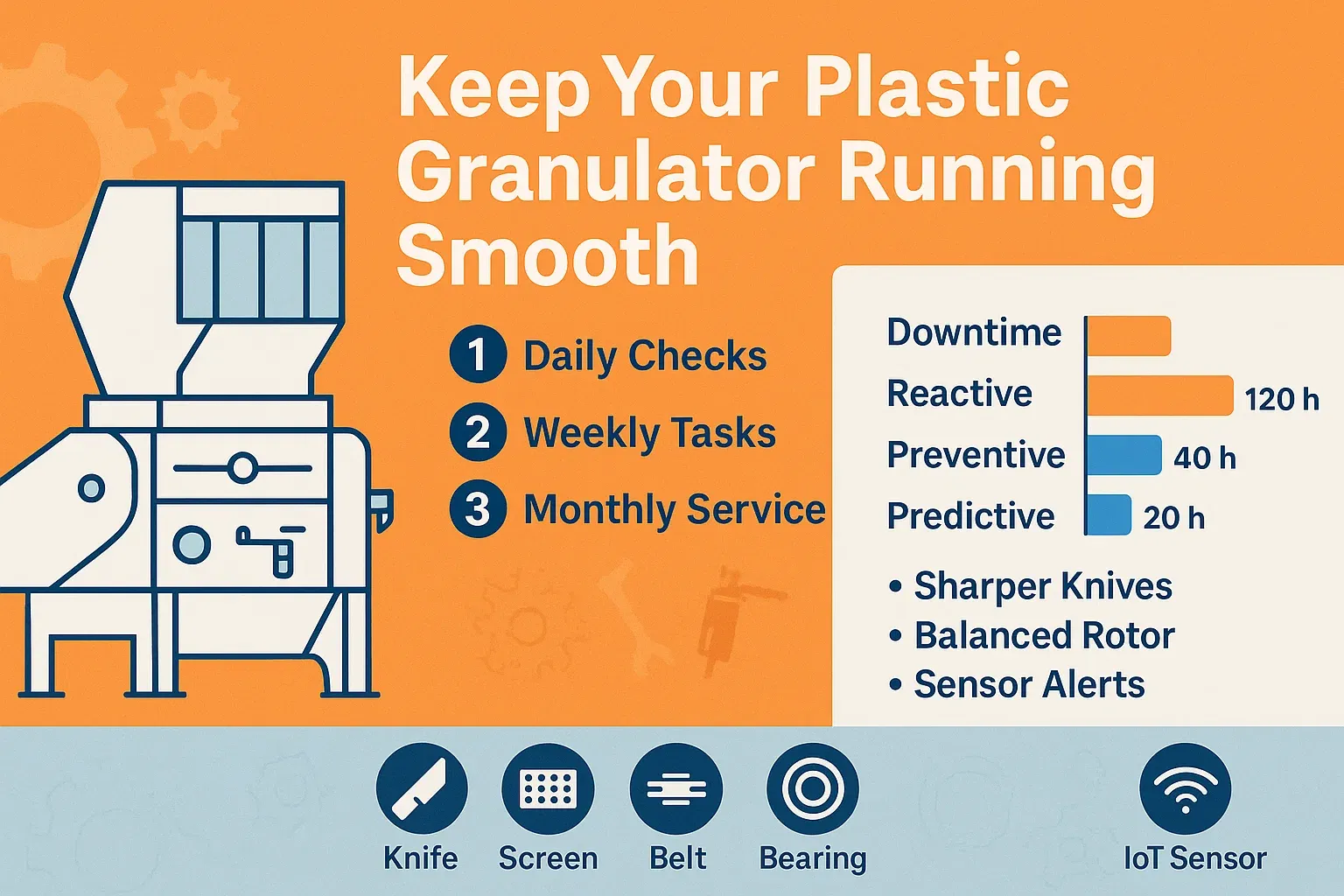
Plastic granulator maintenance should keep the cutting chamber, screen, bearings, drive and safety systems within the machine manufacturer’s limits. A useful program combines shift checks with measured knife condition, planned shutdown work and operating records. It should not promise a fixed percentage reduction in downtime, energy use or blade cost because wear depends on the machine, feedstock, contamination and production schedule.
Start every maintenance task with safe isolation
A granulator contains electrical energy, rotating mass and sharp cutting components. Before opening the hopper, cutting chamber, screen cradle or drive guard, follow the site’s documented hazardous-energy control procedure. Isolate and lock out all energy sources, release or restrain stored energy, verify the zero-energy state and control access to the work area.
Never rely on a stop button or open interlock as the only protection. After service, reinstall guards, account for tools and loose parts, rotate the rotor by the approved manual method where required, and complete a controlled restart. OSHA provides official guidance on control of hazardous energy et protection des machines. The installed machine manual and local rules remain the primary instructions.
Build the schedule from condition and workload
Use the manufacturer’s minimum inspection and lubrication schedule as the baseline. Then adjust planned work using hours run, tonnes processed, material type, motor current, bearing temperature, vibration, noise, particle-size consistency and inspection findings. Mineral-filled plastic, glass fibre, dirt and foreign metal can change wear much faster than clean production scrap.
| Maintenance point | Routine check | Record or trigger |
|---|---|---|
| Before or during each shift | Guards, interlocks, abnormal sound, leaks, feed flow, motor load, discharge and housekeeping | Log alarms, material changes and deviations from the normal operating range. |
| Planned short shutdown | Knife edges and clearance, screen openings, fasteners, belts or coupling, visible seals and chamber build-up | Measure rather than estimate; plan correction before quality or load deteriorates. |
| Scheduled service | Rotor, bearings, alignment, lubrication, electrical connections, drive system and structural wear | Record settings, torque values, replaced parts and restart checks. |
| After a jam or impact | Foreign object, knives, rotor, screen, bearings, shafts and drive components | Do not restart until qualified personnel approve the machine’s condition. |
Inspect knives and set clearance correctly
Dull knives tend to push, tear or rub material instead of cutting it cleanly. Warning signs include lower throughput, rising motor current, extra heat, irregular regrind, more fines and repeated feed surges. Inspect rotor and bed knives as a cutting system. Sharpen or replace them using the specified geometry, compatible sets and approved fastening procedure.
Knife clearance must follow the machine manual and the processed material. Clearance that is too wide can worsen cutting and particle consistency; clearance that is too tight can allow contact as components heat or move. After setting knives, check the full rotation and all knife positions with the approved method. Our gamme de granulateurs en plastique illustrates why rotor and chamber designs require model-specific service instructions.
Check the screen as a safety and sizing component
A granulator screen controls the maximum path for material leaving the chamber, but it also experiences repeated impact and abrasion. Look for cracks, distortion, enlarged holes, blocked openings and damaged supports. Do not operate with an improvised or poorly seated screen, and do not weld a damaged screen unless the manufacturer provides an approved repair method.
Particle size does not depend on screen opening alone. Knife sharpness, clearance, rotor speed, feed rate, material temperature and recirculation also matter. See our plastic granulator screen-size guide for the selection factors.
Monitor bearings, rotor and drive components
Track bearing temperature and vibration under comparable material and load. A trend change can point to incorrect lubrication, contamination, seal damage, looseness, misalignment or rotor imbalance. Use the lubricant type, quantity and method specified for the bearing arrangement; adding extra grease is not a universal cure for heat.
Inspect belts, pulleys, couplings, motor mounts and accessible fasteners during a safe shutdown. Belt dust, glazing, repeated tension loss or coupling debris should trigger root-cause inspection. After knife or rotor work, a no-load test followed by controlled feeding helps confirm direction, clearance, vibration and discharge before normal production resumes.
Prevent feed and discharge problems
Granulators operate more consistently when material enters at a controlled rate and leaves without restriction. Overfeeding can raise motor current and cause bridging, while a blocked cyclone, blower, conveyor or collection bin can back material into the chamber. Match the feed form to the hopper and rotor: thin film, bottles, thick plate and purge lumps do not behave alike.
Use upstream metal control and operator inspection where foreign objects are plausible. If the machine experiences a hard impact, isolate it and inspect the cutting chamber rather than assuming that a normal restart means no damage occurred.
Housekeeping, dust and electrical checks
Remove accumulated regrind and dust with a site-approved method. Maintain extraction and ventilation, and assess the actual dust properties and ignition hazards. OSHA’s combustible dust overview explains why dust risk needs facility-specific controls. Avoid cleaning methods that disperse dust into the air or electrical enclosures.
Qualified personnel should inspect terminals, overload history, cooling paths, sensors and interlock function. Repeated trips require diagnosis; increasing a protection setting without confirming motor, cable and machine limits can hide a mechanical or electrical problem.
Use records to plan parts and shutdowns
A simple record should identify the machine, hours or throughput, feed material, measured knife clearance, screen condition, motor-load trend, bearing observations, alarms and parts used. Photos at consistent inspection points help distinguish normal wear from rapid deterioration. The record also shows whether a problem follows a particular material lot, shift or maintenance action.
Keep the correct knives, screens, fasteners, belts, seals and lubricants available for the installed model. Planned parts availability reduces waiting time, but stocking decisions should follow actual wear and supplier lead time rather than an invented universal replacement interval.
Common symptoms and first checks
| Symptôme | Check first | Related guide |
|---|---|---|
| Falling throughput | Consistance du feed, lames, jeu, écran bouché et restriction de déchargement | Dépannage des bouchons et du bruit du granulateur |
| Courant moteur élevé | Suralimentation, lames usées, chambre bouchée, résistance au déplacement et bouchon en aval | |
| Excès de fines | État des lames, jeu, dommages au tamis, coupe répétée et matière première fragile | |
| Bruits de vibration ou d'impact | Arrêt en toute sécurité ; inspecter les matériaux étrangers, le verrouillage des lames, les roulements, le rotor et les montants |
Foire aux questions
À quelle fréquence les lames d'un granulateur en plastique doivent-elles être affûtées ?
Il n'y a pas d'intervalle universel. Inspecter l'état des bords et utiliser les tendances de charge moteur, de débit et de qualité des particules ensemble avec le calendrier minimum du fabricant.
Peut un tamis bouché augmenter la charge du moteur ?
Oui. La décharge restreinte peut maintenir le matériau dans la chambre de coupe plus longtemps et augmenter le recyclage. Isoler la machine, inspecter l'ensemble du chemin de décharge et corriger la cause avant de redémarrer.
Quels points doivent être vérifiés après le remplacement des lames du granulateur ?
Confirmez l'identité et l'orientation de la lame, la procédure de verrouillage, la marge de chaque position, le mouvement libre du rotor, la restauration du garde-corps et de l'interlock, puis effectuez les vérifications approuvées sans charge et à charge contrôlée.
Entretenez la machine installée, pas un calendrier générique
Energycle peut examiner le modèle de granulateur, le matière première, le relevé d'exploitation et les symptômes pour identifier les pièces d'usure pertinentes et les points d'inspection. Le personnel formé du site doit contrôler l'isolement, les décisions de réparation et l'autorisation de retour en service.
