

Pneumatic Flash & Hot Air Drying Technology
Thermal Dryer & Pipeline Hot Air Drying System for Plastic Flakes
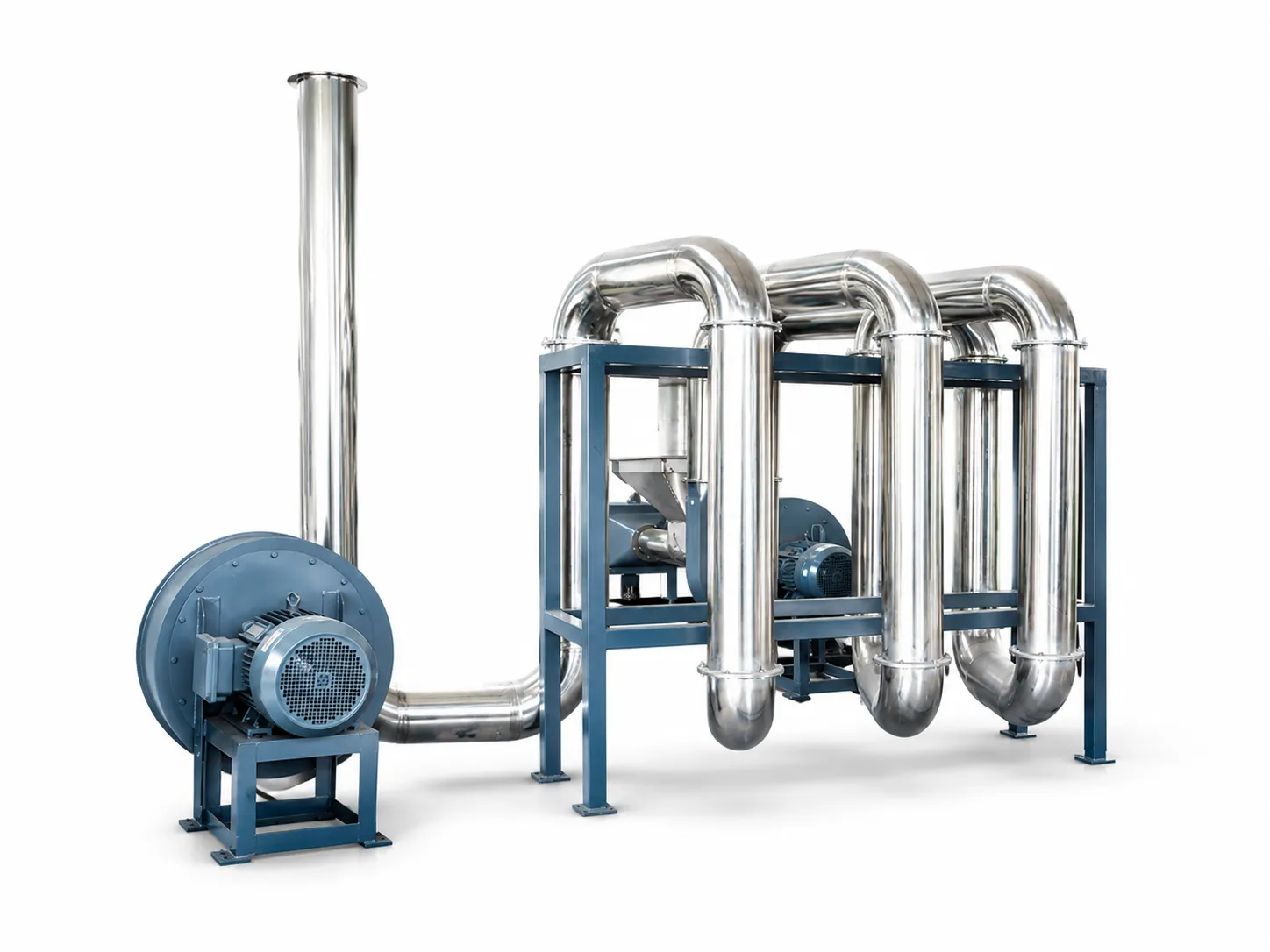
Continuous hot-air pneumatic drying for washed PET flakes, HDPE, PP regrind, and rigid plastics. Combines high-velocity conveying, multi-stage electric heating (36 kW / 72 kW), and cyclone separation to achieve stable residual moisture (<1–2%) before pelletizing.
Why This System
Pipeline Hot Air Dryer Benefits
Combine continuous conveying and hot-air drying to remove residual wash water from PET flakes and rigid-plastic regrind.
Install this unit after centrifugal or other mechanical dewatering. Match the heating power, airflow and pipeline dimensions to your material, inlet moisture and required output.
Available in modular configurations from 36 kW to 72 kW heating power with matched pneumatic blowers, custom-routed SUS304 stainless steel piping, and high-efficiency cyclone separators.
Residual Wash-Water Removal
Under suitable inlet conditions and configuration, the system can target <2% outlet moisture at this washing-line stage. Confirm the moisture specification for downstream processing separately, especially for PET.
Continuous Drying & Conveying
The reference 72 kW heating system and 30-meter pipeline support continuous processing. Final throughput depends on the material, inlet moisture, airflow, temperature settings and selected configuration.
Insulation & Routine Cleaning
Insulated piping helps reduce heat loss, while SUS304 material-contact parts support corrosion resistance and routine cleaning. Actual energy use and service life depend on the material, throughput, operating conditions, maintenance and selected configuration.
Heavy-Duty SUS304 Construction
All material-contact parts are fabricated from corrosion-resistant SUS304 stainless steel. The carbon-steel frame (60x60x3 mm) supports continuous industrial operation; final construction details are confirmed with the selected configuration.
How It Works
Pipeline Drying Process
After mechanical dewatering, heated airflow conveys PET flakes or rigid-plastic regrind through the pipeline, removes residual wash water and carries the material to a cyclone separator.
Material Feeding
Mechanically dewatered PET flakes or rigid-plastic regrind enter the pipeline through a screw conveyor or rotary valve, according to the selected feeding arrangement.
Hot Air Acceleration
In the reference configuration, a 72 kW electric heater heats the air and an 11 kW blower generates the airflow that conveys the material.
Pipeline Drying
Heated airflow removes residual wash water as material travels through the reference 30-meter insulated SUS304 pipeline. Outlet moisture depends on the material, inlet moisture, throughput and operating settings.
Cyclone Separation & Collection
A cyclone separates the material from the conveying air for collection or transfer to the next stage. Confirm outlet moisture and temperature meet that stage’s requirements before direct feeding.
See the System in Action
Watch the pipeline hot air drying system operating in a real plastic recycling production line.
Rigid Plastic Drying
PET Flakes & Rigid Plastic Regrind
Use the system after washing and mechanical dewatering of PET, HDPE, PP and other suitable rigid plastics. Select operating conditions for the polymer, particle size and required outlet moisture.
Post-Consumer PET Bottle Flakes
Remove residual wash water after mechanical dewatering. For PET melt processing, confirm the required feed moisture and any additional drying or vacuum-processing stage with the downstream equipment supplier.
Post-Industrial HDPE Regrind
Remove surface water from washed HDPE regrind before collection or further processing. Match airflow and temperature to particle size and throughput.
Washed PP Flakes & Regrind
Dry mechanically dewatered PP flakes and regrind in a continuous washing line. Verify the outlet moisture against the requirements of the next processing stage.
ABS & Mixed Rigid Plastics
Remove wash water from suitable ABS and other rigid-plastic streams. Confirm polymer composition, temperature limits and particle geometry before selecting a configuration for mixed regrind.
Technical Specifications
The values below describe a reference configuration. Final heating power, airflow, pipeline size and output moisture are confirmed according to the material, inlet moisture, target throughput and project conditions.
| Specification Parameter | Standard Line (ERM-TDR-800) | High-Capacity Line (ERM-TDR-1200) |
|---|---|---|
| Target Materials | PET, HDPE, PP Flakes & Regrind | PET, HDPE, PP, ABS Rigid Plastics |
| Process Type | Hot-air pneumatic pipeline + cyclone | Hot-air pneumatic pipeline + cyclone |
| Heating Power | 36 kW (Electric) | 72 kW (Electric) |
| Fan / Blower Power | 5.5 kW | 11 kW |
| Pipeline Diameter | 159 mm | 219 mm (wall thickness 2 mm) |
| Pipeline Length | 15–20 meters (customizable) | 30 meters (insulated) |
| Material Contact Parts | SUS304 Stainless Steel | SUS304 Stainless Steel |
| Stage Outlet Moisture | <1–3% (material dependent) | <1–2% target under suitable conditions |
| Reference Throughput | 300–600 kg/h | 800–1500 kg/h |
| Support Frame | Structural carbon steel | Carbon Steel (60x60x3 mm) |
| Warranty & Service | 1-year warranty + commissioning support | 1-year warranty + commissioning support |
Swipe horizontally to view the full table.
System Overview & Material Samples
A closer look at the drying system, stainless steel construction, and heating unit.

Reliable Support Throughout the Equipment Lifecycle
From installation planning to routine maintenance, our service team helps keep your equipment operating safely, consistently, and efficiently.
1-Year Limited Warranty
Coverage includes manufacturing defects in major mechanical and electrical components for one year. Normal wear parts and damage caused by improper operation are handled separately.
Installation Guidance
We provide layout, foundation, utility, clearance, line-integration, and commissioning guidance to support a smooth installation and reliable startup.
Spare Parts Supply
Replacement wear parts, bearings, seals, sensors, electrical components, and other service items are available for scheduled maintenance and long-term operation.
Technical Assistance
Remote troubleshooting, operating recommendations, maintenance guidance, and optional on-site service are available when your project needs additional support.
Frequently Asked Questions
Request a Drying Configuration for Your Material
Share your material, throughput (kg/h), inlet and target outlet moisture, upstream dewatering equipment and downstream process. Our team can recommend a configuration and prepare a project quote.