

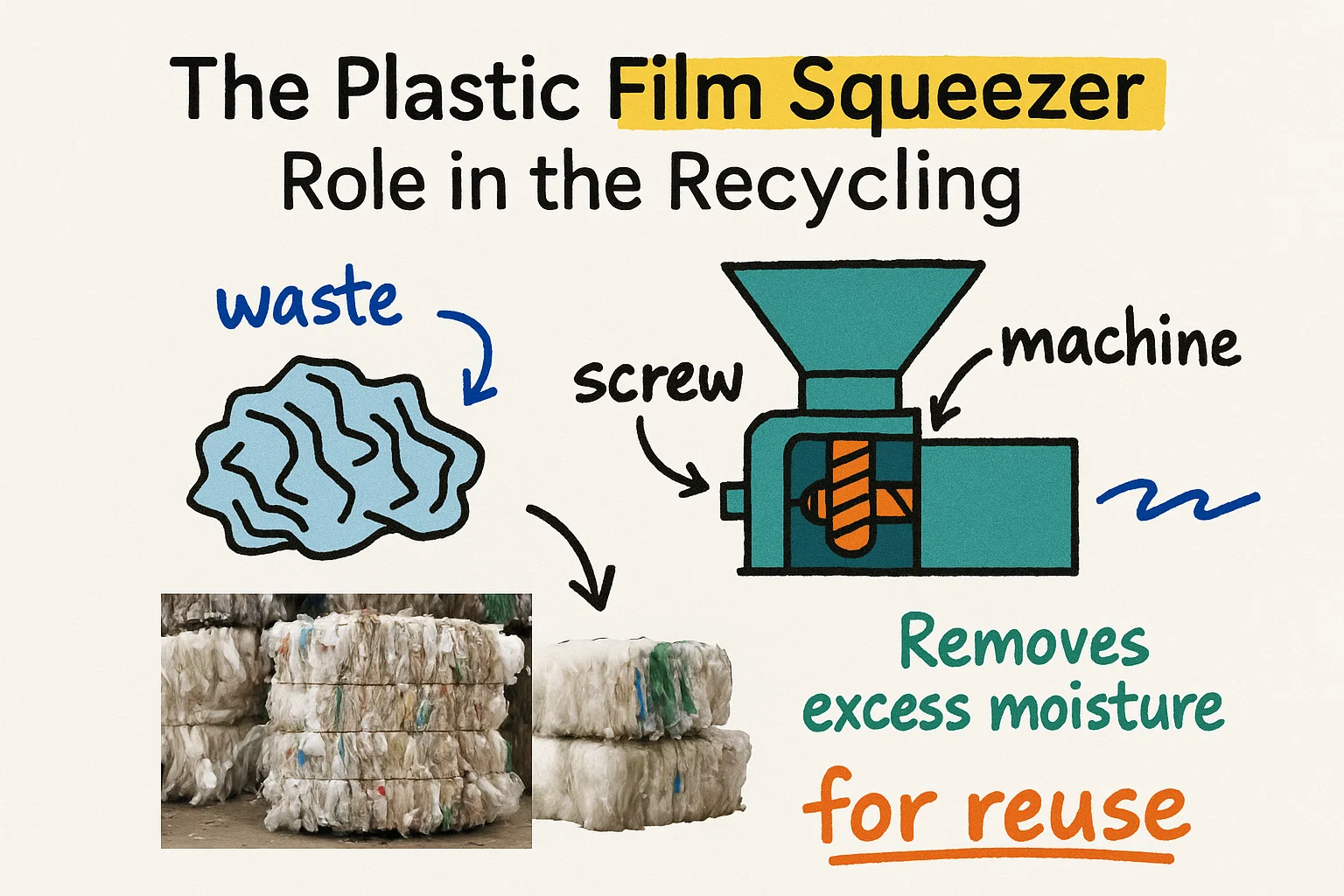
A plastic film squeezer removes water from washed PE or PP film and compacts the light flakes into a denser, more stable feed. It sits between washing and extrusion or storage. Its job is dewatering and feed preparation—not washing, polymer separation or guaranteed pellet quality.
Why washed film needs a dedicated dewatering step
Thin film has a large surface area, traps water in folds and has very low loose bulk density. After washing, that combination can overload a thermal dryer, bridge in a silo and feed an extruder unevenly. Rigid-flake equipment may not handle the same material effectively.
A squeezer applies mechanical pressure in a screw and barrel to expel water. Some designs also use controlled heat or friction to soften and densify the film before discharge. The correct arrangement depends on polymer, film thickness, contamination and the downstream feed specification.
Where the squeezer fits in a film washing line
- Sorting and size reduction: define the PE or PP stream and create a washable size.
- Prewashing and friction washing: release soil, paper, food residue and other target contamination.
- Rinsing and separation: remove loosened contamination and manage the water circuit.
- Mechanical dewatering: a squeezer expresses free and surface water.
- Densified discharge: material leaves as compacted pieces suitable for controlled conveying or feeding.
- Final preparation: cooling, additional drying, buffering, agglomeration or pelletizing may follow according to the output requirement.
CEFLEX describes size reduction and washing in flexible-packaging recycling. Feed construction and attached components must still be considered before the dewatering stage.
How the screw-squeezing process works
Washed film enters a feed section and is captured by the screw. As channel volume or outlet restriction changes, pressure increases and water escapes through screens or drainage openings. The material becomes denser as it moves toward discharge.
Performance depends on stable feeding, screw geometry, speed, screen condition, pressure, outlet restriction and temperature where heat is used. Excessive restriction can raise motor load or overheat material. Insufficient restriction can leave the output wet and loose.
What a film squeezer can and cannot do
| Function | Reasonable expectation | Important boundary |
|---|---|---|
| Mechanical dewatering | Removes free and surface water from washed film | Final moisture depends on feed, machine condition and test method |
| Densification | Raises bulk density and improves material handling | Does not prove compatibility with an extruder |
| Feed stabilisation | Can reduce fluffy surges into downstream equipment | Requires a matched conveyor, buffer and pelletizer |
| Heating in some designs | Can support moisture removal and compact discharge | Must not degrade or fuse the material uncontrollably |
| Contamination removal | Water and some loose fines leave through screens | It is not a substitute for sorting and washing |
Squeezer versus other drying and densifying equipment
| Equipment | Main role | Typical decision |
|---|---|---|
| Centrifugal dryer | Uses rotor action to remove surface water | Useful where material form and screen system allow stable separation |
| Screw press | Mechanically expresses water through a screened barrel | Compare outlet form, pressure and handling with the feed |
| Film squeezer | Dewaters and compacts flexible flakes | Use when low bulk density and wet film impair downstream feeding |
| Thermal dryer | Evaporates remaining moisture with heated air | Apply after economical mechanical removal and to a written moisture target |
| Agglomerator or compactor | Densifies and conditions material, often before extrusion | Not a primary washing or contamination-removal stage |
The thermal drying machine guide explains the evaporation step. Our film densification cost guide covers how to model transport and operating savings without fixed percentage claims.
Define the feed before selecting a squeezer
Record polymer, film type, print, layer construction, particle size, loose bulk density, incoming moisture and contamination. Agricultural film, post-consumer packaging and clean production trim can behave very differently.
Mineral-filled film, aluminium layers, string, tape and non-polyolefin materials can change pressure, wear and melt behaviour. A water-based separator cannot reliably split unfilled PE from PP, so the intended mixed or separated outlet should be agreed earlier in the process.
Capacity must be reported on one basis
State whether capacity refers to wet input, dry solids or accepted compacted output. Moisture removed in the squeezer makes these values different. Record incoming and outgoing moisture using one method and calculate dry solids for the mass balance.
During an acceptance test, measure stable feed, accepted output, expelled water, rejects, electricity, downtime and output bulk density. A short peak rate does not represent a shift’s sustained saleable output.
Set moisture and bulk-density limits with the pelletizer
There is no universal final moisture or bulk density for every film recycling line. The downstream extruder supplier or material buyer should provide acceptance limits and sampling methods. Verify whether the output must be cooled, buffered or further dried before storage or feeding.
Bulk density should be measured using a repeatable container, filling method and conditioning. A higher value is not automatically better if the material has overheated, fused into oversize pieces or become difficult to meter.
Energy evaluation
Mechanical water removal can reduce the amount that must later be evaporated, but the saving depends on measured incoming and outgoing water, squeezer electricity and any added heat. Calculate total system energy per accepted dry tonne.
Compare at least two cases on the same feed: existing mechanical plus thermal drying, and the proposed squeezer configuration. Include motors, heaters, fans, cooling and idle periods. The result should not be inferred from motor nameplates or a supplier’s generic percentage.
Common operating problems
| Symptom | Possible cause | Checks |
|---|---|---|
| Wet, loose output | Feed surge, worn screw, blocked drainage, low restriction or different film | Moisture, current, screen, pressure and feed lot |
| Motor overload | Overfeeding, excessive restriction, jam, foreign object or mechanical wear | Isolate safely; inspect feed path, screw and drive |
| Overheated or fused output | High restriction, temperature-control fault, long residence or incompatible resin | Sensor accuracy, zone temperatures, speed and feed continuity |
| Unstable pelletizer feed | Variable bulk density, oversize lumps, hot discharge or poor buffering | Output distribution, cooling and conveying |
| Water leaks or solids loss | Damaged screen, seals, blocked drainage or excessive fines | Screen integrity, wastewater solids and particle size |
Safety and maintenance
The feed screw, compaction zone, drive and discharge can store mechanical, electrical, hydraulic and thermal energy. Guard access points and isolate all hazardous energy before clearing film or opening screens. OSHA’s hazardous-energy guidance provides a baseline for site procedures.
Inspect screw and barrel wear, screens, drainage, seals, gearbox, bearings, motor current, temperature sensors and discharge cutters where fitted. Link maintenance intervals to feed abrasion and condition records rather than copying a calendar from a different installation.
Frequently asked questions
Does a plastic film squeezer replace washing?
No. It dewaters and densifies material after washing. It cannot reliably remove incompatible polymers, oils, labels or embedded contamination.
Can squeezed film go directly into a pelletizer?
Only if moisture, bulk density, temperature, particle form and contamination meet the pelletizer’s written feed specification. Cooling, buffering or further drying may be required.
How should a film squeezer’s capacity be tested?
Use representative wet feed and report dry solids, accepted output, incoming and final moisture, bulk density, energy, rejects and downtime over a stable run.
Test the complete dewatering handoff
Send Energycle representative washed film, particle size, wet feed rate, moisture results and the downstream extruder specification. The plastic film squeezing machine should be evaluated together with its feed conveyor, water drainage, cooling and pelletizer handoff.

Comments are closed.