

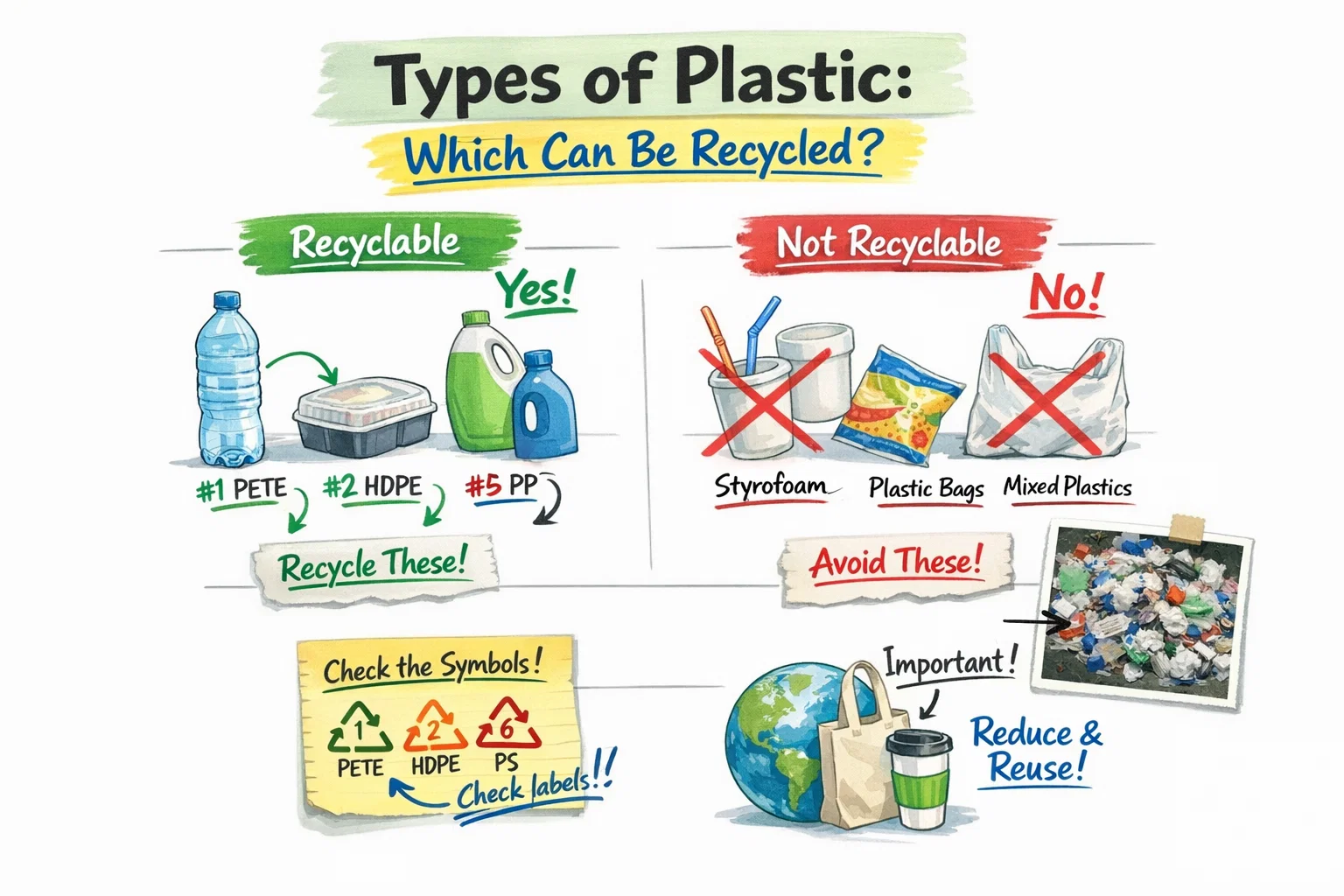
Types of Plastic: Which Can Be Recycled and Under What Conditions?
The numbers 1–7 identify broad resin groups; they are not a promise that an item is accepted or can become a saleable recycled product. Recyclability depends on product design, collection, sorting, contamination, available processing and a downstream market. The same polymer may be recyclable as a clean factory scrap stream but unsuitable in a small, multilayer or contaminated consumer product.
Resin code is not a recycling grade
ASTM resin identification codes help identify the plastic resin family. StopWaste’s resin identification code guidance notes that use of a code does not imply that the article is recycled or that recycling systems exist for it.
For household disposal, the U.S. EPA advises checking what the local programme accepts because community programmes do not accept every plastic type. See its common recyclables guidance. Industrial recyclers need an even more specific feed and buyer specification.
The seven resin categories
| Code | Resin group | Common products | Recycling reality |
|---|---|---|---|
| 1 | PET | Beverage bottles, thermoforms, fibre and strapping | Established bottle streams exist, but colour, PVC, labels, trays and food-contact requirements matter. |
| 2 | HDPE | Bottles, crates, drums, pipe and closures | Natural and coloured rigid streams can have strong outlets; PP, fillers and product residue require control. |
| 3 | PVC | Pipe, profiles, cable, flooring and flexible products | Dedicated streams can be recycled; additives and cross-contamination make mixed processing difficult. |
| 4 | LDPE | Film, bags, shrink wrap and agricultural film | Clean commercial film can be recycled; thin format, soil, food and multilayers constrain collection and washing. |
| 5 | PP | Closures, tubs, crates, woven bags and automotive parts | Rigid and flexible PP need different preparation; mixing, fillers and attached materials affect quality. |
| 6 | PS | Rigid cups, trays and expanded foam | Defined rigid or EPS streams can be recycled where collection and outlets exist; loose EPS needs densification. |
| 7 | Other | PC, PA, ABS, PLA, multilayers and unlisted resins | This is not one material. Each polymer or composite needs identification and a specific process and market. |
Code 1: PET
Post-consumer PET bottles are commonly sorted, granulated, washed, density-separated and dried into flake. Qualified material may become fibre, sheet, strapping or new bottles. Trays, opaque PET, multilayers and non-bottle products may behave differently from clear beverage bottles.
PET and PVC commonly sink in water, so density separation does not reliably split them. Colour, adhesive, labels, moisture and intrinsic viscosity can also control the outlet. The PET flake applications guide links these quality properties to end uses.
Code 2: HDPE
Natural HDPE bottles, coloured bottles, crates, caps and pipe should not automatically be mixed. Natural bottle resin may have different buyer requirements from a mixed-colour injection stream. Product residue and odour can require additional intake and washing controls.
In water, unfilled HDPE and PP commonly float together. A float tank can reject many heavy contaminants but cannot reliably produce an HDPE/PP split. APR’s natural HDPE guidance shows how colour, labels, closures and additives affect the stream.
Code 3: PVC
Rigid PVC pipe and window profiles can be processed in dedicated, well-characterised streams. Flexible PVC cable, flooring and medical products may contain different plasticisers, fillers, reinforcements or other components. Legacy products can also require restricted-substance assessment.
Keep PVC separate from PET and polyolefin lines. Cutting, dust control, washing and extrusion must match the specific PVC product and downstream application; there is no generic “chlorine-safe” machine that makes all PVC waste equivalent.
Code 4: LDPE and flexible PE
Clean transport film and production trim are easier to recycle than wet agricultural film or multilayer consumer packaging. Flexible material has low bulk density, traps moisture and can wrap rotating equipment.
Typical processing can include shredding, friction washing, rinsing, squeezing or other dewatering, densification and pelletizing. CEFLEX’s flexible packaging recyclability guidance explains why structure, attachments and size influence polyolefin recycling.
Code 5: PP
PP appears in rigid tubs, caps, crates, automotive parts, woven sacks and nonwovens. These formats require different feeding, size reduction and washing. Mineral-filled or glass-reinforced PP can have a different effective density and outlet from unfilled packaging PP.
A recycler should separate rigid and flexible formats and define colour, filler, ash, melt flow and contamination with the buyer. Washing removes surface contamination; it does not restore degraded resin or separate every PP compound.
Code 6: PS and EPS
Rigid polystyrene and expanded polystyrene are the same resin family in different physical forms, but collection and equipment differ. Loose EPS is mostly volume and needs source segregation and densification to make transport practical.
A cold press mechanically compacts EPS, while a hot melt densifier produces a thermally densified ingot. See the EPS cold press versus hot melt guide. Food residue, tape, construction foam and mixed foams still need control.
Code 7: “Other” is not a recycling process
Code 7 can cover polycarbonate, polyamide, ABS, PLA, multilayer structures and other resins. Combining them creates an unidentified mixture with unpredictable melting and mechanical properties.
Identify the actual polymer using supplier records, product knowledge and analytical testing where necessary. Clean, separated engineering-plastic production scrap may have a viable outlet, while a mixed composite may not be suitable for mechanical recycling.
Why the product matters as much as the resin
Size, shape, colour, labels, adhesives, coatings, fillers and multilayers affect collection and processing. A large HDPE bottle can be sorted by equipment that cannot reliably identify a small black component. A mono-material film and a laminated pouch can carry the same printed code but behave differently in washing and extrusion.
Use material-specific design guidance and buyer trials rather than declaring an entire resin category recyclable or unrecyclable.
Mechanical recycling decision test
- Can the material be collected in sufficient quantity?
- Can the polymer and product format be identified?
- Can incompatible or unsafe items be removed?
- Can it be size-reduced, cleaned and dried without unacceptable loss?
- Can the output meet a buyer’s written specification?
- Do the site, environmental and worker controls support the process?
- Does the dry mass balance and full cost model support operation?
A “no” at one stage identifies the barrier that must be solved. It does not mean a different machine automatically fixes the stream.
Typical equipment by material form
| Feed form | Typical functions | Main caution |
|---|---|---|
| Rigid bottles and containers | Sorting, granulation, washing, density separation and drying | Previous contents, labels, closures and polymer mixing |
| Film and bags | Shredding, friction washing, rinsing, squeezing and pelletizing | Low bulk density, moisture, wrapping and multilayers |
| Pipe and profiles | Shredding, granulation, dust control and material-specific extrusion | Metal, fillers, wall thickness and legacy additives |
| EPS foam | Sorting, crushing and cold or hot densification | Transport volume, food residue and mixed foams |
| Engineering-plastic scrap | Identification, size reduction, drying and compounding | Grade, reinforcement, flame retardants and thermal history |
Frequently asked questions
Does the number inside the triangle mean the item is recyclable?
No. It identifies a resin group. Actual recyclability depends on product design, local collection, sorting, processing and a market for the resulting material.
Which plastic is easiest to recycle?
There is no universal answer. Clean, consistent PET or HDPE bottle streams often have established systems, but a clean factory scrap of another resin may be easier than contaminated packaging.
Can different plastic types be recycled together?
Only when the downstream specification accepts the blend and trials confirm processing and properties. Uncontrolled polymer mixing commonly reduces quality.
Identify the stream before choosing equipment
Send Energycle the actual product types, resin evidence, contamination, monthly supply and buyer specification. Use the plastic recycling equipment guide to map each verified material stream to the required process functions.
