

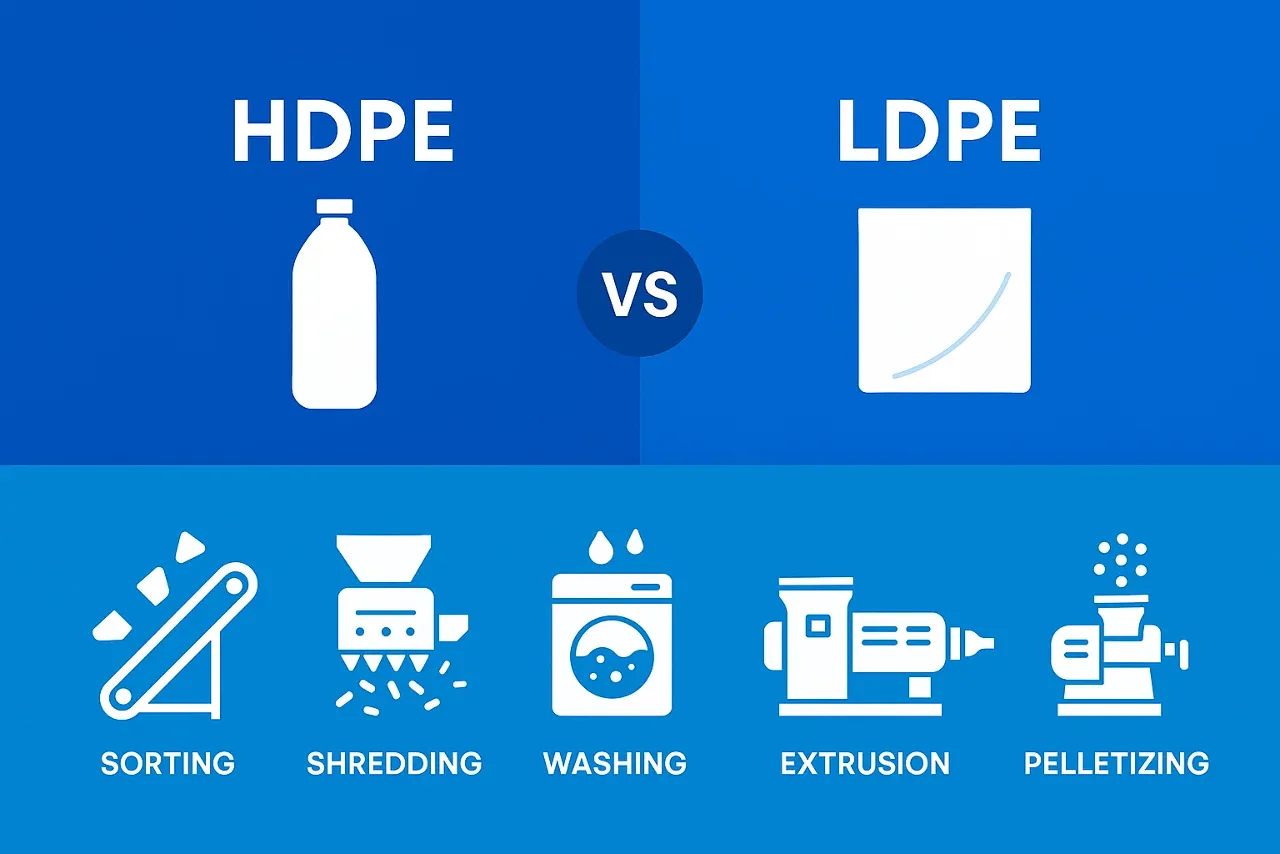
HDPE and LDPE belong to the polyethylene family, but they usually reach recycling plants in very different forms. HDPE is commonly found as bottles, crates, drums and pipe; LDPE and LLDPE are common in bags, stretch film and agricultural film. For equipment design, this difference in product form, contamination and bulk density often matters more than the resin name alone.
A line should therefore be specified from representative feedstock and the required recycled product. A generic “PE line” can be undersized for rigid containers, unable to meter loose film or missing the washing and drying stages needed for the actual contamination.
HDPE vs LDPE: the machinery-relevant differences
| Design input | Typical HDPE rigid stream | Typical LDPE/LLDPE film stream |
|---|---|---|
| Physical form | Bottles, crates, drums, caps, pipe or molded scrap | Bags, stretch film, packaging film or agricultural film |
| Bulk behavior | Bulky but generally conveyable as discrete parts or flakes | Very low bulk density; can bridge, wrap and arrive in clumps |
| Common contamination | Labels, closures, product residue, dirt and other rigid resins | Soil, moisture, paper, labels, organics, printing and multilayer structures |
| Size-reduction issue | Impact load, part size and wall thickness | Feeding, wrapping, heat and fines |
| Dewatering issue | Water is mainly on flake surfaces and in small cavities | Thin film folds and traps water; low bulk density complicates thermal drying |
| Extruder feeding | Rigid regrind generally meters more predictably | Loose film often needs force feeding, squeezing or densification |
Sorting and separation
Rigid HDPE
Rigid containers can be spread on conveyors for manual or optical sorting. Natural and colored HDPE may be separated when the end markets require different grades. Labels, closures, barrier layers and product residues affect yield and output quality, so the sorting specification must follow the buyer’s feedstock and bale standard.
The APR has separate design guidance for natural HDPE rigid packaging and colored HDPE. This reinforces an important equipment point: “HDPE” is not one uniform input. Color, attachments and packaging design affect the separation and washing work required.
Flexible PE film
Film sorting is strongly influenced by its two-dimensional shape and low mass. Thin pieces can wrap around shafts, become airborne or travel with paper. Ballistic, optical and air-based systems may be combined with manual quality control, but the suitable arrangement depends on how the stream is collected and presented.
Flexible packaging may also be multilayer or contain adhesives, coatings and non-PE components. APR’s PE flexible guidance evaluates the whole package, not only the nominal base resin. A recycling line cannot correct every incompatibility after collection.
What sink-float separation can and cannot do
Common unfilled HDPE and LDPE both have densities below water and normally report to the float fraction. A water tank can separate them from many denser materials, but it does not reliably separate HDPE from LDPE. Product form, optical sorting, controlled collection and the downstream quality specification must do that work.
Feeding and size reduction
HDPE bottles, crates and pipe
The design should start from maximum part size, wall thickness, mass and any metal inserts. Bottles may be granulated directly after sorting, while large drums, pipe and thick purgings may need a shredder before final granulation. The feed opening and hopper must accept the actual part without unsafe manual pushing.
Rotor inertia, knife geometry, screen area and drive protection are evaluated together. A high-power motor does not compensate for an opening that cannot accept the part or a screen that causes excessive recirculation.
LDPE and LLDPE film
Loose film requires controlled feeding. Conveyors, bale openers, nip feeds or hydraulic pushers may be used depending on the form. Rotor-end details and knife configuration should limit wrapping, while the discharge system must remove light regrind consistently.
Agglomeration is not automatically an upstream requirement. Washed film is normally size-reduced before squeezing or densification; the appropriate order depends on whether the plant is processing baled film, factory edge trim or wet film flakes. The granulator application guide compares the main feed forms.
Washing-system differences
Rigid HDPE washing
A rigid-plastic line may use pre-washing, granulation, friction washing and sink-float separation to remove labels, residues and denser contaminants. The required chemical and thermal steps depend on the original product and the specification for the clean flake. A detergent bottle, an oil container and clean post-industrial molding scrap do not need the same process.
Film washing
Film has a high surface area and can carry soil, organic matter, labels and moisture in folds. Agricultural film may require robust pre-washing and grit removal before high-speed equipment. Water balance, sediment management and wastewater treatment should be sized from contamination testing, not only tonnes per hour.
The PP/PE film washing line shows a film-specific configuration. For rigid material, compare it with a rigid plastic washing line rather than assuming the same conveying and dewatering equipment will work equally well.
Dewatering and drying
Rigid flakes can often be mechanically dewatered in a centrifugal dryer and then finished to the moisture target required downstream. Film is harder to dry because it folds, retains surface water and has low bulk density. Mechanical squeezing can remove free water while compacting the film into a more feedable form.
No universal residual-moisture percentage should be specified without the material, sampling method and throughput. Test the film squeezing machine on representative washed film and measure moisture distribution over time, not from one hand-picked sample.
Extrusion and pelletizing
Both HDPE and LDPE are polyethylene, but grade, melt flow, degradation, contamination and feed form control the extruder configuration. Set temperature zones from the resin and process trial; melting-point values from a handbook are not an extrusion recipe. Excessive residence time or temperature can degrade either material.
Rigid regrind generally feeds more consistently by gravity than loose film. Film systems may use a cutter-compactor, agglomerator, crammer or squeezer to stabilize feeding. Venting and filtration are selected from moisture, printing, paper, aluminum and other contamination. Single- or double-stage extrusion is a process choice, not an automatic rule based only on HDPE versus LDPE.
Strand, water-ring and other pellet-cutting methods can be used with polyethylene when the die, melt strength, cooling and required pellet quality are compatible. Validate the complete plastic pelletizing system with the intended feed.
Utilities and cost drivers
The resin name alone does not show which line costs more. Film systems may need more feeding, pre-washing, grit removal, squeezing and wastewater capacity. A heavy rigid stream may require larger shredding equipment, stronger material handling or additional sorting. End-product purity can outweigh both differences.
Compare capital and operating cost using:
- Net acceptable output from representative trials
- Electricity, water, heat and compressed air per tonne
- Labor for sorting, cleaning and material handling
- Wear parts, screens, blades, filters and planned maintenance
- Wastewater, fines and reject disposal
- Yield into the saleable product specification
Specification checklist
- Define resin, product form, source and contamination—not just “HDPE” or “LDPE.”
- Supply representative samples, including worst-normal contamination and largest parts.
- State the required flake or pellet specification and test methods.
- Map every feed, washing, drying, extrusion and waste-handling module.
- Run an acceptance test that records output, yield, quality, utilities and stoppages.
- Confirm safety, electrical supply, water treatment, site layout and local compliance.
The correct design follows the material’s real behavior through the entire line. Separating rigid HDPE and flexible LDPE into clearly defined feed specifications prevents equipment from being selected around assumptions that fail during production.
Frequently asked questions
Can HDPE and LDPE be separated in a sink-float tank?
Not reliably from each other. Both normally float in water. Sink-float separation can remove many denser materials, but separating HDPE and LDPE requires controlled collection, sorting by form or other identification methods.
Can the same recycling line process HDPE rigid plastic and LDPE film?
Some modules may be shared, but feeding, size reduction, washing, dewatering and extrusion feed requirements differ. Validate each stream and define the changeover, cleaning and configuration changes required.
Why is washed LDPE film difficult to dry?
Thin film folds and traps surface water while remaining low in bulk density. Mechanical squeezing or densification can remove free water and improve downstream feeding, but results depend on material and test conditions.
