

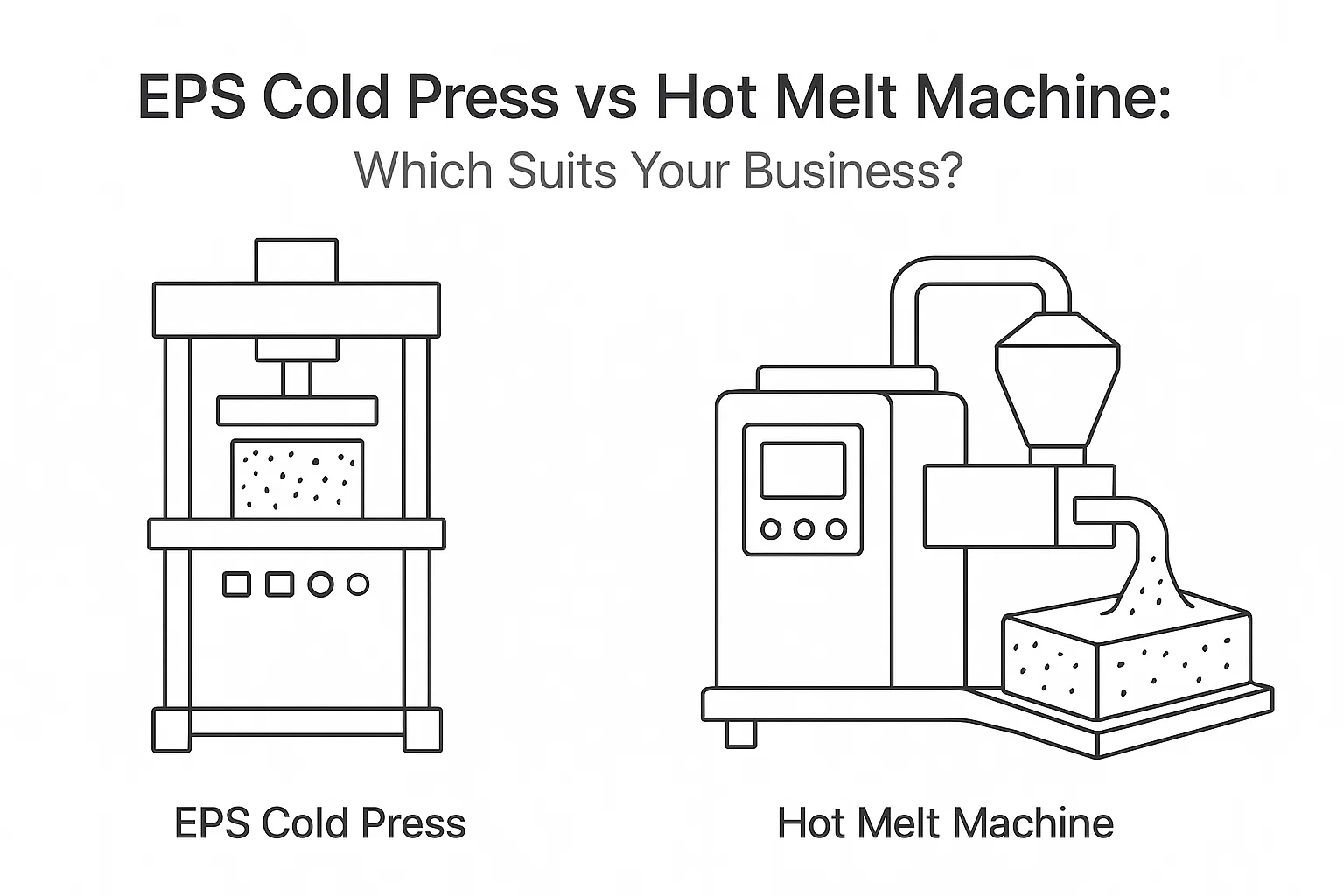
Choosing between an EPS cold press and an EPS hot melt densifier is mainly a decision about feed cleanliness, required shipping form, utilities, ventilation, operator skills and the downstream buyer. Both reduce the transport and storage burden of expanded polystyrene, but they use different mechanisms and produce different intermediate materials. Published compression ratios and hourly capacities are not comparable unless the test feed and output density are stated.
Cold press and hot melt at a glance
| Decision point | EPS cold press | EPS hot melt densifier |
|---|---|---|
| Mechanism | Crushing plus screw or hydraulic mechanical compaction | Crushing plus controlled heating and extrusion into an ingot |
| Output | Compacted blocks, logs or briquettes with visible cellular structure | Solidified melt logs or ingots |
| Thermal load | No process melting; motor and friction still generate heat | Requires controlled heat and cooling |
| Air handling | Dust and loose-bead control are central | Dust control plus local exhaust and fume assessment |
| Feed tolerance | Clean, dry EPS is preferred; bulky pieces must feed consistently | Clean, dry EPS is still required; heat does not make contaminated feed acceptable |
| Buyer question | Will the buyer accept mechanically compacted EPS? | Will the buyer accept hot-melt ingots and their thermal history? |
How an EPS cold press works
The feed hopper accepts clean EPS packaging or production scrap. A breaker or crusher opens large pieces, and a screw or hydraulic chamber applies pressure to expel air and form a denser shape. The compacted output is cut or broken into manageable lengths for storage and transport.
The absence of a melting stage simplifies thermal controls, but the machine still needs guarding, overload protection, dust management and a stable feed. Loose beads and light fragments can escape collection points. Wet or food-contaminated foam can create odour, corrosion, poor blocks and buyer rejection.
How an EPS hot melt densifier works
A hot melt system first reduces the foam and meters it into a heated barrel. Heat and screw work collapse the cellular structure and move the softened polystyrene through a die. The material then cools into dense logs or ingots.
Temperature must be controlled for the specific machine and feed. Excess heat or long residence can degrade or discolour the polymer; insufficient heat can create unstable output or overload. Heating plastics also requires an exposure assessment and suitable local exhaust. OSHA’s styrene safety resources describe relevant health hazards, but the employer must assess the actual substances and exposure at the installation.
Do not select by compression ratio alone
A volume-reduction ratio depends on the loose feed bulk density, shape, moisture, feed method and final density. Very light moulded packaging may show a larger ratio than denser offcuts on the same machine. A vendor’s “50:1” or “90:1” statement is therefore incomplete without test conditions.
For a meaningful trial, weigh a known feed, measure its loose occupied volume using an agreed method, weigh the accepted compacted output and determine final dimensions or density. Report rejected material and loose losses. Compare transport using the legal payload and usable vehicle volume, because some routes become weight-limited before the container is full.
Compare capacity on accepted output
Nominal input capacity can be limited by manual feeding, hopper bridging, crusher performance, contamination stops, cooling or output handling. Ask for sustained accepted output from the buyer’s EPS over an agreed run period. Record:
- dry input mass and accepted output mass;
- feed type, dimensions, bulk density and moisture;
- rejects and material losses;
- running time and stoppage causes;
- electricity for the complete system, including extraction and cooling;
- output density, form, temperature and buyer acceptance.
Feed quality determines both options
Separate EPS from extruded polystyrene (XPS), polyurethane foam, polyethylene foam, paper, tape, labels, food residue and flame-retardant construction material when the downstream specification requires it. Colour and previous use may also affect the outlet.
The Association of Plastic Recyclers publishes EPS rigid design guidance that illustrates how packaging features influence compatibility with recycling. The collector and recycler still need a written intake policy for the actual market.
Electricity and utility comparison
Compare measured kWh per accepted tonne, not motor nameplates alone. A cold press uses cutting and compaction drives. A hot melt unit adds barrel heating and may need more extraction or cooling. Actual consumption changes with utilisation, feed density, start-stop operation and temperature control.
Prepare a full load list for crusher, screw, hydraulics, heaters, fans, conveyors and controls. Include warm-up and idle periods in the trial. Confirm site voltage, phase, frequency, protective devices and available current before the order.
Safety and workplace controls
Both machines need guarded rotating parts, safe access, emergency stops and hazardous-energy isolation. EPS is light and combustible; keep ignition sources controlled and address housekeeping, dust, storage and fire protection with the local authority and insurer.
A hot melt machine adds hot surfaces, molten polymer and potential fume exposure. Specify enclosure, local exhaust, discharge guarding and safe removal of hot output. A cold press avoids deliberate melting but can still create heat, dust, noise and crushing hazards.
Maintenance differences
| Cold press checks | Hot melt checks |
|---|---|
| Crusher knives, screen, screw or hydraulic seals | Crusher knives, screw, barrel and die |
| Compaction chamber and output restriction | Heaters, temperature sensors and controllers |
| Drive load, bearings and loose-material leakage | Drive load, bearings, cooling and fume extraction |
| Block consistency and mechanical wear | Residue, carbonised material and output consistency |
Maintenance intervals should follow the installed manual and condition records. Do not clear a jam, enter a hopper or service a screw until all hazardous energy is isolated and verified.
Calculate economics from the route to market
Obtain buyer terms for each output form before buying a densifier. Calculate annual incoming EPS, accepted yield, labour, electricity, bags or pallets, maintenance, extraction, floor space, freight and rejected loads. Compare this with current collection or disposal cost and realistic buyer revenue.
A hot melt unit may justify its added utilities when its output form reduces transport or is preferred by the buyer. A cold press may be preferable where energy, ventilation, operating simplicity or an established compacted-EPS outlet dominates. There is no universal payback period or price premium.
Selection checklist
- Confirm that the feed is EPS and document contaminants and previous use.
- Get written acceptance criteria and pricing basis from the downstream buyer.
- Run representative material on both technologies where practical.
- Compare accepted output, density, kWh, labour and stoppages on the same basis.
- Review power, ventilation, fire protection, noise and space with local specialists.
- Agree the acceptance test, training, spares and maintenance scope before purchase.
Frequently asked questions
Does an EPS hot melt densifier always achieve a higher volume reduction?
It often produces a denser ingot, but the reported ratio depends on loose feed and test method. Compare final density and transport loading using representative EPS.
Can dirty food-service EPS go directly into either machine?
Not unless the intake policy and buyer allow it. Food residue, moisture and mixed materials can cause odour, unstable processing and rejected output; sorting or washing may be required.
Which EPS densifier has the lower operating cost?
That depends on electricity, labour, utilisation, maintenance, extraction, freight and buyer terms. Measure total cost per accepted tonne rather than comparing installed motor power only.
Test the buyer’s EPS before choosing
Send Energycle representative EPS, monthly volume, contamination photographs, site utilities and the buyer’s output specification. Compare the EPS cold press machine with the EPS foam melting machine using one documented acceptance basis.
