

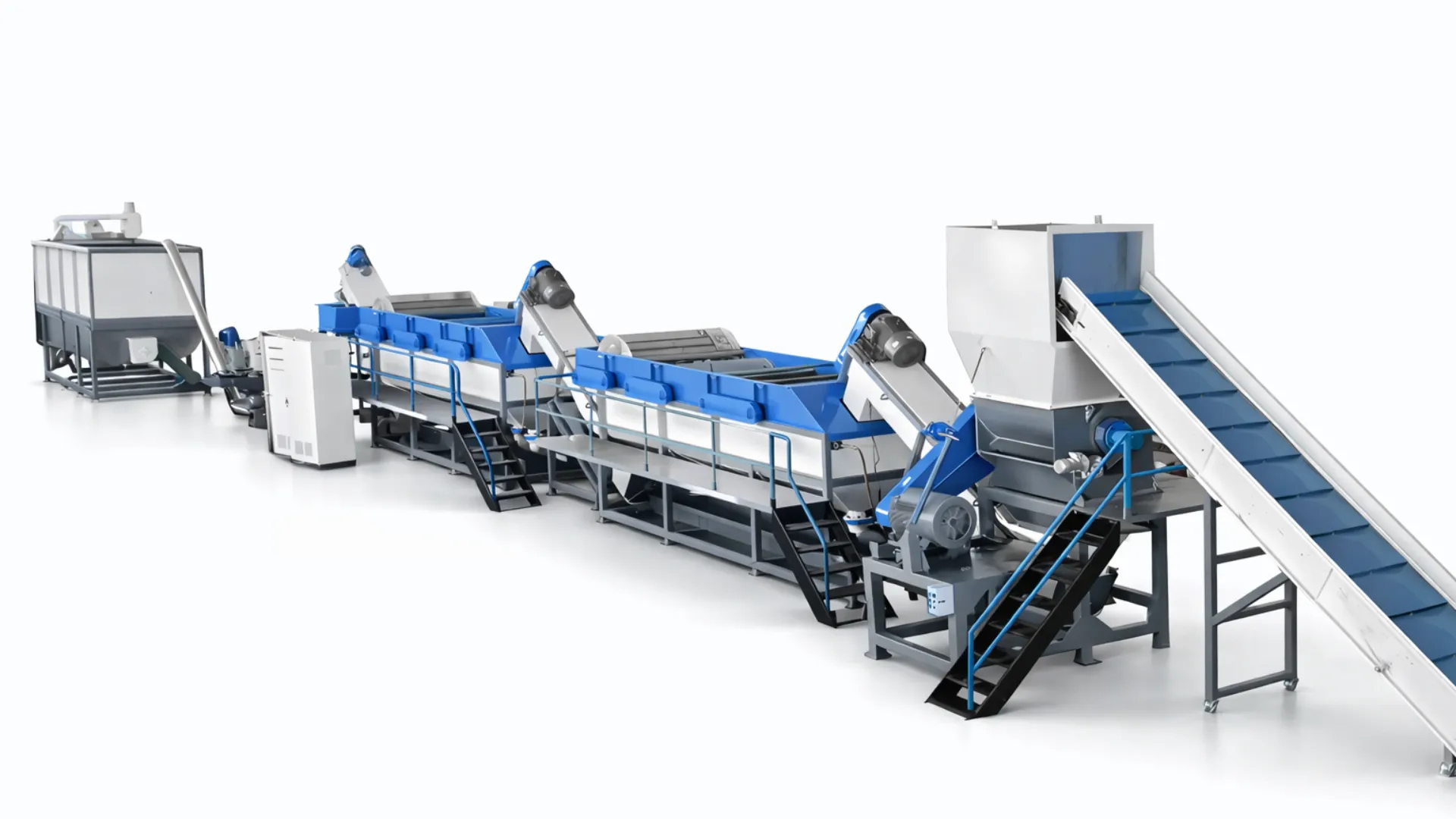
A hard plastic recycling line in Kenya should be designed around a verified stream of HDPE, PP or another target resin, the contamination actually collected, available utilities and a buyer’s product specification. A “500 kg/h line” or any other nameplate rate does not establish saleable output, food-contact suitability or project profitability. Those results require feed trials, a mass balance, quality testing and a site-specific business case.
Start with material and market evidence
Before choosing equipment, document where the rigid plastic comes from, how much can be supplied through seasonal changes and what products contain it. Common streams may include bottles, crates, buckets, drums, closures and injection-moulded scrap. Separate natural HDPE, coloured HDPE, PP and mixed rigid plastics when the intended buyers value them differently.
Obtain written acceptance requirements from prospective flake or pellet buyers. Relevant properties may include polymer identification, colour, moisture, ash, bulk density, melt flow, odour, particle size and restricted contamination. “Clean flakes” is not a testable specification.
Kenya compliance belongs in the project plan
Kenya’s Sustainable Waste Management Act establishes a national framework for sustainable waste management. NEMA publishes the current gazetted waste, extended producer responsibility and plastic-management regulations and should be checked for the operative documents.
A recycler should confirm applicable licensing, environmental assessment, waste transport, workplace, water abstraction or discharge, county and fire requirements with the competent Kenyan authorities and qualified local advisers. Requirements can change and depend on the site and activity, so an equipment quotation is not a compliance approval.
Recommended process development sequence
| Stage | Purpose | Evidence to collect |
|---|---|---|
| Feed audit | Define resin, format and contamination | Lot weights, samples, photographs and seasonal supply |
| Sorting | Remove incompatible or unsafe items | Reject categories and mass |
| Size reduction | Create a controlled, washable particle | Size distribution, fines and motor load |
| Washing | Remove soil, labels, product residue and other target contaminants | Samples after each washing stage |
| Density separation | Split a defined float and sink fraction | Purity and recovery at both outlets |
| Dewatering and drying | Meet storage or extrusion moisture requirement | Moisture using an agreed test method |
| Pelletizing if required | Homogenise, filter and form pellets | Filtration, melt flow, colour and application tests |
1. Sort rigid plastics before shredding
Manual sorting, magnets, metal detection or sensor sorting may be used according to the incoming stream. Remove batteries, pressurised containers, medical waste and containers with unknown hazardous residues through an approved procedure. Keep PVC and other incompatible resins out of a polyolefin stream where the buyer limits them.
Sorting after shredding is harder because labels and small fragments are distributed through the feed. Define supplier acceptance rules and return recurring contamination data to collection partners.
2. Select size reduction from the actual object
A shredder can accept bulky or thick-walled items and provide a controlled feed to a granulator. A granulator produces smaller regrind for washing or extrusion. Some clean production scrap needs only one stage; large drums, crates or mixed bulky feed may benefit from two.
Specify the largest object, wall thickness, bulk density, metal risk and required discharge size. Confirm knife access, screen change, wear protection, dust and noise controls. The plastic granulator range should be evaluated by material test rather than nominal capacity alone.
3. Build washing around the contaminant
Prewashing can release sand and loose dirt before intensive equipment. Friction washing scrubs surfaces, while hot washing may be considered for a defined oil, adhesive or product residue. Temperature and chemistry increase rinsing, heating and wastewater requirements and should be justified by trials.
A water-based sink-float tank can often keep unfilled HDPE and PP in the float fraction while many stones, metals and denser plastics sink. It cannot reliably separate HDPE from PP, and fillers or attached components can change behaviour. See the revised sink-float separation guide.
4. Design the water loop before commissioning
List water makeup, recirculation, solids removal, sludge handling and final discharge. Water reuse is useful only if suspended and dissolved contamination stay within limits for the process. Measure actual makeup and carry-over during trials rather than promising a fixed reuse percentage.
Kenyan water availability and discharge conditions are site-specific. Size tanks and treatment around contaminant load, operating hours and required cleaning, with provision for sampling and safe sludge removal.
5. Dewater to a written output requirement
A centrifugal dryer removes free and surface water from rigid flakes. Heated air may follow where storage or extrusion needs a lower moisture level. The required value depends on polymer, extruder design, storage time and customer specification; it is not a universal percentage.
Sample after stable operation and use one documented moisture method. Check drainage, screen condition, rotor load and air system before adding more heat. The centrifugal dewatering machine is one component, not a guarantee of final moisture.
6. Pelletize only when the market requires it
Some buyers accept washed regrind; others need filtered pellets. Pelletizing adds melting, filtration, cooling, cutting, energy and maintenance. It can improve feeding and homogenisation, but it does not turn mixed or unsafe waste into food-grade resin.
Food-contact recycled plastic requires an appropriate feed-control and decontamination pathway under the rules of the destination market. Do not describe ordinary washed or pelletized material as “food grade” without the required process authorisation, testing and customer approval.
Calculate capacity with a mass balance
Define the required saleable output and estimate dry saleable yield from representative trials:
Required design input = target saleable output ÷ saleable yield ÷ planned operating availability
Then check the sustained capacity of every stage on the same feed. A line rated at a nominal input may deliver less dry output after removing labels, dirt, moisture, incompatible plastics and fines. Include buffer capacity where one process runs intermittently.
Develop Kenya-specific operating costs
Use current quotations and site data for collected plastic, transport, electricity tariff and demand charges, water, wastewater, labour, rent, consumables, screen and knife wear, maintenance, permits, laboratory tests and financing. Estimate revenue from written buyer terms and conservative saleable output.
Run sensitivity cases for lower yield, lower selling price, reduced availability and higher contamination. A generic pellet price, conversion rate or payback period cannot demonstrate the economics of a Kenyan project.
Factory acceptance and site acceptance
Agree test conditions before the order. The factory test should use representative material and record dry input, rejects, saleable output, electricity, water makeup, downtime and quality results over an agreed stable period. The site test should repeat the relevant criteria after utilities and local operators are ready.
Document operator training, maintenance intervals, critical spares and safety checks. Production should not begin until guarding, emergency stops, electrical protection, dust or fume controls and water systems are commissioned for the installed configuration.
Frequently asked questions
Can a Kenya rigid-plastic line process HDPE and PP together?
It may process both in separate campaigns, but a mixed output is suitable only if the buyer accepts it. A water tank does not reliably separate unfilled HDPE from PP.
Does washing and pelletizing make recycled plastic food grade?
No. Food-contact suitability requires an approved feed and recycling pathway, decontamination evidence, testing and compliance with the destination market’s rules.
How should a buyer verify the promised line capacity?
Use representative feed, an agreed run duration and a dry mass balance. Verify saleable output and quality together with utility consumption and downtime.
Prepare a material and site brief
Send Energycle representative samples, feed analysis, expected monthly supply, product specification, site layout and utility information. The rigid plastic washing line can then be configured and tested against measurable requirements for the Kenyan project.
