

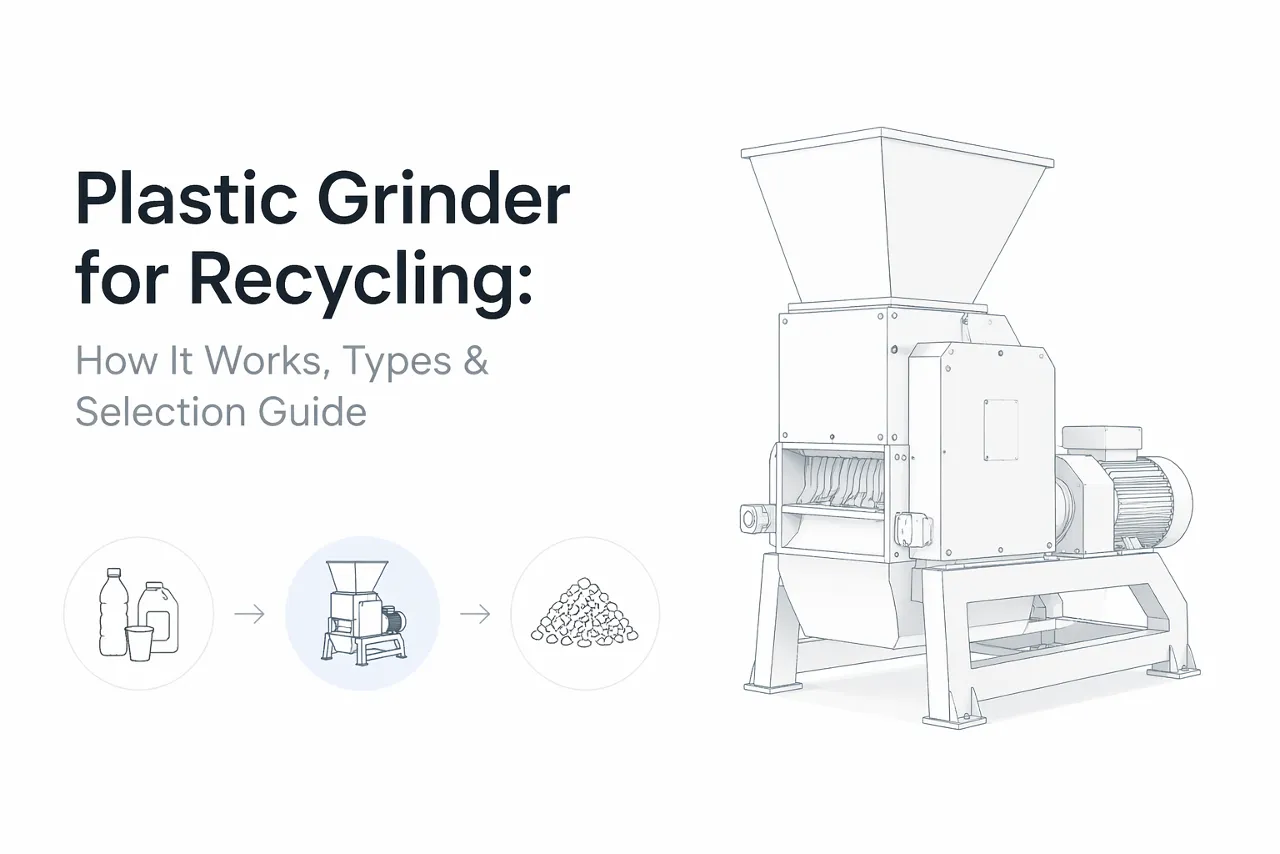
Maszyna do mielenia plastiku do recyklingu przetwarza odpady z plastiku — butelki, rury, skrzynie, folie i profile — na jednolite granulki o wymiarach odpowiednich do bezpośredniego podawania do ekstrudera lub pelletizera. Bez tego etapu zmniejszania rozmiaru większość lin recyklingowych nie może przetwarzać napływających materiałów w skali. niniejszy przewodnik omawia, jak działa maszyna, jakie typy istnieją, jakie specyfikacje są naprawdę ważne oraz jak dopasować odpowiednią maszynę do Twoich specyficznych wymagań dotyczących materiału i przepustowości.
Co to jest maszyna do mielenia plastiku do recyklingu?
Maszyna do mielenia plastiku — również nazywana granulatorem lub kruszarką plastiku na różnych rynkach — to maszyna do zmniejszania rozmiaru, która tnie masywne odpady z plastiku na małe, jednolite cząstki, zazwyczaj o średnicy 4–25 mm. Wyjście (nazywane regranulatem lub granulatem) jest czyste, swobodnie przepływające i gotowe do następnego etapu: mycia, kompozycji lub bezpośredniego reekstrudowania do nowych granulek.
Terminy mielarka, granulator i kruszarka są używane zamiennie w przemyśle recyklingu plastiku, mimo że istnieją techniczne różnice:
- Granulator — dokładne cięcie przy średniej prędkości wirnika (200–600 obr./min), produkujące jednolite granulki z minimalną ilością pyłu; standardowy etap końcowego zmniejszania rozmiaru
- Mielarka — wyższa prędkość, bardziej agresywne zmniejszanie rozmiaru dla trudniejszych lub grubszych materiałów podawanych
- Łamacz — pierwotne zmniejszanie rozmiaru bardzo dużych lub grubowarstwowych elementów (dęby, skrzynie, grube rury) przed granulacją; zobacz nasz przewodnik po kruszarkach do tworzyw sztucznych szczegółowy rozkład
W praktyce jedno maszyna często obsługuje wszystkie trzy funkcje. Wybór nazwy maszyny rzadko odzwierciedla znaczącą różnicę w wydajności — co ma znaczenie to projekt wirnika, prędkość cięcia i rozmiar siatki.
Jak działa maszyna do mielenia plastiku
Wszystkie maszyny do mielenia plastiku mają tę samą zasadę działania: wirnik obrotowy wyposażony w noże pracuje przeciwko stałym nożom statora, tnąc napływający plastik na coraz mniejsze kawałki. Sekwencja ma pięć etapów:
- Karmić — Materiał wchodzi do komory tnącej przez zlew, ręcznie zasypany, przez taśmę transportową lub bezpośrednio z linii produkcyjnej.
- Pierwsze cięcie — Noże wirnika (poruszające się) przechodzą obok noży statora (stałych) przy bliskiej tolerancji, tnąc plastik. Prędkość wirnika wynosi od 200 do 900 obr./min w zależności od typu maszyny i materiału.
- Regranulacja — Kawałki zbyt duże, aby wyjść, recyrkulują się wewnątrz komory tnącej i są cięte ponownie.
- Wylot przez siatkę — Przebity ekran na dole komory kontroluje rozmiar cząstek wyjściowych. Tylko cząstki wystarczająco małe, aby przejść przez otwory, opuszczają maszynę. Standardowe średnice otworów siatki: 6, 8, 10, 12, 15, 20, 25 mm.
- Kolekcja — Granulki wyjściowe spadają do pojemnika zbiorczego lub są przewożone pneumatycznie do następnego etapu procesu (mycie, suszenie, ekstruder).
Siatka jest głównym mechanizmem kontroli rozmiaru. Zmiana siatki zmienia rozmiar cząstek wyjściowych bez jakichkolwiek innych regulacji maszyny. Większość komercyjnych granulatorów pozwala na bez narzędziową zmianę siatki w mniej niż pięć minut.
Typy maszyn do mielenia plastiku do recyklingu
Dla projektu wirnika
Geometria wirnika określa, jakie materiały maszyna przetwarza najbardziej efektywnie. Cztery najczęstsze projekty to:
| Typ wirnika | Najlepszy materiał | Typowa prędkość |
|---|---|---|
| Otwarty wirnik (łopatki lub wkręty) | Grube, sztywne elementy — rury HDPE, obudowy ABS, komponenty PA | 200–400 obr./min |
| Zamknięty wirnik (rozstawione ostrza) | Cienkościenne części, materiały do czyszczenia, elastyczne profile | 300–600 obr./min |
| Wirnik promieniowy | Ciągłe cięcie na boki i sprzączki z wtryskiwania | 400–900 obr./min |
| Wirnik dwusprzęgłowy | Zmieszane lub zanieczyszczone balowane plastiki, duże puste pojemniki | 50–150 obr./min |
Mokre mielarnie kontra mielarnie suche
Ta różnica jest niedoceniana w większości przewodników zakupowych, mimo że znacząco wpływa na jakość wyjściowego produktu i zgodność z procesami pośrednimi.
Mokre mielarnie jest standardowym trybem pracy. Komora tnąca działa bez wody. Wyjście to suchy granulat gotowy do natychmiastowego pelletyzowania lub kompozycji. Nagromadzenie ciepła może degradować wrażliwe na ciepło tworzywa sztuczne (PVC, PET) przy wysokim przepływie lub z trudnymi do cięcia materiałami.
Suche mielarnie wprowadzają kontrolowany przepływ wody do komory tnącej podczas działania. Zalety obejmują:
- Chłodzenie zapobiega degradacji ciepła tworzywa sztuczne
- Woda wypłukuje drobne pyły z komory ciągło
- Etykiety, brud i zanieczyszczenia powierzchniowe są częściowo wypłukane podczas mielarni
Mokre mielarnie są standardem w liniach recyklingu butelek PET, gdzie zarówno wrażliwość na ciepło, jak i zanieczyszczenie etykiet są problemami — zobacz nasze zalety mokrego mielarni dla butelek PET dla szczegółowego porównania. Niestety: suchy granulat musi przejść przez suszarkę centryfugową lub suszarkę gorącym powietrzem przed dalszym przetwarzaniem, co dodaje kosztów kapitałowych i operacyjnych.
Dla rozmiaru maszyny i zastosowania
- Małe / laboratoryjne mielarnie (7,5–22 kW): przepustowość 50–300 kg/h. Używane w małych warsztatach recyklingowych, laboratoriach R&D lub w liniach z pojedynczą maszyną wtryskową do recyklingu sprzączek i sprężek.
- Średnie przemysłowe mielarnie (22–90 kW): przepustowość 300–1,000 kg/h. Główny element większości zakładów recyklingu plastików obsługujących jeden lub dwa stałe strumienie materiałów.
- Ciężkie przemysłowe mielarnie (90–250+ kW): przepustowość 1,000–5,000 kg/h. Dla dużych zakładów przetwarzających mieszane odpady konsumenckie, baliki folii lub duże odpady z wtryskiwania rur.
Rekomendacje specyficzne dla materiałów
Not every plastic grinder works equally well on every resin type. Material properties — stiffness, melt temperature, shape, and contamination level — determine the correct machine configuration. Use this table as a starting point:
| Tworzywo | Main Challenge | Recommended Configuration |
|---|---|---|
| Butelki PET | Heat-sensitive resin; label contamination; caps | Wet granulator, tangential feed rotor, 8–10 mm screen, metal detector upstream |
| HDPE / PP sztywny (crates, drums, thick pipe) | High impact loads; large input dimensions | Heavy-duty open rotor, 200–350 RPM, pre-shredding recommended for pieces over 500 mm |
| PE / PP film (packaging, agricultural) | Material wraps around rotor; feeding inconsistency | Anti-wrap rotor design, force-feed roller system, 10–15 mm screen, slower intake speed |
| PVC profiles and pipe | Chlorine off-gassing; rapid blade wear; fine dust | Closed rotor with hardened blades (SKD11 or carbide), dust extraction system, dry grinding only — see our PVC grinding vs. crushing guide |
| ABS / PS (electronics, housings) | Brittle fracture; metal contamination risk from e-waste | Metal detector upstream, slow-speed grinder, 6–8 mm screen, sound insulation enclosure |
| Nylon / engineering plastics | Tough and abrasive; heat build-up in chamber | Water cooling or wet grinding, tungsten carbide-tipped blades, 6–10 mm screen |
Najważniejsze wnioski: If you process more than one material type on the same line, choose a granulator with quick-change screens and a rotor geometry suited to your most challenging material — then adjust screen size and feed rate for lighter materials.
Key Specifications to Evaluate Before You Buy
Manufacturer spec sheets often highlight peak capacity figures. Here is what the numbers actually mean in practice:
Przepustowość
Rated in kg/h, but always request capacity figures for your specific material and screen size. A machine rated at 600 kg/h on rigid HDPE regrind may deliver only 150–200 kg/h on flexible PE film. Ask for a material test or include a capacity guarantee in the purchase contract.
Cutting Chamber Width and Rotor Diameter
Chamber width determines the maximum input dimension the machine accepts without pre-cutting. Rotor diameter affects cutting energy: a larger-diameter rotor at the same RPM delivers higher blade peripheral speed and more shearing force. For pipe or profile recycling, confirm chamber width covers your largest cross-section.
Screen Hole Diameter
This is the direct control over output particle size. Standard options: 6, 8, 10, 12, 15, 20, and 25 mm. Most downstream extruders and compounders require 6–12 mm granulate — confirm your pelletizer’s feed specification before specifying the screen. Our Przewodnik maszyn do granulacji plastiku covers the full downstream requirements.
Moc silnika
Undersized motors cause repeated thermal shutdowns and shortened motor life. As a practical rule: for rigid plastics, allow 1 kW per 5–8 kg/h of rated throughput. For flexible or low-density material (film, foam), allow 1 kW per 10–15 kg/h. Always size for your peak throughput, not your average.
Blade Material and Replacement Cost
Blades are a consumable with a direct impact on operating cost. D2 tool steel blades (hardness HRC 58–62) handle most standard applications. For abrasive materials — glass-filled nylon, PVC, contaminated post-consumer waste — SKD11 or tungsten carbide insert blades extend service life by 3–5x but cost more upfront. Confirm blade replacement price and local availability before committing to a machine. For a detailed breakdown, see our guide to selecting plastic granulator blades.
Noise Level and Dust Control
Industrial granulators typically generate 85–100 dB(A) without enclosures. EU and US workplace safety regulations require hearing protection above 85 dB(A) and engineering controls above 90 dB(A). Ask for the machine’s measured sound pressure level at 1 m with the standard hopper installed — not the theoretical value. Dust extraction connection (typically 150–250 mm ducting) is essential for PVC, ABS, and any dry grinding of contaminated material.
Plastic Grinder vs. Shredder vs. Crusher: What’s the Difference?
These three machine types sit at different points in the size-reduction chain. Using the wrong one — or skipping one — creates bottlenecks and poor regrind quality.
| Plastic Grinder / Granulator | Niszczarka do plastiku | Kruszarka do plastiku | |
|---|---|---|---|
| Rozmiar wyjściowy | 4–25 mm (screen-controlled) | 20–150 mm (coarse, irregular) | 10–80 mm (medium) |
| Output uniformity | High — consistent particle shape | Low — strips and chunks | Średni |
| Przedział wydajności | 50–5,000 kg/h | 200–15,000+ kg/h | 100–3,000 kg/h |
| Primary role | Final size reduction for extrusion-ready regrind | Volume reduction of bulky waste; primary processing of mixed waste | Intermediate reduction between shredder and granulator |
| Typical position in line | Last size-reduction step before washing or extruding | First step — primary reduction | Between shredder and granulator |
For most post-consumer plastic recycling operations, the optimal sequence is: Shredder → Washer → Crusher → Granulator → Pelletizer. For clean industrial scrap — sprues, runners, pipe offcuts — a single granulator inline is sufficient. For a full equipment comparison, see our shredder vs. granulator vs. pelletizer selection guide.
Plastic Grinder Maintenance: What to Monitor
Maintenance determines both output quality and machine lifespan. Three areas require regular attention:
Blade Inspection and Sharpening
Dull blades produce irregular particle shapes, more fines, higher energy consumption, and heat build-up. Inspect blades every 200–500 operating hours depending on material abrasiveness — PVC and glass-filled resins wear blades 3–5x faster than clean HDPE or PP. Most granulator blades can be resharpened 3–5 times before replacement. Keep a spare set so the machine is never down during blade service.
Screen Inspection
Check the screen for cracks, deformation, or enlarged holes after every 500 operating hours. A damaged screen allows oversized particles to pass, directly contaminating your regrind and potentially causing blockages in downstream extruders. Keep at least two spare screens per machine — one installed, one ready.
Bearing Temperature and Lubrication
Rotor bearings operate under continuous high load. Monitor bearing temperature during operation — sustained readings above 80°C indicate inadequate lubrication, misalignment, or overload. Regrease according to the manufacturer’s schedule: typically every 500–1,000 hours for sealed bearings, more frequently in dusty or high-humidity environments. Always use the grease type specified by the bearing manufacturer — mixing grease types accelerates wear.
Czesto zadawane pytania
Czym różni się plastikowy mielarka od plastikowego granulatora?
In the plastic recycling industry, the terms are used interchangeably. Both describe a machine that reduces plastic waste to small, screen-controlled particles using a rotor-and-stator cutting system. If a technical distinction is made: a granulator produces highly uniform granules at medium speed (200–600 RPM) with minimal fines, while a grinder may operate at higher speed for more aggressive size reduction of bulkier or tougher material. The machine function matters more than the label.
Czy jeden młotowy rozdrabniacz plastikowy może przetwarzać wszystkie rodzaje plastiku?
Most commercial granulators handle the six common recyclable plastics — HDPE, PP, PET, PVC, ABS, and PS — but material properties require different configurations. PET requires wet grinding to manage heat sensitivity; PE film needs an anti-wrap rotor and force-feed system; PVC requires hardened blades and dust extraction. A single granulator can be configured for multiple materials by swapping screens and adjusting feed rate, but it cannot be optimized for all materials simultaneously. Multi-material operations typically run material-dedicated machines or maintain a library of screen and blade configurations.
Ile kosztuje przemysłowy mielarka do plastiku?
Entry-level granulators (7.5–15 kW) for sprue and runner recycling start at $3,000–$8,000 USD. Mid-range industrial units (22–55 kW, 300–800 kg/h) typically cost $15,000–$50,000. Heavy-duty systems for post-consumer recycling lines (90 kW+, 1,000+ kg/h) range from $60,000 to over $200,000 depending on rotor design, automation level, wet or dry configuration, and manufacturer. Request a formal quotation with specifications locked to your material type and throughput requirement — capacity-to-cost ratios vary significantly by configuration.
Jaka wielkość cząstek produkuje się w wyniku przetwarzania plastiku w maszynie mielącej?
Output particle size is directly controlled by the screen installed in the cutting chamber. Standard screen hole diameters range from 6 mm (fine granulate for direct extrusion) to 25 mm (coarse regrind for pre-drying or washing). For feeding a standard single-screw or twin-screw extruder, 6–12 mm granulate is most common. Changing the screen — a five-minute operation on most machines — changes the output size. No other machine adjustment is needed.
Choosing the Right Plastic Grinder for Your Recycling Line
The right plastic recycling grinder is defined by three parameters: your input material, your required throughput, and your downstream process. Get these three inputs wrong and no amount of machine quality compensates.
Start with your material — its density, stiffness, contamination level, and heat sensitivity determine rotor type, blade material, screen size, and whether you need wet or dry grinding. Then size the motor and chamber width for your peak throughput, not your average. Finally, confirm the output particle size your downstream pelletizer or compounder requires and specify the screen accordingly. Our detailed plastic granulator selection guide walks through this process step by step.
Energycle manufactures industrial plastic granulators and plastic grinders for recycling lines handling everything from clean injection molding scrap to mixed post-consumer film and rigid waste. Skontaktuj się z naszym zespołem inżynierii with your material type, input dimensions, throughput target, and required output particle size — we will recommend the correct configuration and provide a formal quotation.
