

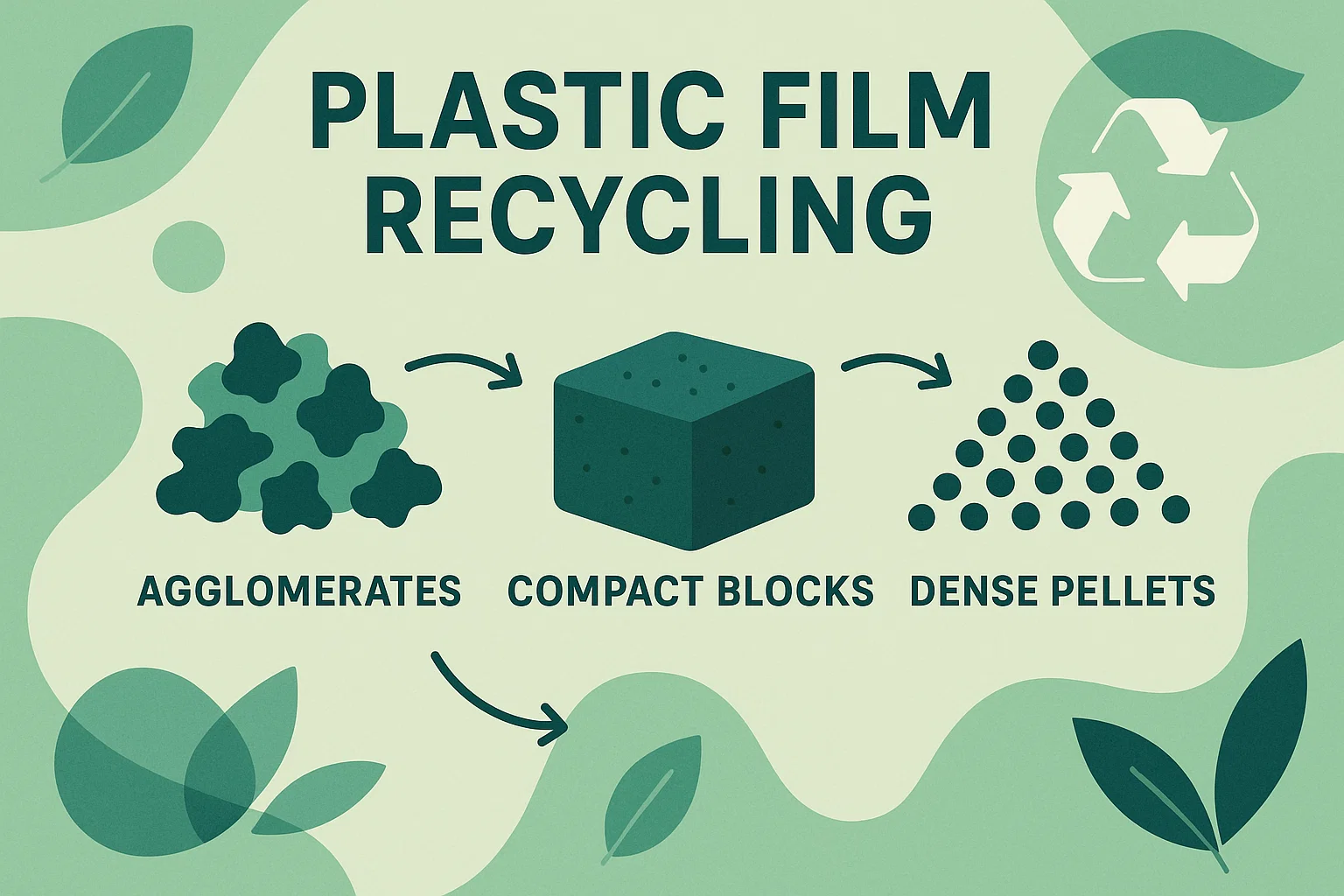
Film Agglomerator vs Cutter-Compactor vs Screw-Press Densifier
A film agglomerator, cutter-compactor and screw-press densifier all make lightweight plastic film easier to handle, but they solve different process problems. The correct choice starts with feed condition and downstream destination: dry loose scrap, washed wet film and an integrated pelletizing line should not be treated as the same application.
Commercial terminology varies, so this comparison uses the operating mechanism rather than the equipment label alone.
Quick comparison
| Decision factor | Batch agglomerator | Cutter-compactor | Screw-press densifier |
|---|---|---|---|
| Primary function | Cut, heat and agglomerate film in a chamber | Continuously condition and force-feed an extruder | Mechanically dewater and densify washed film |
| Typical feed | Dry or suitably prepared light film | Dry, controlled production or recycled film | Wet PE/PP film leaving a washing line |
| Output | Irregular dense agglomerate | Conditioned feed transferred to extrusion | Dense squeezed pieces or short logs |
| Downstream route | Storage, blending or separate extrusion | Normally integrated pelletizing extruder | Conveying, thermal conditioning or pelletizing |
| Key control | Batch endpoint, heat and cooling | Feed/extruder balance | Inlet water, pressure and discharge stability |
1. Batch film agglomerator
A plastic film agglomerator uses high-speed knives to cut and mix material. Mechanical friction raises the temperature and softens the film. The operator or automatic control then ends the cycle and cools the material so it forms dense, irregular agglomerate.
Choose it when
- The feed is light, predominantly one compatible polymer and dry enough for the specified machine.
- You need a separate intermediate product before an existing extruder.
- Batch flexibility is useful for controlled material changes.
Limitations to account for
- Cycle quality depends on feed mass, knife condition, motor load, heat and cooling.
- It does not replace sorting, washing or melt filtration.
- Excess temperature or residence time can degrade the polymer or create melted buildup.
- It is not a treatment for unknown mixed or heavily contaminated film.
Friction heat does not “burn off” contamination in a controlled recycling process. Paper, grit, metal, incompatible polymers and residues should be removed upstream.
2. Cutter-compactor integrated with an extruder
A cutter-compactor continuously cuts, mixes, warms and compacts film, then meters it into the extruder screw. Unlike a standalone batch agglomerator, its central value is integration: the conditioning chamber and extruder operate as one feeding system.
Choose it when
- The objective is continuous pellet production rather than storing agglomerate.
- Feed is relatively dry and controlled, such as edge trim, bags, stretch film or prepared washed film.
- The line needs steady force feeding and automatic control between cutting and extrusion.
Limitations to account for
- Moisture and volatile loading must stay within the extruder and degassing design.
- A sudden feed change affects compaction, extruder fill, pressure and filter loading together.
- The system is less flexible if the user only needs a standalone dense intermediate material.
- Contamination still requires sorting, washing and appropriate melt filtration.
Review the complete cutter-compactor pelletizing line, including venting, filtration and pellet cutting, rather than comparing only the compactor motor.
3. Screw-press film squeezer and densifier
A film squeezer dryer accepts wet, washed film. A high-torque screw compresses the material, expels free water through the designed drainage path and forms a denser discharge with controlled mechanical and thermal conditioning.
Choose it when
- Wet PE or PP film comes directly from a washing line.
- Mechanical dewatering and densification are both required.
- The next step needs a more stable bulk feed than loose wet flakes.
Limitations to account for
- Performance changes with inlet moisture, film thickness, polymer, contamination and feed rate.
- Screw, barrel and drainage components are wear points.
- It may not meet the final moisture requirement without downstream thermal drying or conditioning.
- It prepares feed but does not provide the melting, venting and filtration of pellet extrusion.
Do not select a squeezer from a universal outlet-moisture claim. Specify the test method, representative inlet material and required downstream condition.
Decision path by feed condition
Clean, dry post-industrial film
If the goal is finished pellets in one continuous process, start with a cutter-compactor extrusion line. If the plant already has suitable extrusion capacity and needs a separate dense feed, a batch agglomerator may fit.
Washed, wet post-consumer film
Start with a screw-press squeezer when water removal and bulk-density increase are the immediate needs. Confirm whether the squeezed output will enter thermal drying, a buffer silo or a pelletizer.
Dry light film requiring batch preparation
An agglomerator can produce a transportable or meterable intermediate product. Verify that feed contamination and moisture are within the machine’s accepted limits.
Mixed or unknown polymer film
None of these machines is the first solution. Characterize and sort the feed, test compatibility, and define the target product before densification. Processing incompatible polymers together can reduce pellet quality even if feeding becomes easier.
Questions to send each supplier
- Which polymers and film structures were used for the quoted performance?
- What were the inlet bulk density, moisture, size and contamination?
- Is capacity stated as wet input, dry input or usable output?
- What output form, moisture and bulk density were measured, and by which method?
- Does the quotation include feeding, controls, cooling, conveying and downstream integration?
- What are the knife, screw, barrel, screen and bearing maintenance requirements?
- How are overload, temperature and access risks controlled?
- Can the supplier run an acceptance test using a representative production sample?
How to compare operating cost fairly
Measure electricity, water, labor, wear parts, maintenance time and saleable yield across the same system boundary. An agglomerator used before a separate extruder cannot be compared directly with an integrated cutter-compactor line unless the extrusion stage is included. A screw press may reduce a thermal-dryer load, but that benefit must be measured on the complete wash-to-pellet route.
Also count losses caused by stoppages, unstable feeding, filter changes and off-spec output. Nameplate power and purchase price alone do not establish total cost.
Acceptance-test checklist
- Use feed that represents normal and difficult production lots.
- Record inlet and output mass, moisture and bulk density.
- Run long enough to reach stable temperatures and material levels.
- Record motor load, stoppages, cleaning needs and wear observations.
- Process the output through the intended downstream equipment.
- Check final pellet or product quality against the written specification.
For a line assessment, provide feed samples, photos, target throughput, utilities and intended downstream use through the Energycle contact form.
Frequently asked questions
Which machine is suitable for washed wet plastic film?
A screw-press squeezer is normally evaluated first because it combines mechanical dewatering and densification. The exact outlet condition must be demonstrated with the actual feed.
Can agglomerate feed an injection-molding machine directly?
Usually agglomerate is an intermediate material that is extruded, filtered and pelletized first. Direct use requires the molding process and product quality to be specifically validated.
Is a cutter-compactor a standalone densifier?
It can condition film, but in this comparison it is part of an integrated extrusion and pelletizing system. Confirm the supplier’s actual configuration because terminology varies.
