

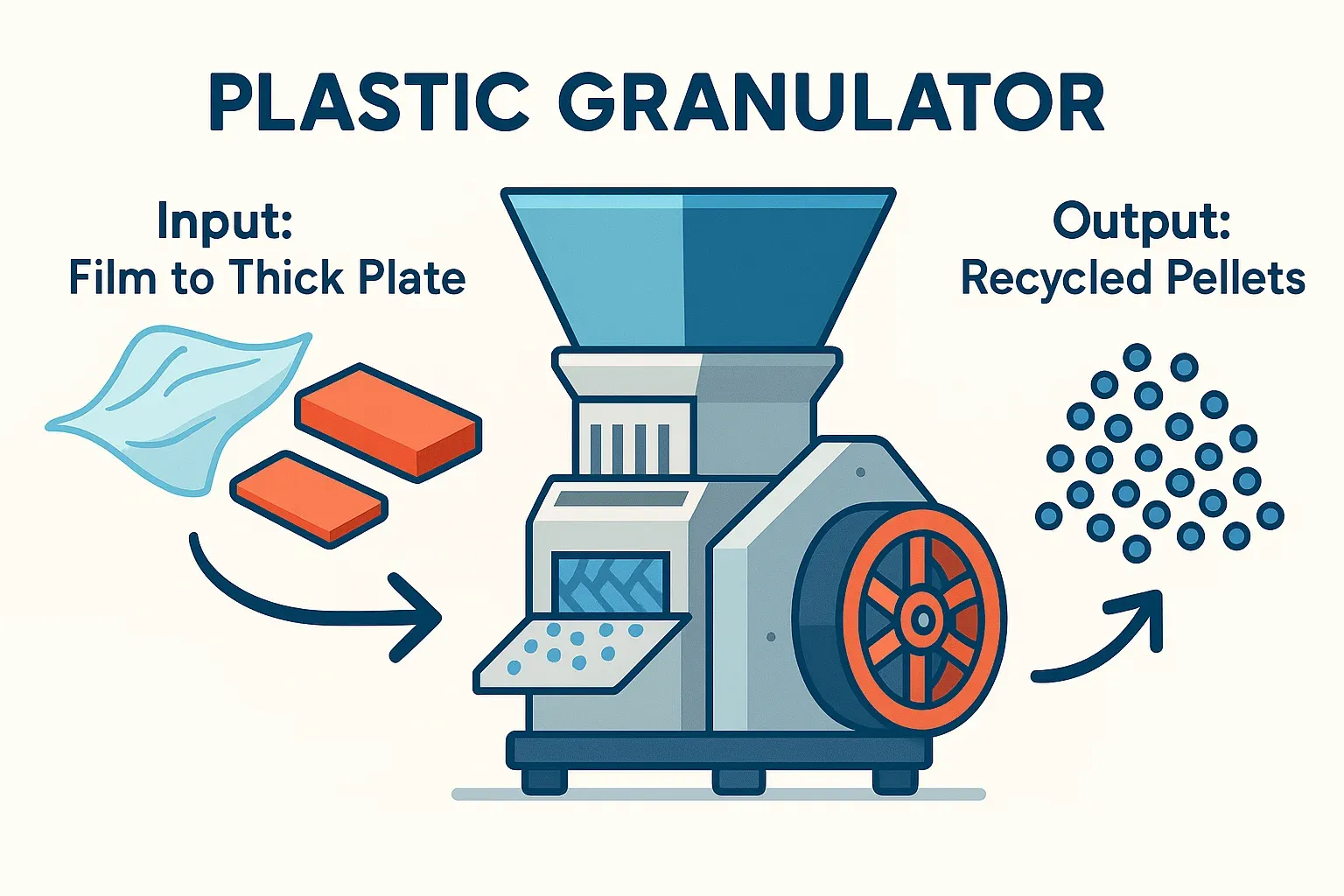
A plastic granulator can process film, bottles, molded parts, sheet and some thick scrap, but one rotor and hopper design will not perform equally well on every form. Material geometry determines how it enters the cutting chamber, how the knives engage it and whether the machine produces controlled regrind or unstable loads. This guide maps common plastic forms to the granulator features that matter.
What a plastic granulator does
A granulator uses rotating knives against fixed bed knives to cut plastic into particles. A screen retains oversize material until it is small enough to leave the chamber. The result is usually called regrind or flake; it is not a finished pellet unless a separate extrusion and pelletizing process follows.
Granulation may be the primary size-reduction step for bottles, molded parts and production scrap. Bulky pipe, large purgings, baled film or thick profiles may first need a trituratore di plastica to create a controlled feed for the granulator. Choosing between one-stage granulation and shredder-plus-granulator processing is often more important than adding motor power to an unsuitable machine.
Application map: film to thick plate
| Feed form | Main handling problem | Features to evaluate | Possible upstream step |
|---|---|---|---|
| Loose film and bags | Low bulk density, wrapping and feed surges | Controlled feed, scissor-cut geometry, anti-wrap details, effective evacuation | Bale opening, sorting or pre-cutting |
| Rigid bottles and containers | Hollow parts bounce and collapse unpredictably | Hopper geometry, tangential chamber, wet or dry configuration, metal protection | Debaling, label removal and sorting |
| Molded parts, runners and crates | Variable wall thickness and impact load | Feed opening, rotor inertia, knife mounting and screen access | Robotic or conveyor feeding |
| Sheet and edge trim | Continuous strips can whip or bridge | Roll feeder or nip feed, guarded inlet and synchronized controls | Length cutting where required |
| Thick plate, profile and purgings | High bite load, shock and stalling risk | Pre-shredding decision, chamber opening, torque, bearing and rotor construction | Single- or double-shaft shredding |
Thin film and flexible packaging
Film is difficult because it is light and has a large surface area. It may float in a hopper, wrap around the rotor ends or arrive in sudden clumps. A high catalogue throughput based on rigid regrind says little about performance on loose film.
Evaluate the complete feeding arrangement: bale opener, conveyor, nip or roll feeder, hopper angle and the logic that stops the infeed during an overload. Knife geometry should create a controlled shearing action, while rotor-end seals and clearances should limit wrapping. The discharge or pneumatic evacuation system must remove light regrind without allowing it to recirculate unnecessarily.
Washed film introduces water and contamination. A wet granulator can help control heat and loose dirt, but it must be designed for drainage and corrosion resistance. If the objective is stable extrusion feeding after washing, a essiccatore a spremitura di film or densification step may be required after granulation.
Bottles and hollow rigid containers
PET and HDPE bottles compress when the rotor contacts them. Hopper and chamber geometry should prevent repeated bounce-back and provide a consistent bite. Tangential-feed designs are often considered for bulky hollow parts, but performance still depends on bottle size, bale preparation, screen opening and feed control.
PET bottle processing may use water in the chamber as part of a washing line. HDPE containers may be granulated dry or wet depending on contamination and the downstream process. In either case, upstream metal removal and sorting protect the knives and reduce non-target resin in the output. See the dedicated Guida alla selezione dei granulatore per bottiglie in PET for trial and acceptance criteria.
Molded parts, runners and crates
Injection-molding scrap can range from small runners to large housings and thick start-up pieces. Measure the largest part in three dimensions and identify inserts, fasteners or glass reinforcement. The feed opening must accept the actual part without unsafe manual pushing or uncontrolled kickback.
For beside-the-press work, low noise, dust control, easy color-change cleaning and a small footprint may be priorities. Central recycling systems place more emphasis on sustained throughput, material transport and rapid access for screens and knives. Abrasive fillers can change the knife material, wear protection and sharpening interval required.
Sheet, edge trim and continuous strip
Continuous sheet and edge trim need a controlled feed rate. A roll feeder or nip system can synchronize material entry with the granulator, reduce whipping and prevent the chamber from receiving a large loop at once. The inlet must be guarded for the final installation and should not allow an operator to reach the cutting zone.
Sheet thickness alone does not determine motor size. Width, polymer toughness, feed speed, number of layers, temperature and the required particle size all affect the load. A production trial should reproduce the maximum width and the fastest normal line speed.
Thick plate, profiles and purgings
Thick pieces require a reliable bite and can create high shock loads. Do not select a machine from maximum wall thickness alone. Record part dimensions, mass, polymer, temperature, fillers and whether the piece is solid or hollow. A large purge may exceed the safe infeed size even if its material is technically cuttable.
Pre-shredding is often the practical route when parts are too large, irregular or heavy for controlled granulator feeding. A shredder reduces them at lower speed, and the granulator then produces the final particle size. This staged arrangement may provide steadier loading and easier automation than attempting to force every piece directly into a high-speed cutting chamber.
Where direct granulation is appropriate, assess rotor construction, knife retention, bearings, drive protection, screen support and access for lifting heavy components. An granulatore di plastica rigida extra-large should be evaluated with the actual largest piece, not a smaller demonstration sample.
Screen size and output quality
The screen sets the maximum discharge path, but it does not create a perfectly uniform particle. Knife sharpness, gap, rotor speed, polymer behavior and recirculation also shape the distribution. Smaller openings can increase residence time, power demand, heat and fines; larger openings can release pieces that are too coarse for washing or extrusion.
Define the acceptable particle-size distribution and fines fraction, then measure them during the trial. The granulator screen-size guide explains how to move from a downstream requirement to a testable screen choice.
Capacity and motor selection
Nameplate motor power cannot be converted into a universal kg/h figure. Usable throughput depends on feed geometry, bulk density, screen, blade condition and the amount of oversize recirculation. Ask for sustained results from a representative test, including normal and peak current, stoppages and the mass of acceptable output—not only material fed into the hopper.
Size the machine with the upstream and downstream line. A granulator that repeatedly fills a washer or pneumatic conveying system beyond its stable rate creates a new bottleneck. A buffer and controlled feed may deliver a better line result than a larger cutting chamber.
Safety and maintenance checks
- Interlocked access doors and guards appropriate to the feed method
- Protection against unexpected restart and a documented energy-isolation procedure
- A secure rotor-locking method for knife and screen work
- Safe lifting points and space to remove the hopper, screen and knives
- Protezione metallica adatta al rischio di materiale di alimentazione
- Controlli per polvere, rumore e processo umido appropriati per l'installazione
- Componenti di usura disponibili, istruzioni per l'affilatura e supporto tecnico
Un modo migliore per confrontare i granulatori
Fornire a ogni fornitore la stessa descrizione del materiale, dimensione massima del pezzo, output richiesto, utilità e layout della linea. Testare un lotto rappresentativo, poi confrontare il throughput accettabile, distribuzione delle particelle, polvere, energia per tonnellata, tempo di pulizia e usura osservata. Più ampio guida di selezione del granulatore di plastica include domande per l'evaluazione commerciale e tecnica.
Un granulatore correttamente abbinato non è la macchina che afferma di trattare la più ampia lista di plastiche. È la configurazione che alimenta in modo sicuro, produce il riciclaggio richiesto e si integra con la successiva operazione sotto le condizioni reali del materiale della fabbrica.
Domande frequenti
Può un granulatore trattare sia pellicola che lastre spesse?
Alcuni macchinari possono processare più di una forma, ma il sistema di alimentazione, il rotore, i coltelli e la griglia potrebbero dover essere cambiati. Validare entrambi i materiali in prove separate e confrontare la qualità dell'output, non solo se la macchina può tagliarli.
Quando dovrebbe essere installato uno shredder prima di un granulatore?
Considerare il pre-trinciamento quando i rifiuti sono troppo ingombranti, irregolari, pesanti o difficili da misurare in modo sicuro nel granulatore. Il trinciatore crea un alimentazione controllata; poi il granulatore stabilisce la dimensione finale del riarrivo.
Un motore più potente aumenta sempre la capacità del granulatore?
Numero di alimentazione, geometria del rotore, area della griglia, condizione delle lame e evacuazione a valle possono limitare l'output. La capacità deve essere misurata con materiale rappresentativo e la griglia necessaria.
