

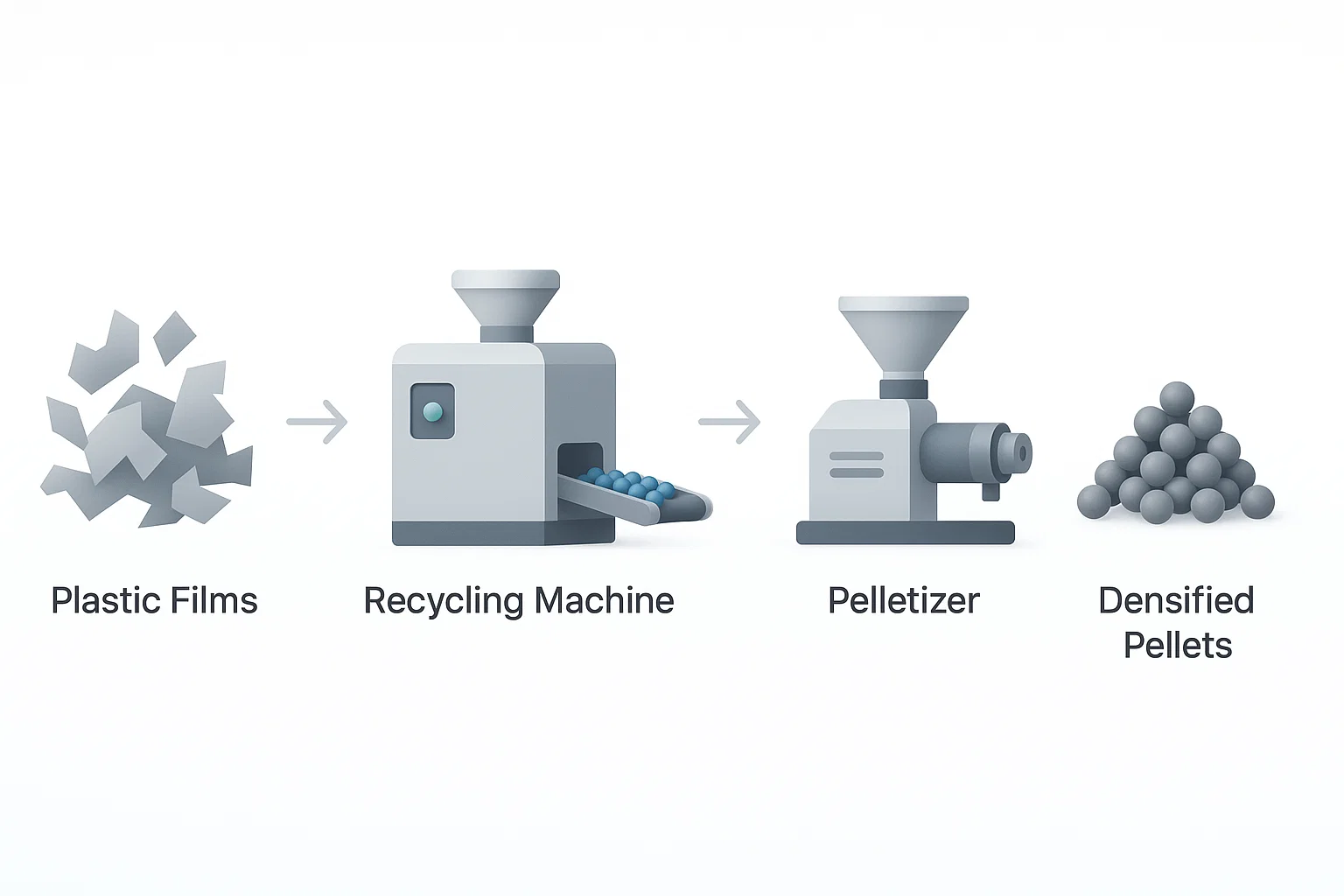
Film densification cost savings should be calculated from measured bulk density, usable vehicle volume, legal payload, storage layout, added energy and downstream value. Densification can reduce handling and transport cost when loose film is volume-limited, but it does not guarantee a fixed saving for every plant. This guide provides formulas and an illustrative example that operators can replace with their own data.
What film densification changes
Loose plastic film has a low and variable bulk density. It occupies substantial space, bridges in hoppers and can feed an extruder unevenly. A densification step changes the physical form so that the same mass occupies less volume. Depending on the process, it may also remove water or create a more stable feed form.
The equipment must match the feed condition. A screw press or wyciskarka do folii plastikowej is intended for washed, wet PE or PP film where dewatering is a primary task. An agglomerator or cutter compactor is better suited to sorted, reasonably dry thermoplastic scrap that needs densification and feeding preparation. Densification does not replace upstream sorting or washing.
Measure bulk density before calculating savings
Bulk density is the mass of material divided by the volume it occupies under a defined filling method. Use the same container, filling procedure and number of samples before and after densification. Film can settle during storage or transport, so document whether the measurement represents material directly from the machine, material after cooling or material after a stated settling time.
Bulk density (kg/m³) = sample mass (kg) ÷ occupied volume (m³)
Record the range as well as the average. If density varies by feedstock, colour or moisture, calculate each major stream separately instead of applying one result to the entire year.
Transport calculation: volume-limited or weight-limited?
A load is volume-limited when the vehicle fills before reaching its legal or operational payload. It is weight-limited when payload is reached while volume remains. Densification reduces trips only when volume is the limiting factor or when it allows safer, more consistent loading.
| Calculation | Formuła | Input source |
|---|---|---|
| Material volume | Mass ÷ measured bulk density | Scale and standardized density test |
| Volume-limited mass per load | Usable vehicle volume × bulk density × fill factor | Carrier specification and measured loading practice |
| Allowed mass per load | Lower of volume-limited mass and payload limit | Vehicle, container and local transport rules |
| Number of loads | Round annual or monthly mass ÷ allowed mass per load upward | Production forecast and actual dispatch records |
| Transport cost per tonne | Total freight, loading and handling cost ÷ delivered tonnes | Carrier invoices and plant labour records |
Illustrative transport example
Assume a recycler must move 20 tonnes of film each month. For illustration only, the loose material measures 50 kg/m³, the densified material measures 300 kg/m³ and the usable vehicle volume is 90 m³. Assume a fill factor of 0.85 and a payload limit above both calculated volume-limited loads.
- Loose film per load: 90 × 50 × 0.85 = 3,825 kg.
- Densified film per load: 90 × 300 × 0.85 = 22,950 kg, subject to the vehicle’s legal payload.
- Loose-film trips: 20,000 ÷ 3,825, rounded upward.
- Densified-film trips: 20,000 ÷ the lower of 22,950 kg and the legal payload, rounded upward.
This example does not describe a guaranteed Energycle result. Replace every assumption with measured material, vehicle and route data. If the legal payload is already reached with loose material, densification may improve handling without reducing the number of trips.
Calculate storage space without inventing a percentage
Storage savings depend on usable stacking height, aisle space, fire protection, container type, material stability and inventory days. First calculate the material volume, then convert it to required floor area using a realistic stacking height and layout factor.
Required material volume (m³) = stored mass (kg) ÷ measured bulk density (kg/m³)
Indicative floor area (m²) = material volume ÷ usable stacking height × layout factor
The layout factor should account for aisles, separation distances, access and non-stackable space. Site fire and safety requirements override an attractive spreadsheet result. Use actual warehouse rent, handling labour and inventory days to convert the space difference into money.
Add the cost of densification
Transport and storage are only one side of the calculation. Include electricity, wear parts, planned maintenance, labour, water or heat where applicable, reject handling and the capital recovery method used by the business. Meter energy under representative feed rather than multiplying installed motor power by operating hours.
| Cost element | How to measure it | Common omission |
|---|---|---|
| Elektryczność | Metered kWh during stable production ÷ saleable tonnes | Używanie mocy tabliczki jako rzeczywistej konsumpcji |
| Zużycie i konserwacja | Części, robocizna i planowany czas przestoju w określonym okresie ÷ tony | Ignorowanie zużycia śruby, siatki, noża lub łożyska |
| Robocizna | Godziny operatora i obsługi materiałów przypisane do etapu | Liczenie tylko bezpośredniego obecności maszyny |
| Wpływ na wydajność | Sprzedawalna wyroby przed i po granicy procesu | Zawodzenie wody lub usunięta brud jako straty produkcyjne |
| Koszt kapitałowy | Użycie zatwierdzonej metody amortyzacji lub finansowania firmy | Zwrot z inwestycji bez danych o wykorzystaniu i marży |
Zalety spływu dolnego muszlu muszą być przetestowane
Zgęstniona folia może być dostarczana bardziej konsekwentnie niż luźna, splątana folia, ale wpływ na wydajność i energię specyficzną extrudera zależy od mieszanki polimerów, wilgotności, zanieczyszczeń, ustawień zagęszczacza i extrudera. Pomiar stabilności podawania extrudera, wydajności, ciśnienia, zmian filtracji, jakości granulek i kWh na sprzedawalną tonę podczas kontrolowanego porównania.
Prasa może zmniejszyć obciążenie suszenia termicznego w dółspływu, usuwając mechaniczną wodę, ale wynik musi być określony z metodą testowania surowca i wilgotności. Nie usuwa farby, papieru, metalu lub niekompatybilnych polimerów. Nasze porównanie maszyn aglomeracyjnych, kompresorów i zagęszczaczy śrubowych wyjaśnia te różne funkcje.
Kiedy zagęszczanie może nie się opłacać
- Fabryka już wysyła ładunki o ograniczonej wadze i nie uzyskuje zmniejszenia liczby przejazdów.
- Bliski kupujący akceptuje luźną lub skręconą folię i nie płaci premii za formę zagęszczoną.
- Surowiec jest zbyt zanieczyszczony lub zmieszany dla zamierzonego produktu końcowego.
- Przepustowość jest zbyt nieregularna, aby uzasadnić stałe wydatki na sprzęt i utrzymanie.
- Wybrana metoda zagęszczania zmienia materiał w sposób, który kupujący nie może przetworzyć.
Zgodność opakowań i kontrola źródła pozostają ważne. Stowarzyszenie Recyklerów Plastiku publikuje PE projektowanie opakowań elastycznych, podczas gdy CEFLEX dostarcza przewodnik recyklingu opakowań elastycznych.
Lista kontrolna danych do obliczeń projektu
- Miesięczna i szczytowa masa folii przez typ surowca.
- Zmierzona luźna i przetworzona gęstość objętościowa.
- Wilgotność przychodząca i wychodząca, stosując ten sam sposób testowania.
- Pojemność użytkowa pojazdu, współczynnik wypełnienia, legalna ładowność i koszt przewozu.
- Dni zapasów, zasady magazynowania i koszt magazynowania.
- Mierzona energia, siła robocza, części zużywające się, konserwacja i sprzedażowa wydajność.
- Specyfikacja i wartość dla każdej formy produktu dla nabywcy poniżej.
Dla kompleksowego procesu mycia i zagęszczania, zobacz: Linia do rozdrabniania i zagęszczania folii PP/PE.
Często zadawane pytania
Czy zagęszczanie zawsze redukuje koszty transportu folii?
Nie. Redukuje liczby wyjazdów, gdy ładunki są ograniczone objętością, a przetwarzany materiał można bezpiecznie załadować. Trasa ograniczona wagowo może nie wykazywać redukcji liczby wyjazdów.
Czy stosunek kompresji wystarcza do porównania kompresorów?
Numer. Porównaj mierzony wskaźnik gęstości objętościowej wejścia i wyjścia, wilgotność, przepustowość, energię na sprzedawalną tonę, zużycie, temperaturę materiału oraz wydajność procesu pośredniego.
Czy przetworzona folia mokra powinna być przetwarzana przez aglomerator czy wyciskarkę?
Wyciskarka jest zazwyczaj odpowiednim pierwszym wyborem, gdy główną potrzebą jest mechaniczne odwadnianie. Aglomeratory są zazwyczaj używane do posegregowanych, stosunkowo suchych folii, które wymagają zagęszczenia i przygotowania do podawania.
Złóż prośbę o obliczenie na podstawie Twojego materiału
Energycle może przeanalizować pomierzoną gęstość, wilgotność, miesięczny wolumen, limity transportu i wymagania poniżej, aby zdefiniować odpowiednią trasę zagęszczania. Każda oszczędność oszacowana powinna pokazać jej wejścia, formuły i wyłączenia, aby wynik można było sprawdzić.
