

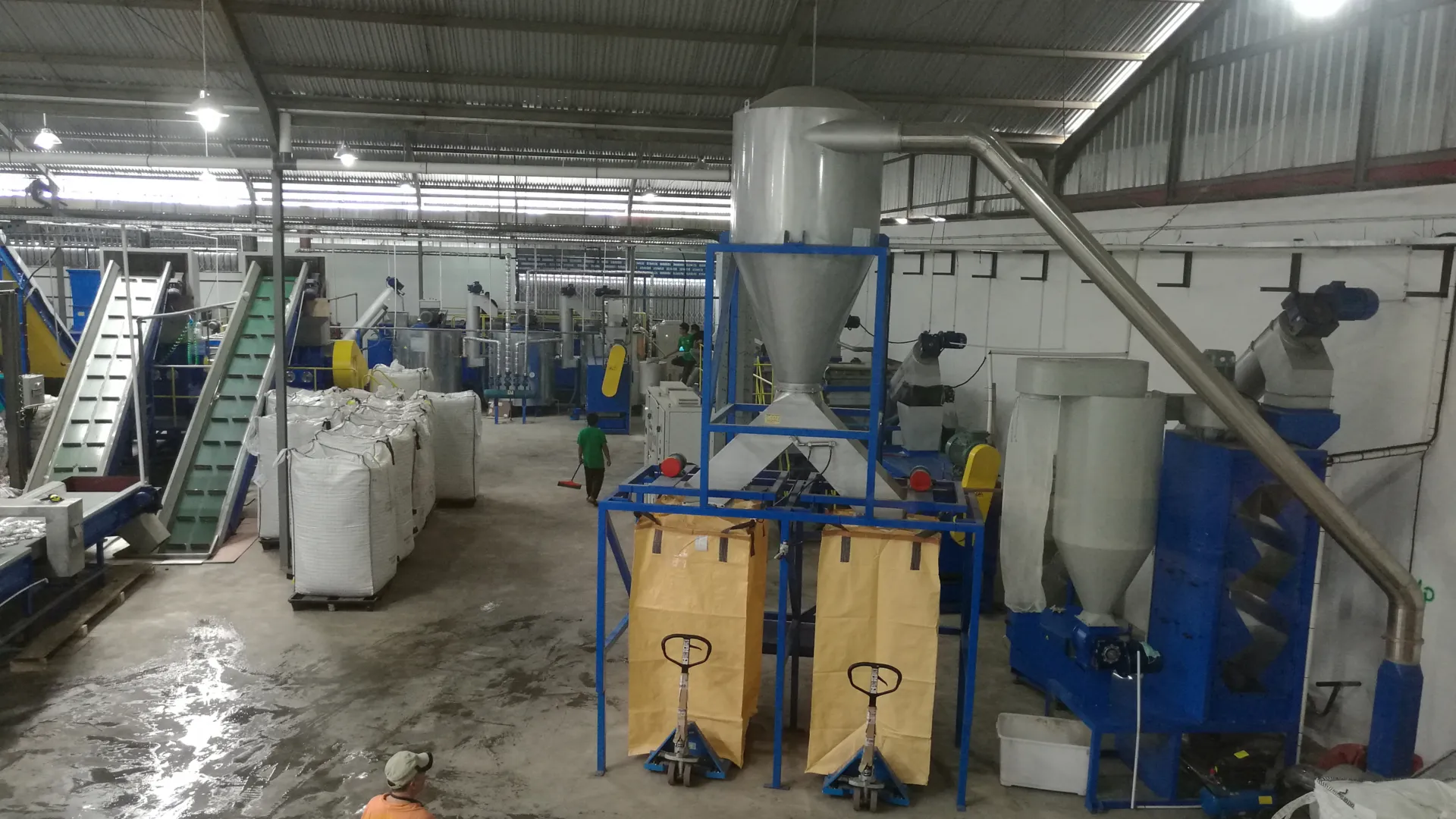
Engineering Reference: 1,000–1,500 kg/h PET Bottle Washing Recycling Line
For mid-to-high capacity plastic recycling facilities, a 1,000–1,500 kg/h PET bottle washing recycling line represents an optimal balance between capital investment, footprint, and industrial throughput. While our general PET bottle washing line overview covers the overall turnkey system, this engineering reference provides the specific equipment bill of materials (BOM), power sizing methodology, process sequence, and selection advisory for the 1,000–1,500 kg/h capacity tier.
Engineering Clarification: Infeed Capacity vs. Clean Flake Output
In post-consumer PET recycling, nominal capacity must distinguish between Baled Bottle Infeed Capacity and Finished Clean Flake Output:
- Infeed Capacity (1,000–1,500 kg/h): Raw baled post-consumer PET bottles contain 15%–25% non-PET materials including PP/PE caps, PVC/BOPP label films, beverage residues, and dirt/sand.
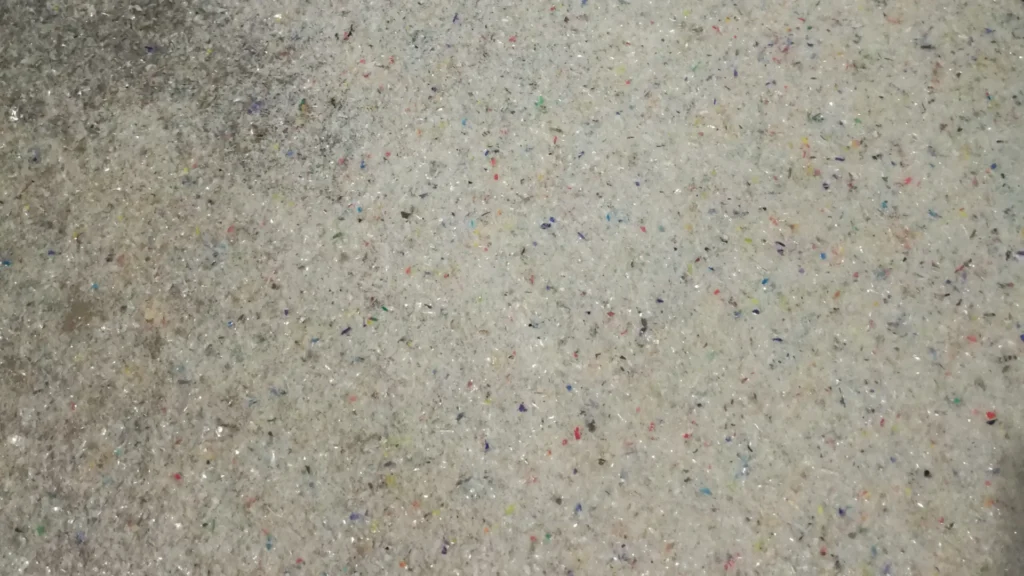
- Net Flake Output (~800–1,200 kg/h): Based on an average 75%–85% net clean flake recovery rate, feeding 1,000–1,500 kg/h of raw bales produces approximately 800–1,200 kg/h of washed, dried rPET flakes.
- Crusher Sizing Architecture: The baseline specification table below includes a single 45 kW wet granulator rated at 1,000–1,200 kg/h infeed (delivering ~800–1,000 kg/h finished flakes). For recycling plants requiring continuous 1,200–1,500 kg/h net clean flake output, the washing, hot-washing, and drying modules already possess adequate volumetric and hydraulic headroom, while the size-reduction section is typically upgraded to a 55 kW / 75 kW heavy-duty granulator or a two-stage shredding-granulation layout.
Process Flow & Sequence
To convert dirty post-consumer PET bottles into premium rPET flakes suitable for sheet extrusion, polyester staple fiber (PSF), or food-grade bottle-to-bottle pelletizing, material progresses through 8 automated stages:
Infeed & Pre-Sorting
Baled bottles are opened and fed via an inclined belt conveyor where heavy tramp metals and large stones are intercepted before granulation.
Water-Assisted Wet Granulation
A heavy-duty 45 kW wet granulator shears bottles into uniform flakes. Continuous water injection cools knife edges, suppresses dust, and initiates pre-cleaning.
Air Classification & Label Separation
Crushed flakes enter a zigzag air separator where an induced upward draft carries lightweight paper and PP/PVC labels to a cyclone and collection silo.
Dual Sink-Float Density Washing
In two sequential 5-meter sink-float washing tanks, sinking PET flakes (density > 1.33 g/cm³) are conveyed from the bottom, while floating PP/PE cap fragments are skimmed off.
Twin Continuous Hot Washers
Flakes undergo high-intensity hot washing at 85–95°C with caustic soda (NaOH) in two continuous hot washers to dissolve glue and oils.
High-Speed Friction Scrubbing
A 37 kW high-speed friction washer rotates at 960 RPM to scrub residual caustic solution, dislodged glue, and surface contamination from the flake surface.
Mechanical Centrifugal Dewatering
A 75 kW centrifugal dewatering machine uses high G-force to separate wash water through a perforated screen drum, lowering flake moisture down to 2–3%.
Pipeline Thermal Drying & Storage
A two-stage pipeline thermal dryer finishes drying to <1% moisture, delivering flakes via cyclone into a stainless steel storage silo.
Equipment Bill of Materials (BOM) & Technical Specifications
The table below provides the detailed reference specifications for the 16 standard mechanical and electrical units comprising the core 1,000–1,500 kg/h line configuration:
| Machine Description | Engineering Specifications | Qty |
|---|---|---|
| 1. Belt Conveyor 1 | 1) Belt width: 800 mm 2) Belt material: Heavy-duty PVC 3) Motor power: 2.2 kW 4) Gear reduction ratio: 1:30 5) Drive roll diameter: φ273 mm 6) Belt linear velocity: 0.63 m/s 7) Driven roller diameter: φ323 mm |
1 |
| 2. Wet Granulator (Crusher) | 1) Main motor power: 45 kW 2) Cutter head rotary diameter: φ630 mm 3) Cutter head width: 1,150 mm 4) Rotating knives: 10 pcs 5) Stationary knives: 4 pcs 6) Blade material: High-wear SKD-11 / D2 alloy 7) Rotor rotating speed: 462 RPM 8) Rotor core material: 45# forged steel 9) Screen mesh: φ12–16 mm interchangeable (customizable to project flake specification; reference draft listed φ95 mm, which is an industry typographical reference for 9–15 mm flake sizing) 10) Hydraulic open feeding hopper & hydraulic screen changer (2.2 kW hydraulic station) 11) Granulator capacity: 1,000–1,200 kg/h infeed 12) Integrated discharge screw conveyor: 3 kW (screw diameter φ250 mm, NMRV130-30 reducer, stainless steel screw) |
1 |
| 3. Screw Conveyor 1 | 1) Motor power: 3.7 kW 2) Rotating speed: 20–72.5 RPM adjustable 3) Screw vane diameter: φ390 mm 4) Screw pitch: 300 mm 5) Contact material: SUS304 stainless steel 6) Frame structure: Structural carbon steel |
1 |
| 4. Film and Flake Separator (Zig-Zag Air Classifier) | 1) Principle: Zigzag multi-stage counter-current air classification column 2) Contact material: SUS304 stainless steel 3) Frame: Heavy structural carbon steel |
1 |
| 5. Wind-Sending System | 1) High-pressure blower motor: 5.5 kW 2) Pipeline diameter: φ159 mm 3) Ductwork material: SUS304 stainless steel |
1 |
| 6. Storage Silo For Labels | 1) Material: SUS304 stainless steel 2) Storage volume: 2.0 m³ with quick-discharge bagger |
1 |
| 7. Screw Conveyor 2 | 1) Motor power: 3.7 kW 2) Rotating speed: 20–72.5 RPM adjustable 3) Screw vane diameter: φ390 mm 4) Screw pitch: 300 mm 5) Contact material: SUS304 stainless steel |
1 |
| 8. Sink-Float Washing Tank | 1) Internal width: 1,500 mm 2) Effective length: 5,000 mm each 3) Contact body: SUS304 stainless steel 4) Drive package per tank: Bottom discharge screw motor 5.5 kW, forward flake transfer screw 3.7 kW, lifting dirt/sludge screw 3.0 kW, top surface skimming paddle motor 3.0 kW (Subtotal: 15.2 kW per tank, 30.4 kW for 2 units) |
2 |
| 9. Hot (Boiler) Washer | 1) Agitator motor power: 7.5 kW with cycloidal reducer BLD5-71-7.5 (20 RPM) 2) Discharge screw motor: 3.7 kW with NMRV110-20 reducer 3) Electric heating power: 60 kW per tank (or steam coil heat exchanger option) 4) Tank body: Insulated SUS304 stainless steel 5) Screw vane diameter: φ290 mm, pitch: 200 mm 6) Operating temperature: 85–95°C for hot caustic washing (Subtotal: 11.2 kW motor + 60 kW heat per unit; 22.4 kW motor + 120 kW heat for 2 units) |
2 |
| 10. High-Speed Friction Washer | 1) Rotor diameter: φ524 mm 2) Effective washing barrel length: 2,800 mm 3) Rotor speed: 960 RPM dynamic centrifugal washing 4) Rotor paddles: 24 pcs high-wear alloy steel 5) Chamber material: SUS304 stainless steel with perforated dewatering screen 6) Drive motor: 37 kW belt-driven 7) Incline conveying angle: 15° |
1 |
| 11. Screw Conveyor 3 | 1) Motor power: 3.7 kW 2) Rotating speed: 20–72.5 RPM adjustable 3) Screw vane diameter: φ390 mm 4) Contact material: SUS304 stainless steel |
1 |
| 12. Centrifugal Dewatering Machine | 1) Main motor power: 75 kW heavy-duty drive 2) Rotor rotary diameter: φ850 mm 3) Rotor speed: ~1,200–1,400 RPM 4) Internal screen & housing: SUS304 stainless steel 5) Dewatering capability: Expels surface wash water down to 2%–3% moisture |
1 |
| 13. Pipeline Thermal Dryer | 1) Blower motor: 5.5 kW high-pressure centrifugal fan (Model 9-19 NO.4X55) 2) Pipeline diameter: φ159 mm insulated SUS304 stainless steel 3) Electric air heating power: 30 kW per unit 4) Drying effect: Thermal flash drying reducing residual moisture to <1% (Subtotal: 11.0 kW motor + 60 kW heat for 2 units) |
2 |
| 14. Cyclone Separator | 1) Cyclone diameter: φ1,000 mm 2) Separation type: High-efficiency aerodynamic centrifugal air-material separation 3) Material: SUS304 stainless steel |
1 |
| 15. Finished Product Storage Silo | 1) Contact material: SUS304 stainless steel 2) Silo volume: 2.5 m³ with dual bagging ports and dust filter sock |
1 |
| 16. Centralized Electric Control Panel | 1) Main cabinet: Centralized IP54 dust-proof electrical enclosure 2) Control logic: Integrated PLC automation with thermal overload relays, emergency-stop circuits, and interlocking sequential start/stop protection |
1 |
| Engineering Totals & Power Analysis |
1. Total Connected Load (All-Electric Heating): 424.8 kW (Mechanical Motors: 244.8 kW + Electric Heaters: 180.0 kW) 2. Connected Load (Steam/Boiler Option): 244.8 kW (Mechanical Drives only, using external steam boiler for hot washing) 3. Average Operating Power Demand: ~260–310 kW (Reflecting standard diversity factor of 0.65–0.70 on motors and PID cycling on heating elements) 4. Baled Bottle Infeed Capacity: 1,000 – 1,500 kg/h 5. Finished Clean Flake Output: ~800 – 1,200 kg/h (Expandable to 1,500 kg/h output with upgraded 55/75 kW or dual granulator setup) |
16 Units |
Swipe horizontally to view the full specifications table.
Standard Configuration vs. Optional System Upgrades
Every plastic recycling facility processes a unique feedstock mix. Below is an overview of what is included in the base 16-machine setup versus optional modules that can be integrated depending on your raw material contamination and target product grade:
Frequently Asked Questions (FAQ)
The standard reference configuration consists of 16 coordinated machines: infeed belt conveyor, 45 kW wet granulator with hydraulic screen changer, zigzag label air separator, label collection cyclone, two screw conveyors, dual 5-meter sink-float washing tanks, twin continuous hot washers (85–95°C), high-speed friction washer, 75 kW centrifugal dewatering machine, two-stage thermal hot-air pipeline dryers, cyclone separator, finished flake storage silo, and a centralized electrical control panel.
The nominal line capacity of 1,000–1,500 kg/h refers to raw baled bottle infeed. Because post-consumer bales contain 15%–25% non-PET waste (caps, labels, dirt, residual liquid), feeding 1,000–1,500 kg/h yields approximately 800–1,200 kg/h of clean PET flakes. The baseline 45 kW granulator is sized for 1,000–1,200 kg/h infeed. If your production goal is continuous 1,200–1,500 kg/h finished flake output, the crushing section can be configured with an upgraded 55 kW/75 kW granulator or dual granulators, while the downstream washing and drying units have ample capacity to handle the higher throughput.
Total connected electrical load for the all-electric configuration is 424.8 kW (244.8 kW mechanical motors + 180 kW electric heating in hot washers and thermal dryers). If your facility provides industrial steam or utilizes a gas boiler, electrical connected load drops to 244.8 kW. In continuous operation, actual average electrical consumption is typically around 260–310 kW due to standard motor load diversity factors and automated PID temperature control cycling.
Yes. When equipped with upstream dry delabeling, thorough caustic hot washing (NaOH + surfactant), and downstream optical flake sorting, this line achieves high-purity flakes with <100 ppm total impurities (<50 ppm PVC, <20 ppm polyolefin, <1% moisture). For food-grade bottle-to-bottle authorization (e.g., FDA NOL or EFSA positive opinions), clean flakes are subsequently processed in an SSP (Solid State Polycondensation) decontamination reactor or a certified food-grade pelletizing extrusion system.
Request a Customized PET Washing Line Quotation
At Energycle, we configure and manufacture robust PET bottle washing recycling lines engineered to your exact feedstock composition, target output purity, and workshop layout. Share your project requirements below to receive a detailed technical proposal, layout drawing, and competitive commercial quotation.
Related Reference: For a comprehensive overview of turnkey washing solutions, modular components, and international plant standards, see our PET Bottle Washing Line & Recycling System guide.
