

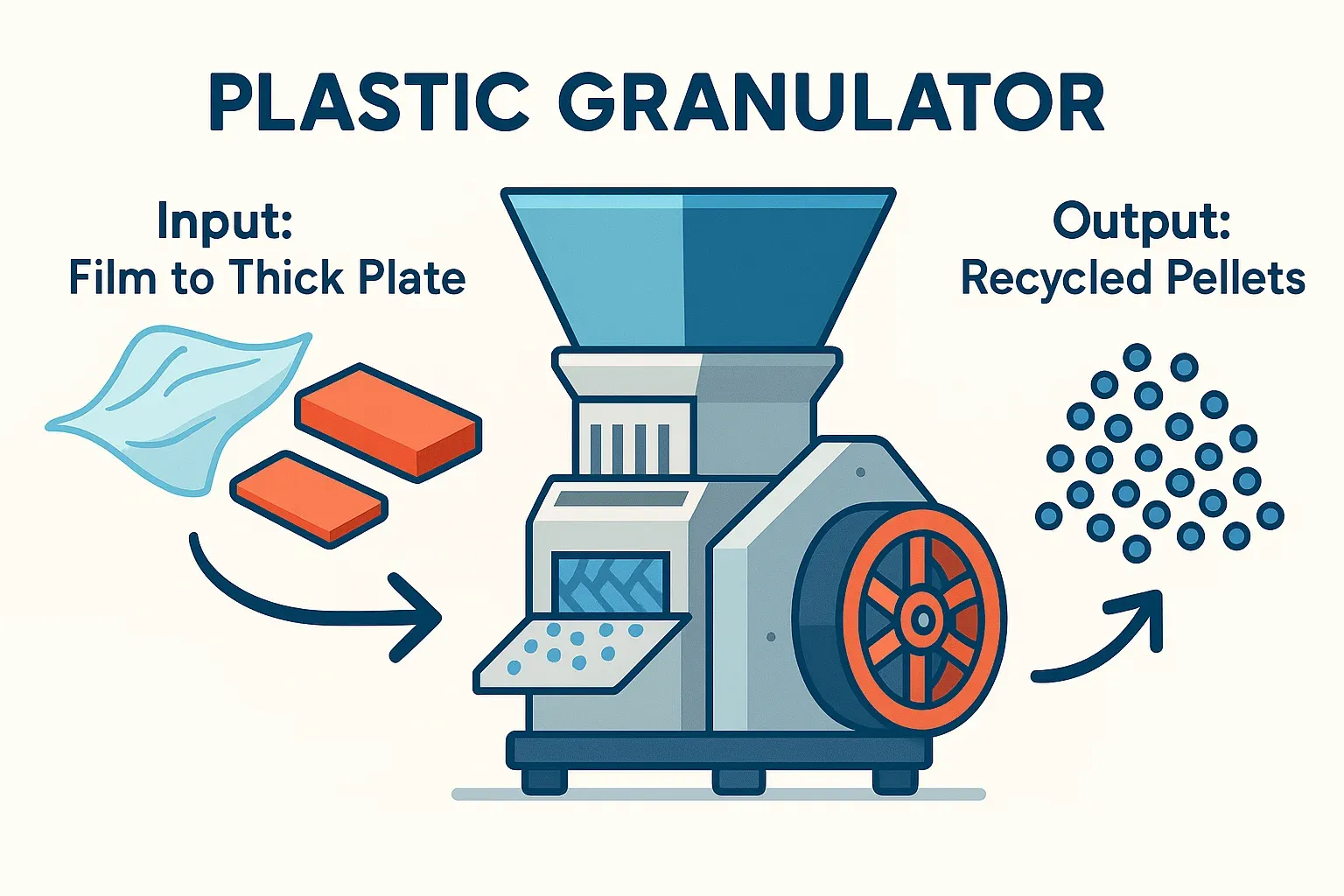
Plastikowy granulator może przetwarzać folię, butelki, odlewy, arkusze oraz niektóre grube odpady, ale projekt jednego wirnika i zbiornika nie będzie działał równie dobrze w każdym przypadku. Geometria materiału określa, jak wchodzi on do komory cięcia, jak noże go wciągają oraz czy maszyna produkuje kontrolowany regrind lub niestabilne ładunki. Ta instrukcja mapuje powszechne formy plastiku do cech granulatora, które mają znaczenie.
Co robi plastikowy granulator
Granulator używa obrotowych noży naprzeciw stałych noży do cięcia plastiku na cząstki. Sieć zatrzymuje nadmiarowy materiał, aż staje się na tyle mały, aby opuścić komorę. Rezultat jest zazwyczaj nazywany regrindem lub łuską; nie jest to gotowy granulat, chyba że następuje oddzielny proces wytłaczania i pelletyzacji.
Granulacja może być głównym krokiem zmniejszania rozmiaru butelek, odlewów i odpadów produkcyjnych. Grube rury, duże czyszczenia, sklejone folie lub grube profile mogą najpierw wymagać niszczarka do plastiku do stworzenia kontrolowanego dostarczania dla granulatora. Wybór między jednostopniową granulacją a przetwarzaniem zmywarki i granulatora jest często ważniejszy niż dodanie mocy silnika do niewłaściwej maszyny.
Mapa zastosowań: folia do grubej blachy
| Forma podawania | Główny problem obsługi | Cechy do oceny | Możliwy etap górnego przepływu |
|---|---|---|---|
| Luźna folia i worki | Niska gęstość objętościowa, owijanie i nagłe skoki dostarczania | Kontrolowany dostarczanie, geometryka nożyc, szczegóły anty-owijania, efektywna evacuacja | Otwieranie balów, sortowanie lub wstępne cięcie |
| Sztywne butelki i pojemniki | Pustki wypadają i zawalają się nieprzewidywalnie | Geometria zbiornika, komora promieniowa, konfiguracja sucha lub mokra, ochrona metalowa | Debalowanie, usuwanie etykiet i sortowanie |
| Odlane części, wtryskiwacze i skrzynki | Zmienne grubości ścianki i obciążenie uderzeniowe | Otwór dostarczania, inercja wirnika, montaż noży i dostęp do siatki | Podawanie robotyczne lub taśmowe |
| Arkusz i obróbka krawędzi | Ciągłe paski mogą się plątać lub mostkować | Podajnik rolkowy lub podajnik ślizgowy, zabezpieczony wejście i synchronizowane sterowanie | Cięcie na długość, gdy jest wymagane |
| Gruba blacha, profil i czyszczenia | Wysokie obciążenie zębate, szok i ryzyko zatrzymania | Decyzja o przedgranulacji, otwieranie komory, moment obrotowy, łożyska i budowa wirnika | Jedno- lub dwurzędowy zmywarka |
Cienka folia i opakowania elastyczne
Folia jest trudna, ponieważ jest lekka i ma dużą powierzchnię. Może unosić się w zbiorniku, owijać się w końcówkach wirnika lub przybywać w nagłych gronach. Wysoki katalogowy przepływ oparty na sztywnym regrindzie mówi niewiele o wydajności na luźnej folii.
Evaluate the complete feeding arrangement: bale opener, conveyor, nip or roll feeder, hopper angle and the logic that stops the infeed during an overload. Knife geometry should create a controlled shearing action, while rotor-end seals and clearances should limit wrapping. The discharge or pneumatic evacuation system must remove light regrind without allowing it to recirculate unnecessarily.
Washed film introduces water and contamination. A wet granulator can help control heat and loose dirt, but it must be designed for drainage and corrosion resistance. If the objective is stable extrusion feeding after washing, a suszarka do wyciskania folii or densification step may be required after granulation.
Bottles and hollow rigid containers
PET and HDPE bottles compress when the rotor contacts them. Hopper and chamber geometry should prevent repeated bounce-back and provide a consistent bite. Tangential-feed designs are often considered for bulky hollow parts, but performance still depends on bottle size, bale preparation, screen opening and feed control.
PET bottle processing may use water in the chamber as part of a washing line. HDPE containers may be granulated dry or wet depending on contamination and the downstream process. In either case, upstream metal removal and sorting protect the knives and reduce non-target resin in the output. See the dedicated PET bottle granulator selection guide for trial and acceptance criteria.
Odlane części, wtryskiwacze i skrzynki
Injection-molding scrap can range from small runners to large housings and thick start-up pieces. Measure the largest part in three dimensions and identify inserts, fasteners or glass reinforcement. The feed opening must accept the actual part without unsafe manual pushing or uncontrolled kickback.
For beside-the-press work, low noise, dust control, easy color-change cleaning and a small footprint may be priorities. Central recycling systems place more emphasis on sustained throughput, material transport and rapid access for screens and knives. Abrasive fillers can change the knife material, wear protection and sharpening interval required.
Sheet, edge trim and continuous strip
Continuous sheet and edge trim need a controlled feed rate. A roll feeder or nip system can synchronize material entry with the granulator, reduce whipping and prevent the chamber from receiving a large loop at once. The inlet must be guarded for the final installation and should not allow an operator to reach the cutting zone.
Sheet thickness alone does not determine motor size. Width, polymer toughness, feed speed, number of layers, temperature and the required particle size all affect the load. A production trial should reproduce the maximum width and the fastest normal line speed.
Thick plate, profiles and purgings
Thick pieces require a reliable bite and can create high shock loads. Do not select a machine from maximum wall thickness alone. Record part dimensions, mass, polymer, temperature, fillers and whether the piece is solid or hollow. A large purge may exceed the safe infeed size even if its material is technically cuttable.
Pre-shredding is often the practical route when parts are too large, irregular or heavy for controlled granulator feeding. A shredder reduces them at lower speed, and the granulator then produces the final particle size. This staged arrangement may provide steadier loading and easier automation than attempting to force every piece directly into a high-speed cutting chamber.
Where direct granulation is appropriate, assess rotor construction, knife retention, bearings, drive protection, screen support and access for lifting heavy components. An extra-large rigid plastic granulator should be evaluated with the actual largest piece, not a smaller demonstration sample.
Screen size and output quality
The screen sets the maximum discharge path, but it does not create a perfectly uniform particle. Knife sharpness, gap, rotor speed, polymer behavior and recirculation also shape the distribution. Smaller openings can increase residence time, power demand, heat and fines; larger openings can release pieces that are too coarse for washing or extrusion.
Define the acceptable particle-size distribution and fines fraction, then measure them during the trial. The granulator screen-size guide explains how to move from a downstream requirement to a testable screen choice.
Capacity and motor selection
Nameplate motor power cannot be converted into a universal kg/h figure. Usable throughput depends on feed geometry, bulk density, screen, blade condition and the amount of oversize recirculation. Ask for sustained results from a representative test, including normal and peak current, stoppages and the mass of acceptable output—not only material fed into the hopper.
Size the machine with the upstream and downstream line. A granulator that repeatedly fills a washer or pneumatic conveying system beyond its stable rate creates a new bottleneck. A buffer and controlled feed may deliver a better line result than a larger cutting chamber.
Safety and maintenance checks
- Interlocked access doors and guards appropriate to the feed method
- Protection against unexpected restart and a documented energy-isolation procedure
- A secure rotor-locking method for knife and screen work
- Safe lifting points and space to remove the hopper, screen and knives
- Metalna ochrona odpowiednia dla ryzyka surowca
- Kontrola pyłu, hałasu i wilgotnego procesu odpowiednia dla instalacji
- Dostępne części zużyte, instrukcje szlifowania i wsparcie techniczne
Lepszy sposób porównania granulatorów
Zapewnij każdemu dostawcy tę samą opis materiału, maksymalny rozmiar części, wymagany wydatek, media i układ linii. Przetestuj reprezentacyjną partię, a następnie porównaj akceptowalną przepustowość, dystrybucję cząstek, pył, energię na tonę, czas czyszczenia i zaobserwowany zużycie. Szersze przewodnik wyboru mielarki plastikowej zawiera pytania dotyczące oceny komercyjnej i technicznej.
Poprawnie dopasowany granulator to nie maszyna, która twierdzi, że przetwarza najszerszą listę plastików. To konfiguracja, która bezpiecznie dostarcza, produkuje wymagany regranulat i integruje się z następną operacją pod rzeczywistymi warunkami materiałowymi zakładu.
Często zadawane pytania
Czy jeden granulator może przetwarzać zarówno folię, jak i gruby płyt?
Niektóre maszyny mogą przetwarzać więcej niż jeden rodzaj materiału, ale system podawania, wirnik, noże i siatka mogą wymagać zmian. Potwierdź oba materiały w oddzielnych próbach i porównaj jakość wyjściową, a nie tylko to, czy maszyna może je przeciąć.
Kiedy należy instalować tnik przed granulatorem?
Rozważ przedkruszenie, gdy odpady są zbyt duże, nieregularne, ciężkie lub trudne do bezpiecznego pomiaru do granulatora. Kruszarka tworzy kontrolowany podajnik; następnie granulator ustawia ostateczny rozmiar regranulatu.
Czy silniejszy silnik zawsze zwiększa pojemność granulatora?
Numer dostarczania, geometria wirnika, powierzchnia sita, stan noży oraz odpływ wstępny mogą ograniczyć wydajność. Pojemność powinna być mierzona reprezentatywnym materiałem oraz wymaganym sitem.
